








Contents
- 1 Introduction
- 2 Understanding the Need for Microservices Migration
- 3 Step 1: Assess and Analyze Your Legacy System
- 4 Step 2: Define the Microservices Strategy and Migration Roadmap
- 5 Step 3: Prepare the Team and Environment
- 6 Step 4: Incrementally Extract and Build Microservices
- 7 Step 5: Address Common Pitfalls and Challenges
- 8 Step 6: Optimize and Evolve in the Cloud
- 9 Lessons Learned from Real-World Migrations
- 10 Frequently Asked Questions (FAQ)
- 11 Conclusion
Introduction
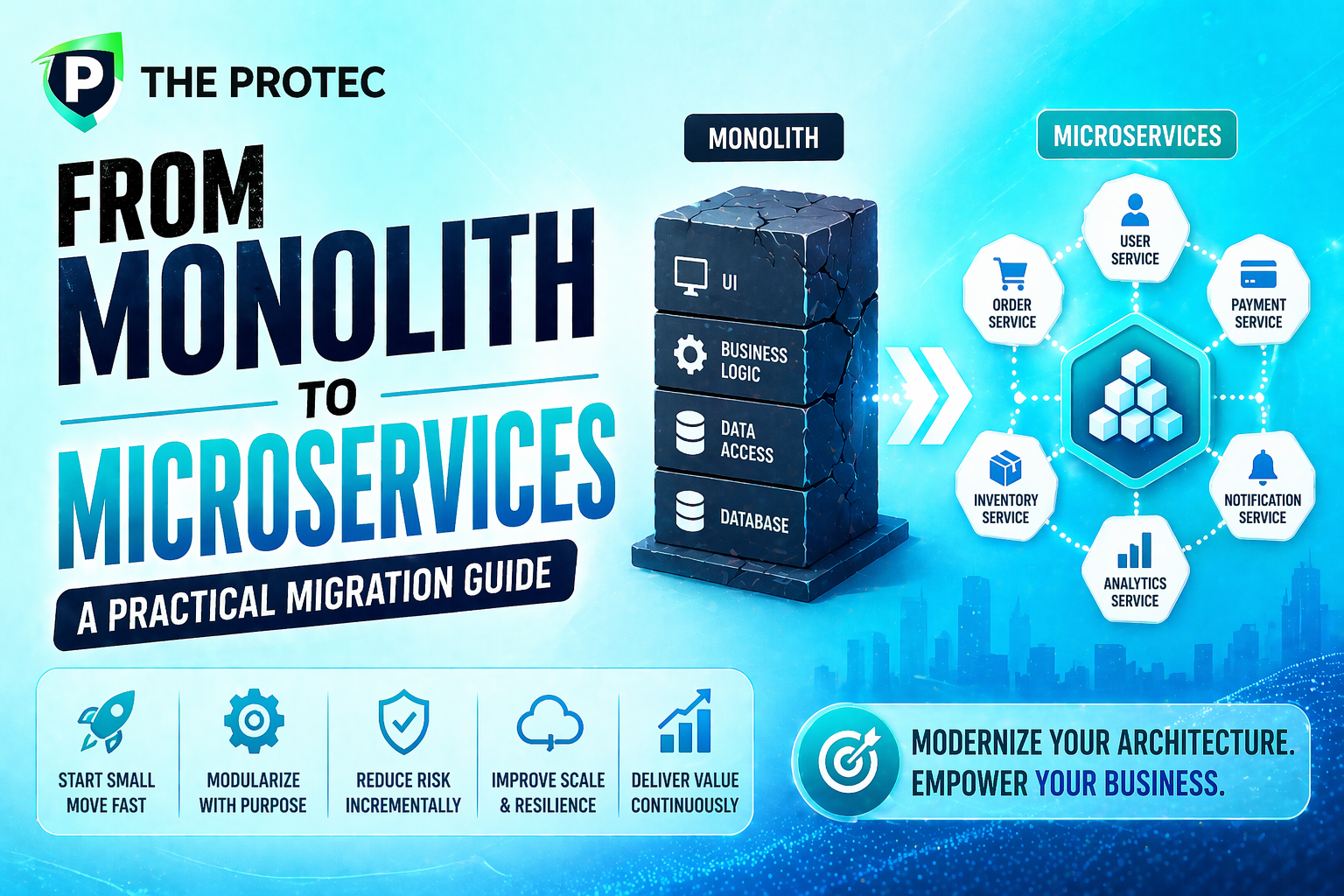
The technology landscape continues to evolve rapidly, pushing businesses to seek modern solutions that offer greater agility, scalability, and resilience. One of the most transformative shifts in software architecture is transitioning from monolithic applications to microservices. This migration not only modernizes legacy systems but also unlocks the benefits of cloud migration and distributed architectures.
Yet, migrating from a monolith to microservices is far from trivial. It requires a carefully planned strategy, deep technical insight, and attention to pitfalls that have jeopardized many attempts. This guide provides a practical, step-by-step approach to microservices migration grounded in industry best practices and lessons learned from real-world projects.
Understanding the Need for Microservices Migration
Monolithic applications bundle all functionality into a single codebase, which can slow down development cycles and introduce maintenance challenges as complexity grows. Legacy systems often become bottlenecks, limiting scalability and impeding cloud migration initiatives.
Microservices architecture decomposes applications into loosely coupled, independently deployable services, each responsible for a discrete business capability. This enables organizations to:
- Scale components independently: Allocate resources dynamically based on demand.
- Accelerate development: Smaller codebases ease testing, deployment, and updates.
- Improve fault isolation: Failures remain contained without crashing the whole system.
- Enhance technology diversity: Use the best tools or languages per service.
- Streamline cloud migration: Microservices align naturally with containerization and cloud-native platforms.
Step 1: Assess and Analyze Your Legacy System
Before formulation of any migration plan, conduct a thorough analysis of your current monolithic system. Focus on the following:
- Identify business domains: Map out the core business functions handled by the monolith.
- Analyze dependencies: Understand internal coupling and data flow between modules.
- Evaluate technical debt: Recognize outdated frameworks or hard-to-maintain areas.
- Assess operational constraints: Consider production issues, deployment cycles, and performance bottlenecks.
This diagnostic phase determines the scope and complexity of migration and informs prioritization.
Step 2: Define the Microservices Strategy and Migration Roadmap
With a clear understanding of your monolith, craft a strategic migration plan that balances business needs and technical feasibility.
- Domain-driven decomposition: Breakdown the monolith into microservices aligned to bounded contexts to encapsulate functionality coherently.
- Prioritize services: Start with business-critical or high-impact areas to demonstrate value early.
- Choose the migration approach:
- Strangler Pattern: Incrementally replace parts of the monolith with microservices while both coexist.
- Big Bang: Riskier full rewrite and cutover, generally discouraged.
- Parallel Systems: Run microservices alongside the monolith temporarily for testing and validation.
- Infrastructure and tooling: Plan for container orchestration (such as Kubernetes), CI/CD pipelines, service discovery, and API gateways to support microservices lifecycle management.
- Cloud migration integration: Consider cloud providers and their managed services that complement microservices (serverless, managed databases, message queues).
Step 3: Prepare the Team and Environment
Successful migration hinges on cross-functional collaboration and upskilling.
- Establish DevOps culture: Promote automation, continuous integration, continuous delivery, and infrastructure as code.
- Invest in training: Educate developers and operations teams on microservices concepts, cloud-native technologies, and container orchestration.
- Define governance: Create standards for APIs, data sharing, security, and monitoring across services.
- Set up monitoring and logging: Implement centralized observability tools (e.g., Prometheus, ELK stack, Jaeger) for distributed tracing and alerting.
Step 4: Incrementally Extract and Build Microservices
Begin extracting services iteratively instead of attempting a full rewrite. Common tactics include:
- Extract core business capabilities first: Services that are stable and well-understood provide a lower risk starting point.
- Maintain backward compatibility: Use APIs and adapters to allow legacy components to communicate with new microservices.
- Decouple data storage: Transition from a shared monolithic database to service-owned data stores to reduce coupling.
- Automate testing: Unit tests and contract testing ensure service interactions remain reliable.
This incremental approach reduces disruption and facilitates gradual validation.
Step 5: Address Common Pitfalls and Challenges
Migration projects frequently stumble on similar obstacles. Anticipate these challenges to mitigate risk:
- Over-fragmentation: Creating too many microservices can increase complexity and operational overhead.
- Ignoring data consistency: Designing eventual consistency models and compensating transactions is critical.
- Underestimating cultural shift: Microservices demand a collaborative, product-focused mindset beyond just technology changes.
- Insufficient observability: Distributed systems require robust monitoring to quickly detect failures and performance issues.
- Security blind spots: Each service expands the attack surface. Secure APIs, use zero-trust access, and apply encryption.
Step 6: Optimize and Evolve in the Cloud
Post-migration, leverage cloud-native features and optimize operations:
- Embrace serverless and event-driven patterns: These can further decouple services and improve scalability.
- Automate scaling: Use cloud autoscaling to dynamically allocate resources per service demand.
- Continuous improvement: Analyze telemetry data to optimize performance, reduce latency, and enhance user experience.
- Cost management: Monitor cloud expenditures and adjust architecture to balance performance and cost-effectiveness.
Lessons Learned from Real-World Migrations
Organizations that have navigated this journey often share valuable insights:
- Patience and incremental progress are key: Avoid rushing large-scale rewrites that can stall projects.
- Strong API design is critical: APIs are the contracts holding services together; invest effort in clear documentation and versioning.
- Automate everything: Manual deployment or testing increases errors; automation ensures reliability and speed.
- Architect for failure: Design services to gracefully degrade and recover to improve system resilience.
- Involve business stakeholders early: Prioritize services that deliver tangible business value and align technical work with company goals.
Frequently Asked Questions (FAQ)
1. How long does a microservices migration typically take?
The timeline varies widely based on system size, complexity, and team expertise. Small to medium projects may take several months, while large-scale migrations can span years. Emphasizing iterative delivery helps provide continuous value and manage risks effectively.
2. Can microservices run without cloud infrastructure?
Yes, microservices can run on on-premises infrastructure or hybrid environments. However, cloud platforms provide many benefits such as scalable container orchestration, managed services, and operational tooling that facilitate microservices adoption and efficiency.
3. What tools support microservices migration and management?
Popular tools include Kubernetes for container orchestration, Istio for service mesh, Jenkins or GitLab CI for pipelines, Prometheus and Grafana for monitoring, and OpenTelemetry for distributed tracing. Cloud providers like AWS, Azure, and Google Cloud offer comprehensive suites to aid migration and operation.
Conclusion
Transitioning from monolithic legacy systems to microservices architecture is a complex undertaking that requires a strategic, step-by-step approach. By carefully assessing your legacy environment, planning a targeted conversion roadmap, equipping your team, and embracing cloud-native capabilities, you can effectively migrate without disrupting service quality.
Anticipating pitfalls such as fragmentation, data consistency, and cultural hurdles strengthens your migration’s likelihood of success. Keep focused on delivering business value incrementally and refining your architecture through ongoing optimization.
For those embarking on this transformation, this practical migration guide aims to serve as a trusted companion, helping organizations modernize and thrive in today’s cloud-driven digital world.
For further reading and tools, explore resources such as Martin Fowler’s Microservices Article and Kubernetes Deployment Guide.