








Introduction
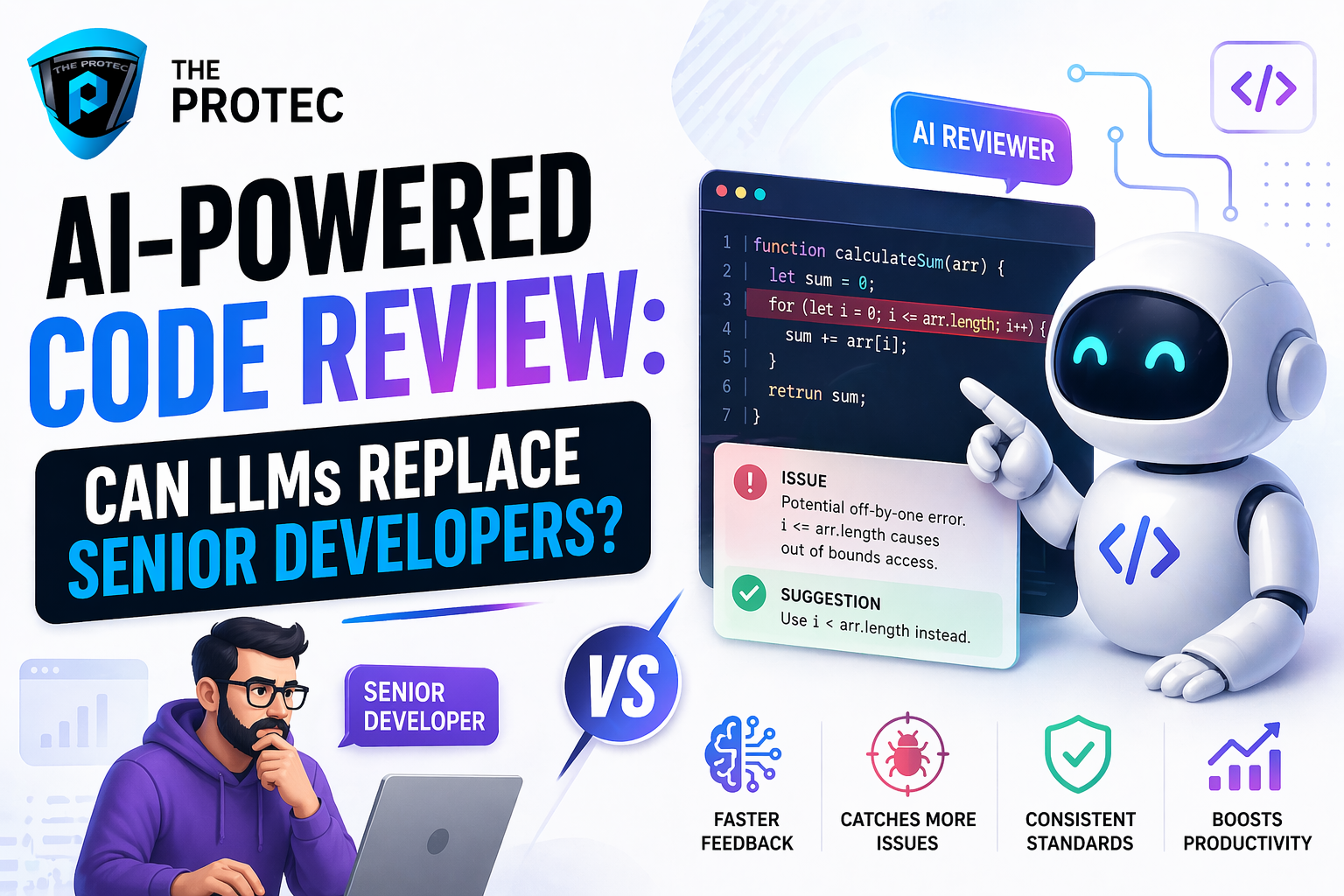
Code review is a cornerstone of software development, pivotal for maintaining code quality, enforcing best practices, and fostering collaborative learning. Traditionally, senior developers have been entrusted with the responsibility to scrutinize code, spot vulnerabilities, and ensure maintainability. However, with the rapid evolution of AI technologies, particularly large language models (LLMs), the industry is witnessing a profound shift toward AI-powered code review. This brings up a critical question: can these AI-driven tools truly replace seasoned senior developers in performing comprehensive code reviews?
In this article, we’ll dissect the capabilities of AI code review systems fueled by LLM coding tools, assess their benefits and shortcomings, and examine their real-world limitations in automated code analysis. We aim to deliver a nuanced perspective grounded in current trends and technological advancements.
Understanding AI-Powered Code Review and LLM Coding Tools
AI code review involves leveraging artificial intelligence algorithms to automatically analyze source code, identify bugs, enforce coding standards, and sometimes even suggest fixes. LLM coding tools, a subset of AI models like GPT-based architectures, combine language understanding with programming syntax to parse, interpret, and evaluate code snippets.
- Large Language Models (LLMs): These models are trained on vast amounts of code and natural language data, enabling them to generate human-like responses and produce meaningful code suggestions.
- Automated Code Analysis: Tools powered by LLMs perform static and dynamic code analysis by scanning syntax, semantic errors, security vulnerabilities, and even style inconsistencies.
Examples of popular LLM coding tools include GitHub Copilot, Amazon CodeWhisperer, and OpenAI’s Codex. They excel at quickly offering code completions and pointing out common bugs, but can they rival the nuanced judgment of an experienced developer?
Strengths of AI Code Review Using LLMs
AI-powered code review brings several significant advantages that augment traditional code inspection:
Speed and Scalability
LLM coding tools can parse and analyze thousands of lines in seconds, a task that would take even senior developers a considerable amount of time. This speed enables continuous integration pipelines to spot defects earlier and reduce technical debt.
Consistency and Lack of Fatigue
Human reviewers may miss errors due to cognitive fatigue or subjective biases. LLMs provide a consistent level of scrutiny regardless of workload or time of day, ensuring no review detail is overlooked.
Early Detection of Common Errors
AI tools are adept at flagging typical syntax errors, unsafe API usage, or security anti-patterns. They can serve as a first line of defense, particularly for junior developers who might benefit from instant corrective feedback.
Knowledge Aggregation
LLM models are trained on immense codebases and documentation, enabling them to surface best practices and syntactic improvements drawn from diverse coding styles across the industry.
Cost Efficiency
For organizations with constrained resources, AI code review tools can complement limited human expertise, lowering the cost of maintaining code quality at scale.
Weaknesses and Limitations of AI Code Review
Despite the promising benefits, AI-powered code review has inherent limitations that highlight why it cannot fully replace senior developers:
Contextual Understanding and Design Insight
Senior developers bring contextual knowledge about the software’s architecture, business goals, and technical debt. LLMs, however, primarily analyze code syntax and semantics and struggle with architectural nuances, intent interpretation, and system-wide trade-offs.
Handling of Complex Logic and Edge Cases
Subtle bugs often arise from intricate multi-module interactions, optimizations, or legacy code quirks areas where LLMs may misinterpret or inadequately assess risks, potentially leading to false positives or missed issues.
Security Vulnerabilities and Privacy Concerns
While AI tools can flag common secure coding issues, adversarial coding patterns or zero-day vulnerabilities often require expert intuition and threat modeling, which AI currently cannot replicate reliably.
Over-Reliance and False Confidence
Blindly trusting automated tools can cause developers to overlook subtle problems, degrade critical thinking, and potentially reduce overall code quality if human oversight is diminished.
Biases in Training Data and Ethical Considerations
LLMs inherit biases and limitations from training datasets. Faulty or outdated coding patterns included in training data can be perpetuated or amplified, leading to propagation of suboptimal advice.
Limited Support for Novel or Highly Specialized Domains
LLMs perform best with widely used programming languages and common tasks. Niche domains or highly innovative code might fall outside their effective knowledge base.
Real-World Applications and Integration Challenges
Many development teams currently integrate AI-powered code review as part of CI/CD pipelines to enhance the feedback loop without fully substituting human reviewers.
- Augmented Assistance: Senior developers use AI tools to accelerate mundane aspects of review, such as syntax checks and style enforcement, freeing them to focus on higher-level architectural critique.
- Junior Developer Support: Automated code analysis serves as an interactive assistant, helping less experienced programmers learn and improve their code incrementally.
- Pipeline Gates: AI-based checks act as gatekeepers to prevent straightforward errors from progressing further in deployment pipelines, increasing overall code health.
However, integration challenges persist:
- Tool Noise: Frequent false positives or irrelevant suggestions can lead to “alert fatigue,” reducing the tool’s perceived value.
- Customization Needs: Each codebase has unique standards and constraints, requiring ongoing tuning to align AI recommendations with team workflows.
- Developer Trust and Adoption: Successful adoption hinges on developers trusting the tool’s output and incorporating it into their workflows without frustration.
Future Outlook: Collaboration Over Replacement
Instead of outright replacement, the most realistic future for AI code review lies in collaboration. LLM coding tools can evolve into sophisticated assistants that handle repetitive tasks, propose improvements, and reduce cognitive load empowering senior developers rather than supplanting them.
Advances in explainable AI, domain-specific models, and integration with project management systems promise to enrich the synergy between human expertise and AI capabilities.
Moreover, developing frameworks for ethical AI use and mechanisms to audit AI-generated code advice will be critical to maintain trust and codebase integrity.
FAQ
Can AI code review tools fully replace human reviewers?
No, current AI code review tools cannot fully replace human reviewers, particularly senior developers. While they provide valuable automated checks and suggestions, they lack deep architectural insight, contextual understanding, and the ability to assess complex logic beyond surface-level analysis.
How reliable are LLM coding tools in identifying security vulnerabilities?
LLM coding tools can catch common and well-known security issues but are limited when it comes to sophisticated or emerging vulnerabilities. Human security experts remain essential for thorough threat assessments and security reviews.
What are the best practices for integrating AI code review into existing workflows?
Effective integration involves treating AI tools as assistants rather than replacements, customizing tool configurations to project needs, combining automated checks with manual reviews, and fostering developer training to interpret AI suggestions critically.
Conclusion
AI-powered code review technology powered by LLM coding tools has transformed automated code analysis, bringing unmatched speed, consistency, and accessibility to identifying coding errors. However, the complex, creative, and context-sensitive nature of software development ensures senior developers remain indispensable.
The future of code review is likely a hybrid model where AI augments human expertise to improve efficiency without compromising quality. By understanding the strengths and limitations of AI code review, organizations can strategically integrate these tools to maximize benefits while minimizing risks.
For further exploration of AI tools in software development, resources like the Open Web Application Security Project (OWASP) offer invaluable insights into securing codebases in the AI era.