








Contents
- 1 Introduction
- 2 Understanding the Limitations of Current Smartphone Batteries
- 3 What Are Silicon-Carbon Batteries?
- 4 How Silicon-Carbon Batteries Solve Charging and Capacity Limits
- 5 Recent Advances and Industry Adoption
- 6 Challenges and Considerations
- 7 The Future Landscape: What to Expect from Silicon-Carbon Battery Tech
- 8 Frequently Asked Questions (FAQ)
- 9 Conclusion
Introduction
Smartphones have become an indispensable part of modern life, yet their true potential often remains restricted by one critical component the battery. Despite significant improvements over the years, the demand for longer-lasting, faster-charging, and safer phone batteries pushes researchers and manufacturers to explore innovative technologies. Silicon-carbon batteries have recently emerged as a leading breakthrough, promising to fundamentally transform smartphone battery technology by offering enhanced capacity, faster charging, and improved lifecycle. This article dives deep into silicon-carbon batteries, explains their advantages, the science behind this next-generation battery technology, and how it could redefine the future of smartphones.
Understanding the Limitations of Current Smartphone Batteries
At the heart of almost every smartphone lies a lithium-ion battery, a technology that has powered mobile devices reliably for decades. However, traditional lithium-ion batteries face inherent limitations:
- Limited Capacity: The energy density of conventional lithium-ion batteries restricts how long a device can operate on a single charge.
- Charging Speed: Fast charging capabilities have improved but still risk degrading battery health over time.
- Lifespan and Degradation: Repeated charge cycles lead to capacity loss, impacting battery life and requiring replacements.
- Safety Concerns: Lithium-ion batteries may experience thermal runaway, potentially causing fires or explosions.
As user expectations continue to rise with all-day battery life, lightning-fast charging, and robust safety these limitations spotlight the critical need for battery innovation.
What Are Silicon-Carbon Batteries?
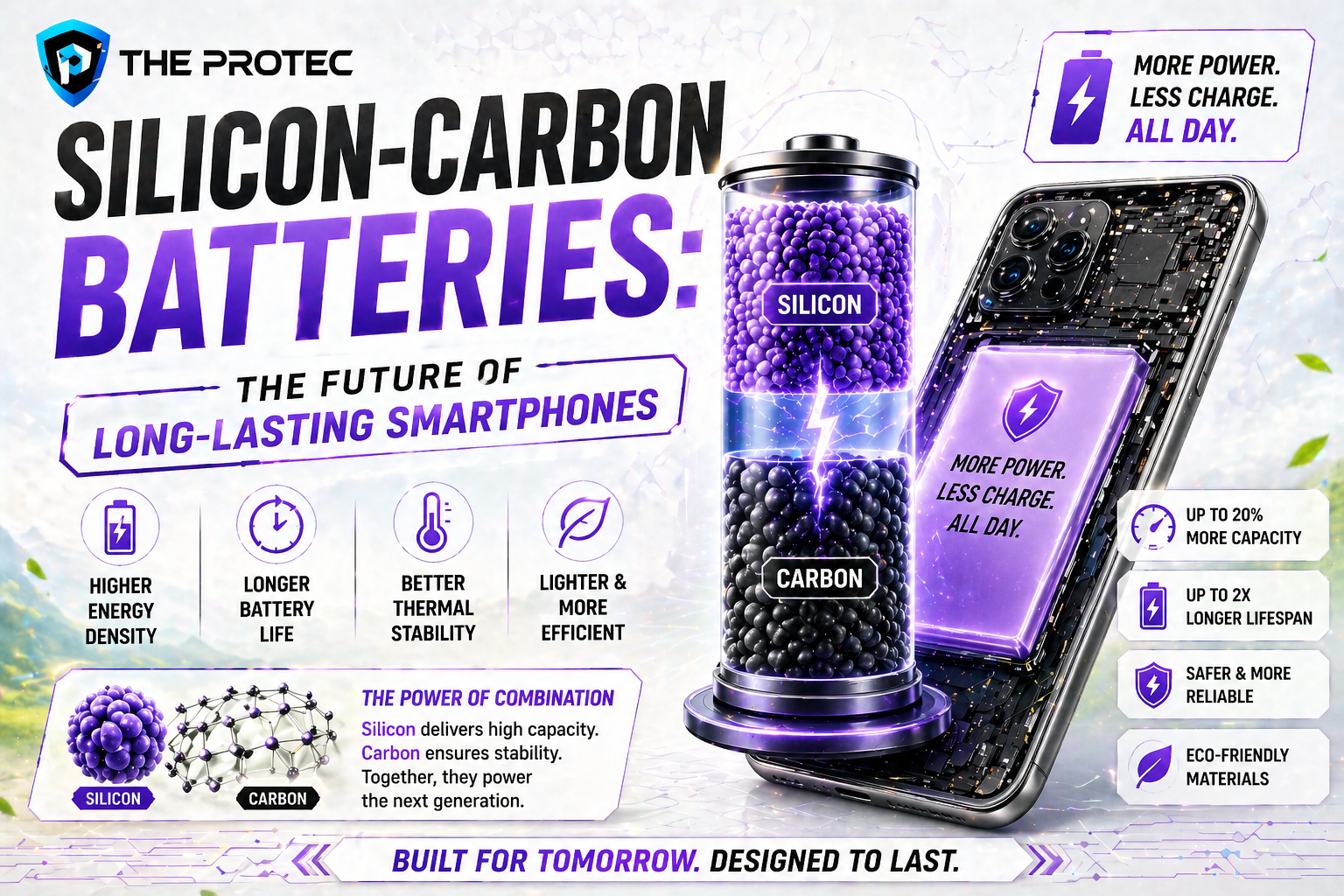
Silicon-carbon batteries represent an exciting advancement in battery technology primarily aimed at replacing or enhancing the traditional graphite anode in lithium-ion cells. The concept leverages the high capacity of silicon combined with the stability of carbon to dramatically increase battery performance.
Unlike pure graphite anodes, silicon anodes can store roughly 10 times more lithium ions, offering potentially much higher energy density. However, silicon’s main challenge is its significant volumetric expansion (up to 300%) during charging cycles, which causes mechanical stress and fast degradation.
By incorporating silicon with carbon materials often in composite forms developers manage to harness the best properties of both. Carbon provides a flexible framework that accommodates silicon’s expansion and prevents structural breakdown, enhancing both capacity and longevity.
How Silicon-Carbon Batteries Solve Charging and Capacity Limits
The integration of silicon and carbon anodes addresses several core issues in current smartphone battery tech:
1. Boosted Energy Density and Extended Battery Life
Silicon has a significantly higher theoretical capacity for lithium ion storage (up to 4200 mAh/g) compared to graphite’s 372 mAh/g. Silicon-carbon composites effectively utilize this capability, enabling smartphone batteries to store more charge in the same physical size. The result: longer battery life per charge or the potential to make thinner devices without sacrificing endurance.
2. Faster, Safer Charging
Silicon-carbon anodes facilitate faster lithium-ion diffusion rates, allowing quicker charging speeds without compromising overall battery health. The robust structural integrity of the composite reduces the risk of dendrite formation one of the causes behind short circuits and safety failures making fast charging safer.
3. Enhanced Durability and Charge Cycle Stability
The combination of carbon and silicon mitigates the typical silicon expansion-related cracking issues. This minimizes capacity fading caused by electrode pulverization and ensures that batteries retain performance over hundreds or thousands of charge cycles. Hence, smartphone users get batteries that last longer both between charges and in overall lifespan.
4. Reduced Environmental Impact
Longer-lasting batteries reduce e-waste, and silicon is abundant compared to other exotic battery materials. This makes silicon-carbon batteries a potentially more sustainable option within the battery innovation space.
Recent Advances and Industry Adoption
As of April 2026, several leading manufacturers and research institutions have accelerated work on silicon-carbon battery prototypes and commercialization:
- Major Tech Companies: Companies like Samsung, Apple, and Xiaomi have invested heavily in silicon-anode research, with preliminary reports indicating incorporation in upcoming flagship models.
- Battery Manufacturers: Enterprises such as Sila Nanotechnologies and Enovix are pioneering silicon-carbon battery cells optimized for consumer electronics.
- Academic Research: Universities worldwide are developing composite materials that address prior technical barriers like expansion and electrode pulverization.
This alignment of industrial and academic efforts fuels optimism that silicon-carbon smartphone batteries will soon transition from labs to handheld devices, reshaping the user experience.
Challenges and Considerations
Despite the promising potential, silicon-carbon battery technology is not without hurdles:
- Manufacturing Complexity: Producing stable silicon-carbon composites at scale requires precise control over material properties and integration with existing production lines.
- Cost Implications: Initial costs may be higher than conventional lithium-ion setups, potentially impacting retail prices.
- Compatibility: Ensuring new battery chemistries operate safely with current smartphone hardware and software systems remains a crucial development step.
Nonetheless, ongoing innovations continue to address these obstacles rapidly, moving closer to commercial viability.
The Future Landscape: What to Expect from Silicon-Carbon Battery Tech
Looking ahead, widespread adoption of silicon-carbon batteries could redefine smartphone design and functionality:
- Ultra-Long Battery Life: Devices lasting multiple days on a single charge, reducing user anxiety about power depletion.
- Rapid Charging Without Heat Risks: High-speed charging becoming safer and more accessible.
- Thinner and Lighter Devices: Increased energy density allows for design flexibility without compromising battery capacity.
- Environmentally Friendly Electronics: Reduced frequency of battery replacements leads to less electronic waste.
Moreover, the advancements in silicon-carbon batteries will likely ripple beyond smartphones into tablets, laptops, wearables, and even electric vehicles, signaling a new era of battery innovation.
Frequently Asked Questions (FAQ)
1. How do silicon-carbon batteries differ from traditional lithium-ion batteries?
While traditional lithium-ion batteries primarily use graphite anodes, silicon-carbon batteries replace or augment the anode with a silicon-carbon composite. This offers higher capacity, faster charging, and improved cycle stability compared to graphite alone.
2. Are silicon-carbon batteries safe for smartphones?
Yes, silicon-carbon batteries are designed with enhanced structural stability that mitigates risks like dendrite formation and thermal runaway. This results in safer charging and usage compared to some traditional lithium-ion cells.
3. When can consumers expect smartphones with silicon-carbon batteries?
Several manufacturers have announced plans to integrate these batteries into upcoming flagship devices. While broad availability depends on overcoming manufacturing and cost challenges, silicon-carbon batteries are anticipated to enter commercial smartphones within the next few years.
Conclusion
Silicon-carbon batteries stand at the forefront of battery innovation, poised to tackle longstanding challenges in smartphone battery technology. By combining silicon’s high capacity with carbon’s structural benefits, this next-gen technology promises smartphones with extended battery life, fast charging, enhanced safety, and greater durability. While there are hurdles to overcome, ongoing research and industrial momentum indicate silicon-carbon batteries will soon help power the future of long-lasting smartphones transforming our everyday mobile experience.
For further reading on battery technologies and innovations, you can explore resources provided by U.S. Department of Energy.