








Why the API Conversation Is Moving Beyond REST
REST has been the default language of web APIs for years because it is simple, predictable, and widely supported. It helped standardize how frontend apps, mobile clients, partner integrations, and internal services exchange data. But as digital products have become more dynamic, distributed, and intelligence-driven, the assumptions that made REST ideal in the past do not always fit modern systems.
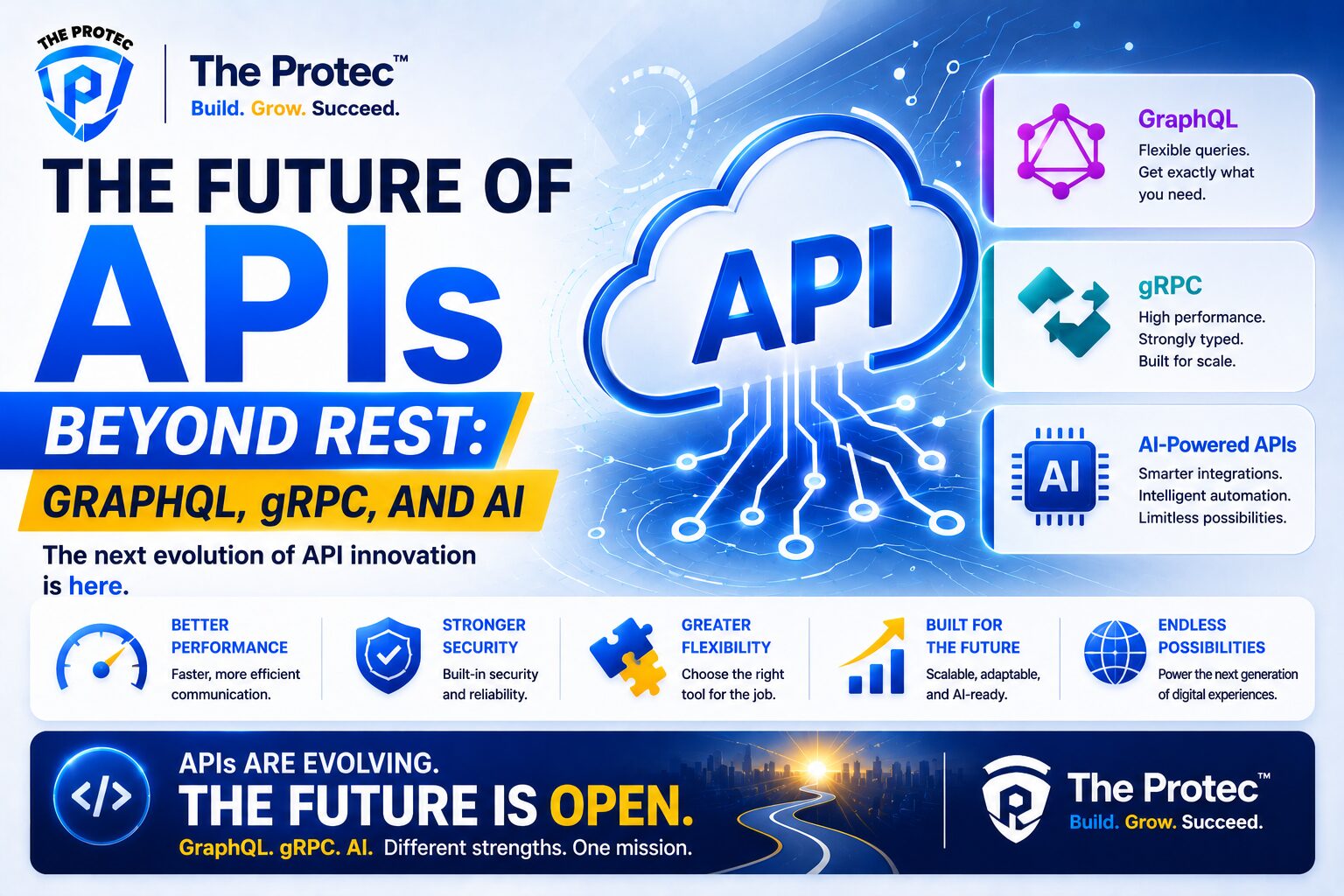
Today’s developers are building applications with multiple clients, real-time features, microservices, edge deployments, and AI-assisted workflows. A single API style rarely solves every problem. Teams now compare REST API alternatives not because REST is obsolete, but because different workloads demand different trade-offs in performance, flexibility, schema control, and developer experience. That is why GraphQL, gRPC, and AI-powered communication are increasingly central to discussions about future APIs.
The shift is not about replacing REST everywhere. It is about choosing the right interface for the right job. In many architectures, REST still works well for public resources, cacheable content, and simple CRUD operations. But when product complexity rises, query efficiency matters, or services need to communicate at high speed, newer API patterns can provide a better fit.
GraphQL vs REST: When Flexibility Becomes the Priority
One of the most common debates in modern API architecture is GraphQL vs REST. The comparison is not purely academic; it reflects a real shift in how developers want to consume data. REST typically exposes multiple endpoints, each with a fixed response shape. GraphQL, by contrast, lets clients ask for exactly the fields they need from a typed schema.
This difference is especially valuable in applications with diverse clients. A mobile app may need a compact payload for speed, while a desktop dashboard may need deeper nested data in a single request. With REST, this often leads to over-fetching, under-fetching, or multiple round trips. GraphQL reduces that friction by allowing the client to define the shape of the response.
That flexibility has made GraphQL a strong option for product teams that want to accelerate frontend development without constantly modifying backend routes. It is also useful when multiple teams build against the same data graph, since the schema becomes a contract that can be evolved more intentionally than a collection of loosely coordinated endpoints.
Where GraphQL shines
- Client-driven data fetching: Frontend teams can request only the fields they need.
- Reduced network chatter: Complex views can often be served in fewer calls.
- Unified schema: A single graph can combine data from multiple services.
- Strong typing: Better tooling, introspection, and validation improve developer productivity.
Where REST still holds an advantage
- Simplicity: REST is easier to understand for many teams and partners.
- Cacheability: HTTP semantics and CDN behavior are straightforward.
- Operational clarity: Resource-oriented endpoints are often easier to monitor and debug.
- Low overhead: For simple CRUD APIs, REST can be faster to implement and maintain.
GraphQL is not universally better. Its strengths come with trade-offs, including resolver complexity, query cost management, and the need for careful governance. Poorly designed GraphQL layers can become expensive to run or difficult to secure. Still, for many product teams, GraphQL represents one of the most practical REST API alternatives when data needs are highly variable and frontend velocity matters.
gRPC and the Rise of High-Performance Service Communication
If GraphQL is often the answer to client flexibility, gRPC is increasingly the answer to service-to-service performance. Built around Protocol Buffers and HTTP/2, gRPC is designed for efficient, strongly typed communication between systems. It is especially common in microservices, internal platforms, real-time workflows, and infrastructure-heavy environments where latency and throughput matter.
Unlike REST, which typically uses JSON over HTTP, gRPC uses a binary protocol that reduces payload size and improves speed. It also supports streaming in ways that are useful for event-driven systems, live updates, and long-lived connections. For internal systems, this can produce major gains in reliability and efficiency.
Developers often choose gRPC when they need strict schemas, generated client libraries, and language interoperability across large distributed systems. Because service definitions are explicit, teams can reduce ambiguity and keep contracts aligned across backend services written in different languages.
Why teams adopt gRPC
- Performance: Binary serialization and HTTP/2 improve latency and efficiency.
- Streaming support: Ideal for bidirectional, server-side, or client-side streaming workflows.
- Contract-first design: Protobuf definitions create clear service interfaces.
- Multi-language support: Code generation simplifies polyglot service ecosystems.
gRPC is not usually the best choice for public browser-facing APIs because browser support is more constrained than REST or GraphQL. However, it is becoming a foundational layer in cloud-native systems, internal platform engineering, and AI infrastructure. In many modern organizations, the external API may be GraphQL or REST, while the internal backbone is gRPC.
How AI Is Changing API Communication
The most interesting shift in future APIs is not just a new protocol or query language. It is the rise of AI-powered communication. As teams integrate large language models, agents, and automated workflows into software products, APIs are beginning to serve more than human-written applications. They are now increasingly consumed by software that can reason, plan, and adapt in real time.
This changes the design goals. Traditional APIs assume a developer writes deterministic code against a stable contract. AI agents, by contrast, may need to discover capabilities, interpret tool schemas, recover from partial failures, and choose the right endpoint based on context. In practice, this is pushing teams toward more structured, machine-readable, and discoverable interfaces.
AI-powered communication does not mean replacing APIs with natural language. In production systems, natural language is too ambiguous to be the contract. Instead, the trend is toward APIs that are easier for AI systems to understand and use: typed schemas, descriptive metadata, explicit capabilities, and standardized tool definitions. This is where APIs become not just endpoints, but programmable surfaces for machine consumers.
What AI systems need from APIs
- Clear schemas: Machines need precise input and output structures.
- Reliable semantics: Endpoint behavior must be consistent and well documented.
- Tool discoverability: AI agents must know what an API can do.
- Error handling: Systems must return meaningful, machine-actionable failures.
As AI agents take on more operational tasks, API design is shifting toward machine usability. This is visible in tool-calling patterns, structured outputs, function schemas, and emerging standards for agent-to-tool interaction. The result is a new layer above REST, GraphQL, and gRPC: communication that is optimized not only for developers, but also for automated reasoning systems.
REST API Alternatives: Choosing the Right Model for the Job
It is tempting to ask which approach will “win,” but the more useful question is which architecture fits a given use case. REST API alternatives are not competing in a single race. They serve different layers of the stack.
For public APIs, partner integrations, and simple resource access, REST remains attractive because of its universality and low friction. For client applications that need flexible data composition, GraphQL often provides the best developer experience. For internal microservices and performance-sensitive communication, gRPC has become a strong default. And for AI-driven automation, the winning pattern is often a well-typed, discoverable interface that can be consumed programmatically by agents.
The modern architecture is usually hybrid. A company might expose a REST API for external customers, use GraphQL at the frontend gateway, and rely on gRPC between backend services. AI tools may then sit on top of those interfaces, orchestrating actions across them. This layered model is one of the clearest signs of where future APIs are headed.
How to think about API selection
- Audience: Is the consumer a browser app, mobile app, service, partner, or AI agent?
- Data shape: Is the response predictable, or does it vary by client?
- Latency needs: Does the system require ultra-low overhead or streaming?
- Governance: How strict do schemas, versioning, and contracts need to be?
- Operational scale: Will the API support a few endpoints or a large distributed platform?
Answering these questions leads to better decisions than choosing a protocol based on trend alone. The strongest API strategies are intentional, not ideological.
The Future APIs Will Be More Composable, Typed, and Intelligent
The future of APIs is likely to be defined by composability. Instead of one interface doing everything, organizations are breaking capabilities into services that can be composed at different layers. A frontend may compose data through GraphQL. Backend services may communicate through gRPC. External integrations may still use REST. AI systems may call all of them through a structured tool layer.
Typing will also matter more. Whether the transport is JSON, Protobuf, or a schema-backed graph, clear contracts reduce integration friction and make systems easier to evolve. As software becomes more distributed, teams need APIs that are not only functional but also self-describing and resilient to change.
Intelligence will become another design axis. APIs will increasingly include metadata that helps humans and machines understand capabilities, constraints, pagination, rate limits, field costs, and supported operations. This will support better automation, safer AI behavior, and more robust developer tooling.
We are also seeing stronger interest in event-driven and asynchronous communication. Many modern products are no longer built around request-response alone. They use webhooks, streams, queues, and subscriptions to keep systems responsive. In this context, future APIs are less about a single interface style and more about an architecture that can support synchronous and asynchronous collaboration.
Practical Guidance for Development Teams
If you are planning an API strategy today, the best approach is to design for adaptability. Start by documenting the problems you are solving instead of assuming a single protocol will solve everything. Then match the interface to the consumer and the workload.
For example, if your product is frontend-heavy and data-intensive, a GraphQL layer may reduce friction and speed up product iteration. If your team is scaling backend services and needs strict performance guarantees, gRPC can improve internal communication. If you are maintaining external integrations or public developer ecosystems, REST may remain the most practical option because of its wide compatibility. If you are building features that agents or AI copilots will use, prioritize explicit schemas, discoverability, and strong validation.
It is also worth investing in governance early. Hybrid API ecosystems can become messy if teams create disconnected contracts, inconsistent naming conventions, or overlapping responsibilities. A shared schema strategy, versioning policy, and observability stack can prevent technical debt from accumulating as your system grows.
What This Means for Developers and Architects
The future of APIs is not a binary choice between REST and its successors. It is a more nuanced shift toward architecture that is specialized, composable, and aware of both human and machine consumers. GraphQL vs REST is still a useful debate, but it is no longer the whole story. gRPC has proven that high-performance service communication can be elegant and practical. AI-powered communication is now forcing teams to think beyond endpoint design and into machine-readable interaction patterns.
For developers, this is an opportunity rather than a disruption. It means more tools, better fit-for-purpose architectures, and new ways to reduce friction across product layers. The organizations that succeed will not be the ones that adopt the newest protocol first. They will be the ones that understand the trade-offs, choose deliberately, and build APIs that can evolve with the next generation of software.
FAQ
Is REST still relevant if GraphQL and gRPC are growing?
Yes. REST remains highly relevant for public APIs, simple resource access, and integrations that benefit from HTTP conventions and broad compatibility. It is still one of the most practical choices in many environments.
Is GraphQL always better than REST?
No. GraphQL is excellent when clients need flexible, precise data fetching, but it adds complexity around query cost, caching, and schema governance. REST is often better for straightforward endpoints and cache-friendly resource delivery.
When should a team use gRPC instead of REST?
gRPC is a strong choice for internal service communication, high-performance systems, streaming use cases, and environments where strict contracts and generated client libraries are valuable.
How do AI agents change API design?
AI agents increase the need for structured schemas, explicit capabilities, reliable error handling, and discoverable tools. APIs must be easier for machines to understand and use safely.
Will future APIs replace REST entirely?
Unlikely. The future is more likely to be hybrid. REST, GraphQL, gRPC, and AI-oriented interfaces will coexist, each serving different layers of the application architecture.