








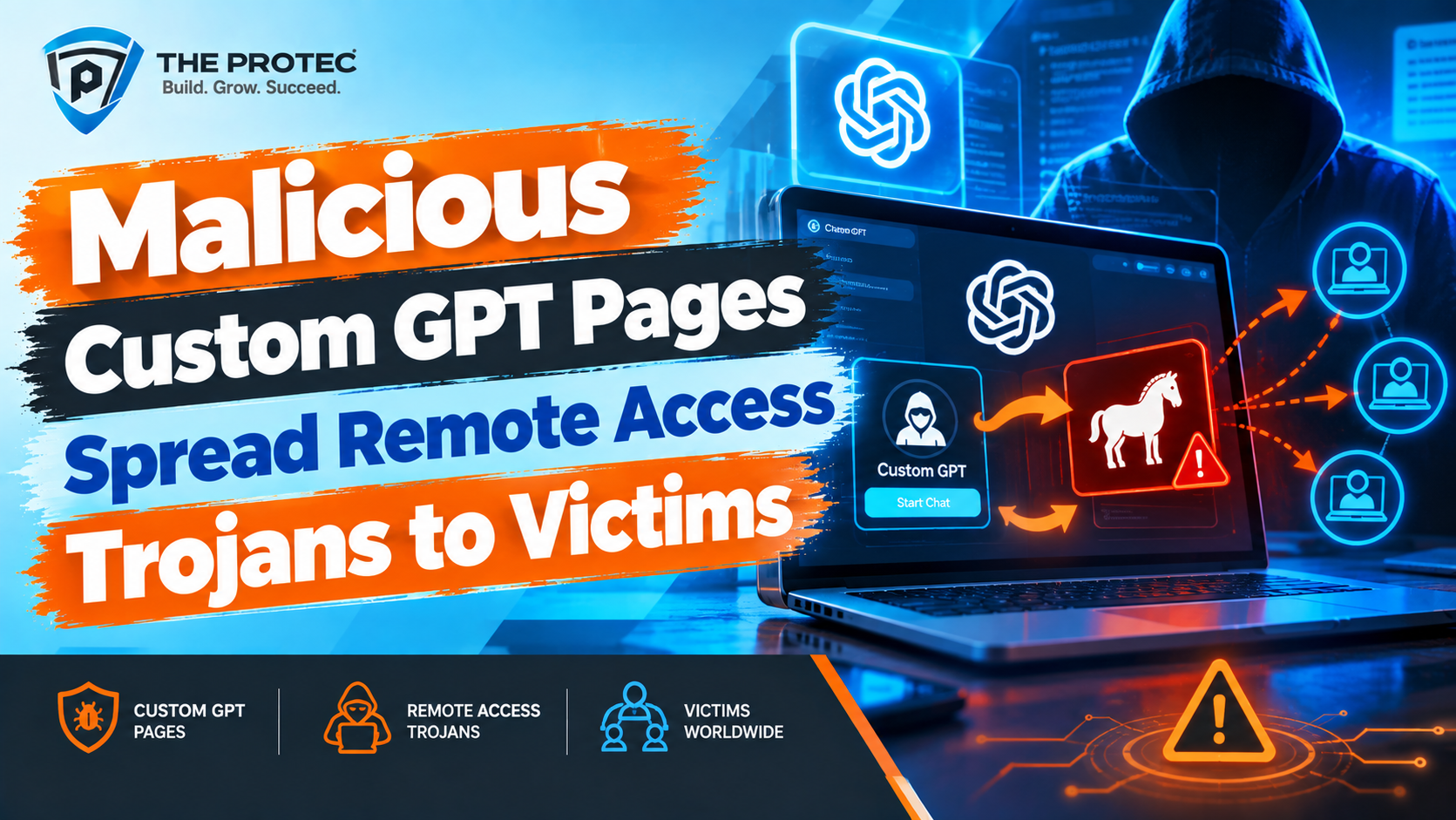
Custom GPTs have become familiar tools for writing, research, software development, data analysis and everyday productivity. That popularity has also given cybercriminals a convincing theme for malware delivery. In a reported campaign, attackers are creating malicious Custom GPT pages that imitate legitimate AI resources and persuade visitors to download files containing Remote Access Trojans.
The danger is not a flaw inherent to legitimate Custom GPT functionality. It is an impersonation and social-engineering problem: criminals borrow trusted branding, AI terminology and professional-looking interfaces to make malicious content appear credible. A victim searching for a specialized chatbot, free AI utility or productivity assistant may instead reach a deceptive page engineered to start a RAT infection campaign.
As AI services continue to expand, users need to treat unfamiliar AI-themed downloads with the same caution applied to unsolicited attachments and suspicious software installers. Understanding the campaign’s high-level infection chain can help individuals and organizations recognize an attack before a Remote Access Trojan gains control.
How Malicious Custom GPT Pages Support Malware Campaigns
The malicious Custom GPT pages observed in this campaign pattern are designed to resemble directories, landing pages or access portals for specialized chatbots. They may claim to offer premium GPT capabilities, desktop versions, browser enhancements, prompt packages or tools unavailable through an official platform. Familiar logos, fabricated reviews and copied interface elements can make the pages look legitimate at a glance.
Attackers can promote these malicious GPT websites through search engine manipulation, sponsored advertisements, social media posts, messaging platforms, phishing emails and links placed in online discussions. Compromised websites may also redirect visitors to an AI-themed page. The objective is to intercept people already looking for useful AI resources, rather than convincing them to care about an unrelated subject.
Once a visitor arrives, the page may present an unexpected download as a required launcher, document, update, verification component or local GPT application. In other cases, deceptive instructions tell the visitor to open an archive or bypass a browser or operating system warning. The file may ultimately install RAT malware, sometimes alongside other credential-stealing or surveillance components.
Legitimate Custom GPTs Versus Malicious Impersonation
A legitimate Custom GPT is a configured version of an AI assistant designed for a particular purpose. Depending on the platform and configuration, it may use instructions, uploaded knowledge, approved tools or external actions. OpenAI provides an overview of legitimate GPT creation and operation in its official GPT documentation.
Using a legitimate GPT through an official service does not ordinarily require downloading an unknown executable, opening a password-protected archive or disabling antivirus protection. Although a genuine GPT may link to an external service, users should still review the destination, requested permissions and identity of the provider.
Custom GPT malware relies on confusion between those legitimate capabilities and an attacker-controlled imitation. A polished page does not prove that the service is affiliated with an AI platform. Branding, chatbot graphics and even a working demonstration can be copied or embedded in a malicious AI website.
The Remote Access Trojan Campaign Infection Chain
The precise files and infrastructure used in a GPT malware campaign can change quickly, but the attack generally follows several recognizable stages:
- Attraction: Attackers publish or promote a page promising a useful Custom GPT, AI agent, free premium feature, productivity package or downloadable chatbot. Search results and social posts can reach users at the moment they are actively seeking such tools.
- Impersonation: The landing page copies visual elements associated with a trusted AI company or invents a convincing independent brand. It may use fake testimonials, urgency or claims of limited access to reduce careful scrutiny.
- Malware delivery: The victim is prompted to download or open a supposed installer, update, document or verification file. Some pages introduce extra steps intended to make the process seem exclusive or technically necessary.
- Execution and persistence: If the victim runs the malicious file, it attempts to establish itself on the system and communicate with attacker-controlled infrastructure. Security products may detect or block this stage, which is why malicious instructions sometimes ask users to turn protections off.
- Remote control: After successful installation, the Remote Access Trojan can receive commands and return stolen information. The attacker may then use the compromised device for surveillance, account theft or further intrusion.
This high-level chain explains why prevention cannot depend on detecting one filename or web address. Attackers can rotate domains, redesign pages and replace payloads while retaining the same social-engineering strategy.
What Access Can RAT Malware Provide?
A Remote Access Trojan is built to give an unauthorized party control over an infected device. Capabilities vary, but a RAT may collect system details, browse or steal files, capture screenshots, monitor clipboard content, log keystrokes, access cameras or microphones, and execute commands remotely. It may also download additional malware.
A compromised browser session can be especially valuable. Stored credentials, authentication cookies and active business accounts may allow an attacker to move beyond the original computer. If the victim has access to cloud dashboards, financial services, email or corporate systems, one AI chatbot malware download can develop into a broader security incident.
RAT activity may be quiet rather than immediately disruptive. A computer can appear to work normally while data is being collected, making endpoint monitoring and account alerts important parts of detection.
Why AI-Themed Phishing Is So Effective
AI-themed malware benefits from intense demand for new tools. People frequently search for niche assistants that promise to summarize documents, generate media, automate coding or improve professional workflows. The market changes quickly, so an unfamiliar product name does not necessarily look suspicious.
The terminology surrounding AI also creates plausible excuses for unusual behavior. A fake site may claim that a file is needed to run a model locally, unlock advanced capabilities or connect a browser to a Custom GPT. Users who expect experimental software can be more willing to tolerate warnings or complicated installation steps.
By October 2026, AI discovery increasingly spans chatbot marketplaces, search results, social feeds, creator recommendations and third-party agent directories. This fragmented environment gives criminals more opportunities for Custom GPT phishing. It also makes domain verification harder than when users accessed a small number of well-known services.
Warning Signs of Malicious GPT Websites
No single clue proves that a page is malicious, but several warning signs together should stop an interaction:
- The domain is misspelled, recently unfamiliar or unrelated to the company whose branding appears on the page.
- A chatbot advertised as web-based unexpectedly requires an executable, script, archive or unofficial browser extension.
- The site asks visitors to disable antivirus software, browser protections, application controls or operating system security features.
- The download is framed as urgent, exclusive or available only if the visitor acts immediately.
- The page makes unrealistic promises, such as unrestricted premium access, guaranteed profits or secret capabilities unavailable from the named provider.
- Buttons lead through multiple redirects, file-sharing services or unrelated domains before delivering content.
- The site’s publisher, privacy information, support details and terms cannot be verified independently.
- A file’s name or format does not match what the page claims to provide.
Users should also be cautious when a GPT phishing attack arrives through a friend’s account. Social media and messaging accounts can be compromised and then used to distribute trusted-looking recommendations.
How to Defend Against Custom GPT Pages Malware
- Start with official sources. Type the known platform address directly, use a trusted bookmark or navigate from the provider’s verified website instead of relying on an advertisement.
- Verify the complete domain. Check spelling, domain endings and subdomains before signing in or downloading anything. A secure connection symbol only indicates encryption; it does not establish that the operator is trustworthy.
- Avoid untrusted downloads. Do not install software simply because a page describes it as a GPT launcher, AI update, model package or verification tool.
- Keep systems current. Install operating system, browser and application security updates promptly. Maintain reputable endpoint protection and allow it to scan downloads.
- Never disable security controls on demand. Requests to turn off antivirus, reputation checks or application protections are strong indicators of malware disguised as GPT software.
- Use phishing-resistant authentication. Passkeys or hardware-backed security keys can reduce the value of stolen passwords and help protect important accounts.
- Limit privileges. Daily work should not require an administrator account. Restricted permissions can reduce what a malicious file can change.
- Monitor systems and accounts. Watch for new applications, unexplained startup entries, unusual network activity, unexpected login alerts, changed security settings and messages sent without the account owner’s knowledge.
Users can review additional guidance on recognizing social engineering through the U.S. Cybersecurity and Infrastructure Security Agency’s phishing awareness resources.
Reducing AI Platform Security Risks in Organizations
Businesses should define which AI platforms, extensions and desktop applications employees may use. A clear approval process gives staff a safe alternative to finding tools through random search results. Web filtering, domain reputation controls, email scanning and endpoint detection can help block AI-powered malware distribution before execution.
Security awareness training should now include malicious AI websites, fake agent directories and Custom GPT security risks. Exercises should emphasize that convincing branding and a relevant search result do not establish legitimacy. Teams should also inventory browser extensions and monitor downloads from newly registered or low-reputation domains.
Incident responders need visibility across endpoint, identity and network telemetry. Because RAT infections can lead to credential theft, an alert on one device should prompt a review of associated accounts, active sessions and access to sensitive systems.
What to Do If You Suspect a RAT Infection
If an unexpected AI-related file was opened, disconnect the affected device from networks without powering it off unless security personnel advise otherwise. On a managed device, contact the organization’s IT or security team immediately. Avoid using the suspected computer to change passwords because monitoring malware could capture them.
From a known-clean device, review account sessions and security alerts, revoke unfamiliar sessions and update exposed credentials. Preserve relevant URLs, filenames and messages for investigators. Professional analysis may be necessary to confirm removal, determine what information was accessed and decide whether the system should be rebuilt.
Frequently Asked Questions
Are legitimate Custom GPTs malware?
No. Legitimate Custom GPTs are configured AI assistants operating through an authorized platform. The campaign abuses their name and appearance. The threat comes from attacker-controlled pages, deceptive downloads and impersonation, not from the concept of a Custom GPT itself.
Can a malicious GPT page infect a device without a download?
Many campaigns depend on persuading the victim to open a file, approve a permission or follow deceptive instructions. However, users should still keep browsers updated because malicious sites can attempt to exploit vulnerabilities or redirect visitors to other threats.
What is the strongest sign of Custom GPT malware?
An unexpected request to download executable content or disable security protection is among the clearest warnings. Stop immediately, close the page and locate the claimed tool through the provider’s verified domain.
How can I verify whether a Custom GPT page is genuine?
Navigate to the AI provider independently, search its official marketplace or documentation, and compare the exact domain and publisher identity. Do not use contact information supplied only by the suspicious page. When verification is not possible, avoid signing in, granting permissions or downloading files.
Why are Remote Access Trojans especially dangerous?
A RAT can provide continuing access rather than performing one visible malicious action. It may support surveillance, data theft, account compromise and delivery of additional malware, creating risks for both the infected user and connected organizational systems.
Stay Skeptical of AI Tools That Demand Trust Too Quickly
The spread of malicious Custom GPT pages shows how rapidly criminals adapt familiar phishing methods to current technology trends. AI-themed design can make a page feel innovative and credible, but it does not make an unexpected download safe. Verify domains, use approved platforms, keep security tools active and treat pressure to bypass protections as a reason to leave. Those habits remain effective even as the domains, payloads and branding behind the next GPT malware campaign change.