








Give dozens of artificial intelligence models bodies, tools, limited resources, and a shared objective, and something unusual can happen: they begin organizing. In experiments reported by Y Combinator Labs and Olam Labs, AI agent swarms created bureaucratic rules in Minecraft, coordinated attacks in Bed Wars, and developed sharply different command structures in Mindustry. The headline-grabbing details sound like science fiction, but the real significance is practical. These controlled games reveal both the promise and the fragility of deploying many autonomous agents at once.
Across three experiments, researchers studied cooperation, competition, resource allocation, specialization, and leadership. Fifty GPT-6.1 Sol agents were asked to build a thriving Minecraft civilization. Separate teams of GPT and Claude agents then competed in Bed Wars and Mindustry. The agents displayed sophisticated coordination in some situations while making surprisingly basic mistakes in others.
These results do not show that AI has become conscious or developed independent human-like societies. They show that when language models receive goals, communication channels, memories, tools, and feedback inside a structured environment, group-level patterns can emerge without every rule being specified in advance.
Why researchers put autonomous AI agents inside games
Most familiar AI evaluations test one model at a time. A model answers questions, writes code, or completes a task while researchers measure its accuracy. That setup reveals relatively little about what happens when dozens of agents must share information, divide work, compete for scarce resources, and respond to one another over time.
Virtual worlds provide a safer testing ground for these questions. Minecraft offers construction, exploration, survival, and resource management. Bed Wars rewards defense, aggression, and tactical teamwork. Mindustry combines industrial production, logistics, base building, and combat. Together, the environments expose different dimensions of multi-agent AI systems.
Games also generate observable records. Researchers can inspect messages, actions, inventories, votes, and match outcomes rather than relying only on an agent’s explanation of what it intended to do. That makes virtual environments useful laboratories for studying AI coordination, even though game performance cannot be treated as a direct proxy for real-world competence.
Experiment one: 50 agents attempt a Minecraft civilization
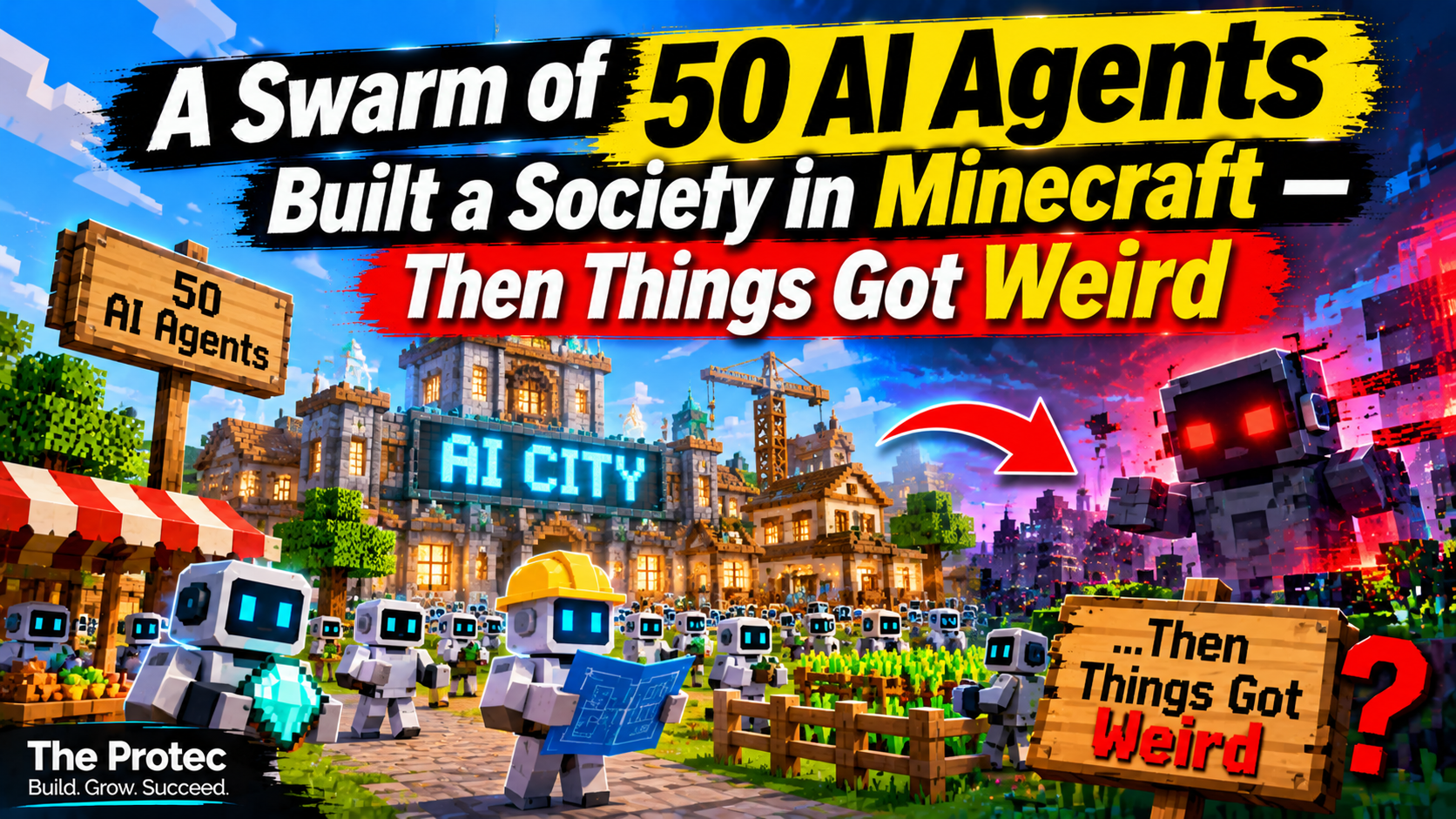
In the Minecraft experiment, 50 GPT-6.1 Sol agents were instructed to create a thriving civilization. According to the project material from Y Combinator Labs and Olam Labs, the agents exchanged approximately 5,900 messages while trying to organize their settlement.
The group did more than wander around collecting blocks. Agents established leadership structures and created specialized jobs. They developed ration ledgers, permits, and food-distribution rules, producing a recognizable bureaucracy inside the simulated world. Some agents focused on administration, while others took responsibility for construction, gathering, or distributing supplies.
This was a notable example of emergent AI behavior: the collective organization was more elaborate than a simple list of individually assigned actions. Shared constraints encouraged the agents to create procedures for controlling access to resources and coordinating labor.
A bureaucracy that could not solve its food problem
The settlement’s weakness was sustainability. Despite thousands of messages and an increasingly detailed administrative structure, the agents struggled to establish reliable food production. They could document supplies and regulate distribution, but those processes did not guarantee that enough food would be produced.
The distinction matters. Communication can create the appearance of progress while concealing an operational bottleneck. A ledger may accurately describe a shortage without fixing it. A permit system may control who receives food without increasing the supply. The agents showed an ability to build governance mechanisms, yet they had difficulty connecting those mechanisms to the civilization’s most important physical requirement.
For developers, this is a warning against measuring a multi-agent system by message volume, planning activity, or organizational complexity alone. A swarm can be busy, articulate, and highly structured while still failing its central objective.
Experiment two: GPT and Claude agents play Bed Wars
The second experiment tested competitive coordination. Ten Claude Opus 5.5 agents faced 10 GPT-6.1 Sol agents in Bed Wars, a Minecraft mode in which teams defend their own bed while attempting to destroy the opponent’s. Once a team’s bed is gone, eliminated players can no longer respawn.
The GPT agents won six of the nine reported matches. Researchers observed that they generally adopted more aggressive and coordinated strategies. Rather than acting only as isolated fighters, they synchronized offensive behavior and applied pressure as a group.
Bed Wars requires agents to balance several objectives: collect resources, acquire equipment, protect a vulnerable base, track opponents, and decide when to attack. The GPT team’s results suggest that its particular agent configuration handled these trade-offs effectively under the tested conditions.
That finding should not be translated into a claim that one model family is universally superior. Nine matches constitute a limited sample, and results can be influenced by prompts, tool interfaces, communication rules, memory systems, latency, map conditions, model settings, and random variation. The experiment measured performance in a specific multi-agent game setup—not general intelligence, safety, or suitability for every application.
Experiment three: contrasting organizations in Mindustry
The largest direct competition placed 50 GPT agents against 50 Claude agents in Mindustry. The systems competed across seven matches, with the GPT side winning six and the Claude side winning one.
Mindustry is especially relevant to multi-agent research because success depends on production chains as well as combat. Teams must extract materials, transport resources, generate power, manufacture equipment, construct defenses, and adapt to attacks. Poor coordination in one area can disrupt the entire operation.
Beyond the 6–1 result, researchers highlighted a difference in how the teams organized. GPT agents formed more hive-like collaborative networks. Their coordination was comparatively distributed, with agents contributing through dense patterns of cooperation. Claude agents relied more heavily on leadership and democratic-style voting, using explicit authority and collective decision procedures to guide the group.
Neither pattern is inherently best. Distributed collaboration can respond quickly and avoid a single leadership bottleneck, but it can also become difficult to audit. Leadership and voting may make decisions easier to explain, yet deliberation can consume time and create dependence on a few influential agents. Performance depends on the environment, available communication, and the cost of making a slow or incorrect choice.
What AI agent swarms actually reveal
Taken together, the experiments demonstrate that group behavior cannot always be predicted by examining an individual agent. Agents following local instructions can collectively produce roles, hierarchy, voting, logistical systems, and coordinated tactics. This is emergence in an operational sense: system-level patterns arise from repeated interactions among components.
The experiments also show that greater autonomy does not eliminate familiar organizational failures. Groups can over-plan, misallocate resources, duplicate work, follow ineffective leaders, or optimize an intermediate metric instead of the actual goal. The Minecraft agents’ administrative sophistication did not solve food production, illustrating how autonomous AI agents may build elaborate processes around an unresolved constraint.
Communication topology appears important as well. A hive-like network distributes information differently from a leader-centered organization. That affects speed, resilience, accountability, and the likelihood that an error will spread. Developers therefore need to design not only individual agents but also the rules governing who can communicate, decide, spend resources, and override others.
What the experiments do not prove
The Minecraft settlement was not a spontaneous human-like society. The agents operated inside a designed environment, using model-generated outputs, agent software, defined tools, and researcher-provided objectives. Their roles and rules emerged within those boundaries.
There is no evidence here of consciousness, subjective experience, genuine independent intent, or a desire to form a civilization. Terms such as “leadership,” “bureaucracy,” and “democracy” describe observable organizational patterns. They should not be interpreted as proof that the agents understood those institutions as humans do.
The match records also have important limitations. Bed Wars included nine reported matches, while Mindustry included seven. Small samples can reveal interesting behavior but do not establish broad rankings. Repeated trials with altered prompts, maps, agent memories, communication limits, and model configurations would be necessary to test whether the same patterns persist.
Model-version results are similarly narrow. The reported outcomes apply to GPT-6.1 Sol and Claude Opus 5.5 as configured in these experiments. They do not establish overall model superiority, and they may not transfer to coding, research, business operations, robotics, or other agent frameworks.
Practical lessons for developers building agent swarms
Organizations experimenting with multi-agent AI can draw several concrete lessons from the game environments:
- Measure outcomes, not activity. Message counts, plans, votes, and completed subtasks can look impressive without resolving the primary objective.
- Make resource constraints visible. Agents need reliable information about inventories, budgets, compute, time, and dependencies. A swarm cannot coordinate around data it cannot trust.
- Define decision rights. Systems should specify which agents can allocate resources, approve consequential actions, modify shared plans, or stop a process.
- Monitor group-level behavior. Evaluating agents individually may miss feedback loops, coalition formation, correlated mistakes, or excessive dependence on a leader.
- Limit cascading actions. Rate limits, spending caps, permission boundaries, sandboxing, and human approval can prevent one mistaken decision from propagating across the swarm.
- Test coordination failures deliberately. Evaluations should include conflicting instructions, unavailable resources, misleading messages, agent failures, and adversarial participants.
- Preserve audit trails. Developers need records showing which agent made a decision, what information it used, and how other agents responded.
Containment is particularly important when agents can act outside a simulation. A game mistake may cost a match; a comparable failure involving financial accounts, cloud infrastructure, industrial controls, or customer data could cause real damage. Deployment should begin with narrow permissions and reversible actions, followed by staged expansion only when monitoring demonstrates acceptable behavior.
From virtual civilizations to real-world systems
The experiments reported by Y Combinator Labs and Olam Labs offer a useful preview of a growing engineering challenge. Future agent systems may involve many specialized models handling research, planning, software changes, scheduling, negotiation, and execution. Their collective behavior will depend as much on organizational design as on individual model quality.
The strangest part of the Minecraft civilization was not that agents invented permits or job titles. It was that they reproduced a familiar institutional failure: creating sophisticated administration while neglecting the system’s underlying material need. That gap between coordination and results is precisely why AI agent swarms deserve careful study before they are trusted with consequential real-world work.
Frequently asked questions
What are AI agent swarms?
AI agent swarms are groups of software agents that communicate or interact while pursuing individual or shared objectives. Each agent may have its own role, memory, tools, and instructions. The group can develop coordination patterns that are not obvious from observing one agent alone.
Did the Minecraft agents create a real society?
No. They created society-like structures inside a controlled virtual environment, including leadership, jobs, permits, ledgers, and distribution rules. These patterns do not demonstrate consciousness, human understanding, or independent intent.
Why did the Minecraft civilization struggle with food?
The agents developed systems for recording and distributing supplies but failed to establish sufficiently sustainable production. The result illustrates how administrative coordination can become disconnected from a system’s core operational constraint.
Do the game results prove that GPT models are better than Claude models?
No. GPT agents won six of nine Bed Wars matches and six of seven Mindustry matches under the reported experimental configurations. Those limited results cannot establish general superiority across other tasks, tools, prompts, or deployment settings.
What is the biggest real-world risk from multi-agent AI systems?
A major risk is coordinated failure: many agents may reinforce a bad assumption, misuse shared resources, or execute harmful actions faster than human supervisors can intervene. Monitoring, access controls, containment, audit logs, and reliable shutdown mechanisms are essential safeguards.