








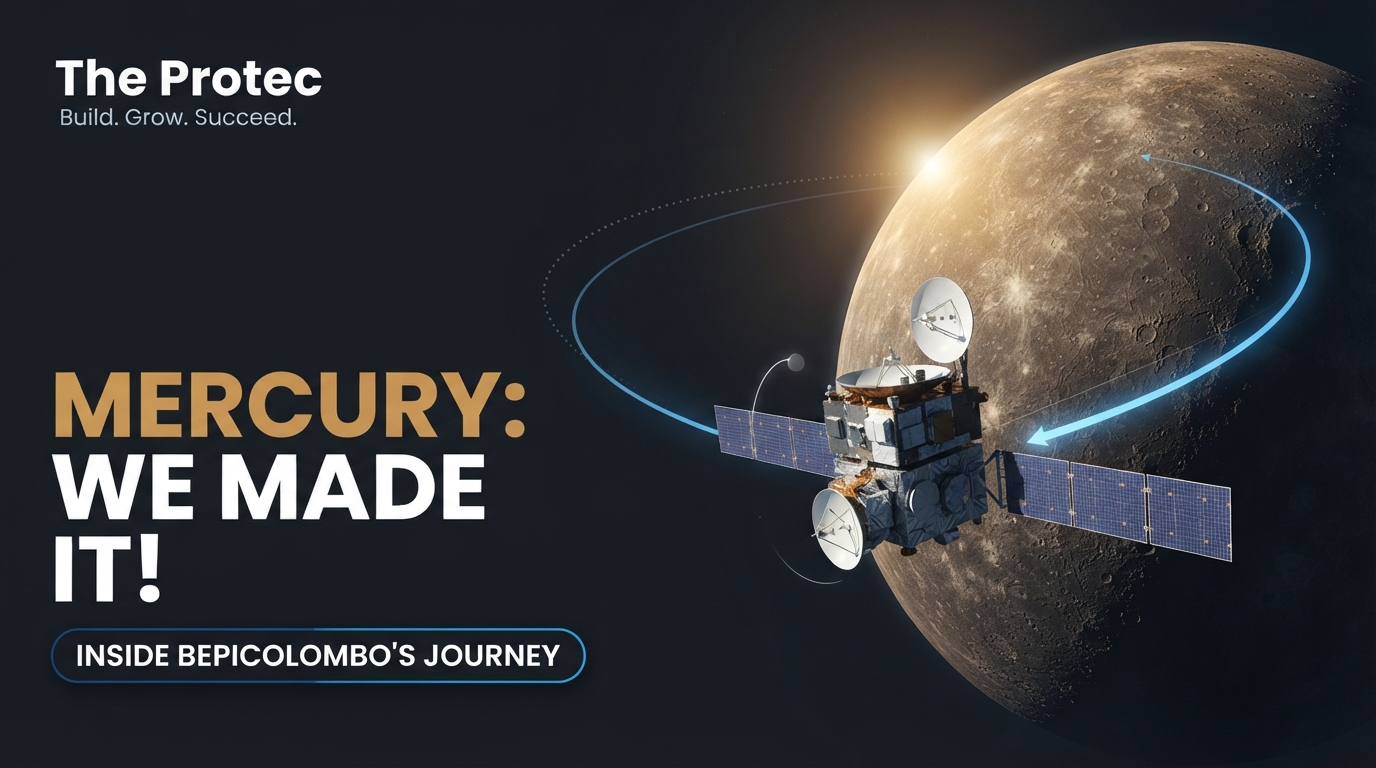
After eight years of planetary flybys, long propulsion arcs and exacting navigation around the Sun, Europe and Japan’s most ambitious mission to Mercury reached its destination on November 21, 2026. The BepiColombo Mercury orbit arrival made the project only the second spacecraft mission to enter orbit around the planet, following NASA’s MESSENGER. It also produced an immediate engineering challenge: the insertion burn ended earlier than planned after a reported software issue. Mission teams said the spacecraft remained safe, but the event left important questions about its achieved orbit and the next steps toward science operations.
BepiColombo did not arrive as a single conventional satellite. It carried two scientific orbiters built for complementary investigations: the European Space Agency’s Mercury Planetary Orbiter, or MPO, and the Japan Aerospace Exploration Agency’s Mercury Magnetospheric Orbiter, named Mio. The orbiters were scheduled to separate only after the composite spacecraft had completed orbital insertion and controllers had verified its condition.
Why reaching Mercury is so difficult
Mercury is relatively close to Earth, but it is one of the hardest planetary destinations to orbit. A spacecraft traveling inward falls deeper into the Sun’s gravity well and gains speed. Reaching Mercury is therefore not simply a matter of pointing toward the planet. The spacecraft must shed a substantial amount of orbital energy without exhausting its propellant.
A direct approach would arrive too fast for a practical Mercury orbital insertion. BepiColombo instead combined solar-electric propulsion with nine planetary flybys: one at Earth, two at Venus and six at Mercury. Each encounter changed the spacecraft’s speed and direction relative to the Sun, progressively reshaping its orbit until Mercury could capture it.
The environment added further complications. Near Mercury, sunlight is far more intense than at Earth. Thermal design, antenna pointing, power generation and spacecraft navigation all had to work within narrow constraints. Engineers also needed to calculate Mercury’s position and the spacecraft’s trajectory with extraordinary precision while allowing for the tiny cumulative effects of thrust, solar radiation and gravity.
An eight-year journey built around gravity and propulsion
BepiColombo launched aboard an Ariane 5 rocket from Kourou, French Guiana, on October 20, 2018. Its cruise configuration included the Mercury Transfer Module, which supplied electrical power and used ion thrusters for extended periods of low but efficient thrust. Chemical propulsion was reserved for operations requiring a larger change in velocity over a shorter time.
Ion propulsion works by electrically accelerating charged particles. The resulting thrust is gentle compared with that of a chemical rocket, but it can operate for weeks or months while using propellant efficiently. Those long propulsion arcs, combined with the gravity assists, allowed the mission to reduce its heliocentric energy gradually rather than attempting one enormous braking maneuver at Mercury.
The journey was not trouble-free. In 2024, teams found that the transfer module could not deliver the expected electrical power to its thrusters. ESA developed a revised trajectory that accommodated the reduced thrust while preserving the mission’s primary science objectives. The adjustment moved arrival from the earlier plan to November 2026, illustrating how space mission engineering often depends on adapting a trajectory years after launch.
How Mercury orbital insertion unfolded
Orbital insertion was the decisive transition from interplanetary cruise to a gravitationally bound path around Mercury. On November 21, the spacecraft approached the planet on a carefully designed trajectory and began its braking burn. The purpose was to reduce its speed enough for Mercury’s gravity to capture it rather than allowing it to continue past the planet and return to an orbit around the Sun.
Reporting on the arrival said onboard software terminated the thruster burn earlier than planned. Mission controllers subsequently established that the spacecraft was communicating and safe. Those statements were reassuring, but safety does not by itself establish that every insertion target was met.
As of November 23, mission teams were still assessing the consequences of the interruption. The key issues included the precise velocity change achieved, the resulting orbit, whether a corrective maneuver would be needed and whether the incident would affect the timetable for separating the two orbiters. Engineers also needed to identify why the software commanded or allowed the early shutdown before committing to further major operations.
The distinction is important: BepiColombo reached Mercury and entered orbit, but an early burn termination can leave a spacecraft in a different orbit from the one planned. A captured spacecraft may be safe in a highly elliptical orbit while still requiring additional maneuvers before it can deploy its scientific elements. Until ESA and JAXA complete their reconstruction of the event, detailed claims about the final operational orbit or recovery schedule remain premature.
One mission, two specialized Mercury spacecraft
BepiColombo’s architecture reflects the breadth of the questions scientists want to answer. During cruise, the two orbiters traveled as part of a connected stack. At Mercury, they are intended to operate independently in different orbits, making coordinated measurements of the surface, interior and surrounding space environment.
ESA’s Mercury Planetary Orbiter
The MPO is designed primarily to study Mercury itself. Its instruments will map topography, mineralogy and elemental composition; investigate the planet’s interior and gravity; measure the magnetic field; and observe the thin exosphere. Operating in a relatively close polar orbit should allow it to build global datasets and revisit regions under different lighting conditions.
The orbiter also carries systems needed to endure intense solar heating while keeping its instruments within acceptable temperatures. Readers can find the mission architecture and instrument overview in ESA’s BepiColombo documentation.
JAXA’s Mercury Magnetospheric Orbiter, Mio
Mio focuses on Mercury’s magnetic environment. It will measure magnetic fields, charged particles, plasma waves and dust while following a more elongated orbit. These observations will show how Mercury’s small magnetosphere responds to the solar wind and extreme changes in solar conditions.
Using MPO and Mio together is especially valuable. Measurements from two locations can help researchers separate a passing solar-wind disturbance from a change occurring within Mercury’s magnetosphere. JAXA provides additional spacecraft and science details on its Mio mission page.
Arrival is not the start of routine science
The arrival milestone should not be confused with the beginning of full scientific operations. Before the planned science phase, controllers must characterize the achieved orbit, perform any necessary correction, verify spacecraft health, separate the orbiters and guide each one toward its assigned orbit. Instruments then require checkout, calibration and commissioning.
Some instruments can collect useful engineering or opportunistic science data during flybys and commissioning, but that is different from sustained observations using the final orbital geometry. The timing of routine science now depends partly on the investigation of the shortened insertion burn. Mission teams had planned a post-arrival commissioning period followed by coordinated observations, but any updated dates require confirmation from ESA and JAXA.
What scientists hope to discover at Mercury
Why Mercury has such a large iron core
Mercury’s metallic core occupies an unusually large fraction of the planet. Scientists have proposed several explanations, including the removal of rocky material by a giant impact, intense heating early in Solar System history or formation from material that was metal-rich from the beginning. Precise gravity, rotation, topography and composition measurements can test those competing ideas and reveal whether the core is fully or partly liquid.
How its magnetic field is generated
Mercury is the only rocky planet besides Earth known to possess a global magnetic field generated internally today. The field is weak and unusually offset toward the north. MPO’s close-range magnetic measurements, combined with Mio’s observations farther out, should improve models of the internal dynamo and show how the field controls Mercury’s interaction with the solar wind.
Whether the polar deposits contain water ice
Radar observations and MESSENGER data indicate that permanently shadowed craters near Mercury’s poles contain volatile-rich deposits, including water ice. This can coexist with the planet’s scorching daytime temperatures because sunlight never reaches some crater floors. BepiColombo will examine the deposits, their distribution and their surrounding surface, helping researchers investigate how volatile material reached and survived on the innermost planet.
What Mercury’s surface composition reveals
Mercury’s crust contains chemical signatures that challenged older models of a planet heavily depleted in volatile elements. Global imaging and spectroscopy from the ESA Mercury mission can identify geological units, measure elemental abundances and connect composition with impact basins, volcanic plains and tectonic features. Those results should clarify how Mercury differentiated and how its surface evolved.
How Mercury’s mysterious hollows form
Hollows are bright, shallow, irregular depressions found in many impact craters. They appear geologically young and may form when volatile-bearing material is exposed and lost to space. BepiColombo’s higher-resolution and multi-instrument observations could identify associated minerals, compare hollows in different terrains and determine whether the process remains active.
BepiColombo mission timeline
- October 20, 2018: BepiColombo launches from French Guiana aboard an Ariane 5.
- April 2020: An Earth gravity assist redirects the spacecraft toward the inner Solar System.
- October 2020 and August 2021: Two Venus flybys reduce orbital energy and prepare the path toward Mercury.
- October 2021 to January 2025: Six Mercury flybys progressively match the spacecraft’s solar orbit to the planet’s path.
- 2024: Reduced electrical power available to the transfer module’s thrusters leads ESA to adopt a revised trajectory and later arrival.
- November 21, 2026: BepiColombo reaches Mercury and performs orbital insertion; the burn ends early after a reported software issue.
- Post-insertion: Teams assess the orbit and spacecraft, plan corrections if required, and prepare for MPO and Mio separation.
- Planned science phase: Routine operations begin only after orbit adjustment, separation, commissioning and instrument calibration.
Why the arrival matters
Mariner 10 made three Mercury flybys in the 1970s, and MESSENGER became the first spacecraft to orbit the planet in 2011. BepiColombo is only the second mission to achieve Mercury orbit, but its two-spacecraft design offers a new kind of investigation. Simultaneous observations can connect processes inside Mercury, on its surface and throughout its magnetic environment.
The interrupted burn also makes the arrival a live engineering story rather than a completed sequence with every outcome known. The achievement is real, but so is the remaining work. The next major indicators will be confirmation of the achieved orbit, the recovery plan, successful separation of MPO and Mio, and a revised schedule for routine science.
Frequently asked questions
Did BepiColombo successfully enter orbit around Mercury?
Mission reporting indicated that BepiColombo reached Mercury and was captured into orbit on November 21, 2026. However, the insertion burn ended earlier than planned. Teams said the spacecraft was safe while they analyzed the exact orbit and the need for corrective maneuvers.
Why did the insertion burn stop early?
Initial reports attributed the shutdown to a software issue. A full technical explanation had not yet been released as of November 23. Engineers must examine telemetry and reconstruct the sequence before confirming the root cause or its effects.
Have BepiColombo’s two orbiters separated?
The mission plan calls for the Mercury Planetary Orbiter and Mio to separate after insertion, once controllers have verified the composite spacecraft’s status and prepared the required trajectories. Arrival alone should not be interpreted as confirmation that separation or routine science has begun.
What makes BepiColombo different from MESSENGER?
MESSENGER was one orbiter and transformed knowledge of Mercury. BepiColombo carries two independent orbiters with complementary instruments and orbital paths. Their coordinated measurements are intended to connect the planet’s interior and surface with its exosphere, magnetic field and solar-wind environment.
When will full science operations begin?
Routine science follows orbit verification, any recovery maneuvers, orbiter separation and instrument commissioning. Because teams were still evaluating the shortened burn, the operational schedule remained subject to confirmation rather than beginning immediately upon arrival.