







Skip to content
Tuesday, November 24, 2026
  • Two Database Leaks Left 3.5 billion records exposed to abuse
  • Why the GTA 6 hacker sentenced to seven years is now walking free
  • Understanding integer vs pointer in C: Memory Rules That Matter
  • BepiColombo Mercury Orbit: How the Spacecraft Reached Its Goal

The Protec Blog

Guarding Your Future, One Byte at a Time.

Contact Us
Latest
  • Home
  • Cybersecurity
  • Artificial Intelligence
    • AI Tools
    • AI Agents
    • AI Automation
    • AI Development
  • Technology
    • Blockchain
    • Green Tech
    • Business Technology
    • Neurotech
    • Internet of Things
    • Technology Trends
    • Quantum Computing
    • Wireless Technology
    • Gaming
  • Development
    • Software
      • Backend Development
      • Frontend Development
      • Mobile Development
    • Website
      • Web Hosting
      • Web Security
      • WordPress
  • Reviews
    • Software Reviews
    • Tech Reviews
    • Buying Guides
Latest
  • Two Database Leaks Left 3.5 billion records exposed to abuse

    Two Database Leaks Left 3.5 billion records exposed to abuse

    16 minutes ago34 minutes ago
  • Why the GTA 6 hacker sentenced to seven years is now walking free

    Why the GTA 6 hacker sentenced to seven years is now walking free

    2 hours ago5 hours ago
  • Understanding integer vs pointer in C: Memory Rules That Matter

    Understanding integer vs pointer in C: Memory Rules That Matter

    3 hours ago19 hours ago
  • BepiColombo Mercury Orbit: How the Spacecraft Reached Its Goal

    BepiColombo Mercury Orbit: How the Spacecraft Reached Its Goal

    6 hours ago19 hours ago
  • Nvidia reinstates Jensen Huang: What His Return Means for AI

    Nvidia reinstates Jensen Huang: What His Return Means for AI

    19 hours ago19 hours ago
  • C# 15 union types: Why Lambdas and Delegates Need a Target

    C# 15 union types: Why Lambdas and Delegates Need a Target

    20 hours ago23 hours ago
  • How to Fix the ERR_TOO_MANY_REDIRECTS WordPress Error Safely

    How to Fix the ERR_TOO_MANY_REDIRECTS WordPress Error Safely

    22 hours ago23 hours ago
  • Fix There has been a critical error on this website in WordPress

    Fix There has been a critical error on this website in WordPress

    23 hours ago23 hours ago
  • What is Magecart? How E-Commerce Web Skimming Attacks Unfold

    What is Magecart? How E-Commerce Web Skimming Attacks Unfold

    1 day ago2 days ago
  • Microsoft MAI Code 2 vs Claude and GPT: What We Actually Know

    Microsoft MAI Code 2 vs Claude and GPT: What We Actually Know

    1 day ago2 days ago
  • Home
  • Cybersecurity
  • Two Database Leaks Left 3.5 billion records exposed to abuse

  • Cybersecurity

Two Database Leaks Left 3.5 billion records exposed to abuse

Aaron Thomas16 minutes ago34 minutes ago010 mins
Two Database Leaks Left 3.5 billion records exposed to abuse Two Database Leaks Left 3.5 billion records exposed to abuse

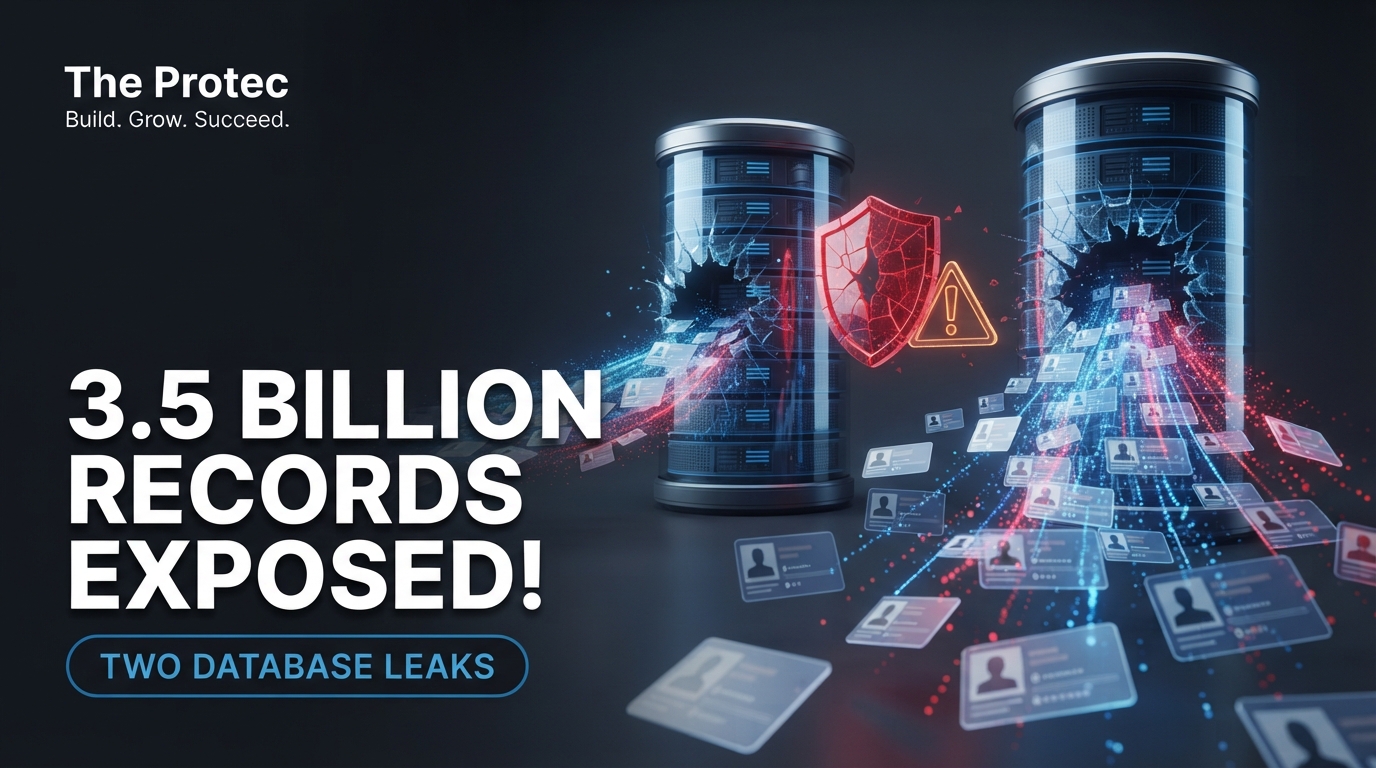
A vast collection of personal data and stolen credentials was left accessible through two separate unsecured databases, with more than 3.5 billion records exposed between them. A November 24, 2026, WIRED investigation detailed the discoveries: a 1.64 billion-document repository found by UpGuard researcher Greg Pollock and a separate credential database containing approximately 2 billion records found by Jeremiah Fowler of Black Hills Information Security. Both databases were taken offline, but critical questions—including who operated them, how long they were exposed, and whether criminals accessed them—remain unanswered.

The numbers are alarming, but they require context. The combined total does not mean 3.5 billion people were affected. A single person may appear in numerous records, credentials may be duplicated, and some entries may be old, incomplete, or unverified. Even with those qualifications, the breadth and organization of the exposed information illustrate how disconnected pieces of data can be assembled into profiles useful for account takeover, identity fraud, phishing, and session hijacking.

Contents

  • 1. What the WIRED investigation found
    • 1.1. The 1.64 billion-document database found by Greg Pollock
    • 1.2. The approximately 2 billion credentials found by Jeremiah Fowler
  • 2. Why 3.5 billion records does not mean 3.5 billion victims
  • 3. How infostealer malware collects passwords and session data
  • 4. How data aggregation cybercrime creates searchable profiles
  • 5. The most serious risks from the exposed information
    • 5.1. Account takeover and credential stuffing
    • 5.2. Session token theft and hijacking
    • 5.3. Identity fraud
    • 5.4. Targeted phishing and social engineering
  • 6. What is known—and what remains unconfirmed
  • 7. Practical security checklist
  • 8. Frequently asked questions
    • 8.1. Were 3.5 billion people affected?
    • 8.2. Were the two exposed databases connected?
    • 8.3. Does multi-factor authentication stop stolen session tokens?
    • 8.4. How can I tell whether my information was included?
  • 9. The bottom line

What the WIRED investigation found

WIRED reported on two independently discovered databases rather than one coordinated breach. The researchers found different collections, at different locations, with different types of information. There is no confirmed evidence that the databases had the same owner or operator.

The 1.64 billion-document database found by Greg Pollock

Greg Pollock, vice president of cyber risk analytics at UpGuard, discovered an unsecured database containing approximately 1.64 billion documents. According to WIRED’s account of Pollock’s findings, the repository included records involving national ID numbers, phone numbers, student information, and business registrations.

Read more
Synthetic Data: Building AI Models Without Privacy Concerns

This collection appears significant because it brought together multiple categories of identifying and administrative data. A phone number alone may have limited value. Combined with a name, national identifier, educational record, or business registration, however, it can help an attacker verify a person’s identity, answer account-recovery questions, or make a fraudulent message appear credible.

The use of the term documents also matters. A document is not necessarily a unique individual, and one document may contain several data fields. The 1.64 billion figure therefore describes entries in the database, not a confirmed population of victims.

The approximately 2 billion credentials found by Jeremiah Fowler

Jeremiah Fowler, a security researcher with Black Hills Information Security, separately found a database containing approximately 2 billion credential-related records. WIRED reported that the exposed material included passwords, browser cookies, session tokens, and device details associated with data commonly collected by infostealer malware.

This second repository presented a different kind of danger. Passwords and stolen login credentials can support direct attempts to access accounts. Cookies and session tokens may be even more immediately useful because they can sometimes allow an attacker to impersonate a signed-in user without entering a password. Device details can help criminals understand the victim’s operating environment or make fraudulent access look less unusual.

Nothing publicly confirmed in the investigation establishes that every credential was current or valid. Stolen-data collections often contain repeated entries, expired sessions, obsolete passwords, malformed records, and information copied from earlier collections. That does not make the exposure harmless: criminals can test data at scale and focus on the subset that still works.

Why 3.5 billion records does not mean 3.5 billion victims

Read more
How Governments Are Shaping Cybersecurity Regulations in 2026

The phrase 3.5 billion data exposure describes the combined volume of database records. It should not be interpreted as a count of unique affected people.

  • One person can generate many records. Separate logins, devices, browser sessions, school files, phone entries, or business records may all refer to the same individual.
  • Credentials may be captured repeatedly. Infostealer malware can collect the same account details during multiple infections or from synchronized browsers.
  • Aggregated datasets often overlap. Operators may combine information obtained from previous leaks, malware logs, scraping, or multiple suppliers.
  • Not every record is verified. Some entries may be incomplete, outdated, incorrectly matched, or automatically generated.

As of November 24, researchers had not established the number of unique individuals represented in either collection. They also had not confirmed how much of the material originated from newly compromised systems rather than older data gathered from other sources.

How infostealer malware collects passwords and session data

Infostealers are malicious programs designed to extract valuable information from infected computers. They are commonly distributed through deceptive downloads, pirated software, malicious advertisements, fake updates, email attachments, or trojanized installers. Once executed, an infostealer searches the device for data that can be packaged and transmitted to an operator.

Depending on the malware and the victim’s software, the stolen material may include:

  • Saved usernames and passwords from web browsers
  • Authentication cookies and active session tokens
  • Autofill data, email addresses, and phone numbers
  • Cryptocurrency wallet information
  • Device names, IP addresses, operating-system details, and browser versions
  • Screenshots, files, or lists of installed applications

Many infostealers create a structured package called a log. Criminals can sell individual logs, provide access through subscription services, or combine them with other stolen datasets. Changing an exposed password is essential, but it may not terminate an already authenticated session. That is why session revocation and malware removal are separate, necessary steps.

How data aggregation cybercrime creates searchable profiles

The two database discoveries highlight a larger cybercrime practice: aggregating fragmented information into organized, searchable collections. Raw stolen data can be inconsistent. Names may use different formats, phone numbers may contain country codes or punctuation, and the same website may appear under several domain variations.

Operators can normalize those records by standardizing fields, removing obvious formatting differences, categorizing data by source, and connecting entries through shared identifiers. An email address might link an exposed password to a phone number. That phone number might connect to a national ID record, school entry, or business registration.

The result can be more useful to criminals than any individual leak. Instead of searching numerous disorganized files, an attacker may be able to look up a person, domain, phone number, or organization and retrieve a consolidated profile. This is why data aggregation cybercrime amplifies risk even when some underlying information is old or publicly available.

The most serious risks from the exposed information

Account takeover and credential stuffing

Attackers can test stolen login credentials against email, social media, shopping, financial, and workplace services. Password reuse makes credential stuffing especially effective: a password stolen from one service may unlock several unrelated accounts. Email compromise is particularly dangerous because an inbox often provides password-reset access to other services.

Session token theft and hijacking

Session token theft can let an attacker reuse proof that a user has already authenticated. Depending on the service and its security controls, this may bypass the normal login prompt and, in some cases, the immediate protection offered by multi-factor authentication. Expiration, risk-based checks, device binding, and manual revocation can invalidate a stolen token, but implementations vary.

Identity fraud

Exposed national ID numbers, phone numbers, student records, and registration information may support impersonation or fraudulent applications. Criminals can also use these details to pass weak identity-verification checks. Identity theft protection and credit monitoring may help detect misuse, but they cannot remove data already copied by an unknown party.

Targeted phishing and social engineering

Detailed personal information makes phishing more convincing. A message that references a real school, business, device, phone number, or account can appear legitimate. Attackers may pose as a bank, employer, government agency, help desk, or service provider and pressure the recipient to disclose a code, open a file, or visit a fake login page.

What is known—and what remains unconfirmed

According to WIRED’s primary reporting and the researchers’ accounts, both databases were exposed without adequate access controls when discovered. The researchers pursued disclosure efforts, and the repositories were subsequently taken offline. Their removal limits continued public access at the same locations, but it cannot show whether data was copied beforehand.

Several important facts were still unconfirmed at the time of publication:

  • The owners or operators of the databases
  • The purpose for which each collection was assembled
  • How long either database had been publicly accessible
  • Whether unauthorized parties found or downloaded the records
  • How much information was duplicated, outdated, or inaccurate
  • The number and geographic distribution of unique affected people
  • Whether the two repositories had any operational connection

Calling the incidents a database leak is useful shorthand for exposed information, but it should not be taken as proof of a newly confirmed intrusion into a single company. The immediate security failure was that the repositories were accessible; the origins and handling history of their contents require further investigation.

Practical security checklist

  1. Use a reputable password manager. It can create and store long, random credentials without requiring you to memorize each one.
  2. Make every password unique. Prioritize email, banking, cloud storage, social media, and work accounts if you have reused passwords.
  3. Enable multi-factor authentication. Prefer passkeys or security keys when available. An authenticator app is generally more resistant to interception than SMS codes.
  4. Review and revoke sessions. Use account security settings to sign out unknown devices—or all devices—especially after changing a password.
  5. Scan devices for malware. Update the operating system and security software, then run a full scan. If infection is suspected, change credentials from a known-clean device.
  6. Check account activity. Review login histories, sent email, password-reset notices, forwarding rules, financial transactions, and changes to recovery information.
  7. Be cautious with personalized messages. Accurate personal details do not prove that a caller or sender is legitimate. Contact organizations through independently verified channels.
  8. Monitor for identity misuse. Where available, consider fraud alerts, credit freezes, government identity-account monitoring, or comparable local protections.

Frequently asked questions

Were 3.5 billion people affected?

No such conclusion has been established. The total refers to records or documents across two separate databases, not unique individuals. Duplicates, multiple records per person, old credentials, and unverified entries may substantially reduce the unique count.

Were the two exposed databases connected?

No connection was confirmed in WIRED’s November 24 reporting. They were independently discovered by Greg Pollock and Jeremiah Fowler and contained different categories of information. Shared ownership or coordination should not be assumed.

Does multi-factor authentication stop stolen session tokens?

Not always. MFA can block an attacker who has only a password, but a valid stolen session token may represent an already authenticated session. Revoking active sessions, removing malware, and changing passwords are therefore important alongside MFA or passkeys.

How can I tell whether my information was included?

No definitive public lookup was identified for the full contents of these databases. Watch for unfamiliar login alerts, password resets, account changes, financial activity, and phishing tied to accurate personal details. Treat reused or malware-exposed credentials as compromised rather than waiting for confirmation.

The bottom line

These discoveries show that the danger lies not only in individual breaches but also in the industrial organization of stolen and exposed data. Although the databases are offline, their ownership, exposure duration, access history, and unique victim count remain unknown. Users should avoid assuming that every record was accurate—or that removal erased the risk. Unique passwords, passkeys or multi-factor authentication, session revocation, clean devices, and careful account monitoring provide the most practical defenses against the kinds of abuse these collections can enable.
Tagged: account takeover credential stuffing Data Exposure Data Privacy database leaks exposed passwords identity theft infostealer malware multi-factor authentication national ID security Passkeys session token theft stolen credentials

Post navigation

Previous: Why the GTA 6 hacker sentenced to seven years is now walking free

Leave a Reply Cancel reply

Your email address will not be published. Required fields are marked *

Related News

Why the GTA 6 hacker sentenced to seven years is now walking free Why the GTA 6 hacker sentenced to seven years is now walking free

Why the GTA 6 hacker sentenced to seven years is now walking free

Ellie Adam2 hours ago5 hours ago 0
What is Magecart? How E-Commerce Web Skimming Attacks Unfold What is Magecart? How E-Commerce Web Skimming Attacks Unfold

What is Magecart? How E-Commerce Web Skimming Attacks Unfold

Aaron Thomas1 day ago2 days ago 0
Inside the Optimizely supply chain attack and its malicious scripts Inside the Optimizely supply chain attack and its malicious scripts

Inside the Optimizely supply chain attack and its malicious scripts

Aaron Thomas2 days ago2 days ago 0
Was the FBI database hacked? Inside the Suspected NCIC Breach Was the FBI database hacked? Inside the Suspected NCIC Breach

Was the FBI database hacked? Inside the Suspected NCIC Breach

Aaron Thomas3 days ago3 days ago 0

Watch Our Videos
GTA 6 is one of the biggest games in the world—but what if PC gamers didn't have to wait for Rockstar to bring it to Windows?

An independent open-source project called **Leonida** is exploring a very different route: taking the Xbox Series version of Grand Theft Auto VI and attempting to transform it into a Windows-compatible program.

And the technical idea is fascinating.

Xbox Series consoles and modern gaming PCs share the x86-64 CPU architecture. That gives Leonida a potential starting point for *static recompilation*—an approach that analyzes existing game instructions and adapts them for another software environment.

But that's only one piece of the puzzle.

In this video, we explore how Leonida's approach differs from traditional emulation, how Xbox graphics shaders could be translated into SPIR-V for Vulkan, and why recreating console services, memory management, graphics pipelines, assets, audio and input is an enormous engineering challenge.

Most importantly, we'll separate technical progress from the hype.

*Leonida has not demonstrated a complete GTA 6 launch or playable gameplay.* Shader translation and asset extraction are meaningful technical components, but they do not amount to a working PC port. This is an independent community project—not an official Rockstar Games release.

Could this approach eventually work? And what would Leonida need to prove before PC gamers could actually play?

Watch until the end for the reality check.

👍 Like the video if you enjoy deep dives into gaming technology, and subscribe to *The Protec* for more stories about the technology changing gaming, software and the digital world.

*Would you trust an open-source community project to bring GTA 6 to PC before Rockstar does?* Tell us in the comments.

Read the full article:
https://www.theprotec.com/blog/leonida-gta-6-pc-xbox-static-recompilation-vulkan/

#GTA6 #Leonida #PCGaming #Vulkan #GamingTechnology
Leonida GTA 6 PC: Can Gamers Run GTA 6 Without an Xbox?
Imagine giving an AI your entire software project—not just one file, not just a few functions, but thousands of connected files, dependencies, configuration settings and documentation.

Could it understand how everything works together?

Google's Gemini 4 Neon arrives with a headline feature that could change how developers work: a *one-million-token context window*. But having room to process an enormous amount of information doesn't automatically mean an AI can understand it.

In this documentary, we investigate what Google's new AI model could mean for software development—and whether it can move beyond code autocomplete to genuinely useful project-level reasoning.

We'll explore:

🧠 *The Million-Token Context Window* – What one million tokens actually means, how much information it can hold and why capacity isn't the same as comprehension.

💻 *Understanding Entire Codebases* – How developers could use Neon to map repositories, follow dependencies, trace bugs across services, refactor applications and generate tests.

🤖 *AI Coding Agents* – How agentic workflows can plan tasks, inspect files, use tools, edit code, run tests and revise their work.

⚙️ *Google Antigravity* – Where Google's development environment fits into the workflow and how it differs from the underlying AI model.

📊 *Gemini vs ChatGPT vs Claude* – How to compare coding models fairly without assuming that one benchmark or context-window size determines the winner.

💰 *The Real Cost* – Why processing hundreds of thousands of tokens can become expensive, how repeated agent calls affect usage and why Google AI Pro access does not automatically mean unlimited API access.

⚠️ *The Limitations* – Hallucinations, missed details, long response times, unreliable code changes, security risks and why developers still need to review AI-generated work.

We'll also separate Google's own benchmark claims from independently verified results and examine what developers should actually test before trusting a model with a large project.

A million-token context window is impressive. But can an AI find the right details, understand their relationships and make changes without breaking something else?

*Would you trust an AI with your entire codebase?*

Read the full article:
https://www.theprotec.com/blog/gemini-4-neon-million-token-ai-developers/

👍 Like the video, subscribe to The Protec for more technology documentaries, and stay tuned as we explore the next generation of AI coding agents.

#Gemini4 #GoogleAI #AICoding #AI Agents #SoftwareDevelopment
Google's Gemini 4 Neon: Can This AI Understand an Entire Codebase?
What happens when the internet disappears? Phones lose their connection. Websites stop loading. Mobile networks may go offline. But thousands of miles away, someone could still receive a message through a radio signal traveling through the sky.

That's the remarkable technology behind *High Frequency (HF) radio communication*.

In this video, we explore how HF radio signals can travel beyond the horizon by interacting with the ionosphere, allowing distant stations to exchange messages without relying on cellular towers, fiber-optic cables or conventional internet infrastructure.

We'll also explore two open-source projects from Rhizomatica:

📡 *HERMES* – A broader communications system designed to bring digital communication to remote and underserved communities.

💻 *Mercury* – An open-source HF software modem that converts computer data into signals that can travel over radio. It supports adaptive data communication and can run on Linux, Windows and Raspberry Pi hardware.

You'll discover:
- How HF radio differs from ordinary FM broadcasting and internet communication.
- How the ionosphere helps radio signals travel beyond the horizon.
- How computers, modems, transceivers and antennas move digital messages through the air.
- Why store-and-forward messaging can work even when a live connection isn't available.
- How open-source radio technology can support remote communities and emergency communication.
- Why HERMES and Mercury matter for independent communication infrastructure.
- The real limitations: bandwidth, interference, atmospheric conditions, antennas, equipment and radio licensing.

HF radio isn't a replacement for broadband internet. It can't deliver the same speed or convenience. But when conventional infrastructure is unavailable, the ability to exchange essential information over long distances can be incredibly valuable.

*Read the full article:*
https://www.theprotec.com/blog/open-source-hf-radio-communications-hermes-mercury/

If the internet disappeared tomorrow, would you know how to communicate?

👍 Like the video if you found it useful, subscribe to The Protec for more technology explainers, and join us as we explore the future of open communication technology.

#HFRadio #OpenSource #EmergencyCommunications #RadioTechnology #OfflineCommunication
How Can Radio Communicate Across the World Without the Internet?
Subscribe

Trending Now

What's New?

Cybersecurity
Two Database Leaks Left 3.5 billion records exposed to abuse 01
16 minutes ago34 minutes ago
02
Cybersecurity
Why the GTA 6 hacker sentenced to seven years is now walking free
03
Programming
Understanding integer vs pointer in C: Memory Rules That Matter
04
Technology News
BepiColombo Mercury Orbit: How the Spacecraft Reached Its Goal
05
Technology News
Nvidia reinstates Jensen Huang: What His Return Means for AI
06
Software Development
C# 15 union types: Why Lambdas and Delegates Need a Target

Category Collection

Artificial Intelligence161 News
AWS2 News
Bitcoin3 News
Blockchain5 News
Design Tools10 News
Digital Courses3 News
Digital Currency2 News
E-Commerce3 News
EdTech8 News
Freelancing3 News
Mobile Technology34 News
Project Management3 News
SEO7 News

Popular This Month

Subscription Form

  • Cryptocurrency
  • Software Development
  • Hardware
  • CRM
  • SaaS
  • Design & Media
  • Career & Earning
  • CRM
  • Buying Guides
  • Privacy Policy
  • Contact Us
The Protec Blogs 2026. Flag Counter Powered By Computer Zila.