








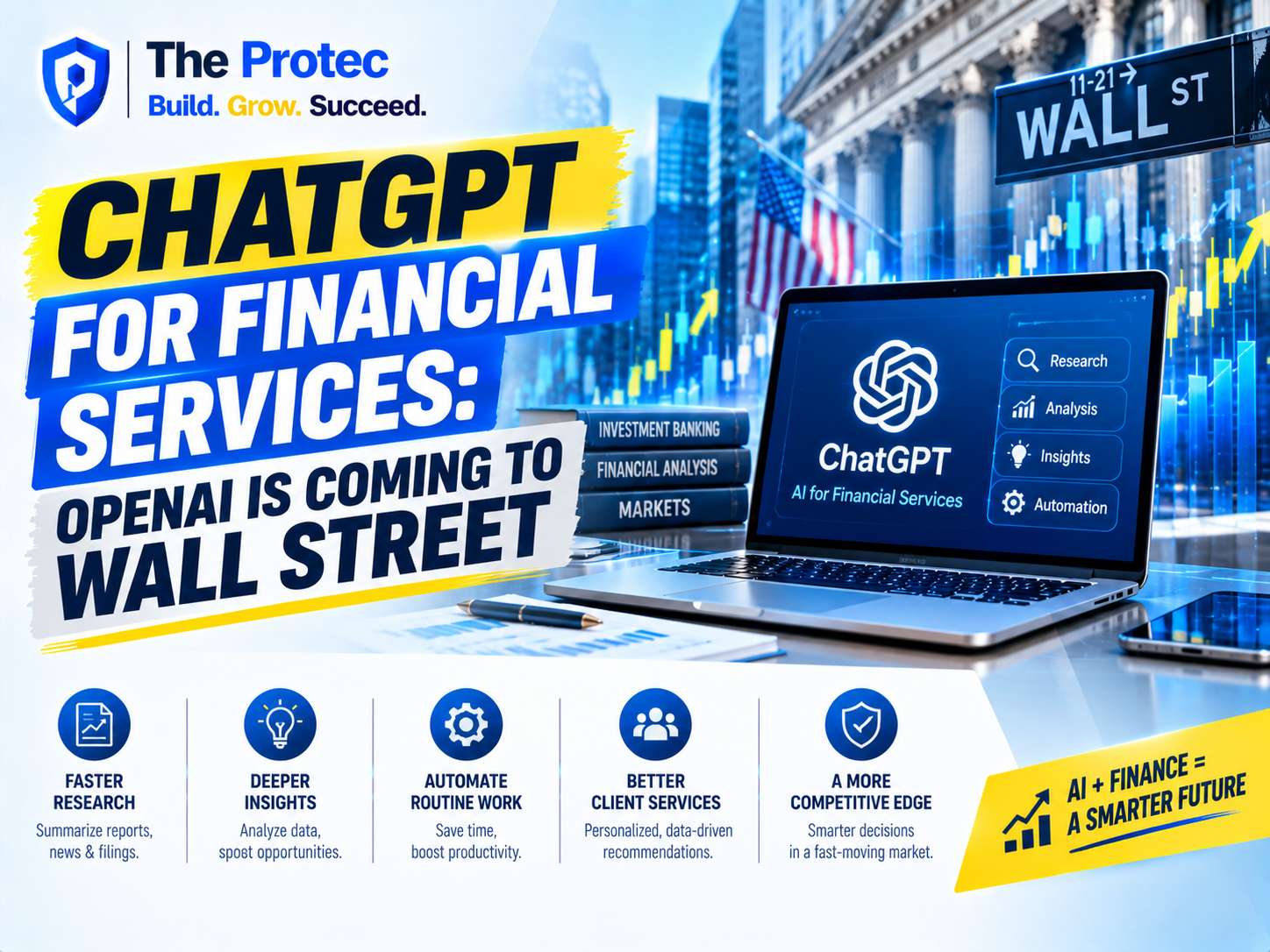
Wall Street has spent years experimenting with generative AI. Now OpenAI is moving closer to the center of the financial workflow with ChatGPT for Financial Services, a specialized AI workspace designed to behave less like a general chatbot and more like a digital analyst.
Built with input from financial institutions including Morgan Stanley and Evercore, the platform targets the research-heavy work that consumes much of an analyst’s day: reviewing filings, comparing companies, synthesizing market information, examining financial models, preparing briefing materials, and tracing conclusions back to source documents. It represents OpenAI’s clearest attempt yet to turn ChatGPT into professional infrastructure for investment banking, asset management, equity research, and other regulated financial businesses.
The important development is not simply that ChatGPT can answer finance questions. Analysts have used general AI tools for that for years. The difference is that OpenAI ChatGPT for Financial Services is being shaped around institutional data controls, finance-specific analysis, auditable research, and the collaborative processes through which professional recommendations are produced.
What Is ChatGPT for Financial Services?
ChatGPT for Financial Services is a finance-focused version of ChatGPT Work, OpenAI’s professional environment for completing complex business tasks with organizational data and connected tools. It combines conversational AI with document analysis, research capabilities, structured reasoning, data interpretation, and enterprise administration.
The service is designed to work across the materials finance teams already use, including earnings releases, regulatory filings, investor presentations, call transcripts, internal research, spreadsheets, market data, and company databases. Instead of manually opening dozens of documents, a user can ask the AI analyst to identify changes in guidance, compare margins across peers, summarize risk disclosures, or assemble an initial investment memo.
The GPT-6 Astra finance configuration adds stronger long-context reasoning and tool use for professional financial analysis. That matters because institutional finance rarely involves a single prompt or document. A useful answer may require reconciling several years of statements, evaluating assumptions, finding inconsistencies, and explaining how each conclusion was reached.
OpenAI is positioning the product as an analyst workbench rather than an autonomous investment adviser. People remain responsible for validating outputs, applying judgment, and approving anything used in client communications, transactions, or investment decisions.
How It Differs From a General-Purpose Chatbot
A consumer chatbot can explain discounted cash flow analysis or summarize a pasted earnings report. It is less suited to handling confidential deal information, applying an institution’s research methodology, or maintaining an evidence trail across a complicated assignment.
ChatGPT financial services deployments are intended to address that gap through controlled access, enterprise identity management, connectors, data-governance policies, and persistent workspaces. Teams can provide approved information sources and limit which employees or AI agents may access particular materials. OpenAI also publishes information about its enterprise data practices through its enterprise privacy resources.
The platform’s finance specialization also changes how answers are assembled. An AI financial analyst should distinguish reported figures from estimates, label assumptions, preserve units and currencies, and show the source behind a claim. It must understand that adjusted EBITDA may differ across issuers and that two companies can use the same metric name while calculating it differently.
These capabilities do not eliminate mistakes, but they make the system more compatible with professional review. In finance, an answer without provenance is often less valuable than an incomplete answer whose supporting evidence can be inspected.
Where ChatGPT for Finance Can Improve Analyst Workflows
Investment and company research
AI for financial research can compress the first stage of company analysis. ChatGPT can review filings, management commentary, earnings transcripts, and industry material before producing a structured overview of revenue drivers, competitive risks, capital allocation, and recent operating changes.
An analyst could ask it to compare management’s latest statements with comments from previous quarters or identify where actual performance diverged from guidance. The resulting research is not a final recommendation, but it gives the analyst a faster starting point and more time to investigate the issues that matter.
Financial statement and valuation analysis
ChatGPT financial analysis can help users reconcile statements, examine working-capital movements, calculate trends, and test valuation assumptions. When connected to approved spreadsheet and market-data tools, it can assist with comparable-company tables, sensitivity analysis, scenario design, and the explanation of model outputs.
The most valuable role may be quality control. The system can flag broken formulas, inconsistent periods, unexplained changes, or assumptions that conflict with source documents. Human reviewers still need to confirm every material figure, especially when models support transactions or published research.
Investment banking execution
ChatGPT for investment banking could reshape the preparation that surrounds a deal. Bankers can use it to create company profiles, screen potential buyers, organize due-diligence questions, summarize virtual data-room materials, and draft initial presentation structures.
AI investment banking tools may also help teams retrieve precedents from internal knowledge repositories without exposing sensitive information to unauthorized users. This is especially important in an industry where information barriers, restricted lists, and deal-level permissions are fundamental controls.
Monitoring and recurring coverage
Analysts repeatedly perform the same monitoring tasks across covered companies. ChatGPT Work can compare new disclosures with established baselines, generate alerts about significant changes, and prepare a concise briefing before an earnings call. Automating this repetitive collection work allows professionals to focus on interpretation, management credibility, market structure, and differentiated investment views.
Morgan Stanley and Evercore as Design Partners
The involvement of Morgan Stanley and Evercore gives the initiative practical significance. Morgan Stanley has already been one of the most visible adopters of OpenAI technology in wealth management, using AI to help advisers navigate large internal knowledge bases. The expanded Morgan Stanley OpenAI relationship brings experience from a heavily regulated, client-facing environment into the design of broader finance workflows.
Evercore contributes a different perspective. Its advisory work involves intensive company research, valuation, transaction analysis, and presentation development. The Evercore OpenAI partnership gives product developers direct feedback about where an AI analyst can save time and where accuracy, confidentiality, and senior review cannot be compromised.
Design partnerships do not mean that every workflow is fully automated or that these institutions use identical deployments. Their importance lies in testing the product against real professional requirements rather than building finance features from generic benchmarks.
Will AI Replace Wall Street Analysts?
The near-term effect is more likely to be job redesign than wholesale replacement. Junior analysts spend substantial time gathering information, formatting materials, checking data, and producing first drafts. An OpenAI finance AI system can complete parts of that work in minutes, reducing the labor required for routine assignments.
That creates genuine pressure on traditional staffing models. Banks may expect smaller teams to handle more engagements, while research organizations may increase the number of companies each analyst covers. Entry-level employees could also receive fewer opportunities to learn through repetitive work that once taught them how statements, models, and deals fit together.
Yet finance depends on responsibilities that remain difficult to delegate. Human analysts evaluate management credibility, challenge assumptions, understand political and industry context, communicate with clients, negotiate transactions, and accept accountability for recommendations. They also recognize when apparently clean data conceals an unusual accounting treatment or when a statistically plausible conclusion makes little commercial sense.
The strongest analysts will treat AI as leverage. They will spend less time retrieving information and more time asking better questions, testing competing explanations, and exercising judgment.
Accuracy, Security, and Compliance Remain the Hard Problems
Financial language models can produce polished but incorrect answers. A system may confuse fiscal and calendar periods, mix reported and adjusted figures, misread tables, or cite an outdated filing. These errors become more dangerous when an answer looks authoritative or flows automatically into a model or client document.
Institutions therefore need verification controls proportionate to the risk of each task. Low-risk summarization may require a quick source review, while valuation work, investment recommendations, and transaction materials need formal human approval. Effective deployments should require citations, retain activity logs, disclose assumptions, and prevent unsupported output from being treated as verified fact.
Security is equally critical. Investment banks and asset managers handle material nonpublic information, client records, proprietary research, and confidential trading strategies. ChatGPT for finance must operate with encryption, access controls, retention settings, regional data handling, and clear restrictions on model training. Connections to internal systems should follow least-privilege principles rather than giving an AI agent broad access simply for convenience.
Compliance teams must also address recordkeeping, supervision, conflicts, communications rules, model risk, and potential bias. AI-generated research could create regulatory exposure if sources are unclear or if employees rely on a tool outside approved channels. The broader regulatory context continues to evolve, and firms can consult resources such as FINRA’s guidance and publications on artificial intelligence when developing governance programs.
- Require human approval for material financial conclusions.
- Restrict sensitive data to approved workspaces and connectors.
- Maintain citations, prompts, outputs, and revision histories where required.
- Test the system for numerical errors, bias, and changing model behavior.
- Define which tasks may be automated and which must remain human-led.
The Race to Put AI on Wall Street
OpenAI is entering a competitive market. Microsoft, Google, Anthropic, Bloomberg, data providers, and specialized financial AI companies are all pursuing institutional workflows. Banks are also building internal models and orchestration layers to avoid dependence on a single provider.
OpenAI’s advantages include broad user familiarity, powerful models, and an expanding business platform. Its challenge is that financial institutions value trusted data, deterministic calculations, permissions, and regulatory support as much as conversational intelligence. Established market-data companies already control many of the terminals, datasets, and workflows where analysts spend their time.
The likely outcome is not one universal Wall Street chatbot. Firms will use combinations of foundation models, proprietary data, specialist tools, and internal controls. Competition will center on who can deliver the most reliable answer inside the institution’s existing workflow while preserving provenance and security.
What ChatGPT Financial Services Means for Finance
ChatGPT for Financial Services moves generative AI from informal experimentation toward an operating layer for professional finance. Its success will depend less on writing impressive summaries and more on whether it can produce traceable, secure, and consistently useful work under institutional controls.
If OpenAI and its design partners get that balance right, AI could change how banks train analysts, staff deals, cover companies, and distribute research. The analyst role will not disappear, but its center of gravity will shift from information production toward verification, interpretation, and judgment.
Frequently Asked Questions
What is ChatGPT for Financial Services?
It is a specialized version of ChatGPT Work designed for professional financial workflows. It supports tasks such as company research, filing analysis, financial modeling assistance, document review, investment research, and recurring market monitoring within an enterprise-controlled environment.
Can ChatGPT perform the work of an investment banking analyst?
It can accelerate research, document review, model checks, company screening, and first-draft materials. It cannot independently replace the judgment, accountability, client interaction, compliance review, and transaction expertise expected from a professional investment banking analyst.
Is ChatGPT financial analysis always accurate?
No. The system can misinterpret data, use inconsistent definitions, or generate unsupported conclusions. Financial institutions should require source citations, numerical checks, approved data connections, and human review before relying on an output.
Why are Morgan Stanley and Evercore important to the product?
As design partners, they provide feedback based on real wealth-management, research, advisory, and investment banking workflows. Their participation helps OpenAI adapt the platform to institutional requirements involving confidentiality, accuracy, permissions, and regulatory oversight.