








The Rise of Local AI Models: Why Companies Want AI That Runs Offline
For years, the default assumption in enterprise AI was simple: if you wanted powerful models, you sent data to the cloud. That approach made sense when large-scale cloud infrastructure was the only practical way to access advanced language models. But the market has changed. Faster chips, more efficient model architectures, better quantization, and the growing demand for data control have pushed a new deployment pattern into the spotlight: offline AI models that run locally, on company-owned hardware or private infrastructure.
This shift is not just a technical preference. It is a business decision. Companies are adopting local LLM deployments and private AI systems because they want tighter privacy controls, lower latency, more predictable costs, and greater resilience. The conversation has moved beyond “Can AI do this?” to “Where should AI run, and who should control it?”
That question matters more now than ever. Regulations are tightening, security teams are more cautious, and AI use cases are moving deeper into core workflows. When AI touches customer data, financial records, legal documents, source code, or proprietary research, sending prompts and outputs to external providers can create friction. Offline deployment offers a compelling alternative.
Why Offline AI Models Are Suddenly in Demand
The rise of offline AI models is tied to a broader shift in how businesses think about data and compute. A few years ago, running serious AI locally was often impractical. Today, that is no longer true. Edge hardware, workstation GPUs, dedicated inference appliances, and compact enterprise servers can run highly capable models efficiently. In parallel, model families have become smaller and more optimized, making local deployment realistic for a growing number of use cases.
Companies are also realizing that cloud AI is not always the fastest or cheapest path. API-based tools can be convenient, but they often introduce recurring usage costs, bandwidth dependency, unpredictable rate limits, and data governance concerns. For teams that need consistent access to AI, especially at scale, those drawbacks become harder to ignore.
Another major factor is strategic control. With a local LLM, businesses can decide how models are deployed, updated, monitored, and secured. They can isolate sensitive workloads, customize prompting and retrieval pipelines, and keep critical processes running even when internet access is limited. That level of autonomy is one reason private AI systems are moving from niche experiments to mainstream enterprise planning.
The Privacy Advantage of Private AI Systems
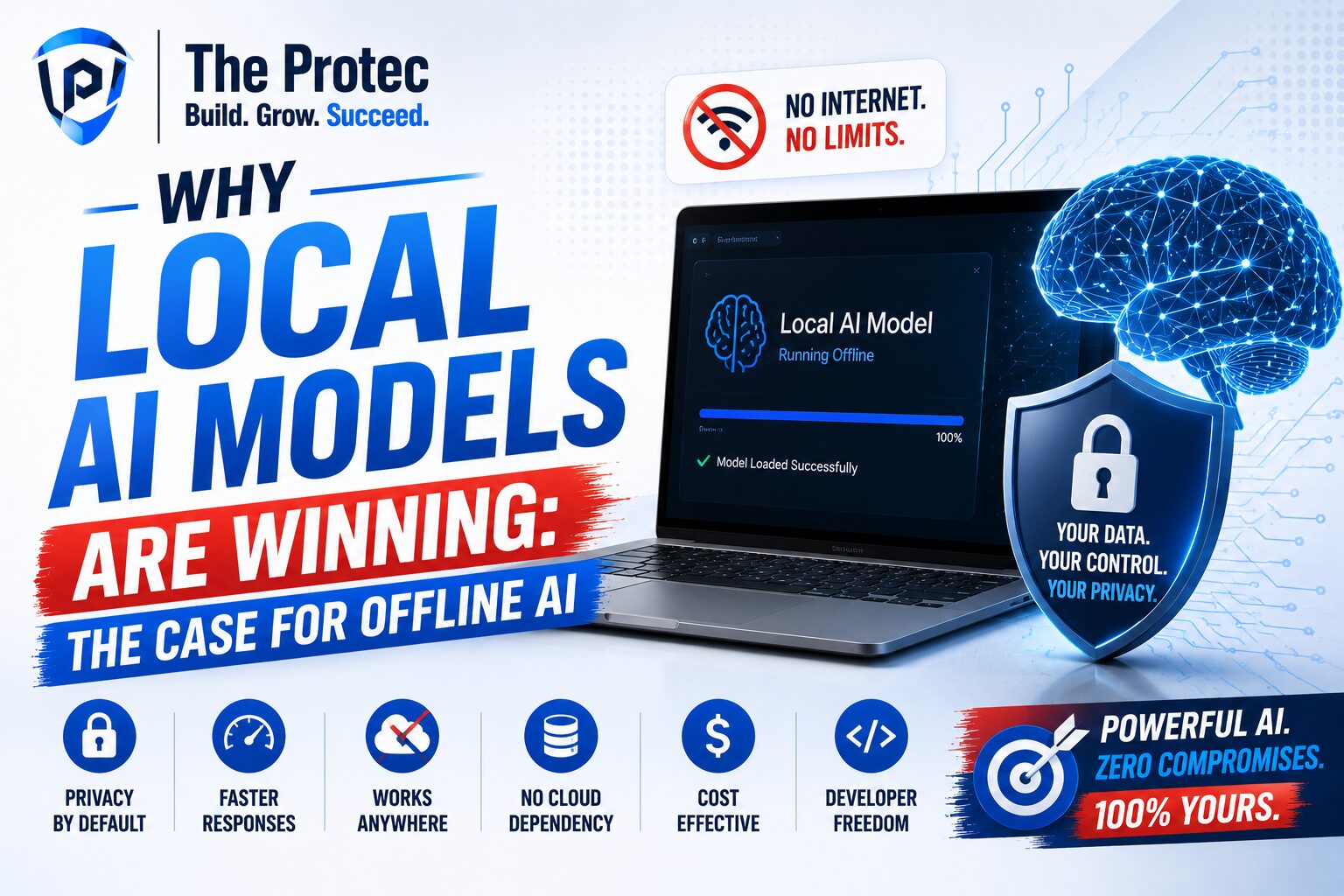
Privacy is the strongest argument for offline AI deployment. When a model runs locally, sensitive data can stay inside the organization’s environment instead of being transmitted to a third-party service. That reduces exposure and simplifies compliance for industries that handle regulated or confidential information.
For legal teams, this might mean keeping case files and contract language in-house. For healthcare providers, it may involve patient records and clinical notes. For manufacturers, it could mean product specifications, quality reports, or trade secrets. In each scenario, the core benefit is the same: fewer data handoffs and less dependence on external processing pipelines.
Private AI systems also help reduce the risk of accidental leakage through logs, telemetry, or prompt storage. Even when cloud vendors offer strong protections, many organizations still prefer to minimize the number of systems that ever see the raw data. Local deployment creates a cleaner security boundary.
There is also a governance benefit. Internal security and compliance teams can audit access more easily when the model, vector database, and application stack are all within the company’s own environment. This makes it easier to enforce policies such as data residency, role-based access, retention rules, and model usage approvals.
For a deeper look at why local inference matters for privacy-sensitive environments, see the NIST AI Risk Management Framework, which highlights governance, measurement, and trust considerations in AI deployment.
Speed and Latency: Why Local LLMs Feel Faster
One of the most immediate advantages of local LLMs is speed. When the model runs on-premises or on-device, every request avoids the round trip to a cloud provider. That can dramatically reduce latency, especially for interactive applications where users expect near-instant responses.
This matters in practical scenarios. Customer support tools need to draft replies quickly. Software teams want code suggestions without waiting on network calls. Analysts need instant document summaries while working through long workflows. In these settings, even a small delay can disrupt productivity.
Offline AI models also perform more consistently when internet connectivity is weak or variable. Remote facilities, secure air-gapped environments, field operations, and edge deployments all benefit from local inference. Instead of depending on network availability, the model remains accessible as long as the local system is running.
Speed is not only about raw inference time. It is also about workflow responsiveness. Local deployments can be integrated directly into internal tools, enabling faster retrieval, faster document processing, and faster decision support. When businesses eliminate external API bottlenecks, they often unlock use cases that would otherwise feel sluggish or unreliable.
There is a subtle but important advantage here: local systems can also reduce queueing delays during peak usage. With cloud APIs, traffic spikes can lead to throttling or longer response times. In a well-provisioned local environment, the organization has more control over capacity planning and performance tuning.
Cost Control Is Driving Adoption
Cost is another major reason companies are investing in offline AI models. Cloud AI pricing can look attractive at small scale, but expenses often rise quickly as usage grows. Token-based billing, premium model tiers, retrieval traffic, and enterprise add-ons can turn a seemingly simple AI feature into a significant recurring expense.
With local LLM deployment, organizations trade variable usage fees for infrastructure investment and operational control. That does not mean local AI is always cheaper in every situation. It means the economics become more predictable. For teams with heavy, repeated, or always-on workloads, that predictability can be a major advantage.
Consider a company that uses AI to summarize documents, classify tickets, generate internal search answers, or assist with code review. If these workloads run constantly, API costs can snowball. A local model on owned hardware may require upfront spending, but it can lower marginal cost per request and improve long-term budget stability.
There are also hidden costs in cloud-only workflows: network transfer, dependency management, vendor lock-in, compliance reviews, and risk mitigation. Private AI systems can reduce some of that complexity by consolidating the stack under one roof. For organizations that operate at scale, those savings can be meaningful.
As the open model ecosystem continues to improve, the cost-performance gap between cloud-only and local deployment keeps narrowing. Many companies now find that a carefully chosen offline AI model can deliver strong ROI without the ongoing pressure of per-call fees.
What Changed: Better Models, Better Hardware, Better Tooling
The current wave of local AI adoption is possible because several technology trends have converged. First, model efficiency has improved. Modern architectures are more capable at smaller sizes, and quantization techniques allow organizations to run high-quality models with less memory and compute.
Second, hardware has caught up. Enterprise GPUs, workstation cards, and edge accelerators are powerful enough to run local LLM workloads at useful speeds. Even CPU-based inference has improved for certain applications, especially when paired with optimized runtimes.
Third, the tooling ecosystem is much better. Model serving platforms, local inference engines, retrieval frameworks, and observability tools have made deployment less intimidating. Teams can now build private AI systems with better support for routing, caching, model switching, and secure access control.
Finally, businesses now have more practical options for hybrid AI. They can keep sensitive tasks local while sending low-risk workloads to the cloud, or they can run a primary model offline and use external APIs only when needed. This flexible approach is appealing because it lets organizations match deployment style to risk profile and cost requirements.
Where Offline AI Models Make the Most Sense
Not every use case needs a local deployment, but several categories clearly benefit from it.
- Confidential document processing: Contracts, financial statements, HR files, legal briefs, and internal reports often require strict data handling.
- Software development: Private codebases and proprietary systems are easier to keep internal when the model runs locally.
- Healthcare and life sciences: Patient data, research notes, and regulated workflows often demand stronger privacy boundaries.
- Manufacturing and industrial operations: Factory systems, maintenance logs, and product designs benefit from local control and resilience.
- Customer support: Private AI systems can draft responses, summarize cases, and assist agents without exposing sensitive ticket data externally.
- Field and edge environments: Remote sites with unreliable connectivity need AI that continues working offline.
In each of these cases, local deployment is not just about security. It is about operational fit. When AI becomes part of a daily workflow, companies want it to be fast, predictable, and easy to govern.
Challenges Companies Must Plan For
Offline AI models are powerful, but they are not a free pass. Running a local LLM introduces operational responsibilities that cloud providers normally handle. Companies need to think about infrastructure, model updates, capacity planning, monitoring, and support.
Hardware selection matters. Underpowered systems can create bottlenecks, while overprovisioned systems can waste budget. Model choice matters too. A model that is too large may deliver better quality but perform poorly in production. A smaller model may be faster and cheaper but require more prompt engineering or retrieval support to achieve the desired result.
Security also remains critical. Keeping the model local does not automatically make the application safe. Organizations still need access controls, encryption, logging policies, patching, and network segmentation. If the surrounding application stack is weak, a private AI system can still be exposed through other attack paths.
There is also a skills consideration. Teams may need expertise in inference optimization, MLOps, GPU scheduling, and knowledge retrieval. That is why many companies start with a focused pilot rather than a full-scale migration. They identify one or two high-value use cases, measure performance and cost, then expand from there.
The New Enterprise AI Strategy: Local First, Cloud When Needed
For many organizations, the future is not purely local or purely cloud. It is a layered strategy. High-risk, high-volume, or latency-sensitive tasks move to offline AI models. Less sensitive or bursty workloads may remain in the cloud. This hybrid approach gives companies the best of both worlds: privacy and speed where they matter most, flexibility where it is useful.
This is also where local AI becomes a strategic differentiator. Companies that can deploy private AI systems efficiently gain more control over product design, compliance posture, and unit economics. They are less exposed to vendor changes and better positioned to tailor AI to their own workflows.
In practice, that can mean internal copilots, document assistants, search tools, automated classification systems, and decision support platforms running on company-owned infrastructure. The model becomes part of the business, not just a rented external service.
For many leaders, that shift is the real story. Offline AI is not simply about avoiding the cloud. It is about owning a key layer of the intelligence stack.
How to Evaluate Whether Local LLM Deployment Is Right for You
If your organization is considering local AI, start by asking a few practical questions:
- Does the use case involve sensitive, regulated, or proprietary data?
- Is low latency important to the user experience?
- Are API and usage costs becoming difficult to predict?
- Do you need the system to work in disconnected or restricted environments?
- Can your team support the infrastructure and model lifecycle?
If the answer is yes to several of these, a local deployment may be worth serious consideration. The best candidates are usually repetitive, high-volume workflows where data privacy and responsiveness matter more than access to the largest possible model.
A good pilot should measure accuracy, latency, throughput, operational effort, and total cost of ownership. That gives decision-makers a realistic view of whether offline AI models will deliver genuine value.
Conclusion: Why the Shift to Offline AI Is Accelerating
The rise of local AI models reflects a broader maturity in the AI market. Businesses are no longer impressed only by raw capability. They want systems that are secure, fast, affordable, and under their control. Offline AI models and local LLM deployments meet that need in a way cloud-only approaches often cannot.
Private AI systems are gaining momentum because they solve practical problems: they keep sensitive data closer to home, reduce latency for users, and make costs easier to manage. As hardware improves and model efficiency keeps advancing, the case for running AI locally will only get stronger.
For companies that treat AI as infrastructure rather than a novelty, local deployment is becoming a serious competitive option. The question is no longer whether offline AI is possible. It is whether your organization can afford to ignore it.
FAQ
What is an offline AI model?
An offline AI model is an AI system that runs locally on a company’s own hardware or private infrastructure rather than sending requests to an external cloud service.
Why do companies prefer local LLMs?
Companies prefer local LLMs because they offer better privacy, lower latency, more control over deployment, and more predictable costs for frequent AI workloads.
Are private AI systems more secure than cloud AI?
They can be, especially when sensitive data stays inside the organization. However, security still depends on proper access controls, encryption, patching, and infrastructure management.
Is running AI locally cheaper than using cloud APIs?
It can be cheaper for high-volume or always-on use cases, but the economics depend on hardware costs, usage patterns, and the level of operational support required.
What kinds of businesses benefit most from offline AI models?
Businesses in healthcare, legal services, finance, software development, manufacturing, and field operations often benefit most because they handle sensitive data or need low-latency, reliable access.