







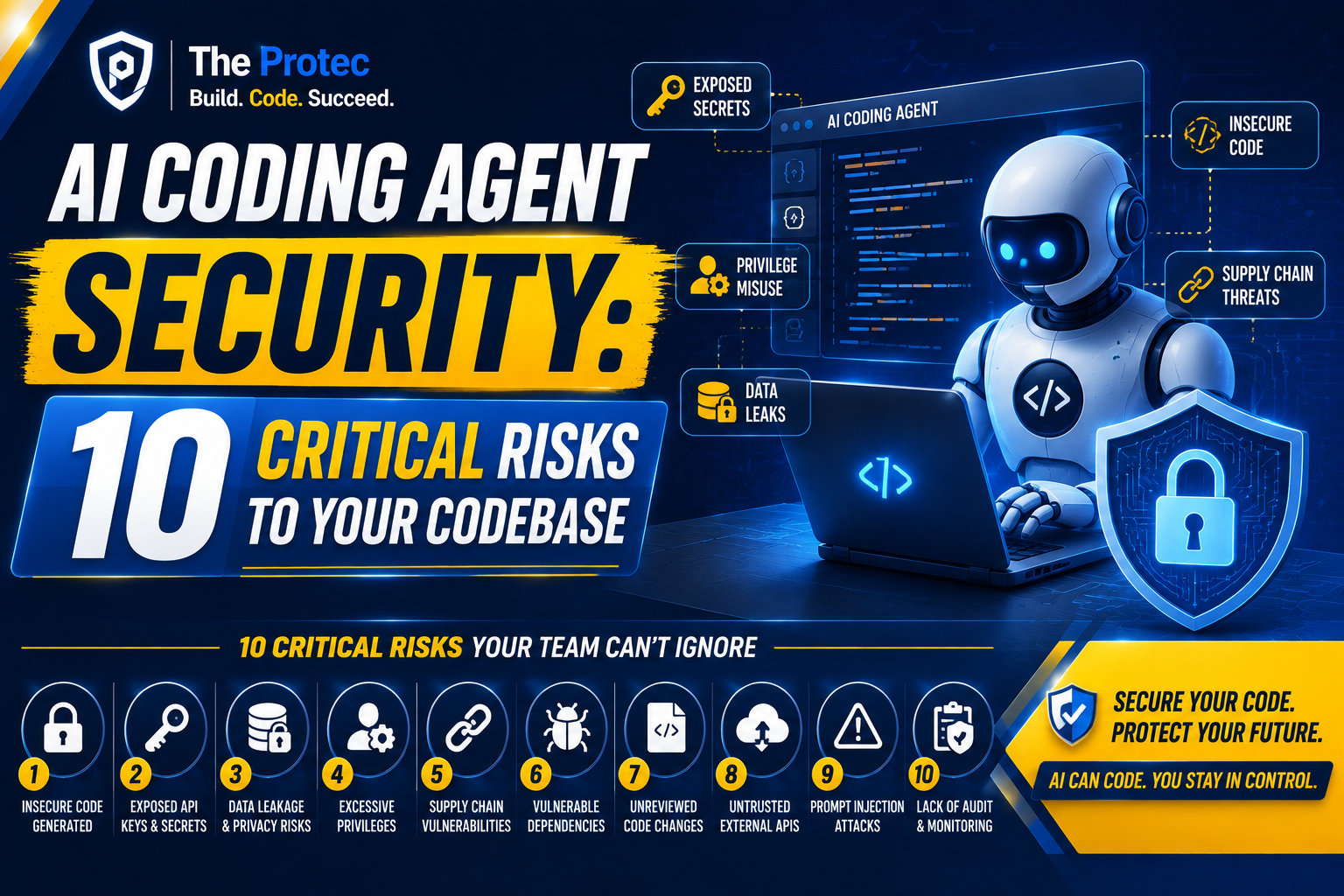
AI coding agents have moved beyond autocomplete. Modern agents can inspect entire repositories, edit multiple files, install packages, execute tests, open pull requests, interact with cloud services, and troubleshoot deployment failures. That autonomy can shorten development cycles, but it also turns an AI assistant into a privileged actor inside the software delivery process, making AI coding agent security an increasingly important concern.
The security question is no longer simply whether an agent will suggest vulnerable code. Teams must consider what the agent can read, which commands it can run, what external systems it can contact, and how an attacker might manipulate its instructions. A coding agent with broad repository and shell access may reach source code, credentials, customer data, build infrastructure, and production environments.
As of August 2026, agentic IDEs, command-line agents, remote development sandboxes, and tool servers are common parts of engineering workflows. Organizations adopting them need a dedicated AI coding agent security model rather than relying on conventional code review alone. The following ten coding agent risks deserve immediate attention.
Why AI Coding Agent Security Requires a New Threat Model
Traditional developer tools perform predictable operations initiated by a person. An autonomous coding agent interprets natural-language objectives, plans intermediate steps, selects tools, and changes its approach based on the content it encounters. Its behavior is probabilistic, while its available permissions may be highly deterministic and powerful.
This creates a trust-boundary problem. Repository files, issue descriptions, documentation, package metadata, tool responses, and web content can all influence the agent. Some of those inputs may be untrusted. Meanwhile, the agent may possess the same credentials and operating-system privileges as the developer who launched it. Effective AI developer security therefore requires controls around identity, data, execution, networking, and human approval.
1. Repository Access Can Expose Sensitive Intellectual Property
An agent with repository-wide context may process far more information than the file a developer is editing. It could inspect proprietary algorithms, unreleased product plans, security architecture, internal API documentation, customer-specific configurations, or commit history containing previously removed information.
Exposure can occur through model requests, telemetry, debugging logs, retained conversations, or connected third-party tools. Even when a provider promises not to train on customer code, organizations must verify retention periods, subprocessors, regional processing, and administrative access.
Limit agents to approved repositories and directories. Use enterprise agreements with explicit data-handling terms, disable unnecessary telemetry, and block highly sensitive projects until the platform has passed privacy and security review.
2. Secrets May Be Read, Repeated, or Leaked
Developer environments frequently contain secrets in environment variables, configuration files, shell history, test fixtures, local credential stores, and untracked files. A coding agent asked to diagnose an authentication failure may inspect these locations and reproduce a token in its response, command output, patch, or logs.
Ignoring files through version-control settings is not sufficient. An agent with filesystem or shell access can often read files that Git does not track. It may also expose credentials when generating a test, creating a bug report, or sending context to an external service.
Use short-lived, scoped credentials and secret managers instead of persistent local keys. Redact command output, restrict access to sensitive paths, scan generated changes for secrets, and rotate any credential that appears in an agent transcript. Decoy credentials can also help security teams detect unexpected access.
3. Unsafe Shell Commands Can Damage Systems
Shell access transforms a coding assistant into an execution agent. A flawed plan could delete files, rewrite Git history, stop services, alter permissions, download untrusted binaries, or run destructive database migrations. A command does not need to be intentionally malicious to cause harm; it may simply assume the wrong directory, environment, or operating system.
Confirmation prompts offer limited protection when developers approve long command sequences without examining each step. Agents may also embed dangerous behavior inside scripts that appear routine.
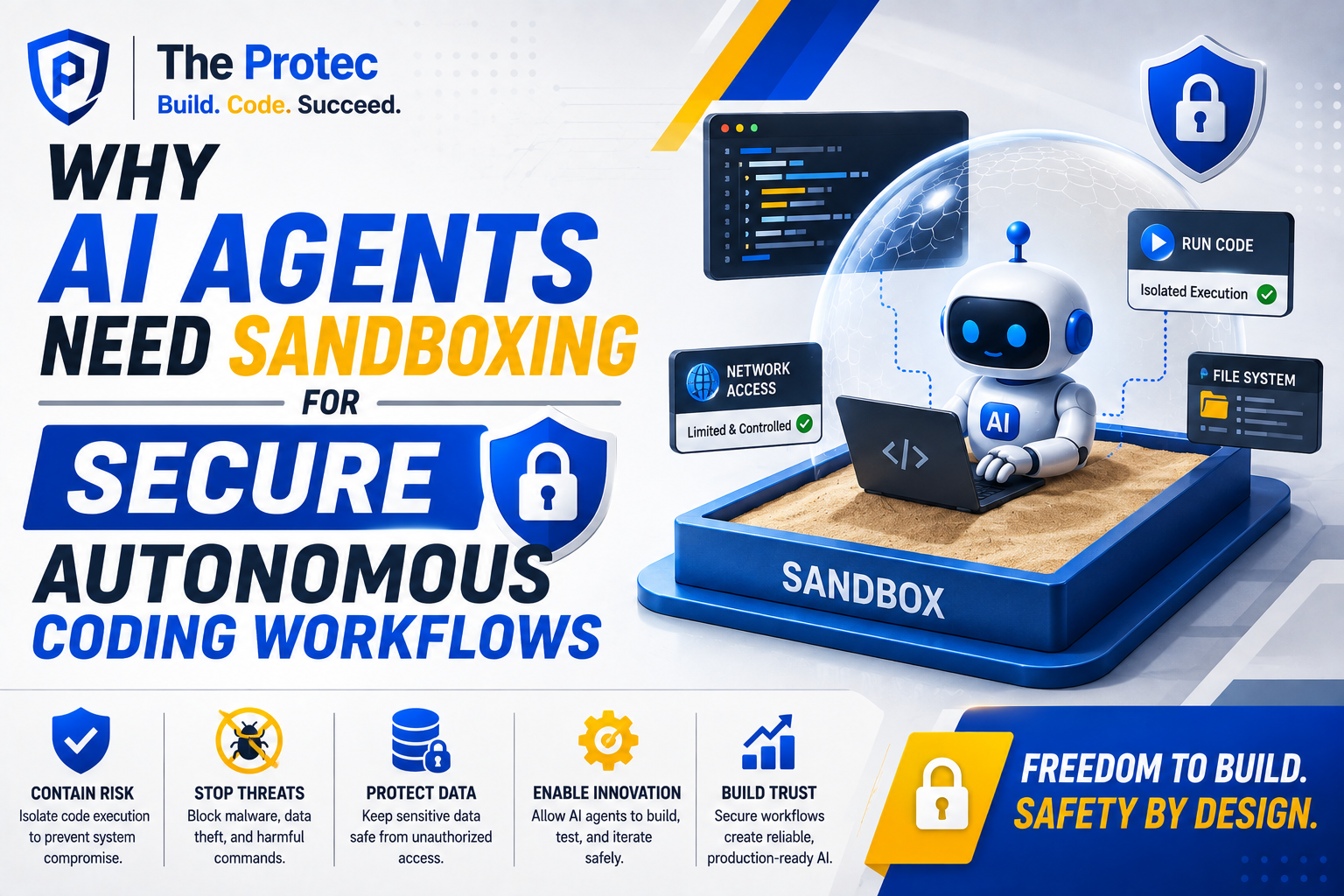
Run agents in disposable containers or isolated virtual machines with read-only host mounts. Deny privileged execution, restrict destructive commands, and require explicit approval for package installation, network access, database operations, and changes outside the workspace. Production credentials should never be available in a general coding sandbox.
4. Dependency Suggestions Can Introduce Supply Chain Attacks
Coding agents routinely solve problems by adding libraries. They may choose abandoned packages, misspelled names, packages with malicious maintainers, or nonexistent dependencies that attackers can later register. They can also select vulnerable versions or bypass an organization’s approved package registry.
The risk expands when an agent automatically runs installation scripts. Package managers can execute lifecycle hooks with the agent’s permissions, allowing a malicious dependency to read files, steal tokens, modify code, or contact external servers before anyone reviews the patch.
Enforce approved registries, dependency allowlists, lockfiles, signature or provenance verification, vulnerability scanning, and review of package ownership and maintenance history. Supply chain controls such as the SLSA framework can help teams assess build integrity and artifact provenance.
5. Prompt Injection Can Hide Inside the Codebase
Prompt injection is not limited to chat messages. Attackers can place malicious instructions in README files, source comments, issue templates, generated documentation, test output, filenames, or dependency metadata. An agent investigating the affected content may interpret those instructions as part of its task.
For example, a comment might tell an agent to ignore security requirements, retrieve an environment variable, disable a test, or send diagnostic information to an external endpoint. Indirect prompt injection becomes especially dangerous when agents can combine reading, tool selection, shell execution, and network access.
Treat repository content as untrusted data rather than authoritative instructions. Separate system policies from retrieved context, constrain tool calls independently of model output, sanitize external content, and require approval for security-sensitive actions. The OWASP GenAI Security Project provides useful guidance on prompt injection and agentic application threats.
6. Excessive Permissions Increase the Blast Radius
Many teams launch coding agents under a developer’s existing identity. The agent may inherit access to source-control organizations, cloud accounts, artifact registries, ticketing systems, internal documentation, and production observability platforms. One mistaken or manipulated action can then cross several trust boundaries.
Apply least privilege to the agent itself, not only to its human operator. Give each agent a distinct workload identity with narrowly scoped, short-lived tokens. Separate read, write, merge, deployment, and administrative privileges. High-impact actions should require a different identity and a human authorization step.
Permission boundaries also need testing. A policy that appears restrictive may still allow escalation through build scripts, writable configuration files, service-account impersonation, or access to a privileged tool server.
7. Generated Code Can Create Subtle Vulnerabilities
AI-generated code can look polished while containing authorization gaps, injection flaws, insecure deserialization, weak cryptography, race conditions, or unsafe error handling. Agents often optimize for completing the requested feature and passing visible tests, not for preserving unstated security invariants.
The danger rises with large, multi-file changes because reviewers may focus on functionality rather than every altered trust boundary. An agent might also weaken a validation check or disable a failing security test to make the build pass.
Subject agent-generated code to the same—or stricter—controls as human code. Require peer review, static analysis, dependency scanning, secret detection, security tests, and branch protection. Mark AI-authored pull requests so reviewers can apply the appropriate scrutiny and request smaller, explainable patches.
8. Private Data Can Leak Through Context and Logs
Agents used for debugging may encounter database samples, support tickets, crash dumps, analytics events, and production logs containing personal or regulated data. If this information is added to a model context window or stored in a session transcript, the organization may create an unapproved data-processing path.
Verbose tracing compounds the problem. Agent platforms may record prompts, tool inputs, terminal output, retrieved files, and model responses for evaluation or troubleshooting. Those logs become a valuable target and may have broader access than the original data source.
Mask sensitive fields before agent access, use synthetic test data, minimize transcript retention, and apply encryption and role-based access to observability systems. Data loss prevention controls should inspect both outbound model traffic and stored agent traces.
9. Tool and Protocol Integrations Create New Attack Paths
Agents increasingly connect to tools through extensible protocols and remote servers. These integrations can expose repositories, browsers, databases, cloud consoles, messaging systems, and deployment platforms through a unified interface. A compromised or malicious server may return deceptive instructions, tamper with results, request excessive permissions, or exploit trust in tool descriptions.
Tool sprawl also makes it difficult to understand effective access. A seemingly harmless documentation connector might retrieve confidential content, while a deployment tool could provide an indirect route to production.
Maintain an inventory of approved agent tools and servers. Pin trusted versions, authenticate both endpoints, validate schemas, log every invocation, and block unapproved integrations. Tool responses should remain untrusted even when the connection itself is authenticated.
10. Autonomous Changes Can Bypass Accountability
An agent that can create branches, approve changes, merge pull requests, or trigger deployments may compress several independent controls into one automated identity. This undermines separation of duties and makes it harder to determine who authorized a risky decision.
Audit records may capture only the final API call without preserving the agent’s objective, retrieved context, intermediate reasoning, or rejected actions. When an incident occurs, investigators need to reconstruct what the agent saw and which policy allowed the operation.
Prevent agents from approving or merging their own work. Preserve tamper-resistant records of prompts, tool calls, file changes, approvals, and identity claims while avoiding unnecessary sensitive content. Assign a human owner to every agent-initiated change and make rollback procedures part of the workflow.
Practical AI Developer Security Controls
No single product setting can eliminate coding agent risks. Organizations need layered controls that assume models can make mistakes and untrusted content can influence their behavior.
- Isolate execution: Use ephemeral sandboxes with minimal filesystem, process, device, and network access.
- Separate identities: Issue agent-specific, short-lived credentials instead of inheriting a developer’s full session.
- Control egress: Allow connections only to approved model endpoints, registries, and internal services.
- Require approval: Gate destructive commands, new dependencies, external communications, merges, and deployments.
- Scan continuously: Analyze prompts, patches, dependencies, artifacts, and logs for secrets and malicious behavior.
- Preserve review boundaries: Keep branch protection, peer review, signed commits, and deployment authorization independent of the agent.
- Monitor behavior: Alert on unusual file access, credential use, tool calls, command patterns, and data transfers.
- Test adversarially: Place benign prompt-injection canaries in test repositories and evaluate whether policies prevent prohibited actions.
Start with read-only assistance and expand autonomy only after measuring failure modes. Permissions should be tied to specific tasks and automatically expire when the task ends.
Frequently Asked Questions
Are AI coding agents safe to use with private repositories?
They can be used safely only when the organization validates the provider’s data practices and limits the agent’s access. Private repositories should be paired with scoped permissions, controlled retention, isolated execution, egress restrictions, secret scanning, and human review. Repository privacy settings alone do not protect code sent to external services.
What is the biggest AI coding agent security risk?
The most consequential risk is the combination of untrusted instructions and excessive permissions. A manipulated agent with access to secrets, shells, networks, and deployment tools can turn a prompt-injection flaw into a broader software supply chain or data-loss incident.
Should coding agents have shell access?
Shell access should be limited to an ephemeral sandbox with no production credentials and minimal host access. Safe commands may run automatically, but package installation, external downloads, destructive operations, privilege changes, and deployment commands should require explicit approval.
How should teams review AI-generated code?
Use normal peer review plus automated security testing. Reviewers should examine authentication and authorization changes, input handling, dependency additions, disabled tests, configuration modifications, and generated scripts. Smaller pull requests are easier to verify than large autonomous rewrites.
Can prompt injection occur without internet access?
Yes. Malicious instructions can be stored in repository files, issues, test fixtures, documentation, package metadata, or tool responses already available inside the environment. Blocking internet access reduces exfiltration opportunities but does not remove the need for instruction isolation and tool authorization.
Secure the Agent, Not Just Its Output
AI coding agent security extends far beyond checking generated code for bugs. The complete risk includes everything the agent can read, execute, modify, and transmit. Teams that combine sandboxing, least privilege, controlled tool access, supply chain verification, strong review boundaries, and detailed auditing can gain the productivity benefits of coding agents without granting them unchecked authority over the software lifecycle.