






Building an AI feature with one model and a few test users is straightforward. Operating that feature across multiple model providers, regions, teams, and thousands of daily requests is not. Each provider has its own API format, authentication method, rate limits, pricing structure, model lifecycle, and failure behavior. Without a shared control layer, application code quickly fills with routing rules, retry logic, usage tracking, and provider-specific exceptions.
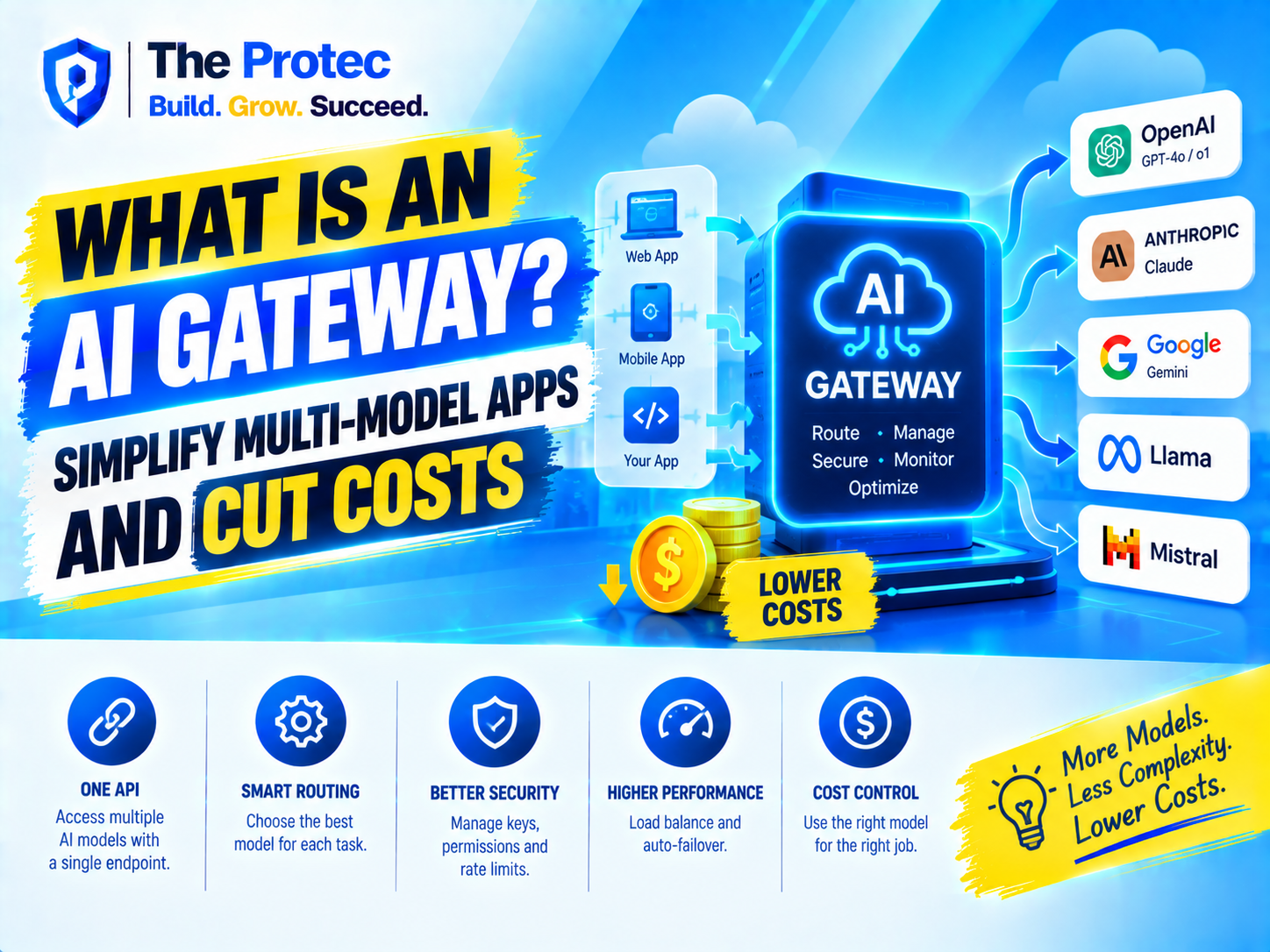
An AI gateway solves this problem by sitting between an application and the models it uses. Instead of integrating separately with every large language model, embedding service, reranker, image model, or speech API, the application sends requests through one managed endpoint. The gateway then applies policies for model routing, API management, security, caching, reliability, and cost control.
As AI applications evolve toward multimodal workflows, reasoning models, autonomous agents, and specialized small models, this architecture is becoming increasingly useful. The gateway is no longer just a proxy. It is an operational control plane for production AI.
What Is an AI Gateway?
An AI gateway is an infrastructure layer that standardizes and governs communication between applications and AI model services. It receives a request, authenticates it, evaluates relevant policies, selects a model or provider, transforms the payload when necessary, and returns a normalized response.
The concept resembles a traditional API gateway, but an AI gateway understands model-specific requirements. It can account for tokens, prompts, context windows, streaming responses, tool calls, reasoning effort, multimodal inputs, semantic similarity, and model-specific pricing. It can also redact sensitive prompt data, cache suitable responses, enforce model budgets, and fall back to another provider when the preferred model is unavailable.
A typical LLM gateway supports capabilities such as:
- One API interface for multiple model providers and self-hosted models
- Policy-based routing by task, cost, latency, region, or quality
- Centralized credentials, quotas, rate limits, and access controls
- Retries, timeouts, circuit breakers, and provider failover
- Prompt, response, token, latency, and cost observability
- Exact-match, prompt-prefix, and semantic caching
- Content filtering, data redaction, and audit logging
The result is a stable application interface even when the underlying model portfolio changes.
Why Multi-Model Apps Need an LLM Gateway
No single model is ideal for every request. A premium reasoning model may perform well on complex analysis but be unnecessarily expensive for classification. A small model may summarize short support tickets quickly, while a model with a larger context window may be required for long legal documents. Image, audio, embedding, and reranking tasks introduce additional endpoints.
Connecting each workflow directly to a provider creates tight coupling. Changing a model can require code changes, testing, credential updates, and a new deployment. An LLM gateway moves these decisions into centrally managed policies. Development teams can call a stable endpoint such as a logical summarization or reasoning route while platform teams change the models behind it.
Model Routing: Sending Each Request to the Right Model
Model routing is one of the most valuable AI gateway functions. The simplest approach uses fixed rules. For example, translation requests go to a multilingual model, embeddings go to a dedicated embedding model, and code reviews go to a model selected for programming performance.
More advanced gateways make decisions from request characteristics. A short, low-risk classification can be sent to an inexpensive model. Requests containing images can be routed only to models that accept visual input. Long prompts can be directed to a model with an adequate context window. Workloads subject to data-residency requirements can remain within an approved region or self-hosted environment.
A practical customer service route might work like this:
- Use a small model to detect intent and urgency.
- Send routine questions to a low-cost response model.
- Route complex billing disputes to a stronger reasoning model.
- Escalate low-confidence outputs to a human review queue.
- Fail over to an approved secondary provider during an outage.
Current routing systems can also use historical quality, time-to-first-token, total latency, error rate, and live provider health. The important principle is to define acceptable quality and reliability first, then select the lowest-cost route that meets those requirements. Routing solely by price often produces poor outputs that must be regenerated, eliminating the expected savings.
Centralized API Management and Rate Limiting
Direct integrations spread API keys and operational logic across services. An AI gateway centralizes provider credentials so applications authenticate to the gateway rather than storing every upstream secret. Keys can be rotated in one place, and access can be limited by team, application, environment, tenant, or model.
The same control point simplifies quota and rate-limit management. Unlike conventional APIs, AI usage should not always be limited by request count alone. One request may consume a few hundred tokens while another uses an extensive context and generates a long response. Effective policies can therefore enforce requests per minute, input tokens, output tokens, concurrent streams, daily spend, or maximum context size.
For a software platform with many customers, the gateway might assign each tenant a monthly AI allowance and reserve additional capacity for premium accounts. When a tenant approaches its limit, the gateway could reject requests, queue non-urgent jobs, shorten output limits, or route traffic to an economical model. This prevents one customer or malfunctioning agent loop from exhausting a shared provider quota.
Security and Governance at the Gateway Layer
Prompts can contain personal information, source code, customer records, or internal documents. Centralized inspection makes it easier to enforce consistent security controls before that data reaches an external model.
An AI gateway can detect and redact sensitive fields, block unapproved models, restrict destinations by data classification, and record which application accessed which model. It can also validate tool-call arguments, limit allowed tools, filter unsafe output, and reject oversized or suspicious payloads. These measures are particularly important for agents because one request may trigger database searches, browser actions, or business transactions.
Gateway controls are only one part of AI security. They should be combined with least-privilege tool permissions, retrieval authorization, application-level validation, and testing against risks documented by resources such as the OWASP Generative AI Security Project. A gateway can enforce policies and provide evidence, but it cannot determine whether every generated answer is factually correct or appropriate for a business decision.
Logging also requires care. Capturing complete prompts may improve debugging while creating a new repository of sensitive information. Mature deployments support configurable redaction, encrypted storage, short retention periods, regional log storage, and metadata-only logging for protected workloads.
How Caching Reduces Latency and API Costs
Caching prevents an application from paying repeatedly for equivalent work. Exact-match caching returns a stored response when the same normalized request appears again. This works well for deterministic transformations, standardized product questions, and repeated document summaries.
Prompt-prefix caching reuses a stable block of context, such as system instructions, schemas, or a large reference document. Provider-native prompt caching can reduce billed input processing when supported. Semantic caching goes further by comparing the meaning of a new request with previous requests. For example, “How do I reset my password?” and “I forgot my password” may safely share an approved response.
Semantic caching needs stricter controls than exact matching. Cache keys should account for the tenant, permissions, model, prompt version, retrieval sources, locale, and tool configuration. Time-sensitive answers need short expiration periods, while personalized or regulated responses may not be cacheable at all. Used selectively, caching improves response time and provides immediate AI API cost optimization without lowering model quality.
AI API Cost Optimization Beyond Choosing a Cheaper Model
Model prices are visible, but inefficient architecture often creates the larger bill. Repeated context, excessive output limits, uncontrolled retries, abandoned streaming requests, duplicate embeddings, and agent loops can all inflate usage.
An AI gateway provides a consolidated cost ledger across providers. Usage can be attributed to a feature, team, tenant, route, prompt version, or model. This makes it possible to measure cost per resolved support case, completed document, active user, or successful workflow instead of tracking tokens without business context.
Useful cost controls include:
- Set input, output, and reasoning limits for each route.
- Use smaller models for classification, extraction, and validation.
- Compress retrieved context and remove duplicate passages.
- Batch suitable offline jobs and embedding requests.
- Cache stable prompts, prefixes, and reusable responses.
- Cap retries and stop recursive agent workflows.
- Apply budget alerts and hard spending limits by tenant or project.
Teams should compare cost with output quality, latency, and task completion. A model that costs less per token can be more expensive per successful result if it needs multiple retries or produces frequent errors. Gateway analytics make that tradeoff visible.
A Practical Multi-Model Gateway Example
Consider a document intelligence application that accepts contracts and answers questions about them. The gateway first checks the file type, tenant policy, and region. It routes scanned pages to an approved vision service and sends extracted text to a lower-cost model for classification. Embeddings are created once and cached, while a reranker identifies the passages most relevant to each question.
Routine extraction requests use a fast model with structured output validation. Complex risk questions go to a stronger reasoning model, but only after the gateway trims irrelevant context and confirms that the user can access the cited sections. If the preferred provider times out, a circuit breaker redirects the request to a tested fallback. Every stage records latency, token use, cache status, and estimated cost through a common telemetry schema.
This design avoids using the most expensive model for every step. It also prevents provider-specific logic from spreading through the document application. Distributed traces can be exported using standards such as OpenTelemetry, allowing AI calls to be examined alongside databases, queues, and other services.
How to Evaluate an AI Gateway
Start with operational requirements rather than a long feature checklist. Confirm which providers, self-hosted endpoints, streaming formats, tool calls, structured outputs, and multimodal payloads the gateway supports. Test whether failover preserves application behavior and whether usage calculations match provider invoices.
Review routing flexibility, credential isolation, data retention, regional deployment, log redaction, auditability, and access controls. Measure the gateway’s own latency under streaming and high-concurrency workloads. Finally, check portability: applications should be able to use normalized interfaces without losing access to important provider-specific features.
A sensible rollout begins with observability and centralized credentials. Teams can then add rate limits, budgets, caching, and dynamic routing after establishing performance and quality baselines. This reduces risk and makes savings easier to verify.
Frequently Asked Questions
Is an AI gateway the same as an API gateway?
No. Both manage traffic, authentication, and policies, but an AI gateway understands AI-specific concepts such as tokens, model selection, prompts, context windows, streaming generation, semantic caching, tool calls, and per-model costs. Some organizations add AI capabilities to an existing API gateway, while others deploy a specialized LLM gateway behind it.
Does an AI gateway improve model accuracy?
It does not make a model inherently more accurate. It can improve overall application quality by routing tasks to suitable models, applying validated prompt templates, enforcing structured outputs, retrying specific failures, and escalating low-confidence cases. Accuracy still depends on model capability, context quality, retrieval, and application design.
How does an AI gateway reduce API costs?
It routes simple work to economical models, caches reusable results, limits token consumption, prevents uncontrolled retries, batches eligible jobs, and reveals spending by application or tenant. These controls reduce waste while preserving premium models for tasks that genuinely require them.
Can an AI gateway prevent provider lock-in?
It can reduce lock-in by giving applications a stable interface and keeping provider selection outside business logic. Complete portability is not automatic, however. Models differ in tool use, output formats, safety behavior, context limits, and multimodal support. Fallback routes must be tested rather than assumed to be interchangeable.
Should every AI application use a gateway?
A small prototype using one model may not need one immediately. A gateway becomes valuable when an application uses several models, serves multiple tenants, handles sensitive data, requires failover, or needs detailed cost and usage controls. Introducing it before provider-specific logic spreads can make production growth easier.
The Bottom Line
An AI gateway turns a collection of model APIs into a governed, observable, and cost-aware platform. By centralizing model routing, API management, rate limiting, security, caching, and spending policies, it lets product teams build multi-model applications without embedding infrastructure decisions throughout their code. The strongest implementations do more than reduce token costs: they improve resilience, simplify governance, and preserve the flexibility to adopt better models as the market changes.