




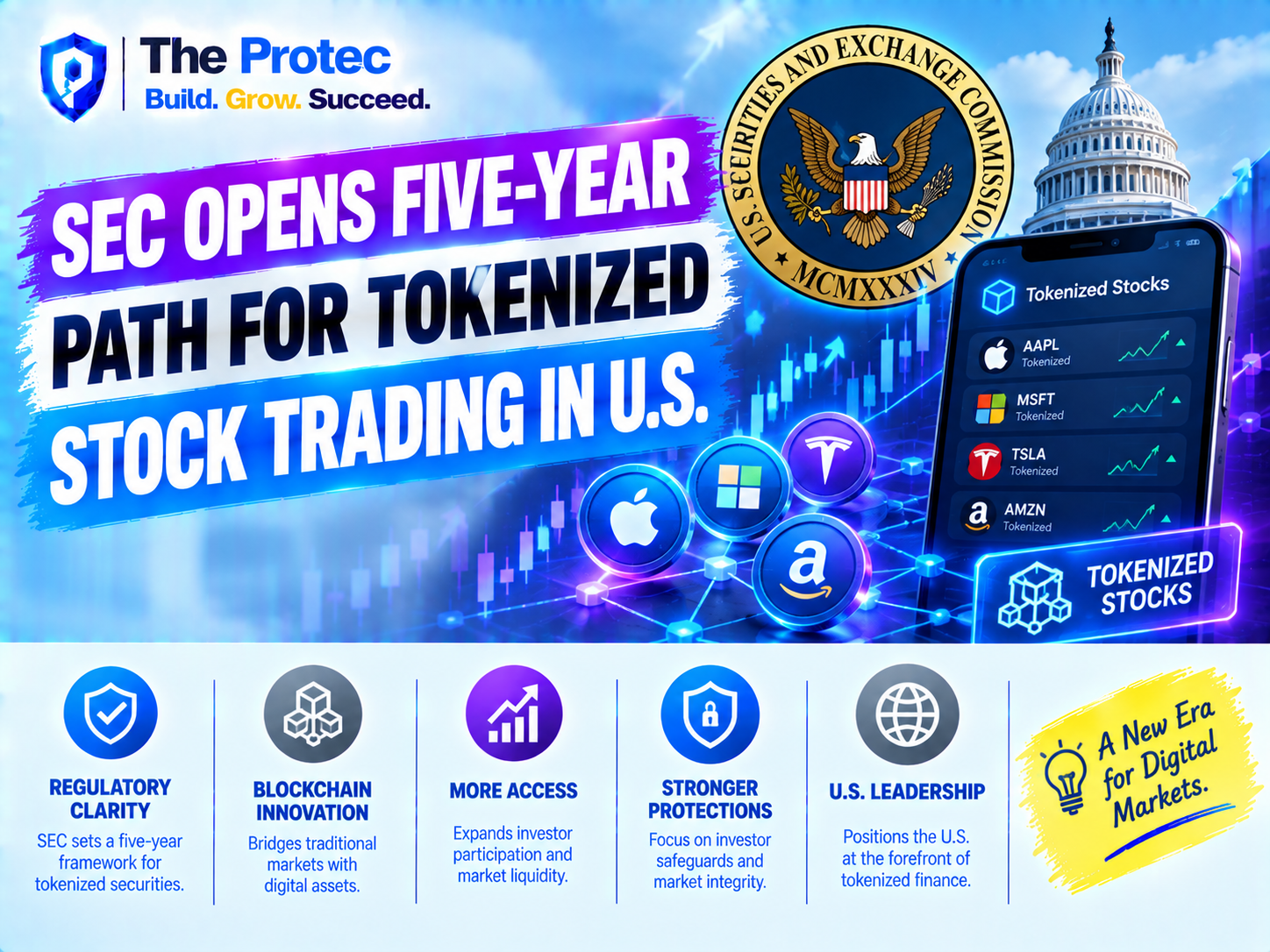
Wall Street’s long-discussed move onto blockchain infrastructure has gained a clearer regulatory path. The Securities and Exchange Commission has unveiled an immediately effective, five-year conditional Innovation Exemption for platforms seeking to facilitate trading in tokenized U.S. stock.
The temporary framework allows qualifying Tokenized Securities Venues, or TSVs, to test models that combine regulated securities trading with blockchain-based ownership records, smart contracts and automated market makers. The SEC 5-year exemption does not remove tokenized stocks from securities law. Instead, it offers conditional relief from specific regulatory barriers while preserving disclosure, recordkeeping, market-integrity and investor-protection obligations.
That distinction matters. The SEC innovation exemption could help move tokenized equities beyond limited pilots, but it is not a blanket authorization for crypto exchanges to list stock-like tokens. Platforms must meet the exemption’s conditions, accurately describe what investors own and respect an issuer’s right to object to tokenization or trading.
What the SEC Tokenized Stock Trading Exemption Changes
Traditional U.S. equity markets divide trading, brokerage, custody, clearing and settlement among specialized entities. Those divisions support oversight and risk management, but they can be difficult to reconcile with blockchain systems designed to perform several functions through a shared ledger.
The Innovation Exemption gives eligible TSVs room to operate a more integrated model for five years. A qualifying venue may use blockchain infrastructure to record transactions and manage tokenized securities while experimenting with trading mechanisms that do not fit neatly within conventional exchange architecture. Depending on its model and the exemption’s conditions, a venue could support order-book trading, peer-to-peer transactions or liquidity pools governed by smart contracts.
The relief is temporary and conditional. Its immediate effectiveness means the regulatory framework is available now, not that every applicant can begin trading without preparation. A platform must establish that it qualifies, submit required information and maintain the operational controls specified by the SEC. The five-year window also gives regulators time to study market data before deciding whether permanent SEC tokenization rules are appropriate.
How Tokenized Securities Venues Can Operate
Tokenized Securities Venues are intended to bridge regulated equity markets and onchain stock trading. Rather than treating a blockchain token as an unregulated substitute for a share, a TSV must account for the legal security represented by that token and the rights attached to it.
A venue’s structure may include several interconnected components:
- A regulated participant or eligible operator responsible for securities-law compliance.
- A blockchain ledger recording issuance, transfers or beneficial ownership interests.
- Smart contracts controlling transactions, settlement and approved wallet access.
- Custody or transfer arrangements linking each token to the underlying security.
- Market surveillance, books, records and reporting systems accessible to regulators.
- Procedures for dividends, voting, splits, mergers and other corporate actions.
The exemption may allow these functions to work together more closely than they do in the existing market. It does not eliminate the need to identify who is accountable when code fails, assets go missing or trading becomes disorderly. TSV tokenized stocks remain securities, and applicable anti-fraud rules continue to follow them.
The Role of Blockchain and Automated Market Makers
Blockchain securities can move through a shared system in which authorized participants see a consistent transaction record. That can reduce reconciliation work between brokers, custodians, exchanges and settlement providers. Smart contracts can also automate transfer restrictions, investor eligibility checks and certain corporate-action payments.
The exemption is especially significant for automated market makers, or AMMs. Instead of matching a buyer’s order with a seller’s order, an AMM uses a smart contract and a pool of assets to quote prices according to predetermined logic. This model is common in decentralized finance but largely untested for public U.S. equities under federal securities regulation.
Applying AMMs to tokenized stock trading introduces difficult questions. A venue must address thin liquidity, stale reference prices, manipulation, smart-contract exploits and sudden differences between an onchain quote and the price on a national securities exchange. Controls such as trading pauses, price bands, independent audits and real-time surveillance will therefore be central to credible SEC blockchain trading.
Not every digital asset displaying a public company’s ticker represents ownership of that company’s stock. Investors must distinguish tokenized securities backed by actual shares from synthetic products that merely track a stock’s price.
An actual tokenized share or beneficial interest is connected to a real security. The issuing company, transfer agent, custodian or another disclosed intermediary maintains the legal link between the blockchain token and the underlying equity. Depending on the structure, the holder may receive dividends, voting rights, redemption rights or an enforceable beneficial interest. Investors still need to determine whether they are recorded shareholders or hold a contractual claim through an intermediary.
A synthetic token, by contrast, may use derivatives, collateral or an oracle to reproduce the price movement of a stock. It does not necessarily grant ownership, voting rights or a claim on underlying shares. Such a product can still fall under securities or derivatives rules, but it should not be marketed as equivalent to owning the referenced equity.
The SEC tokenized stock trading framework emphasizes substance over labels. Calling an asset a digital stock does not establish shareholder rights. TSVs must clearly explain the token’s issuer, backing, custody arrangement, redemption process and treatment during corporate events.
Conditions and Investor Protections Remain Essential
The SEC crypto regulation debate often frames innovation and investor protection as competing goals. The conditional exemption attempts to make them part of the same experiment. Relief is available only while a venue satisfies the framework’s requirements.
Key protections are expected to center on:
- Accurate disclosures: Investors need plain-language information about ownership rights, fees, smart-contract risks, custody, settlement and redemption.
- Asset safeguards: Operators must maintain controls designed to prevent the loss, unauthorized transfer or improper commingling of securities and customer assets.
- Market surveillance: TSVs need systems capable of detecting manipulation, wash trading, abusive activity and conflicts involving liquidity providers.
- Operational resilience: Cybersecurity, wallet security, tested smart contracts, backup systems and incident-response procedures are fundamental.
- Records and regulatory access: Blockchain transparency does not replace compliant books, records, customer information and reporting.
- Clear accountability: A venue cannot rely on decentralized software to avoid responsibility for operating a securities market.
Investors should review the final terms of any platform and product rather than assuming the five-year label creates an SEC guarantee. The agency explains its broader market actions through the official SEC Newsroom, while general investor education remains available through Investor.gov.
Issuer Objection Rights Are a Major Guardrail
Public companies retain an important voice under the framework. If an issuer objects to having its shares tokenized or traded through a TSV, the venue must follow the exemption’s procedures for honoring that objection. This safeguard recognizes that tokenization can affect shareholder records, brand reputation, voting, transfer-agent operations and corporate-action administration.
Issuer objection rights also prevent a platform from implying an endorsement that does not exist. A blockchain stock market cannot be built simply by copying company names and ticker symbols onto tokens. Venues need reliable processes for receiving objections, stopping affected activity when required and informing investors about a change in availability.
Could the Exemption Enable 24/7 Stock Trading?
One of tokenization’s most attractive possibilities is trading beyond the traditional market day. Blockchain networks can operate continuously, and AMMs do not need human market makers to publish every quote. The SEC innovation exemption could therefore bring 24/7 stock trading closer to U.S. markets.
Continuous technical availability, however, does not guarantee continuous liquidity or reliable price discovery. Overnight tokenized equities may trade with wider spreads and fewer participants, particularly when the primary exchange is closed. Venues also need rules for corporate announcements, market-wide halts and price references outside standard hours.
The likely progression is extended trading followed by carefully controlled round-the-clock access for suitable assets. Success will depend less on whether a blockchain runs continuously and more on whether the surrounding market remains fair, liquid and resilient.
Faster Settlement Could Be the Bigger Breakthrough
Longer hours receive attention, but faster settlement may deliver the greatest structural benefit. Conventional trades require multiple organizations to confirm obligations, exchange assets and manage counterparty exposure. Stock tokenization can place cash and securities on compatible digital rails, allowing smart contracts to coordinate delivery and payment.
Near-real-time or atomic settlement could reduce counterparty risk and release collateral sooner. It could also lower reconciliation costs for brokers and custodians. Faster is not automatically better, however. Immediate settlement can reduce opportunities to correct errors and may require investors to pre-fund transactions. The exemption lets markets test where speed improves efficiency without sacrificing safeguards.
What the Framework Means for Market Participants
For broker-dealers, the exemption creates both an opportunity and a competitive challenge. Brokers may gain new ways to offer fractional ownership, extended hours and programmable settlement, but they will need blockchain expertise, compliant custody arrangements and integration with existing best-execution and customer-protection systems.
National securities exchanges and alternative trading systems can use the five-year period to evaluate blockchain infrastructure without assuming that today’s market design is permanent. Transfer agents and custodians may become even more important because they can connect onchain records with legally recognized ownership and corporate actions.
Crypto platforms face the sharpest boundary. Experience with wallets and AMMs does not itself authorize crypto stock trading. A platform dealing in tokenized equities must operate within the exemption or another valid securities framework. Existing customer-identification, sanctions, disclosure and market-conduct obligations cannot be replaced by a smart contract.
A Five-Year Test, Not the Final Rulebook
The SEC 5-year exemption is best understood as a regulatory laboratory. It gives compliant operators enough time to build infrastructure, attract liquidity and generate meaningful evidence. It also gives the SEC an opportunity to observe cybersecurity incidents, settlement performance, market quality and investor outcomes before writing permanent tokenized securities regulation.
The future of stock trading will not be determined by tokenization alone. The decisive question is whether blockchain markets can improve access and efficiency while preserving enforceable ownership, fair prices and investor remedies. If TSVs meet that standard, the temporary exemption could become the foundation for a more programmable U.S. equity market.
Frequently Asked Questions
What is the SEC Innovation Exemption for tokenized stocks?
It is an immediately effective, conditional five-year framework allowing qualifying Tokenized Securities Venues to test trading and settlement models for tokenized U.S. securities. It grants limited regulatory relief rather than removing the products from securities law.
They can represent actual shares or enforceable beneficial interests, but the structure matters. Investors should verify the legal owner, underlying backing, voting and dividend rights, custody model and redemption terms. Synthetic tokens that only track prices are not equivalent to share ownership.
Does the exemption permit 24/7 tokenized stock trading?
It can support extended or potentially continuous trading where a qualifying venue’s systems and controls allow it. Liquidity, price discovery, issuer events and market-halt procedures may still limit when particular tokenized equities trade.
Can any crypto exchange list tokenized U.S. stocks now?
No. A crypto platform must qualify under the exemption or another applicable securities regime and satisfy the relevant conditions. Listing a token with a stock ticker does not make the activity lawful or the token a genuine share.
What happens after the five-year exemption ends?
The SEC can evaluate the program’s results and determine whether to extend, revise or replace the temporary framework. Data gathered from TSV operations is likely to shape future SEC tokenization rules and the broader blockchain stock market.