








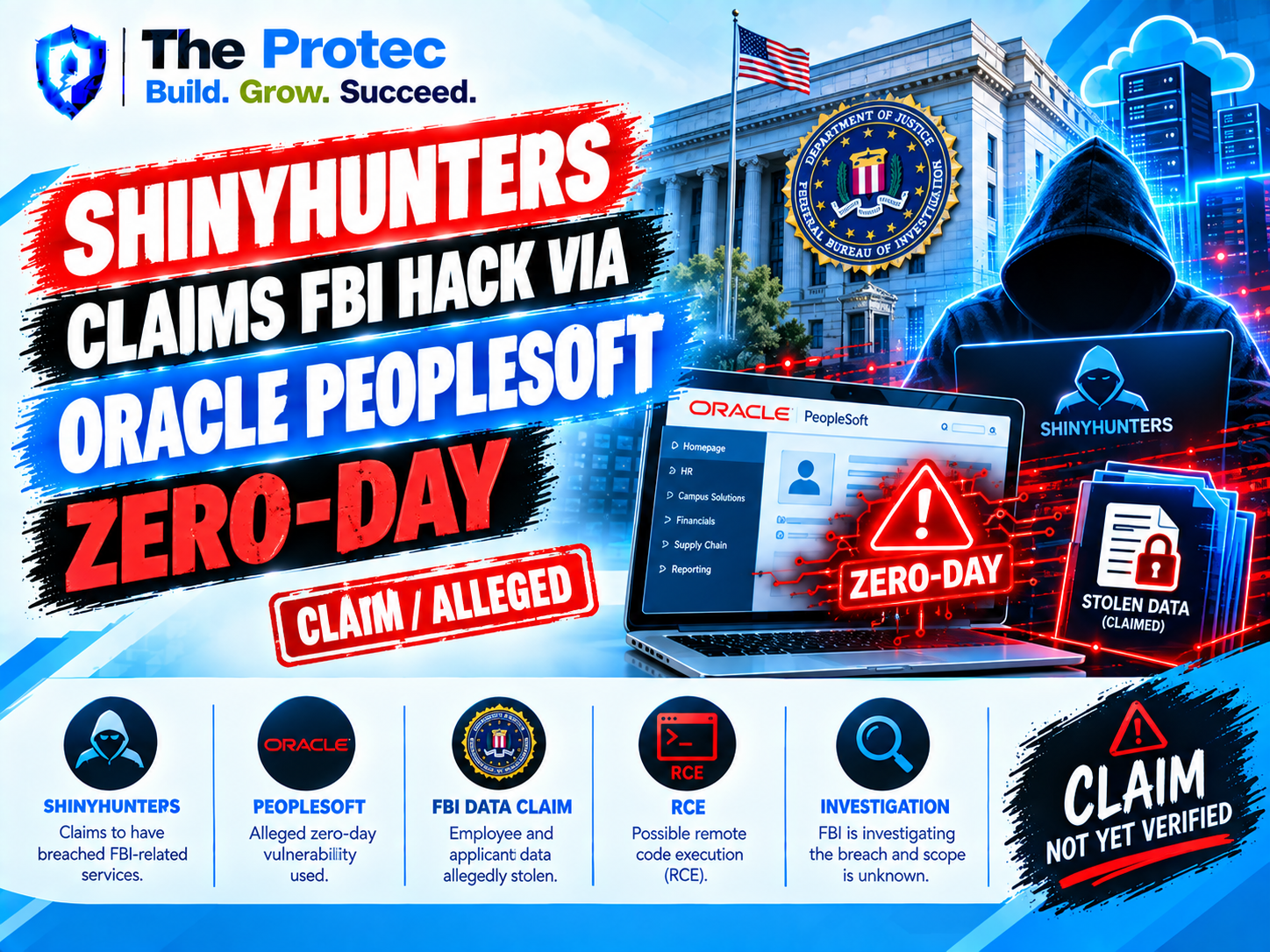
A claim that ShinyHunters breached FBI-related systems through an alleged Oracle PeopleSoft zero-day has put government cybersecurity teams and enterprise software administrators on alert. The group says it obtained sensitive FBI employee and job-applicant information, accessed an environment associated with AWS GovCloud, and defaced FBIJobs.gov after exploiting a previously unknown PeopleSoft vulnerability.
Those allegations are serious, but they are not all established facts. The FBI has acknowledged that it is investigating unauthorized activity affecting FBIJobs.gov. Reporting from Reuters and 404 Media has also examined samples of records presented as stolen data. Neither development independently proves the claimed Oracle PeopleSoft zero-day, the volume or complete contents of the alleged dataset, or access to AWS GovCloud.
As of September 23, 2026, the central challenge is separating evidence from attacker narrative. Here is what is known about the reported ShinyHunters FBI hack, what remains unverified, and what organizations running PeopleSoft should investigate now.
What Is Known About the FBIJobs.gov Incident
The clearest confirmed point is that the FBI is investigating unauthorized activity involving FBIJobs.gov, the bureau’s public recruiting and employment website. That acknowledgment establishes that an incident occurred around the jobs platform, but it does not confirm every element of ShinyHunters’ account.
Independent reporting has added context. Reuters cybersecurity reporting and 404 Media examined samples of records allegedly connected to the intrusion. Such analysis can help determine whether records appear credible, current, or internally consistent. It cannot, by itself, prove how the information was obtained or validate an attacker-provided total.
The facts currently supported by public reporting can be summarized narrowly:
- The FBI acknowledged an investigation into unauthorized activity affecting FBIJobs.gov.
- ShinyHunters claimed responsibility and attributed its access to an Oracle PeopleSoft zero-day.
- Journalists reviewed samples represented as FBI employee or applicant records.
- The full source, size, completeness, and authenticity of the alleged dataset remain unresolved.
What ShinyHunters Claims Happened
ShinyHunters alleges that a previously unknown Oracle PeopleSoft vulnerability provided an entry point into systems connected with FBI recruiting or human resources. The group further claims that it extracted employee and applicant data, reached infrastructure associated with AWS GovCloud, and used its access to alter or deface FBIJobs.gov.
These claims should not be treated as a technical incident report. Threat actors often mix verifiable details with exaggeration, omit access obtained from other criminals, or describe stolen credentials as a software exploit. The ShinyHunters name has long been associated with data theft and public leak activity, but a recognizable brand does not authenticate a particular claim. Handles can also be shared, copied, or used by affiliates.
No public evidence cited in the reporting has conclusively established a new Oracle zero-day, disclosed a reproducible exploit, identified a confirmed vulnerability number, or demonstrated compromise of the underlying AWS GovCloud service. Oracle PeopleSoft zero-day exploitation therefore remains an attacker assertion rather than a verified root cause.
How an Alleged PeopleSoft Zero-Day Attack Could Work
PeopleSoft is used by large organizations to manage human resources, payroll, recruiting, finance, and other sensitive workflows. Deployments can include the PeopleSoft Internet Architecture, web servers, application servers, databases, Integration Broker services, reporting components, custom interfaces, and connections to identity providers or cloud services.
If an unknown PeopleSoft vulnerability were involved, a plausible attack path could begin at an internet-accessible component. An attacker might attempt to bypass authentication, execute code, abuse an integration endpoint, obtain application credentials, or escalate from a low-privilege account. Access to the application tier could then expose connection details, service accounts, integration secrets, reports, attachments, or database queries.
That scenario is technically possible, but it is not proof of what happened in the FBI cyberattack. Other explanations remain viable, including stolen administrator credentials, session theft, credential reuse, social engineering, a compromised contractor, exploitation of a known but unpatched flaw, or an exposed custom application connected to PeopleSoft.
Investigators must reconstruct the sequence from web requests, authentication records, PeopleSoft application logs, database activity, endpoint telemetry, identity-provider events, and cloud audit trails. Until that work identifies the initial access vector, calling the incident an Oracle PeopleSoft vulnerability breach is premature.
Why Enterprise HR Software Is a High-Value Target
An enterprise software vulnerability in an HR or recruiting platform can be unusually damaging because these systems concentrate valuable information. Depending on configuration and retention policies, a recruiting environment may contain names, contact details, employment histories, resumes, application responses, interview notes, eligibility records, internal identifiers, and correspondence with candidates.
HR platforms also connect to other systems. Identity services, document repositories, background-check providers, payroll tools, email platforms, analytics services, and cloud storage may all exchange information with PeopleSoft. A compromise can therefore become more than a database theft: it may provide credentials or trusted pathways that support lateral movement.
This is why PeopleSoft security cannot be reduced to installing quarterly patches. Custom code, integrations, legacy accounts, exposed middleware, excessive privileges, and incomplete logging can create risk even when the core product is current.
The Claimed AWS GovCloud Connection Needs Context
ShinyHunters reportedly linked its alleged access to AWS GovCloud, an isolated cloud region designed for eligible government customers and regulated workloads. That language can be misleading without technical detail.
Accessing an application hosted in AWS GovCloud is not the same as compromising AWS GovCloud itself. An intruder could breach a customer-managed virtual server, PeopleSoft instance, database, identity account, or application credential while the underlying AWS infrastructure continues operating as designed. A broader cloud compromise would require evidence of access to the AWS control plane, such as unauthorized role assumptions, new access keys, altered security policies, snapshots, or unexpected storage operations.
At present, the claimed AWS GovCloud FBI access has not been independently established. There is also no public basis to conclude that AWS infrastructure or GovCloud isolation controls were broken. Incident responders should distinguish application compromise, cloud-account compromise, and cloud-provider compromise rather than treating them as interchangeable.
What Data May Have Been Exposed?
The alleged FBI data breach could affect two distinct populations: employees and applicants. Reporting on samples may support the possibility that at least some records are genuine, but sample validation does not show that every record came from FBI systems or that ShinyHunters possesses the volume it claims.
Potentially affected information could include contact details, recruiting records, resumes, employment information, application status, or internal administrative data. However, organizations should not infer that Social Security numbers, security-clearance files, investigative records, or classified information were exposed unless authorities or reliable evidence specifically establish that fact.
The difference matters. A credible sample can be assembled from a larger breach, an older incident, multiple sources, or publicly available information. Investigators must validate provenance, timestamps, field structures, record counts, and whether queried data corresponds with observed export activity.
Why the FBI Jobs-Site Defacement Matters
A website defacement is visible, but it does not necessarily reveal the depth of access. Attackers may alter a page through a compromised content-management account without reaching an HR database. Conversely, a defacement may be a final publicity step after a deeper intrusion.
For the FBIJobs.gov hack, responders must determine whether the website and PeopleSoft shared credentials, infrastructure, administrative tooling, or deployment pipelines. The timing of the defacement may help correlate web activity with alleged data extraction, but it cannot independently prove the claimed attack path.
What PeopleSoft Organizations Should Do Now
Organizations should not wait for confirmation of a zero-day before reviewing exposed PeopleSoft environments. Defensive action can be proportionate without accepting the attacker’s claims as fact.
Inventory Exposure and Patch Status
- Identify every internet-accessible PeopleSoft, Integration Broker, web server, load balancer, and administrative endpoint.
- Confirm Oracle security updates have been applied across production, disaster-recovery, test, and forgotten legacy instances.
- Review custom components and integrations that may not be protected by a standard Oracle patch.
Hunt for Abnormal Activity
- Examine unusual requests, authentication bypass patterns, unexpected errors, new files, web shells, and suspicious child processes on application servers.
- Review PeopleSoft queries, reports, bulk exports, attachment access, and database activity for unusual volume or execution times.
- Look for logins from unfamiliar networks, impossible travel, dormant-account use, privilege changes, and service-account interaction outside normal workflows.
- Preserve web, application, database, endpoint, identity, and network logs before normal retention periods erase evidence.
Investigate Cloud and Identity Controls
- In AWS environments, review CloudTrail, identity events, role assumptions, key creation, security-group changes, snapshots, storage access, and cross-account activity.
- Rotate credentials and secrets exposed to affected servers, including database passwords, API keys, integration tokens, and certificates.
- Require phishing-resistant multifactor authentication for administrators and restrict management interfaces through controlled networks.
Prepare for Applicant and Employee Risk
Organizations should be ready for targeted phishing that uses recruiting details to appear credible. Applicants may receive fake interview invitations, document requests, or employment offers. Employees could face impersonation or password-reset attempts. Communications should explain what is known without repeating unverified claims as confirmed exposure.
What Evidence Would Confirm the Zero-Day Claim?
Confirmation would typically require Oracle or investigators to identify a previously unknown defect, connect exploitation evidence to that defect, and publish remediation or indicators. A vulnerability identifier, affected-version list, patch, forensic artifacts, or reproducible technical analysis would materially strengthen the claim.
Evidence of bulk extraction, meanwhile, would need to align database or application logs with the structure and timing of the allegedly stolen records. Proof of AWS account access would require corresponding cloud audit activity. Until those elements emerge, the responsible description is an FBI jobs-site incident accompanied by serious but incompletely verified ShinyHunters allegations.
Frequently Asked Questions
Did ShinyHunters definitely hack the FBI?
The FBI has acknowledged investigating unauthorized activity affecting FBIJobs.gov, and ShinyHunters has claimed responsibility. Public information does not yet establish the full scope of access, confirm every claimed system was breached, or prove that all allegedly stolen records came from FBI infrastructure.
Was an Oracle PeopleSoft zero-day confirmed?
No. ShinyHunters claims it exploited an unknown PeopleSoft vulnerability, but the alleged zero-day has not been independently demonstrated. There is no publicly confirmed exploit chain, vulnerability identifier, or Oracle finding tying a new flaw to the incident.
Does the claim mean AWS GovCloud was breached?
No such conclusion can currently be drawn. A customer workload hosted in GovCloud could be compromised without a breach of AWS infrastructure. The attacker has not publicly established the level of access allegedly obtained, and the AWS GovCloud connection remains unverified.
Should PeopleSoft customers take immediate action?
Yes, but action should focus on evidence-based security practices: reduce internet exposure, apply available patches, review integrations, hunt for abnormal access, preserve logs, rotate potentially exposed secrets, and monitor Oracle guidance. These measures are appropriate even if the claimed PeopleSoft zero-day is later disproved.
Is this a confirmed FBI employee data breach?
Not at the scale claimed by the attacker. Reporters have examined samples represented as employee or applicant data, but sample credibility does not confirm the entire dataset, its origin, or the number of people affected. Official findings and individual notifications will be more reliable indicators of actual exposure.
The Bottom Line
The ShinyHunters FBI hack claim combines a confirmed investigation with several unverified technical assertions. Unauthorized activity affected FBIJobs.gov, and allegedly stolen samples have received independent scrutiny. The claimed Oracle PeopleSoft zero-day, full FBI employee and applicant dataset, stated record volume, and AWS GovCloud access remain unproven.
For defenders, uncertainty is not a reason for inaction. PeopleSoft environments hold sensitive data and often connect to critical identity, database, and cloud systems. Organizations should investigate their own exposure now while avoiding conclusions that the available evidence does not support.