








Generative artificial intelligence is moving from producing text and images to designing molecules that could exist in the physical world. Protein generation models can now propose novel amino acid sequences for enzymes, therapeutics, biomaterials, diagnostics, and research tools. That progress creates enormous scientific opportunity, but it also raises a difficult question: if a protein sequence appears in a database, synthesis order, or laboratory workflow, can anyone determine whether it came from nature, a human researcher, or an AI system?
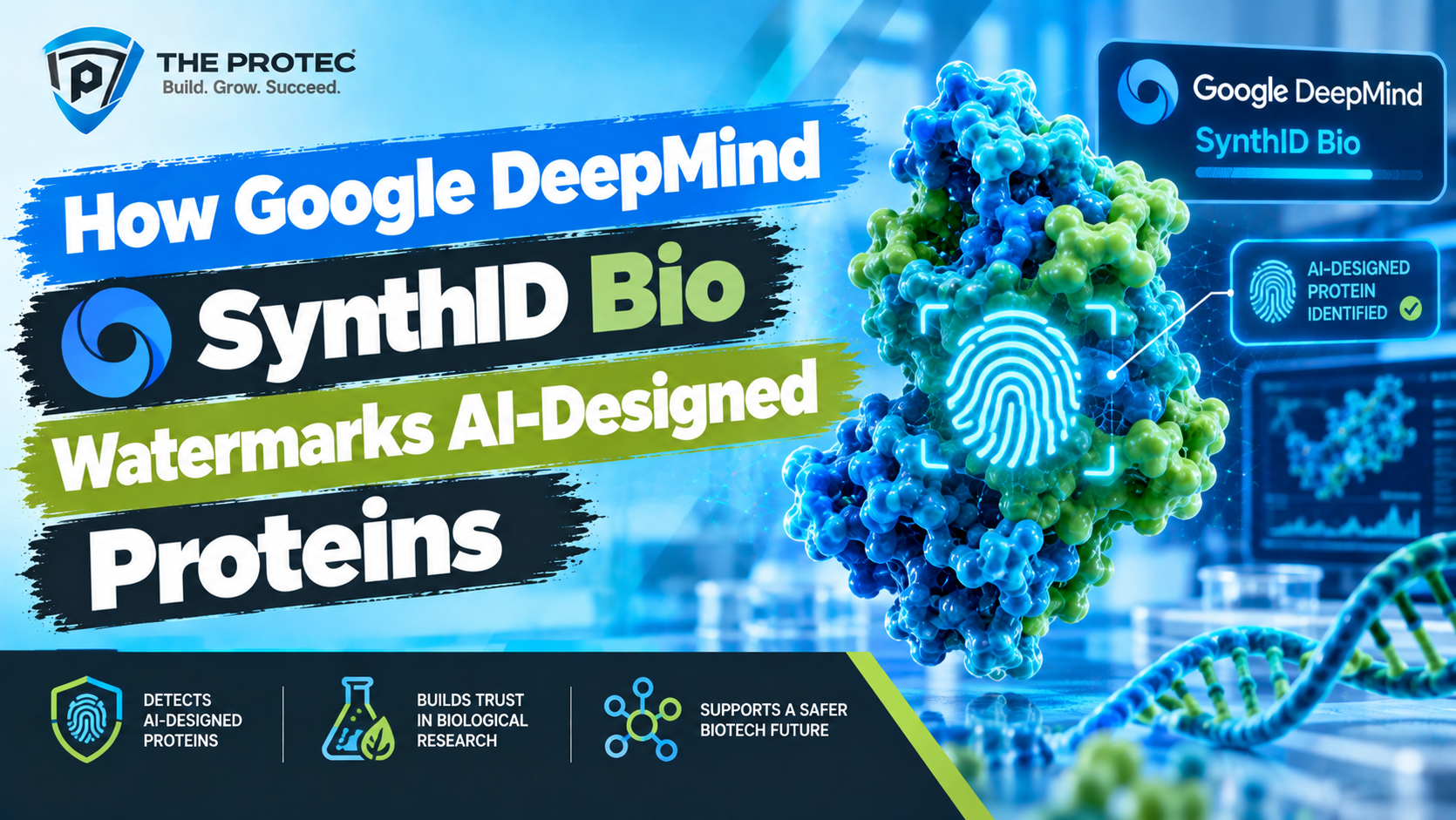
Google DeepMind SynthID Bio is designed to help answer that question. Extending the provenance principles behind the broader SynthID technology, the system embeds an imperceptible signal into an AI-generated protein sequence. An authorized detector can later analyze the sequence and estimate whether it was produced by a compatible watermarked model.
The idea could give researchers, model developers, synthesis providers, and oversight bodies a practical form of AI-designed protein watermark. However, SynthID Bio is not a biological threat detector, a universal test for AI involvement, or a substitute for protein synthesis screening. Its value lies in provenance and attribution—and in how that information can complement broader biosecurity safeguards.
What Is Google DeepMind SynthID Bio?
SynthID Bio is an AI protein watermarking approach intended for generative models that create amino acid sequences. Rather than attaching visible metadata or placing a label in a separate file, the system encodes a statistical signal within the protein sequence itself. The amino acid choices still need to satisfy the model’s design objectives, but they collectively carry a pattern that a corresponding detector can recognize.
This distinction matters because ordinary metadata can easily become separated from a sequence. A database record may be copied, reformatted, exported, or stripped of its original annotations. A watermark embedded in the sequence travels with the protein design, making it potentially more durable than a conventional disclosure field.
The concept builds on a broader trend in generative AI: outputs should carry machine-readable provenance where possible. Yet biological data presents challenges that do not apply to an image or paragraph. A protein’s amino acids determine folding, stability, binding behavior, catalytic activity, and interactions with living systems. A watermark therefore cannot be added casually. It must preserve the properties for which the sequence was designed.
How SynthID Bio Protein Watermarking Works
At a high level, SynthID Bio protein watermarking operates during sequence generation. A compatible protein model predicts amino acids one position at a time or through another structured generation process. The watermarking mechanism subtly influences selection among amino acid options that remain plausible in context. Across many positions, those small choices create a detectable statistical signature.
The goal is not to insert a conspicuous amino acid motif or a fixed biological “barcode.” An obvious pattern could alter function, make removal easier, or create misleading similarities among unrelated proteins. Instead, the signal is distributed through the sequence and designed to be imperceptible to ordinary observation.
A detector with the appropriate methodology or key can then examine the resulting protein sequence watermark. It calculates whether the pattern is stronger than would be expected in an unwatermarked sequence and produces a confidence assessment rather than an absolute declaration. This resembles statistical attribution more than forensic identification of a unique physical object.
Preserving protein quality is the central constraint
Watermarking cannot be useful if it substantially degrades the generated protein. The system must work within the design model’s acceptable sequence space, favoring watermark-compatible amino acids only when those choices remain consistent with the intended structure or function. Evaluation therefore has to consider more than detection rates. Researchers also need to measure predicted structure, sequence diversity, stability, functional constraints, and performance in relevant experiments.
Computational validation can show whether watermarked designs retain expected characteristics, but laboratory testing remains important. Protein models and structure predictors are powerful approximations, not complete representations of biological behavior. Any deployment of AI-generated biological sequences must account for the gap between predicted and experimentally observed function.
Why Protein Provenance Matters
AI systems are making protein design faster and more accessible. Researchers can explore vast sequence spaces, optimize candidates against multiple objectives, and generate proteins unlike those found in known organisms. As those capabilities spread, provenance becomes part of responsible research infrastructure.
Protein provenance tracking could help a laboratory verify that a sequence was generated using an approved model. A journal or research funder could use watermark evidence alongside disclosure requirements. A model provider could investigate whether its system contributed to a sequence involved in an incident. Synthesis companies could incorporate provenance checks into risk-based review, while databases could preserve information about computational origin.
Attribution also supports scientific reproducibility. Knowing that a protein was AI-designed—and potentially which model family or deployment produced it—provides useful context for evaluating a result. It may reveal differences between natural sequence discovery, human-guided optimization, and de novo generation. That history can influence how other researchers interpret novelty, safety, and intellectual contribution.
Crucially, provenance is not proof of intent. An AI origin does not make a protein suspicious, just as a natural origin does not make it harmless. Most AI-designed proteins will be created for beneficial research. The purpose of AI protein identification is to provide context for decisions, not to label every computationally designed molecule as a threat.
How SynthID Bio Could Support AI Biosecurity
The immediate biosecurity value of SynthID Bio comes from adding information to workflows that currently have limited visibility into sequence origin. When combined with existing safeguards, watermark evidence could support several applications.
- Model accountability: Developers could evaluate whether a sequence likely originated from a watermark-enabled model and investigate potential misuse or policy violations.
- Protein synthesis screening: Providers could use watermark detection as one input when reviewing unusual orders, especially when provenance has not been declared.
- Research oversight: Institutional review bodies could verify disclosures about the use of generative protein models in sensitive projects.
- Incident analysis: If a concerning engineered sequence is discovered, a watermark might help narrow the set of tools involved and support forensic investigation.
- Database integrity: Sequence repositories could retain machine-readable indicators that distinguish AI-designed proteins from naturally observed proteins.
- Policy evaluation: Aggregated detection data could help authorized stakeholders understand how generative biology tools are being used without relying entirely on self-reporting.
These uses make the technology relevant to Google AI biosecurity and the wider field of biological AI safety. Watermarking introduces a layer of accountability at the model-output level, where many existing biosecurity controls have little reach.
It could also complement initiatives such as the International Gene Synthesis Consortium, whose members promote screening practices for synthetic nucleic acid orders. Although protein designs and DNA synthesis are not identical, an amino acid sequence is commonly translated into a nucleotide sequence before physical production. Provenance information may therefore be useful within an integrated screening process.
A Watermark Does Not Detect Dangerous Proteins
The most important limitation is conceptual: AI-generated protein detection is not danger detection. SynthID Bio is intended to indicate probable model provenance. It does not determine whether a sequence is toxic, pathogenic, immunogenic, environmentally disruptive, or otherwise hazardous.
A benign enzyme designed to break down plastic could carry a watermark. A dangerous natural protein might not. A harmful sequence produced by an unwatermarked model would also evade watermark-based identification. Even a correctly detected watermark says little about the creator’s intentions or the conditions in which the protein will be used.
Effective screening must therefore evaluate biological properties independently. That can include comparisons against regulated pathogens and toxins, functional risk analysis, structural similarity searches, customer verification, order-pattern review, and expert escalation. Depending on the application, laboratory containment, access controls, red-team testing, and post-deployment monitoring may also be necessary.
SynthID Bio is best understood as an additional signal. In a layered system, provenance can guide scrutiny and improve traceability. It cannot replace the biological analysis that determines whether a design presents a credible risk.
Technical and Adoption Limitations
Sequence modifications may weaken detection
Proteins are often edited after initial generation. Researchers may substitute amino acids, trim terminal regions, combine domains, optimize solubility, or evolve a sequence through repeated mutation. Each change can remove part of a distributed watermark. Minor edits may leave enough signal for detection, but extensive mutation, recombination, or shortening could make attribution unreliable.
This creates a tension between robustness and biological fidelity. A stronger watermark may survive more modifications, but applying too much influence during generation could reduce sequence quality or constrain diversity. Robustness claims consequently need to be tested against realistic protein-engineering operations, not only simple random substitutions.
Detection depends on participation
No watermark can identify outputs from every protein model unless it becomes broadly adopted. Open-source developers, commercial platforms, academic laboratories, and malicious actors may use systems without watermarking. Some may deploy incompatible watermark standards. SynthID Bio can recognize the signal it was designed to detect; it cannot establish that every unmarked sequence was created without AI.
Broad adoption would require practical tooling, clear documentation, acceptable computational costs, independent evaluation, and governance over detector access. Interoperability may be particularly important. A fragmented ecosystem in which every developer uses a private, incompatible system could limit the value of AI biosecurity technology for synthesis providers and regulators.
False positives and false negatives remain possible
Because detection is statistical, thresholds matter. A threshold set too low could incorrectly flag natural or human-designed sequences. A threshold set too high could miss watermarked proteins, especially after editing. Sequence length, composition, protein family, and similarity to training data may all influence performance.
Detection results should therefore include calibrated confidence and should not be treated as conclusive evidence on their own. Independent benchmarking across diverse protein classes will be essential, particularly if watermark evidence is used in consequential decisions.
Security requires careful detector governance
A public, transparent standard can encourage trust and evaluation, but releasing every operational detail might make deliberate removal easier. Conversely, a fully closed detector could prevent independent auditing and concentrate control in one company. Responsible deployment will need a balance among scientific scrutiny, security, accessibility, and due process for disputed results.
The Role of Governance in Synthetic Biology Security
Technical provenance should be paired with rules that define how it is used. Model developers need disclosure policies, acceptable-use controls, abuse monitoring, and procedures for responding to credible incidents. Synthesis providers need risk-based screening that examines both customers and sequences. Research institutions need training and review processes suited to increasingly capable generative biology systems.
Governance must also avoid overreliance on a single company’s signal. Independent researchers should be able to evaluate whether Google DeepMind biosecurity tools work across relevant sequence classes and remain reliable after common modifications. Standards bodies and public agencies can help establish performance benchmarks, reporting conventions, privacy protections, and appeal processes.
The larger goal is an ecosystem in which provenance follows a design through generation, optimization, synthesis, publication, and archiving. SynthID Bio could become one component of that chain. Cryptographically signed records, secure model logs, synthesis screening, database annotations, and laboratory controls would provide additional layers that remain useful when a watermark is absent or damaged.
What SynthID Bio Signals for Generative Biology
SynthID Bio reflects a shift in synthetic biology AI: safeguards are beginning to be designed into generative systems rather than added only after deployment. That is significant because the volume of generated sequences may eventually exceed what experts can review manually. Automated provenance signals can help direct limited attention toward cases requiring deeper analysis.
The system also demonstrates why biological watermarking is uniquely demanding. A media watermark must preserve perceptual quality; a protein watermark must preserve molecular function. Success will depend not only on detector accuracy, but also on whether watermarked proteins remain useful, diverse, safe, and scientifically valid.
As protein design models become more capable, the need for trustworthy origin information will grow. Google DeepMind SynthID Bio offers a technically promising approach to that problem. Its strongest role is not as a complete defense, but as one carefully evaluated layer in a broader framework for responsible generative biology.
Frequently Asked Questions
What is SynthID Bio?
SynthID Bio is a protein watermarking system associated with Google DeepMind. It embeds a subtle statistical signal into amino acid sequences generated by compatible AI models, allowing a detector to assess whether a protein was likely created by a watermarked system.
Can SynthID Bio determine whether a protein is dangerous?
No. SynthID Bio addresses provenance, not biological risk. It may indicate that a sequence came from a participating AI model, but separate screening is required to assess toxicity, pathogenicity, functional hazards, or other security concerns.
Can an AI-designed protein watermark be removed?
Potentially. Small sequence changes may preserve enough of a distributed watermark for detection, while extensive mutation, truncation, domain recombination, or redesign could weaken or erase the signal. The practical robustness of the watermark must be evaluated against realistic protein-engineering workflows.
Does an unmarked sequence prove that it was not generated by AI?
No. The sequence may have come from an AI model that does not use SynthID Bio, or its watermark may have been degraded through modification. A negative result means that the specific detectable signal was not found with sufficient confidence; it does not prove a non-AI origin.
Could SynthID Bio replace protein synthesis screening?
No. Protein synthesis screening examines biological risk, customer context, and other indicators that provenance alone cannot resolve. SynthID Bio could enrich screening with information about likely origin, but it should operate alongside biological analysis, governance, and human review.