








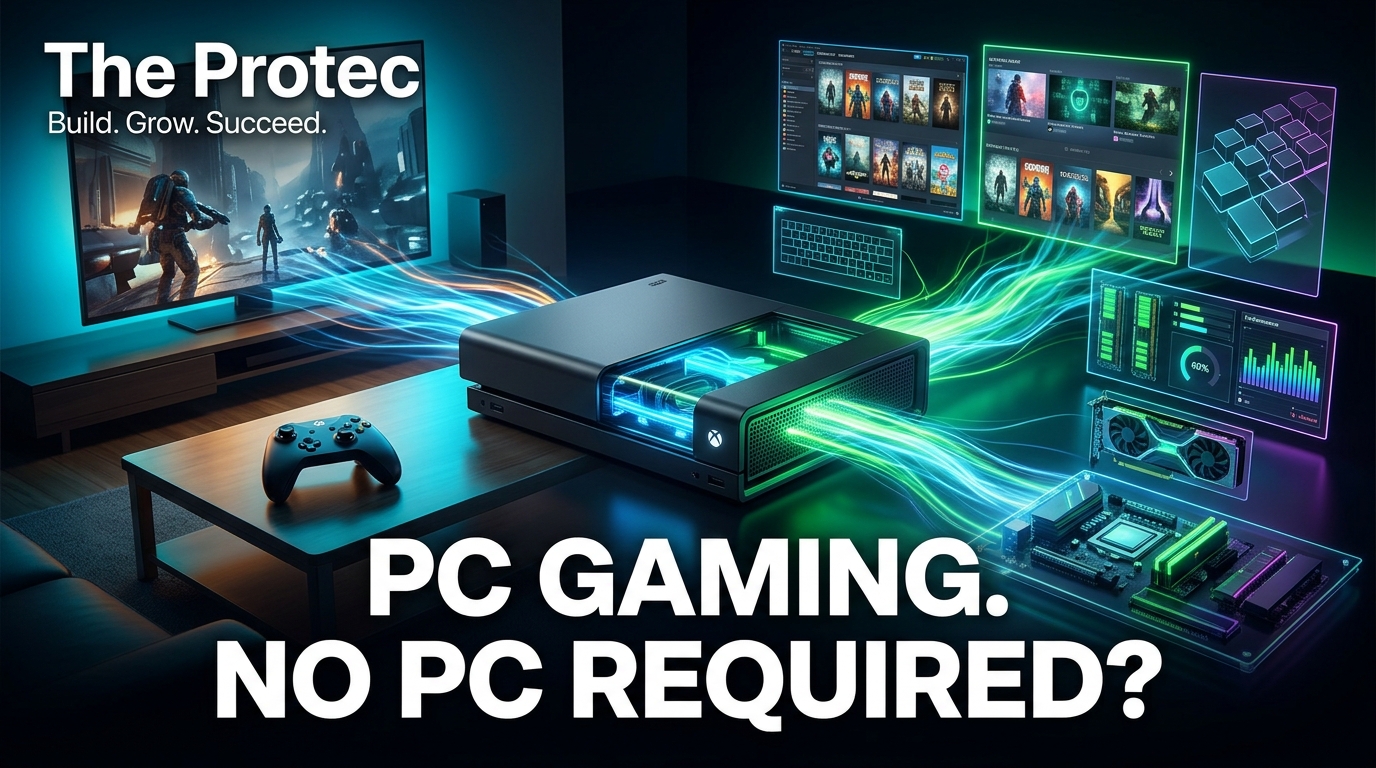
Microsoft is attempting something more complicated than simply building a faster Xbox. The Xbox Project Helix console is being designed to preserve the convenience of a living-room console while gaining access to games associated with the PC ecosystem. Additional details published in the Xbox 25th Anniversary Magazine on November 15, 2026, sharpened that vision—but also exposed how many important questions Microsoft has yet to answer.
The essential distinction comes from Xbox Vice President Jason Ronald: Project Helix is intended to be a console capable of playing PC games, not a PC that happens to play console games. That wording sets expectations for a controller-first device with predictable hardware, streamlined navigation and minimal setup. It also separates Microsoft’s plan from simply placing a conventional Windows desktop in an Xbox-branded box.
What is Microsoft Project Helix?
Project Helix is Microsoft’s next-generation Xbox platform. According to the company’s official Project Helix announcement and the subsequent anniversary magazine, the platform will use a custom AMD system-on-chip and a new graphics architecture built around future DirectX capabilities, AMD FSR technology, machine learning and neural rendering.
Microsoft is also promising continuity. The next generation Xbox is being developed to carry forward four generations of game libraries and player progression, spanning the original Xbox, Xbox 360, Xbox One and Xbox Series eras. That makes backward compatibility a central part of the platform strategy rather than a secondary feature.
What Microsoft has not announced is equally significant. There is no confirmed consumer release date, retail price, final specification sheet, disc-drive configuration or list of supported PC storefronts. Alpha development hardware is planned for developers beginning in 2027, but that is not a consumer launch window.
A console that plays PC games—not a gaming PC
Traditional consoles succeed because they hide complexity. Players sign in, select a game and expect it to run with appropriate settings. Gaming PCs offer broader software access and extensive customization, but they can require driver management, graphics configuration, launcher updates and troubleshooting.
The Xbox Project Helix console aims to occupy the space between those models. It could provide access to a wider pool of Windows-based games while retaining fixed hardware targets and an interface designed for a television and controller. Developers would know the exact performance profile they are targeting, while players would ideally avoid the maintenance associated with a desktop PC.
This is why Ronald’s clarification matters. Project Helix should not be assumed to include an unrestricted Windows desktop, arbitrary application installation or user-replaceable PC components. Microsoft may expose some familiar PC capabilities, but it continues to describe Helix as a console. Until the company defines the software environment, comparisons with a small-form-factor gaming PC remain incomplete.
Confirmed Project Helix console features
A custom AMD SoC
Microsoft has confirmed that AMD is producing the custom chip at the center of the Xbox next-gen console. An integrated system-on-chip can combine CPU, graphics, memory-control and specialized acceleration functions in a design optimized for a fixed power and thermal envelope.
No final CPU core count, graphics configuration, memory capacity or storage specification has been announced. Claims circulating online about exact clock speeds or component counts should therefore be treated as rumor, not settled hardware information.
Next-generation DirectX, FSR and machine learning
Microsoft says Project Helix will use next-generation DirectX technology alongside AMD FSR and machine-learning-assisted graphics. These tools could allow the console to render internally at a lower resolution and reconstruct a sharper image, improve frame generation or devote more resources to lighting, simulation and image quality.
The broader ambition is neural rendering: using trained models or specialized acceleration to help produce parts of a frame more efficiently than traditional rendering alone. That does not mean every Helix game will automatically look photorealistic, nor has Microsoft specified which neural techniques will be available at launch. Performance will still depend on developer implementation.
A major ray-tracing target
Microsoft has claimed an order-of-magnitude improvement in ray-tracing performance for the new architecture. This is a performance goal, not a promise that every game will run fully path-traced graphics at high resolution and frame rates. The eventual result will depend on the comparison baseline, workload, software and amount of ray tracing used.
Even with that caveat, the emphasis suggests Xbox ray tracing will move beyond the limited reflections, shadows and lighting effects common on current consoles. Better acceleration could let developers use more dynamic lighting without making a 30-frames-per-second mode the only practical option.
What four generations of backward compatibility could mean
Microsoft’s promise to carry forward four generations of libraries and progression is one of Helix’s most consequential commitments. A player’s digital purchases, supported backward-compatible titles, achievements and continuing game history could remain relevant instead of being stranded during another hardware transition.
However, Xbox backward compatibility should not be interpreted as a guarantee that every game ever released for an Xbox system will work. Licensing restrictions, discontinued peripherals, server closures and technical dependencies can prevent individual titles from returning. Microsoft has not provided a final Helix compatibility list or explained how unsupported disc-based games would be handled.
The progression promise also strengthens Game Pass. If compatible games can move across console, PC and cloud environments with shared accounts and saves, Microsoft can sell continuity rather than a single box. The value of the platform becomes the persistent library and identity surrounding the player.
Lessons from the ROG Xbox Ally
Microsoft says its work on the ROG Xbox Ally helped inform Project Helix. The handheld demonstrated both the opportunity and the difficulty of making Windows gaming feel natural with a controller. A controller-focused experience can bring games from multiple PC sources into a more coherent interface, but Windows prompts, launcher logins and background processes can still interrupt the console illusion.
Helix gives Microsoft a chance to control more of that experience. Fixed hardware and a purpose-built startup flow could reduce configuration, keep system menus usable from a couch and establish consistent suspend, update and performance behavior. The challenge is doing so without closing off the PC catalog that makes the concept attractive.
The biggest unanswered Xbox PC gaming questions
- Will Steam and the Epic Games Store be supported? Microsoft has not confirmed either storefront. Playing PC games does not automatically mean users will be able to install every Windows launcher.
- How will PC games be delivered? Microsoft could allow selected stores, distribute validated PC builds through the Xbox app or use another compatibility and certification system. None of these methods has been confirmed.
- Will it include a Windows desktop? There is no official promise of traditional desktop access, productivity applications, unrestricted file management or support for arbitrary Windows software.
- Will Project Helix have a disc drive? Microsoft has not announced whether a drive will be standard, optional or absent. That decision will matter to collectors and owners of physical backward-compatible games.
- How will Microsoft preserve simplicity? Multiple launchers can bring separate accounts, updates and interfaces. Helix will need to manage that complexity without turning every gaming session into PC maintenance.
Confirmed facts versus release, price and specification rumors
Officially confirmed
- Project Helix is a next-generation Xbox console platform.
- It is designed to play PC games while remaining a console.
- The hardware uses a custom AMD SoC.
- Microsoft is developing next-generation DirectX, FSR, machine-learning and neural-rendering capabilities.
- The company is targeting a substantial ray-tracing performance improvement.
- Four generations of Xbox libraries and progression are intended to move forward.
- Alpha developer hardware is planned to begin reaching developers in 2027.
Rumored or unconfirmed
A 2028 release window has appeared in reporting and industry discussion, but Microsoft has not announced the Project Helix release date. Likewise, speculative Project Helix price estimates ranging from $1,200 to $1,800 are not official. Such figures may be based on assumptions about premium components or PC-like positioning rather than a finalized retail plan.
Reports summarized by The Verge should be read as reporting about possible plans, not a product announcement. Microsoft could change the schedule, hardware configuration or market strategy before manufacturing begins. Alleged CPU, GPU, memory and storage specifications remain unverified unless Microsoft or AMD confirms them.
Developer hardware in 2027 does not mean a 2027 launch
The Xbox 2027 developer hardware timeline refers to alpha systems intended for studios. Early kits let developers evaluate tools, port engines and test new graphics features before consumer hardware is finalized. Console makers routinely distribute development systems well ahead of release.
Calling 2027 the launch year would therefore be inaccurate. The only responsible conclusion is that Microsoft’s development program is expected to advance during that year. The retail schedule remains unannounced.
How Project Helix could reshape gaming
For Sony, Helix could create pressure beyond raw console performance. If Xbox offers a simple route to a meaningful selection of PC games, PlayStation would be competing against a broader software ecosystem rather than only Microsoft’s console catalog. Sony still has powerful exclusive franchises and a large installed base, but storefront flexibility could become another purchasing factor.
For gaming PCs, the effect may be more nuanced. Helix is unlikely to replace systems valued for modding, upgrades, productivity, high-end performance and open software access. It could instead appeal to people who want PC releases without building or maintaining a computer. The Xbox console vs gaming PC decision would become less about which games exist and more about control, flexibility and convenience.
Console exclusivity could also become less rigid. Microsoft’s recent strategy already treats Xbox as an ecosystem spanning console, Windows and cloud gaming. A console that runs PC titles would make platform boundaries even less visible, although publishers could still restrict individual games by store, license or hardware.
Game Pass may be the connective tissue. A unified subscription, account and save system could make moving among Helix, PC and cloud sessions feel routine. Yet Microsoft must explain whether PC storefront purchases will sit alongside Xbox purchases, whether multiplayer pools will merge and how certification will work for games not originally designed as console software.
Frequently asked questions
When is the Project Helix release date?
Microsoft has not confirmed a consumer release date. A 2028 window has been rumored, while alpha development hardware is planned for 2027. The developer-kit schedule should not be presented as the retail launch.
How much will the Xbox Project Helix console cost?
No official Project Helix price has been announced. Online estimates of $1,200 to $1,800 are speculative and should not be treated as a confirmed range. Microsoft has not revealed the final configuration or sales model needed to judge pricing.
Will Project Helix support Steam?
Steam support has not been confirmed. Microsoft’s statement that the console will play PC games leaves open whether those games will come through third-party stores, the Xbox app, curated conversions or another delivery system.
Will Project Helix play older Xbox discs?
Microsoft has pledged to carry forward four generations of Xbox libraries and progression, but it has not confirmed a disc drive or universal disc compatibility. Digital entitlements and supported backward-compatible titles are likely central to the plan, while physical-media details remain unknown.
A promising idea that still depends on execution
Project Helix presents a compelling answer to a longstanding question: can a device offer the breadth of PC gaming without inheriting the friction of a PC? Microsoft’s confirmed AMD partnership, graphics ambitions and backward-compatibility commitment provide a credible foundation. The decisive details, however, will be storefront access, software delivery, physical-media support, price and interface design. Until those answers arrive, Helix is best understood as an unusually ambitious console strategy—not an unrestricted gaming PC in Xbox clothing.