





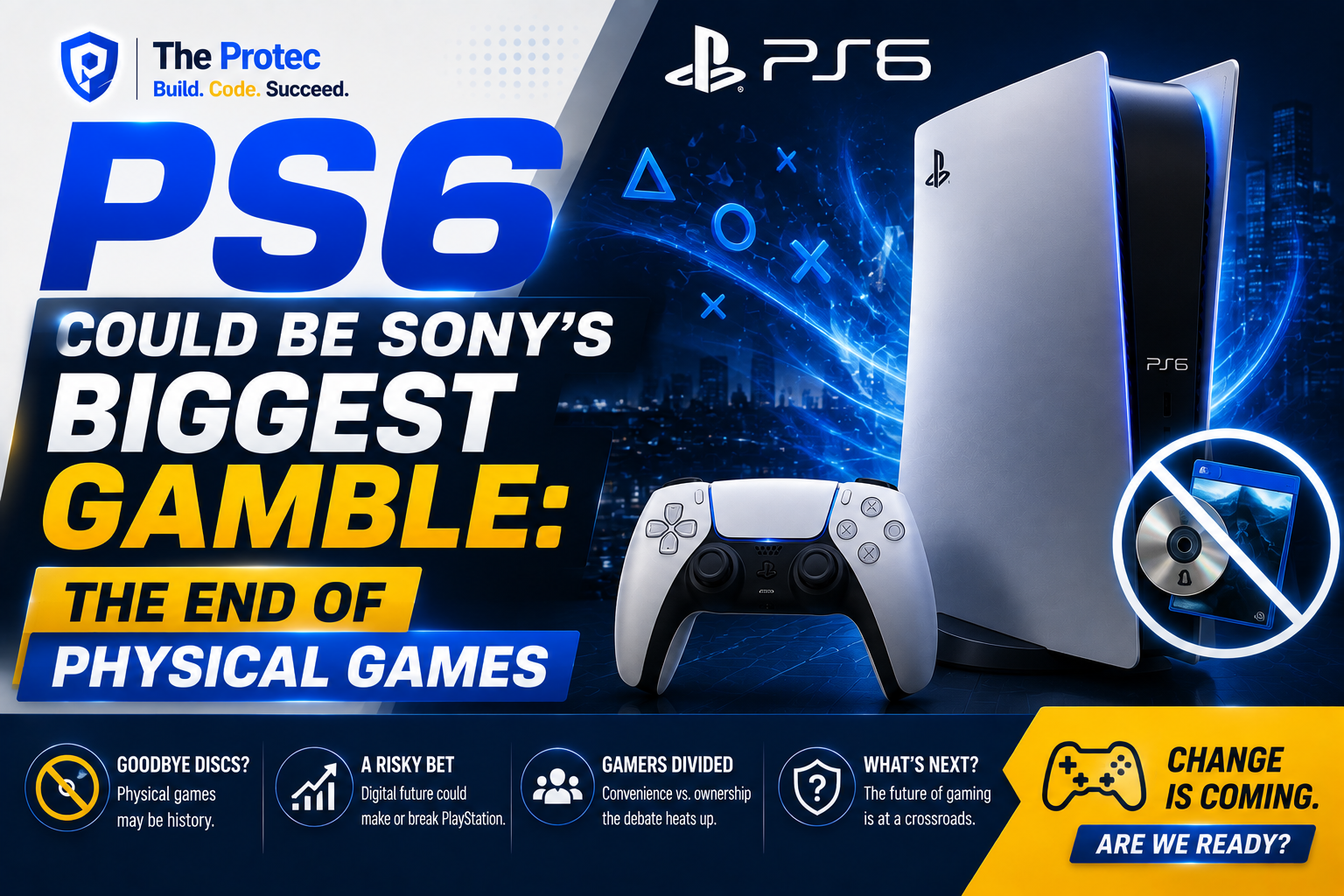
For decades, buying a new PlayStation meant choosing games from a shelf, inserting a disc, and building a collection that could be kept, traded, lent, or resold. The PS6 may disrupt that familiar relationship. Sony has not announced the final PlayStation 6 design, but its evolving hardware strategy points toward a future in which an optical drive is optional rather than standard.
That possibility makes PS6 one of Sony’s biggest strategic gambles. A digital-first console could reduce manufacturing complexity, encourage PlayStation Store purchases, and give Sony greater control over distribution. It could also alienate collectors, used-game buyers, preservation advocates, and players with large PS4 and PS5 disc libraries.
As of August 2026, there is no official PS6 release date, price, hardware design, or confirmed policy for physical media. However, Sony’s current products provide meaningful clues about what the future of PlayStation could look like.
Sony Has Already Tested a Digital-First PlayStation Model
The transition did not begin with PS6 speculation. Sony launched the PS5 generation with separate disc and digital editions, allowing customers to choose a cheaper system without an optical drive. It later introduced a redesigned PS5 with a detachable drive and launched PS5 Pro without a built-in drive, requiring physical-game buyers to purchase the compatible accessory separately.
This modular approach changes the role of physical media. Instead of making a disc drive a defining part of the console, Sony can treat it as an add-on for a narrower group of customers. The standard hardware becomes digital-first, while disc support remains available at an additional cost.
Sony’s official PlayStation 5 hardware information illustrates how disc and digital configurations now coexist within the same platform. That structure could become the foundation of the PlayStation 6 rather than a temporary experiment.
It is important to distinguish digital-first from digital-only. Sony can prioritize digital distribution without immediately abandoning discs. For PS6 physical games, the most plausible short-term outcome may be optional support through a detachable PS6 disc drive.
What a Digital-First PS6 Could Look Like
A digital-first PlayStation 6 would likely ship in one main configuration without an integrated optical drive. Customers who buy exclusively from the PlayStation Store would receive a cleaner, potentially slimmer system. Physical buyers could attach or register a separate drive, assuming Sony continues its current modular strategy.
This arrangement would offer several advantages for Sony:
- Fewer base console configurations to manufacture and distribute
- Lower shipping weight and reduced internal hardware complexity
- More software purchases through Sony’s own digital storefront
- Less reliance on retail inventory and physical game production
- The ability to sell a premium disc-drive accessory separately
A removable drive would also allow Sony to adjust supply independently. It could sell disc drives in regions where physical games remain popular while emphasizing all-digital systems in markets with stronger broadband access and higher digital adoption.
The risk is that an optional accessory can become expensive, scarce, or inconvenient. If drive availability is limited during the launch window, customers could own a PS6 that is technically compatible with discs but cannot access that feature without finding additional hardware.
The PS6 Disc Drive Could Decide the Fate of Physical Games
The design and policies surrounding the PS6 disc drive may matter more than whether the console includes one in the box. A consumer-friendly solution would be widely available, reasonably priced, replaceable, and compatible with PS5 discs. Ideally, Sony would allow one drive model to work across multiple supported PlayStation systems.
A more restrictive approach could require the drive to be paired with one console through an internet connection. Sony already uses online drive registration with compatible PS5 hardware. Although pairing can help authenticate hardware and meet security requirements, it raises long-term preservation questions. Players need to know whether a replacement drive can still be activated if authentication servers are unavailable years later.
There is also the issue of mechanical failure. An internal drive can be repaired, but a detachable model is easier to replace if Sony continues producing it. If the accessory is discontinued early, however, functional used drives could become expensive. Physical compatibility would then exist on paper while becoming impractical for many owners.
PS6 Physical Games and the Meaning of Ownership
The debate is not simply about nostalgia for boxes and discs. Physical games provide consumer options that digital licenses generally do not. A disc can often be resold, traded, shared with a friend, or purchased second-hand. Retail competition may also produce discounts that are unavailable through a single console storefront.
Digital games offer real advantages: immediate access, no disc swapping, remote installation, and a library connected to an account. They are particularly convenient for handheld streaming devices and households using multiple consoles. Yet purchasing a digital game typically grants a license governed by platform terms rather than unrestricted ownership of a transferable copy.
Physical media is not perfect ownership either. Many modern releases rely on patches, server connections, downloadable content, or substantial downloads. Some discs function mainly as an installation source and proof of entitlement. Even so, a playable disc can offer more independence than a digital purchase tied entirely to an account and authentication infrastructure.
If PS6 digital games become the default, Sony will face pressure to strengthen consumer confidence. Clear rules for account recovery, offline access, inheritance, refunds, and continued downloads would make the transition less threatening. Without those protections, players may see digital convenience as a trade for reduced control.
How Going Digital-First Could Affect the PS6 Price
Removing the optical drive could help Sony advertise a lower starting PS6 price. The company would save on the drive mechanism, internal assembly, packaging, and shipping. A lower headline price could be crucial if advanced processors, memory, storage, and cooling make next-generation hardware expensive to produce.
However, the lowest console price would not represent the real cost for everyone. A player who needs the console, a proprietary disc drive, and perhaps a stand could pay considerably more than the advertised entry price. The difference would be especially noticeable for customers who already own dozens of physical PlayStation games.
Digital pricing presents another complication. Boxed games compete across large retailers, independent shops, and the used market. PS6 digital games would mainly be sold through the PlayStation Store, giving Sony more control over pricing and promotions. Frequent digital sales can offer excellent value, but customers cannot shop among competing storefronts for the same native console download.
Sony must therefore balance short-term digital revenue against trust. If physical access becomes a premium feature while digital game prices remain rigid, the PS6 price debate will extend far beyond the cost of the console itself.
Backward Compatibility Is the Critical Test
Backward compatibility could determine whether existing PlayStation owners embrace or resist the new system. Millions of customers have invested in PS4 and PS5 libraries, and many of those games are on disc. A powerful PlayStation 6 that cannot read them would weaken one of the clearest reasons to upgrade.
Digital backward compatibility should be easier to present: players sign in, view eligible purchases, and download supported titles. Disc backward compatibility requires compatible hardware as well as system-level support. If the base PS6 has no drive, physical-library owners would need the optional accessory before they could install or authenticate older games.
Sony also needs to explain compatibility boundaries. Questions will include whether PS4 discs work, whether PS5 upgrades remain available, whether saved data transfers cleanly, and whether older accessories are supported. Some games may face licensing or technical exceptions, but broad support would make a digital-first design far easier to accept.
The ideal policy would treat physical and digital buyers equally once a compatible game is verified. Performance upgrades, higher frame rates, and improved image quality should not depend on whether the original license came from a disc or the PlayStation Store.
Why the PS6 Release Date Matters for Physical Media
Sony has not confirmed the PS6 release date. Predictions based on previous console cycles may suggest a launch later in the decade, but they remain speculation until Sony announces its plans.
The timing matters because every additional year gives digital distribution more room to grow. Faster broadband, larger storage options, subscription libraries, cloud features, and remote-play devices all reduce dependence on discs. Publishers can also avoid manufacturing, shipping, and unsold retail inventory by emphasizing downloads.
Physical games will not disappear evenly, however. Internet speeds, data caps, payment access, and retail habits vary significantly by country. Large downloads remain a serious obstacle for some households. Sony sells PlayStation globally, so a design that works well in highly connected cities may create barriers elsewhere.
Game preservation is another unresolved concern. Organizations, libraries, researchers, and collectors depend on access to software after commercial support ends. The Library of Congress game preservation resources reflect the broader cultural importance of maintaining access to interactive media. A digital-only ecosystem makes preservation more dependent on rights holders and functioning online services.
Three Possible Futures for PlayStation 6
1. A Standard PS6 With a Detachable Drive
This appears to be the most balanced path. Sony could sell one digital-first console and offer a PS6 disc drive separately. Physical media would survive, but buyers would pay more for access. Success would depend on fair accessory pricing, strong availability, and reliable long-term pairing.
2. Separate Disc and Digital PS6 Models
Sony could repeat the original PS5 strategy with two complete consoles. This would give physical buyers a straightforward option but increase manufacturing and inventory complexity. The disc model might also become a premium version produced in smaller quantities.
3. A Fully Digital PlayStation 6
A PS6 with no disc support would maximize Sony’s shift toward digital sales, but it would carry the greatest risk. Existing physical libraries would be stranded unless Sony offered a conversion program, external legacy hardware, or another entitlement system. None of those solutions would be simple, and converting discs into digital licenses could create resale and verification problems.
What Buyers Should Watch Before PS6 Launches
Players should focus on official policy rather than treating hardware rumors as confirmation. The most important details will be the base PS6 price, disc-drive cost, PS4 and PS5 compatibility, offline requirements, accessory pairing, and Sony’s commitments to long-term download access.
Retail packaging will also be revealing. If major releases increasingly use download codes or require extensive online installation, the practical value of a physical edition may change even before PlayStation 6 arrives.
The Future of PlayStation Depends on Consumer Choice
Sony does not need to preserve physical media exactly as it existed in previous generations. Distribution habits are changing, and many players genuinely prefer digital libraries. The challenge is avoiding a transition that removes useful rights and options without delivering meaningful benefits in return.
A reasonably priced, readily available PS6 disc drive could bridge the two markets. It would let Sony streamline its core hardware while respecting collectors, used-game buyers, and customers with existing libraries. Eliminating disc support entirely would be a much larger gamble—one capable of reshaping not only PlayStation hardware, but also how players understand game ownership.
Frequently Asked Questions
Will PS6 have a disc drive?
Sony has not confirmed the PlayStation 6 design. Based on the detachable PS5 drive and the disc-free PS5 Pro configuration, an optional external PS6 disc drive is plausible. That does not confirm that physical support will continue.
When is the PS6 release date?
There is no official PS6 release date as of August 2026. Any specific launch window circulating online should be treated as speculation unless it comes directly from Sony.
Will PS5 discs work on PS6?
PS5 backward compatibility has not been announced for PS6. Sony has a strong incentive to support existing libraries, but physical PS5 games would require a compatible optical drive as well as software-level compatibility.
Could a digital-only PS6 be cheaper?
Removing the drive could reduce the base PS6 price. Physical buyers might still pay more overall if they must purchase a separate drive, and long-term game costs will depend on digital pricing and PlayStation Store competition.
Are PS6 digital games safer than physical games?
Digital games avoid disc damage and can be downloaded again while the account and service remain available. Physical games offer greater transferability and may provide offline installation, although patches and server dependencies mean neither format guarantees permanent access.