








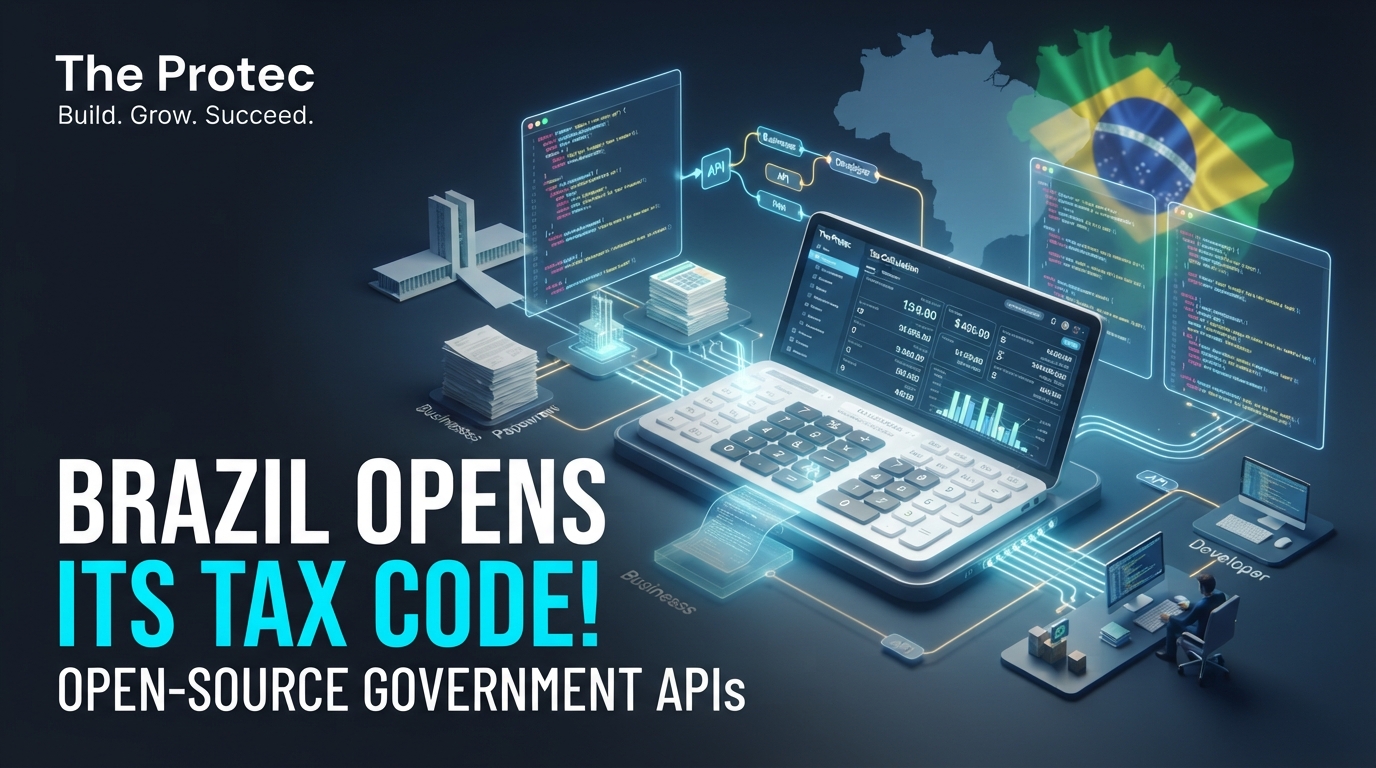
Tax engines are difficult to build not because multiplication is hard, but because legislation, classifications, exceptions, and effective dates must be translated into dependable software. The Brazil open-source tax calculator changes that equation: Receita Federal has published official calculation projects on GitHub under the permissive MIT license, giving developers direct access to government-maintained logic associated with Brazil’s consumption-tax reform.
This is more than a transparency gesture. It creates a potential reference implementation for software vendors, ERP providers, accounting platforms, and internal engineering teams that must calculate and document the new CBS and IBS taxes. Instead of interpreting every rule independently, developers can inspect official code, exercise its APIs, reproduce results, and evaluate how the logic fits into production systems.
What Receita Federal released on GitHub
According to the official Receita Federal announcement, the publication covers three projects with distinct responsibilities:
- Regular tax-regime calculator: A Java-based service implementing calculations for organizations outside Simples Nacional, including logic related to the new consumption-tax framework.
- Simples Nacional calculator: A separate Java project addressing the simplified regime, where calculation requirements and taxpayer treatment differ from the regular regime.
- DANFSe generation service: A Go-based application for producing the auxiliary document associated with Brazil’s national electronic service invoice, the NFS-e.
The separation is important. A calculation engine answers questions about taxable values and resulting amounts, while a document generator turns validated invoice information into a standardized representation. Keeping those concerns in distinct projects can make testing, deployment, and future maintenance more manageable.
The repositories are available through the Receita Federal GitHub organization. Developers should consult the repositories themselves for current documentation, branches, release history, configuration, and supported API behavior because those details can change after publication.
Why the release matters for Brazil tax reform software
Brazil’s consumption-tax reform introduces CBS and IBS taxes into an already demanding compliance environment. CBS is the federal contribution on goods and services, while IBS is the tax on goods and services administered within the new subnational framework. Their implementation requires systems to account for tax classifications, calculation bases, rates, credits, invoice data, and rules that may vary by transaction or effective period.
For software companies, the central challenge is consistency. If dozens of vendors independently translate the same legal provision, subtle differences can appear in rounding, validation, interpretation, or the order of operations. Those discrepancies can flow into invoices, ledgers, reports, and tax filings.
An official open-source tax calculator provides a common technical reference. It does not eliminate every legal or operational question, but it gives teams executable code against which they can compare their own implementation. That is materially more useful than a prose specification alone: engineers can submit inputs, inspect outputs, trace decisions, and construct regression tests around known behavior.
Inside the technological architecture
Java calculation services and REST APIs
The two calculation projects use Java and expose tax functionality as services. A service-oriented design allows a tax engine to remain separate from the ERP, billing system, or accounting application consuming it. The calling platform can send transaction data through a REST API integration and receive a structured calculation response without embedding every rule in its own codebase.
That separation also supports centralized updates. Rather than modifying several applications whenever official logic changes, an organization could update a dedicated tax-calculation service and have multiple systems call the same version. Whether that architecture is appropriate will depend on latency, availability, data-governance, and deployment requirements.
The projects also provide visibility into official tax tables and validation logic. For developers, this is as significant as the formulas themselves. A production calculation depends on valid codes, applicable rates, dates, and correctly structured electronic invoice information. Validation can identify inconsistent or incomplete input before an incorrect amount propagates through downstream processes.
The Go-based DANFSe generator
The third project addresses DANFSe, the auxiliary document for the national NFS-e. Implemented in Go, it focuses on document generation rather than serving as another tax engine. This gives invoicing platforms a government-published implementation to study when transforming NFS-e information into the expected auxiliary output.
A DANFSe generator can be useful to municipal service-invoice platforms, payment and billing products, accounting tools, and ERP modules that need consistent document presentation. However, generating an auxiliary document is not the same as authorizing an invoice. Integrators must preserve the distinction between calculation, validation, issuance, authorization, and document rendering.
How ERP and financial platforms could use the code
The most obvious application is ERP tax integration. When a sales order or invoice reaches the tax-calculation stage, the ERP could map its internal transaction model to the calculator’s API contract, submit the relevant fields, and store the returned result with the transaction.
Other practical uses include:
- Invoicing systems: Calculate CBS and IBS values before constructing electronic invoice data, then validate totals and classifications.
- Accounting platforms: Reconcile posted amounts against results produced by the official calculation logic.
- Billing applications: Separate commercial pricing from statutory tax calculation while retaining a traceable calculation record.
- Compliance products: Run batch checks to identify records that differ from the official implementation.
- Software testing: Use the government code as an oracle for comparison tests during Brazil tax reform software updates.
Teams do not necessarily have to adopt the projects unchanged. One company might deploy a calculator as an internal service, another might place an adapter in front of its REST API, and a third might use the source only to verify an existing engine. The right approach depends on transaction volume, infrastructure, security controls, and the need to support historical rule versions.
A developer workflow for inspecting and integrating the repositories
Open code is valuable only when teams evaluate it systematically. A sound integration process should include the following steps.
- Inspect repository structure and history. Review documentation, source directories, dependency definitions, examples, tests, issues, commits, and tags. Confirm which branch or release is intended for evaluation rather than assuming the default branch is production-ready.
- Understand the API contract. Identify required and optional fields, data types, enumerations, response objects, error formats, rounding behavior, and validation rules. Pay particular attention to dates and tax classifications because they often determine which rule applies.
- Run the service in an isolated environment. Follow the repository’s current build and configuration instructions. Record runtime versions, external resources, environment variables, and any official tables required for repeatable execution.
- Create representative test cases. Test ordinary transactions as well as exemptions, discounts, invalid codes, missing fields, boundary values, and rounding scenarios relevant to the business. Do not rely only on successful examples included with a repository.
- Build an integration adapter. Avoid coupling the ERP’s entire domain model directly to an external API schema. An adapter can map internal products, parties, jurisdictions, and invoice fields to the service contract while insulating the core application from later interface changes.
- Preserve calculation evidence. Store the calculator version, request data, response, timestamp, and relevant rule or table version where permitted. That record supports troubleshooting and auditability.
- Plan version control and rollback. Pin tested versions rather than deploying unreviewed changes automatically. Use regression suites to compare results before an upgrade and retain a rollback path.
For high-volume systems, teams should also test concurrency, response times, failure handling, and retry behavior. A tax calculation API may sit in the critical path for checkout or invoice issuance, so timeouts and unavailable dependencies need explicit treatment. Caching can improve performance for reference data, but calculated transaction results should not be reused without confirming that all tax-relevant inputs are identical.
What the MIT license enables
The MIT license is short and permissive. In general, it allows organizations to use, copy, modify, distribute, and incorporate the software into commercial products, subject to preserving the required copyright and license notice. That flexibility makes the release relevant to both open-source projects and proprietary financial software development.
A vendor can create adapters, add observability, package the service for its infrastructure, or incorporate selected logic into a broader platform. The license reduces the friction that a restrictive or custom government license might create.
More broadly, MIT license software can reduce duplicated implementation effort. Instead of every vendor privately recreating the same baseline formulas, engineering resources can move toward integration quality, testing, user experience, and support for business-specific workflows.
Auditability, reproducibility, and the limits of official code
Publication improves auditability because calculation behavior can be inspected rather than treated as a black box. Given the same code version, reference data, configuration, and inputs, teams can attempt to reproduce the same result. A commit history can also show how implementation changes over time.
Those advantages do not make deployment risk-free. An official repository should not automatically be treated as a hosted service, a service-level guarantee, legal advice, or certification that a particular deployment is compliant. The MIT license also includes warranty and liability limitations.
Before production use, developers should verify:
- Whether the repository reflects the latest enacted regulation and official technical guidance.
- How tax tables and effective dates are updated and versioned.
- Which runtime, database, network, and security requirements apply.
- Whether authentication, authorization, logging, monitoring, and privacy controls must be added.
- How fixes and breaking API changes will be communicated.
- Whether internal tax and legal specialists approve the resulting workflow.
This distinction is essential: government-authored logic can be authoritative as a technical reference while still requiring an organization to validate its own facts, classifications, operational controls, and regulatory obligations.
A broader model for open-source government software
Receita Federal’s move points toward a different relationship between regulation and software. Governments traditionally publish laws, manuals, schemas, and technical notes, leaving the private sector to produce executable interpretations. Publishing source code and API-oriented services adds another layer: regulation can be accompanied by inspectable implementation.
If maintained effectively, this model could support faster tax compliance automation, more consistent vendor behavior, and better feedback between public agencies and developers. Public repositories also make defects and ambiguities easier to discuss with precise examples rather than abstract descriptions.
The larger opportunity is open-source public infrastructure: reusable code, documented government APIs, versioned rules, and testable reference implementations that private systems can integrate without surrendering control of their architecture. Brazil’s release does not resolve every challenge of CBS and IBS implementation, but it offers a concrete foundation for a more transparent and automated compliance ecosystem.
Frequently asked questions
Is the Brazil open-source tax calculator free for commercial use?
The projects are published under the MIT license, which generally permits commercial use, modification, and distribution when its notice requirements are followed. Companies should still have counsel review license compliance for their distribution model.
Does the calculator replace tax or legal advice?
No. It provides official source code and calculation logic, but a taxpayer remains responsible for correct transaction data, classifications, configuration, and compliance. Regulatory and technical updates must also be monitored.
Can an ERP call the calculator through a REST API?
The Java calculation services are designed around REST APIs, making service-based ERP integration possible. Developers should review the current API contract and build a tested mapping layer between the ERP data model and required inputs.
Are the regular regime, Simples Nacional, and DANFSe tools interchangeable?
No. The calculators address different tax regimes, while the Go-based DANFSe project generates an auxiliary NFS-e document. Each project should be evaluated for its stated purpose and integrated into the appropriate stage of the invoicing or compliance workflow.