








Contents
- 1 Apple A20 Pro Chip AnTuTu Score: What to Expect
- 2 Quick Benchmark Snapshot
- 3 Why the A20 Pro Benchmark Could Be So Strong
- 4 Expected Apple A20 Pro Chip Specs
- 5 Expected A20 Pro AnTuTu Score Breakdown
- 6 How the A20 Pro May Compare With Snapdragon 8 Elite Gen 5
- 7 Real-World Performance: What the Numbers Mean
- 8 What Could Affect the Final A20 Pro AnTuTu Score?
- 9 Should You Care About Benchmark Numbers?
- 10 Final Verdict
- 11 FAQ
Apple A20 Pro Chip AnTuTu Score: What to Expect
The Apple A20 Pro chip is already drawing attention from performance-focused users, even before its official launch details fully settle. If you are searching for the A20 Pro AnTuTu score, the key question is not just how high the number may go, but what that number means in day-to-day speed, gaming, thermals, and sustained performance. Apple’s Pro-class silicon has typically set the tone for mobile performance, and the A20 Pro is expected to continue that pattern with a stronger focus on efficiency, AI acceleration, and GPU throughput.
In this article, we break down the expected Apple A20 Pro chip benchmark numbers, the architectural changes that could drive them, and how the chip may compare with Qualcomm’s Snapdragon 8 Elite Gen 5. Since benchmark leaks and early estimates can vary widely, the most useful approach is to focus on realistic score ranges, likely gains over the previous generation, and how those results translate into actual user experience.
For readers who want a benchmark-first summary: the A20 Pro is widely expected to land in the top tier of mobile performance, potentially pushing well beyond current flagship scores in CPU, GPU, and AI-heavy workloads. But raw benchmark numbers only tell part of the story.
Quick Benchmark Snapshot
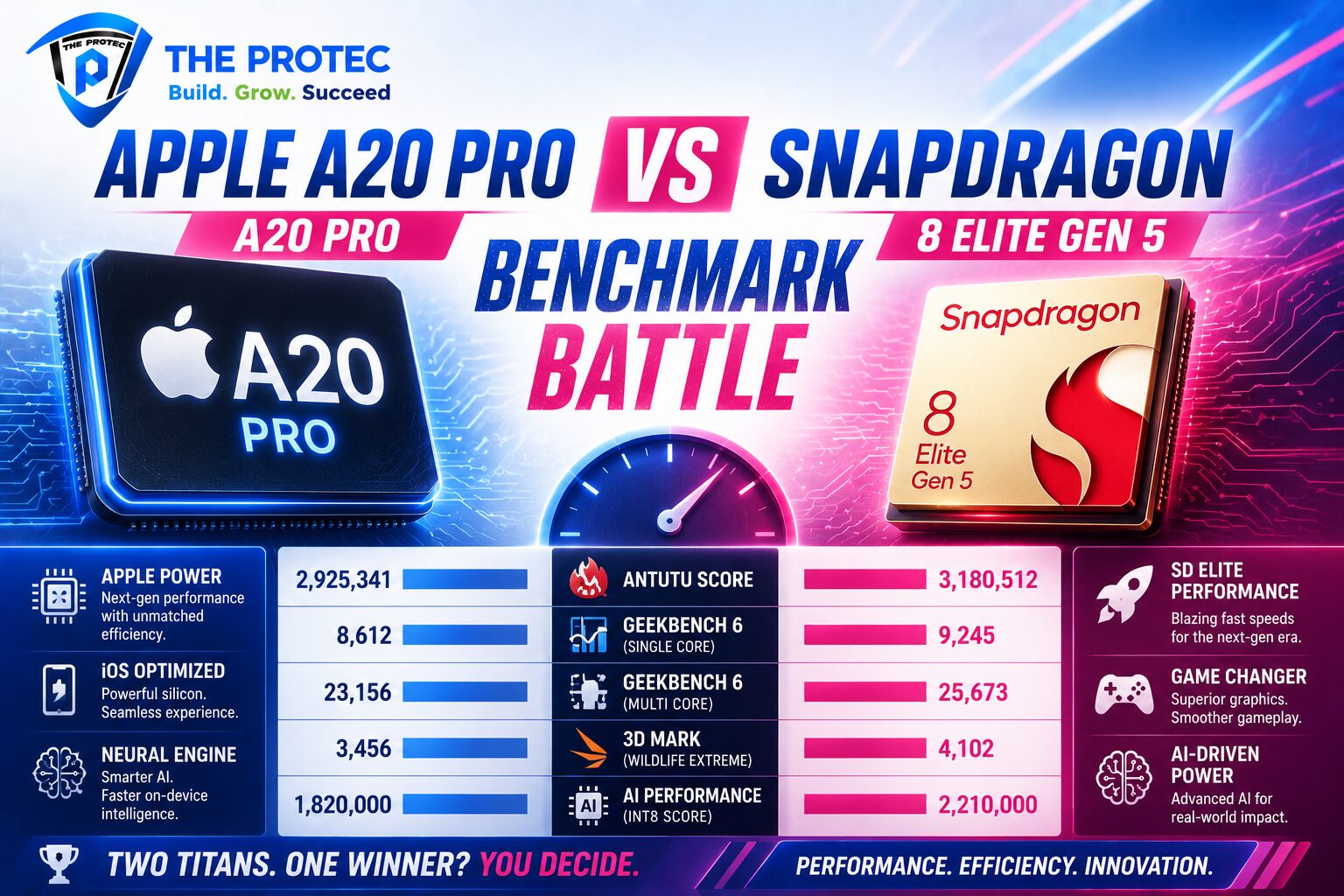
Below is a practical estimate of the A20 Pro chip’s likely performance in popular benchmark suites. These are forecast ranges based on Apple’s historical scaling, process-node improvements, and expected core redesigns. Final numbers can shift depending on cooling, device thickness, iOS tuning, and test conditions.
| Benchmark | Estimated A20 Pro Score | What It Means |
|---|---|---|
| AnTuTu v10 | 2,650,000 – 3,050,000 | Elite-tier overall performance with strong CPU, GPU, memory, and UX results |
| Geekbench 6 Single-Core | 3,800 – 4,300 | Very strong app launch speed and snappy everyday responsiveness |
| Geekbench 6 Multi-Core | 10,800 – 12,800 | Major uplift in multitasking, video editing, and productivity workloads |
| 3DMark Wild Life Extreme | 6,500 – 8,200 | High-end gaming performance with improved sustained graphics output |
| AI/ML Workloads | Top-tier uplift | Faster on-device AI tasks such as photo editing, transcription, and generative features |
Why the A20 Pro Benchmark Could Be So Strong
Apple’s silicon roadmap has consistently focused on a few pillars: architectural efficiency, a powerful integrated GPU, tightly controlled memory architecture, and deep OS optimization. The A20 Pro chip benchmark expectations are built around the idea that Apple will continue refining these strengths rather than chasing headline core counts alone.
Compared with previous generations, the A20 Pro is expected to benefit from a more advanced fabrication process, better transistor density, and a refined CPU cluster layout. The result should be better sustained performance at lower power levels, which matters more than short benchmark bursts. In real phones, especially slim flagships, thermal throttling is often the difference between impressive peak scores and genuinely superior long-session performance.
Another major factor is Apple’s control over the entire stack. Because hardware and software are designed together, the A20 Pro does not need to rely on generic Android tuning to achieve peak performance. That often gives Apple an advantage in consistency, app optimization, and battery efficiency under mixed workloads.
Expected Apple A20 Pro Chip Specs
Exact specifications remain unconfirmed, but the most realistic expectations for the A20 Pro chip point to a high-efficiency design with upgraded CPU cores, a stronger GPU block, and a more capable neural engine. Here is a likely spec profile based on current industry direction and Apple’s recent silicon strategy.
| Spec Area | Expected A20 Pro Direction |
|---|---|
| Process Node | Next-generation advanced node with improved power efficiency |
| CPU Design | Refined performance cores and efficiency cores for better burst and sustained work |
| GPU | Upgraded integrated graphics with stronger ray-tracing and gaming efficiency |
| Neural Engine | Faster on-device AI processing for generative tools and smart system features |
| Memory | Improved bandwidth and latency for better app switching and pro workflows |
| Thermal Behavior | Better sustained output under load, especially in thicker Pro models |
Architecture Improvements That Matter Most
- Higher IPC: A better instructions-per-cycle design can raise real performance without huge power penalties.
- Improved efficiency cores: Everyday tasks may run more smoothly while consuming less battery.
- Next-gen GPU pipeline: Gaming, video effects, and 3D rendering should scale upward noticeably.
- AI acceleration: More local processing can speed up smart features without depending as heavily on cloud services.
- Thermal optimization: Lower heat means fewer performance drops during long sessions.
Expected A20 Pro AnTuTu Score Breakdown
AnTuTu is useful because it combines CPU, GPU, memory, and user-experience scoring into one number. For the A20 Pro, the most important detail is not just the total score but the balance between all four sub-scores. A chip that wins only in CPU but falls behind in graphics will not feel like a true flagship leader.
| AnTuTu Category | Estimated Score Range | Performance Takeaway |
|---|---|---|
| CPU | 850,000 – 980,000 | Fast app launches, quick exports, and excellent general responsiveness |
| GPU | 950,000 – 1,150,000 | Strong gaming performance and better sustained frame rates |
| Memory | 420,000 – 520,000 | Improved multitasking and reduced lag when switching between heavy apps |
| UX | 380,000 – 450,000 | Smoother animations, quicker app behavior, and more responsive system feel |
| Total | 2,650,000 – 3,050,000 | Top-end flagship score with strong real-world efficiency |
These estimates place the A20 Pro chip performance in the premium flagship tier, potentially above many current Android competitors in single-core speed and app responsiveness. The total score may also reflect better balance than some chips that rely on very high peak GPU numbers but weaker CPU efficiency.
How the A20 Pro May Compare With Snapdragon 8 Elite Gen 5
The Snapdragon 8 Elite Gen 5 is expected to be one of the strongest Android flagship chips, especially in high-refresh gaming phones and performance-oriented devices. The comparison with Apple A20 Pro is particularly interesting because both chips are likely to focus on AI, graphics, and efficiency rather than only raw CPU frequency.
In a direct benchmark comparison, the A20 Pro may hold an edge in single-core CPU performance and system responsiveness, while Snapdragon 8 Elite Gen 5 could be extremely competitive in GPU-heavy scenarios depending on the device’s cooling and OEM tuning. Android flagships often vary more because manufacturers can choose different thermal designs, memory configurations, and software overlays. Apple’s advantage usually comes from tighter hardware-software integration and more predictable performance across devices.
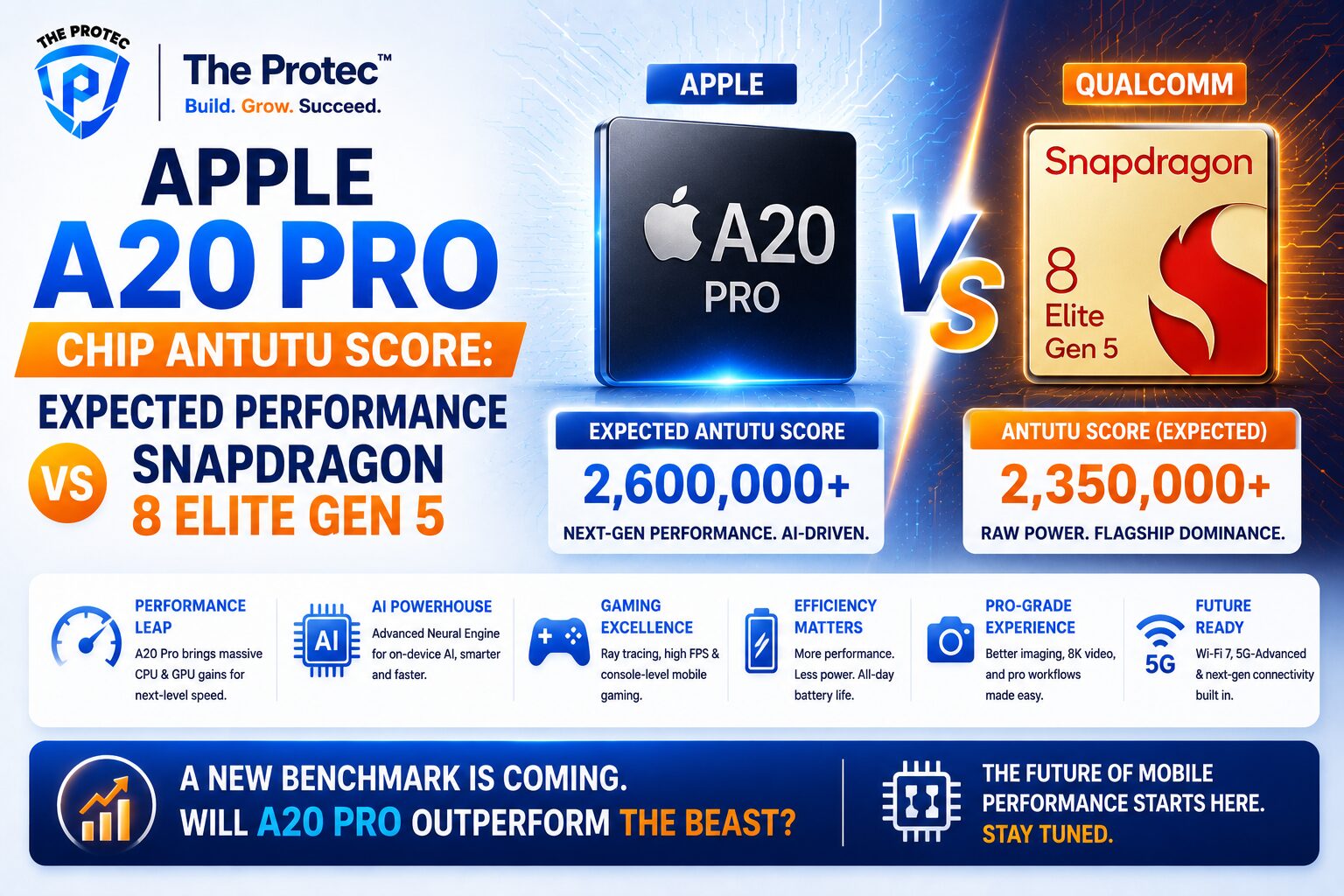
| Metric | Apple A20 Pro | Snapdragon 8 Elite Gen 5 |
|---|---|---|
| AnTuTu Total | 2.65M – 3.05M | 2.55M – 3.00M |
| Single-Core CPU | Likely stronger | Very strong, but usually slightly behind Apple in peak IPC |
| Multi-Core CPU | Excellent | Excellent, with some devices potentially matching or exceeding under ideal cooling |
| GPU Gaming | Very strong and efficient | Potentially equal or better in some sustained Android gaming phones |
| AI Performance | High local AI throughput | High local AI throughput with broad Android ecosystem support |
| Thermal Consistency | Usually more predictable | Depends heavily on OEM cooling solution |
If you want the short version: the A20 Pro chip benchmark may lead in single-threaded tasks and overall system smoothness, while Snapdragon 8 Elite Gen 5 could shine in device-specific gaming tuning and flexibility. For most users, both chips will be more than fast enough, but benchmark enthusiasts will care about how each chip performs under sustained load, not just in short tests.
Real-World Performance: What the Numbers Mean
Benchmark scores are useful, but they only matter if they translate into faster, smoother experiences. The A20 Pro chip performance is expected to stand out in several real-world scenarios.
Everyday Use
App launches should feel immediate. Social feeds, messaging, email, and web browsing will likely see little to no lag. The A20 Pro’s strongest advantage may be how quickly it transitions between tasks without noticeable stutter, especially when paired with high-refresh displays and optimized iOS animations.
Gaming
High-end games should run at excellent frame rates with strong image quality. The real test will be heat management during long sessions. If Apple improves GPU efficiency and sustained thermal output, the A20 Pro could be one of the best mobile gaming chips for stable performance rather than just peak bursts.
Content Creation
Video editing, photo processing, and large file exports are areas where the A20 Pro could show measurable gains. Faster CPU cores and better memory bandwidth can reduce export times, while AI acceleration can speed up noise reduction, object removal, and smart editing tools.
On-Device AI
Modern flagship chips are increasingly judged by how well they handle AI locally. The A20 Pro is expected to support a faster neural pipeline for transcription, image generation features, personalization, and other smart system functions. That matters because local AI is usually faster, more private, and less dependent on network connectivity.
What Could Affect the Final A20 Pro AnTuTu Score?
It is important to remember that benchmark scores can vary a lot before retail phones ship. The same chip can score differently depending on the device and test conditions. Here are the biggest factors that could influence the final A20 Pro AnTuTu score:
- Thermal design: Better cooling can keep scores higher for longer.
- Battery state: Low power mode or thermal constraints can reduce benchmark results.
- iOS optimization: Final software tuning often changes scores materially.
- Device size: Larger Pro models may sustain performance better than thinner versions.
- Benchmark version: Different AnTuTu builds can produce different totals.
That is why early leaks should be treated as directional rather than absolute. A single leaked score is not enough to judge the chip. Averages from multiple devices and multiple runs usually give a far better picture.
Should You Care About Benchmark Numbers?
If you are choosing between flagship phones, benchmark numbers can be helpful, but they should not be the only factor. The A20 Pro chip benchmark will tell you how powerful the silicon is on paper, but the real value lies in consistency, battery life, app optimization, and how the phone handles demanding tasks over time. A device with a slightly lower peak score but better thermals may feel faster after 20 minutes of gaming or video editing than a hotter device with a higher one-time score.
For most buyers, the A20 Pro matters because it is likely to deliver an excellent mix of speed and efficiency. For enthusiasts, the benchmark race against Snapdragon 8 Elite Gen 5 will be especially interesting because it highlights two different philosophies: Apple’s tight, vertically integrated approach versus Qualcomm’s broader platform strategy across multiple Android makers.
For deeper benchmark context, you can also review the official AnTuTu benchmark platform and Qualcomm’s chipset updates at Qualcomm Snapdragon.
Final Verdict
The Apple A20 Pro chip is shaping up to be one of the most anticipated mobile processors of the coming flagship cycle. Based on current expectations, the A20 Pro AnTuTu score could land in the 2.65 million to 3.05 million range, placing it firmly among the fastest mobile chips available. More importantly, the chip is expected to improve not only peak performance but also real-world responsiveness, thermal stability, gaming consistency, and on-device AI speed.
Against Snapdragon 8 Elite Gen 5, the A20 Pro may continue Apple’s pattern of leading in single-core performance and smoothness while staying extremely competitive in graphics and sustained workloads. If Apple delivers the architecture improvements currently expected, the A20 Pro chip performance could make it one of the most balanced and powerful smartphone chips yet.
For benchmark watchers, the headline number will matter. But for everyone else, the real story is whether the A20 Pro turns those numbers into a faster, cooler, and more capable phone experience.
FAQ
What is the expected A20 Pro AnTuTu score?
The expected A20 Pro AnTuTu score is estimated to fall between 2,650,000 and 3,050,000, depending on the device, thermal design, and software tuning.
How does the Apple A20 Pro chip benchmark compare to Snapdragon 8 Elite Gen 5?
The Apple A20 Pro chip benchmark is likely to lead in single-core CPU performance and system smoothness, while Snapdragon 8 Elite Gen 5 could be highly competitive in GPU-heavy workloads and Android-specific tuning.
Will the A20 Pro be better for gaming?
Yes, the A20 Pro should be excellent for gaming thanks to improved GPU performance and efficiency. The biggest difference will likely come down to how well the phone handles heat during long sessions.
Why do A20 Pro benchmark scores vary so much before launch?
Early scores can vary because of prototype hardware, unfinished software, thermal limits, and differences in benchmark versions. Retail phones usually provide the most reliable results.
Is AnTuTu enough to judge A20 Pro chip performance?
No. AnTuTu is useful for comparison, but real-world performance also depends on battery life, thermal management, app optimization, and how the chip behaves over time.