








Contents
- 1 PostgreSQL vs MySQL: The database decision developers still get wrong
- 2 Quick verdict: which database should developers choose?
- 3 Core differences in the PostgreSQL vs MySQL comparison
- 4 Performance: which database is faster?
- 5 Scalability: how each database grows with your application
- 6 AI workloads: why the database choice matters more now
- 7 Data modeling and developer experience
- 8 Reliability, consistency, and transaction handling
- 9 Cloud support and managed services
- 10 Cost and operational overhead
- 11 When MySQL is the smarter choice
- 12 When PostgreSQL is the smarter choice
- 13 Final recommendation: PostgreSQL vs MySQL in modern development
- 14 FAQ
PostgreSQL vs MySQL: The database decision developers still get wrong
Choosing between PostgreSQL vs MySQL is still one of the most important architecture decisions a development team can make. Both are mature, battle-tested open-source databases with huge communities, strong tooling, and broad cloud support. Yet they are not interchangeable. The right choice depends on how your application handles transactions, schema complexity, scaling, analytics, and increasingly, AI-related workloads.
In many teams, the decision gets reduced to a simple slogan: MySQL is faster, PostgreSQL is more advanced. That shorthand is not useless, but it is incomplete. Modern applications demand more than raw query speed. They need flexible data models, reliable concurrency, observability, JSON support, vector search, and the ability to grow without forcing a painful migration later. That is why the best database 2026 discussion is really a discussion about fit, not hype.
This article breaks down the PostgreSQL vs MySQL debate from a developer’s perspective, with a focus on performance, scalability, and AI workloads. If you are building SaaS products, APIs, internal tools, data-heavy applications, or ML-powered features, this database comparison will help you decide which system makes the most sense.
Quick verdict: which database should developers choose?
If your application needs advanced querying, complex joins, strong consistency, extensibility, or support for AI and analytics features, PostgreSQL is usually the better long-term choice. If you are building a straightforward web application, a read-heavy product, or a system where simplicity and familiar operational patterns matter most, MySQL remains a very strong option.
In practice, the decision often looks like this:
- Choose PostgreSQL for complex data models, analytics, geospatial data, JSON-heavy applications, and vector search.
- Choose MySQL for simpler relational workloads, content platforms, high-read web apps, and teams that value operational familiarity.
- Choose both carefully only when your organization has a real reason to split data systems, not because one database is trendy.
For most greenfield projects with modern requirements, PostgreSQL has become the default recommendation among many senior developers. But MySQL is still an excellent choice when your needs are straightforward and you want an efficient, well-understood relational database with minimal overhead.
Core differences in the PostgreSQL vs MySQL comparison
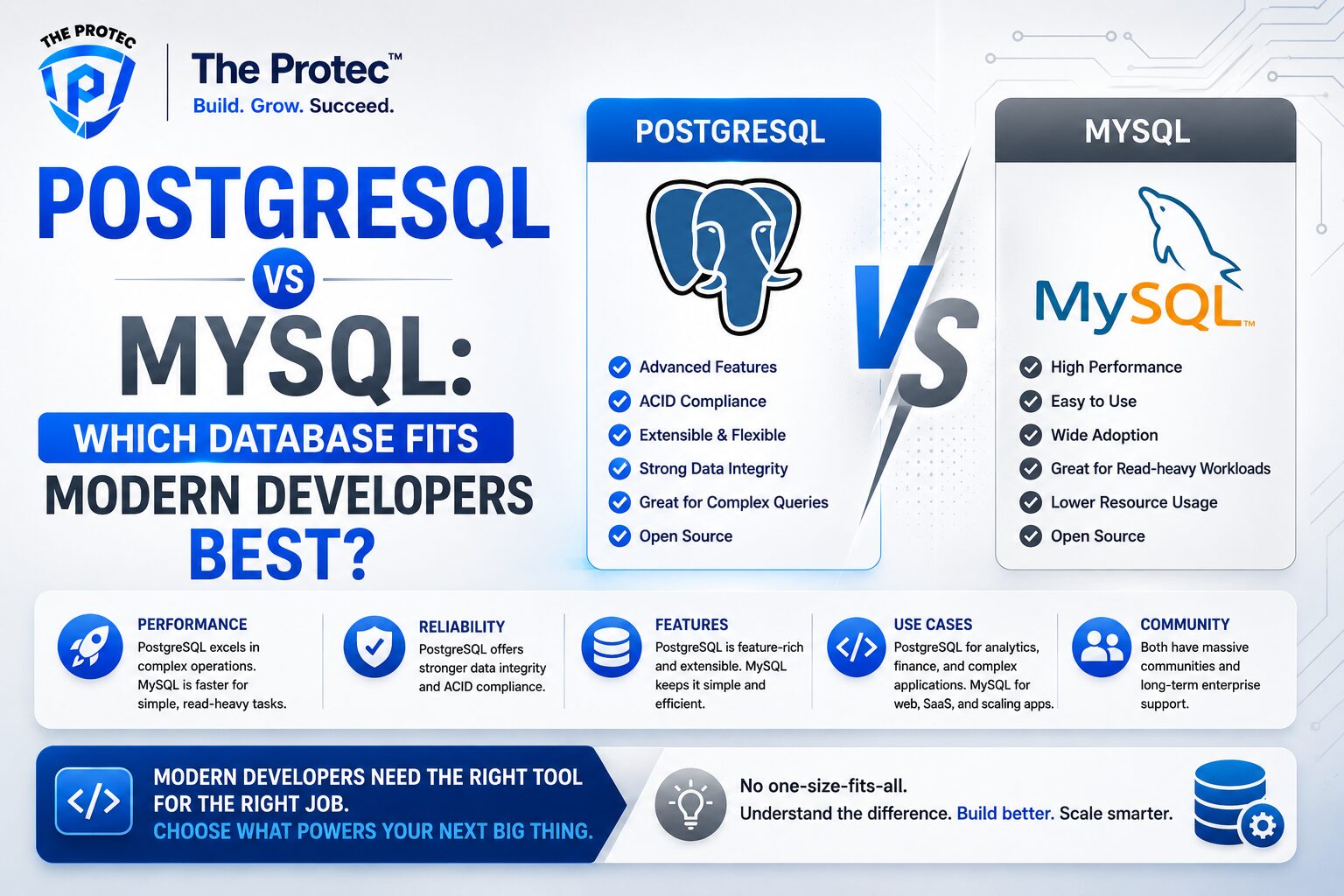
At a high level, PostgreSQL is known for standards compliance, extensibility, and feature depth. MySQL is known for simplicity, speed in common workloads, and operational ease. Both have improved dramatically over the years, but their philosophies remain distinct.
PostgreSQL is often described as an object-relational database, which reflects its richer type system and extensibility model. It supports custom data types, advanced indexing options, sophisticated constraints, and powerful query planning. MySQL is more traditionally relational and often feels easier to get running quickly, especially for teams that want a predictable setup with fewer knobs.
The practical takeaway is simple: PostgreSQL gives developers more expressive power, while MySQL often gives teams a smoother path for basic relational workloads.
Performance: which database is faster?
Performance is the most misunderstood part of the PostgreSQL vs MySQL debate. The right answer is not that one database is always faster. It depends on the workload.
Where MySQL often shines
MySQL performs very well in read-heavy applications with relatively simple queries. Many CMS-driven sites, ecommerce catalogs, and content platforms benefit from its ability to serve standard relational requests efficiently. Its execution patterns can be straightforward, and teams often appreciate how little effort is needed to get solid baseline performance.
For workloads dominated by indexed lookups, simple joins, and high concurrency from web traffic, MySQL can feel extremely responsive. In practical terms, if your application mostly fetches a user record, loads a product page, or retrieves a list of posts, MySQL is often more than enough.
Where PostgreSQL often wins
PostgreSQL tends to pull ahead when queries become more complex. Its planner is highly capable, and its support for advanced joins, window functions, common table expressions, and richer indexing strategies gives developers more leverage as data models grow. If your product needs reporting queries, aggregation-heavy dashboards, or multi-step filtering across several related tables, PostgreSQL often performs better in real-world conditions.
PostgreSQL also handles mixed workloads well. It can support transactional writes, analytical queries, and application traffic in a more balanced way than many teams expect. That flexibility matters when a product evolves beyond its original MVP.
The real performance lesson
Performance problems usually come from poor schema design, missing indexes, bad query patterns, or unbounded growth, not from the database brand itself. The best database 2026 for one team may be the wrong choice for another because of application shape, query complexity, and operational skill.
If you benchmark carefully, you will often find that MySQL is excellent for straightforward throughput, while PostgreSQL is more consistent as complexity rises. That is why developers should test realistic production queries instead of relying on generic benchmarks.
Scalability: how each database grows with your application
Scalability is about more than handling more traffic. It includes schema evolution, operational resilience, read replicas, partitioning, and the ability to support new features without redesigning the data layer.
MySQL scalability strengths
MySQL has long been popular in horizontally scaled web architectures. It is widely supported by managed cloud services, replication tools, and operational playbooks. For teams building systems with a high proportion of reads, MySQL replicas can be an effective way to spread load.
Its ecosystem also makes it a comfortable choice for teams that want a straightforward path from local development to production. If your application is mostly CRUD, and your scaling strategy relies on read replicas and caching, MySQL remains highly practical.
PostgreSQL scalability strengths
PostgreSQL has made major gains in scalability, especially in managed cloud environments. Features like table partitioning, logical replication, parallel query execution, and strong support for extension-driven architecture make it very attractive for products that grow in both size and complexity.
PostgreSQL is especially useful when scaling is not just about traffic but about data variety. As applications add event logs, search-like filtering, time-series data, JSON documents, and analytical features, PostgreSQL often reduces the need to bolt on separate systems too early.
This is one of the biggest reasons developers increasingly choose PostgreSQL as the best database 2026 for modern product development. It scales not only in size but also in capability.
AI workloads: why the database choice matters more now
AI workloads have changed the database conversation. Applications increasingly need to store embeddings, support semantic search, combine structured and unstructured data, and power retrieval-augmented generation workflows. That means the database is no longer just a place to store user records. It is part of the AI application stack.
PostgreSQL and AI readiness
PostgreSQL has become especially popular in AI-centric development because of its extensibility. The ecosystem around vector search, embedding storage, and hybrid retrieval has matured quickly. The pgvector extension has become a common path for teams that want to keep transactional data and vector data in the same system. See the project details at pgvector on GitHub.
This matters because many AI products do not need a separate heavyweight vector database on day one. A team can start with PostgreSQL, store embeddings alongside metadata, and build useful retrieval workflows without adding operational sprawl. PostgreSQL also handles JSON very well, which makes it a strong fit for AI application data that mixes structured records with prompt logs, tool outputs, and model responses.
MySQL and AI workloads
MySQL can absolutely support AI-enabled applications, especially when the core need is still relational storage. However, it is generally less compelling for vector-first or hybrid retrieval architectures. Teams often end up pairing MySQL with another specialized service sooner if they need advanced semantic search or richer indexing strategies around embeddings.
If your AI feature set is light, such as tagging, classification metadata, or storing model output alongside user records, MySQL can work well. But if AI is becoming central to the product, PostgreSQL usually offers a cleaner and more future-proof foundation.
Data modeling and developer experience
Developer experience matters because the database shapes how quickly teams can ship. PostgreSQL and MySQL differ noticeably in how they support modeling, validation, and querying.
PostgreSQL advantages for developers
PostgreSQL is often favored by engineers who want strong constraints and expressive schema design. It supports rich data types, including arrays, JSONB, ranges, enums, and custom types. That flexibility helps teams model real-world data without awkward workarounds.
Its JSONB support is particularly useful for modern applications. Instead of splitting every semi-structured field into separate tables too early, developers can keep flexible document-like data where it belongs while still benefiting from indexing and query performance. This is a major reason PostgreSQL has become the default for many startups and platform teams.
MySQL advantages for developers
MySQL is often easier for teams that want a predictable relational model and a gentle learning curve. Many developers already know it from web hosting, LAMP-style stacks, and common CMS environments. Its simplicity can be an advantage when you want to avoid overengineering.
For teams building standard applications with familiar patterns, MySQL can reduce cognitive overhead. That can translate into faster development, fewer schema debates, and simpler onboarding.
Reliability, consistency, and transaction handling
Reliability is another area where PostgreSQL tends to stand out. It is known for strong ACID compliance, robust transaction behavior, and excellent consistency guarantees. For applications where data correctness is critical, that depth matters.
MySQL also supports ACID transactions and can be highly reliable, especially when configured correctly. But PostgreSQL is often preferred for systems where transactional integrity and sophisticated concurrency control are non-negotiable, such as financial workflows, booking systems, and operational dashboards with complex updates.
Developers choosing between PostgreSQL vs MySQL should ask not only which database is faster, but which one will be easier to trust when the system is under pressure.
Cloud support and managed services
Both databases are widely available through major cloud providers and managed database platforms. That means the old operational barriers are much lower than they used to be.
MySQL is often the most familiar managed relational database in cloud environments, and many teams appreciate how easy it is to provision. PostgreSQL support is equally strong across most major platforms, and in many cases the managed PostgreSQL experience has become especially polished.
The practical difference is that PostgreSQL often benefits more from managed features because its ecosystem is so extension-friendly. Teams can adopt advanced capabilities without self-managing every component. That makes it easier to build sophisticated products without heavy infrastructure work.
Cost and operational overhead
Cost is not just license expense. It includes engineering time, scaling effort, maintenance, and the hidden cost of future migration.
MySQL can be cheaper in the short term if your team already knows it well and your data model is simple. PostgreSQL can be cheaper in the long term if it reduces the need for separate tools, custom workarounds, or a later migration to support features your product eventually needs.
This is where many teams get tripped up. They pick the simpler database for the first version of the app, then discover that analytics, JSON processing, or AI retrieval features require a more capable system. Replatforming later is expensive. If your roadmap includes complexity, PostgreSQL is often the more economical choice over time.
When MySQL is the smarter choice
MySQL is still the right answer for many teams. Choose it when your application is relatively simple, your schema is stable, and your main priority is a straightforward relational database with broad support and familiar operational patterns.
- Your app is mostly CRUD with predictable queries.
- You want a widely understood default in web hosting and SaaS stacks.
- You prioritize easy onboarding and simple operations.
- You do not need advanced query features or AI-friendly extensibility yet.
In these cases, MySQL may be the best database choice because it solves the problem cleanly without extra complexity.
When PostgreSQL is the smarter choice
PostgreSQL is the better fit when your team expects the product to evolve quickly or when the application already has complex data needs.
- You need complex joins, reporting, or analytics.
- You plan to use JSON heavily, or mix structured and semi-structured data.
- You want a strong foundation for embeddings, vector search, or AI retrieval.
- You care about extensibility and future-proof schema design.
For modern product teams, PostgreSQL often becomes the default because it offers more room to grow without forcing architectural compromises.
Final recommendation: PostgreSQL vs MySQL in modern development
So, which database should developers choose? The honest answer is that both PostgreSQL and MySQL are excellent, but PostgreSQL is usually the more capable long-term platform for modern application development. It tends to win on query sophistication, schema flexibility, analytics support, and AI readiness. MySQL remains a strong, practical option for simpler relational systems and teams that value operational familiarity.
If you are starting a new product today and expect it to grow beyond basic CRUD, PostgreSQL is often the safest bet. If you are building a lean web app with predictable access patterns, MySQL may be the better fit. The best database 2026 is not the one with the loudest reputation. It is the one that matches your workload, your team, and your roadmap.
The smartest developer decision is to choose the database that minimizes future friction. For many modern teams, that means PostgreSQL. For many straightforward applications, that still means MySQL. The key is to make the choice intentionally, not by habit.
FAQ
Is PostgreSQL better than MySQL for most new applications?
For many new applications, yes. PostgreSQL is often better when you expect complex queries, flexible schemas, analytics, or AI-related features. MySQL is still excellent for simpler apps and read-heavy workloads.
Which database performs better for large-scale applications?
It depends on the workload. MySQL can perform very well for simple, read-heavy systems. PostgreSQL usually performs better as query complexity, data variety, and feature requirements increase.
Is PostgreSQL good for AI applications?
Yes. PostgreSQL is widely used for AI applications because it handles JSON well and supports vector search workflows through extensions like pgvector. That makes it a strong choice for retrieval-augmented generation and embedding-based systems.
Should startups choose PostgreSQL or MySQL?
Many startups choose PostgreSQL because it offers more flexibility as the product evolves. If the app is very simple and the team already knows MySQL well, MySQL can still be a perfectly good choice.
Can I migrate from MySQL to PostgreSQL later?
Yes, but migration can be costly if your application has grown large or has MySQL-specific assumptions. If you expect advanced requirements later, it is often better to choose PostgreSQL earlier.