








Contents
- 1 The AI Chip War Is No Longer About Hype
- 2 Why the AI Semiconductor Market Is So Valuable
- 3 NVIDIA: Still the Benchmark in AI Hardware Dominance
- 4 AMD: The Most Credible Challenger in the NVIDIA AMD Intel AI Race
- 5 Intel: Can the CPU Giant Become an AI Chip Contender?
- 6 AI Chips Comparison: Performance, Software, and Ecosystem
- 7 Who Has the Strongest Position in Training?
- 8 Who Can Win Inference?
- 9 The Hidden Factor: Custom Silicon and Customer Diversification
- 10 So Who Will Win the AI Chip War?
- 11 Bottom Line
- 12 FAQ
The AI Chip War Is No Longer About Hype
The battle for AI hardware dominance has moved far beyond benchmark bragging rights. What started as a race to accelerate machine learning workloads has become a full-scale struggle for control over the AI semiconductor market, spanning training clusters, inference engines, edge devices, and the cloud infrastructure that powers modern AI products. Today, the real question is not whether AI chips matter. It is which company can build the most complete stack of silicon, software, packaging, and ecosystem support to win the next phase of the AI economy.
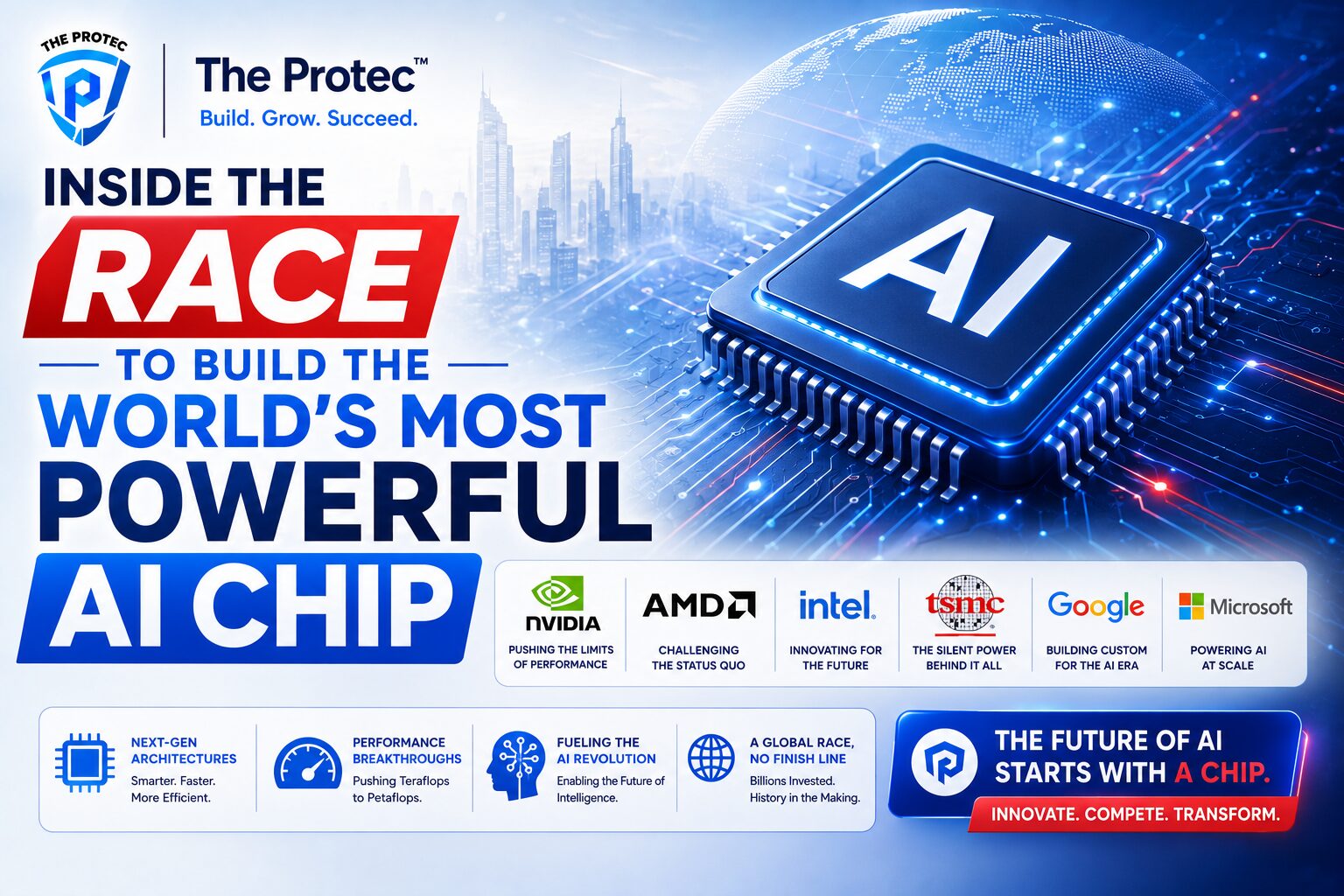
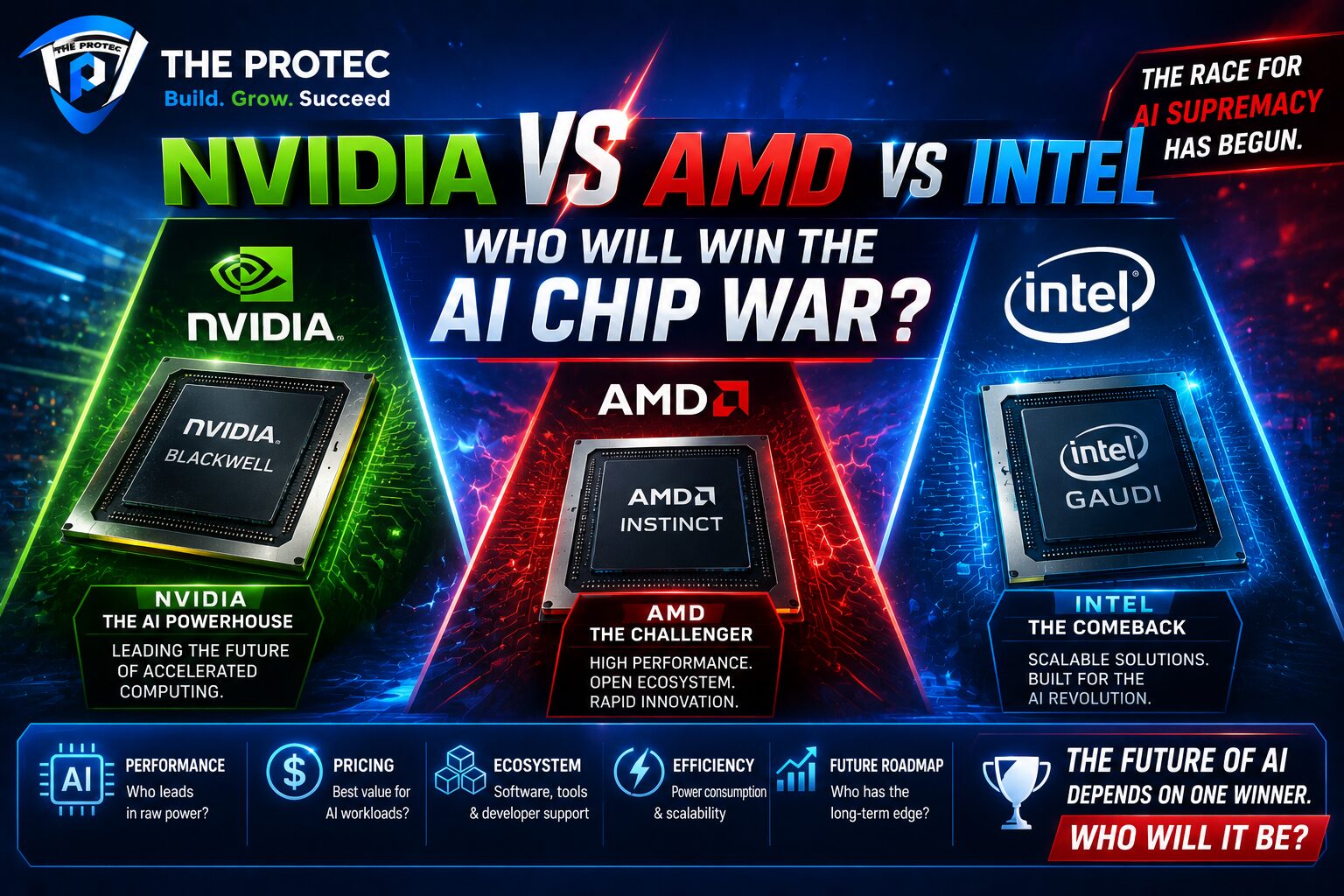
That is why the NVIDIA vs AMD vs Intel AI debate matters so much. NVIDIA remains the benchmark for high-end training and enterprise AI deployment. AMD is pushing aggressively with competitive performance, a stronger open software story, and increasingly credible data center ambitions. Intel, meanwhile, is trying to turn its manufacturing scale, CPU dominance, and packaging capabilities into a broader AI platform strategy. This AI chips comparison is no longer just about GPUs. It is about the total architecture of AI infrastructure.
As of June 2026, the market is being shaped by a few powerful trends: hyperscalers are diversifying suppliers, inference is growing faster than training in many deployments, custom silicon is rising, and buyers are becoming more careful about total cost of ownership. That shift changes the competitive dynamics. A company can no longer win by having the fastest chip alone. It must deliver supply, software, memory bandwidth, power efficiency, developer adoption, and a clear roadmap.
Why the AI Semiconductor Market Is So Valuable
The AI semiconductor market is one of the most strategically important markets in technology because every major AI application depends on compute. Large language models, image generation, recommendation systems, autonomous systems, robotics, scientific computing, and enterprise copilots all require specialized hardware to run efficiently. The companies that dominate AI chips capture not just revenue from silicon, but also recurring demand from cloud providers, model builders, and enterprise platforms.
Unlike traditional consumer processors, AI accelerators are sold into systems where the chip is only part of the value. Memory, networking, cooling, software, and cluster design all matter. This makes the market harder to disrupt and more defensible for incumbents with strong platforms. It also means that the winner may not simply be the fastest chip vendor, but the company that best integrates the entire AI stack.
- Training workloads reward raw compute, memory bandwidth, and interconnect.
- Inference workloads reward efficiency, latency, cost per token, and deployment flexibility.
- Enterprise AI buyers care about availability, support, software stability, and security.
- Cloud providers care about rack density, power consumption, and scale economics.
That is the context for evaluating NVIDIA, AMD, and Intel. Each company is approaching the AI chip race from a different position, and each has strengths that matter in specific parts of the market.
NVIDIA: Still the Benchmark in AI Hardware Dominance
NVIDIA remains the company everyone else is chasing. Its biggest advantage is not just the performance of its GPUs, but the depth of its ecosystem. CUDA, its software stack, libraries, developer tools, and system-level integration have created a moat that is still difficult to match. For many customers, choosing NVIDIA is less about liking the company and more about minimizing risk.
In high-end AI training, NVIDIA continues to set the standard. Its newest data center platforms are built to handle massive model sizes, demanding memory requirements, and tightly coupled multi-node clusters. The company has also pushed hard into networking, systems, and full-rack solutions, which is important because the AI chips comparison is increasingly about platform performance rather than isolated chip specs.
NVIDIA’s strength is especially clear in three areas:
- Software ecosystem: CUDA and the surrounding stack remain deeply embedded in AI development workflows.
- Platform breadth: NVIDIA sells GPUs, networking, inference platforms, and integrated systems.
- Developer trust: Engineers know the tooling, documentation, and optimization paths.
That said, NVIDIA is not invincible. Its dominance has encouraged customers to diversify. Hyperscalers want bargaining power. Startups want lower-cost alternatives. Enterprises want more supply options. And as AI workloads shift more toward inference, cost efficiency becomes more important than maximum performance. NVIDIA still leads, but the market is no longer willing to accept single-vendor dependence as a given.
For a useful industry benchmark, see NVIDIA’s own data center and AI platform information on the official site: NVIDIA Data Center.
AMD: The Most Credible Challenger in the NVIDIA AMD Intel AI Race
AMD has become the most serious challenger to NVIDIA in the AI semiconductor market. For years, AMD was discussed as the underdog in accelerators, but that picture has changed. The company has invested heavily in its Instinct line, improved its software ecosystem, and positioned itself as the alternative for buyers who want strong performance without complete dependence on NVIDIA.
AMD’s opportunity is especially large in data centers where customers want more leverage. Cloud providers and large enterprises are increasingly open to multi-vendor deployments, and AMD is well positioned to benefit from that shift. Its chips are attractive where buyers are focused on memory capacity, throughput, and cost efficiency rather than absolute ecosystem lock-in.
One of AMD’s most important strategic moves has been improving its software story. Historically, software friction made it hard to gain share in AI. Today, AMD’s ROCm platform is much more mature, and the company has worked to make its tools more accessible to developers. That does not erase NVIDIA’s advantage, but it narrows the gap enough for serious evaluation in large deployments.
AMD’s case in the AI chips comparison comes down to value and openness:
- Competitive hardware: AMD’s accelerators are increasingly capable in training and inference.
- Better economics: Buyers often see AMD as a path to lower total cost of ownership.
- Growing ecosystem: ROCm and broader software support continue to improve.
The key question is whether AMD can convert technical progress into durable market share. The answer depends on execution, supply, and how quickly the company can win confidence with the biggest AI buyers. If NVIDIA is the default, AMD is the most plausible alternative default.
For more on AMD’s AI and data center strategy, the official source is a good reference point: AMD Accelerators.
Intel: Can the CPU Giant Become an AI Chip Contender?
Intel enters the NVIDIA vs AMD vs Intel AI conversation from a different starting point. Unlike NVIDIA and AMD, which are primarily known for GPU acceleration in AI, Intel has long dominated the CPU side of the data center. That gives Intel a major installed base, long-standing enterprise relationships, and deep expertise in manufacturing and packaging. But it also means Intel has had to adapt from being the central compute vendor to being one part of a much broader accelerator ecosystem.
Intel’s AI strategy depends on more than just one chip. It spans CPUs with stronger AI capabilities, accelerators for specific workloads, and advanced packaging approaches that connect different compute blocks efficiently. This matters because many AI deployments are hybrid systems. Not every workload needs a massive GPU cluster. Some run best on CPUs, especially when latency, cost, or integration with existing enterprise infrastructure is important.
Intel’s challenge is credibility in the highest-end AI accelerator market. The company has the scale, relationships, and manufacturing ambitions to compete, but it still must prove that its AI hardware can match the pace of software adoption and performance scaling that NVIDIA has already established. Intel’s advantage is breadth; its weakness is that breadth can look unfocused if the product roadmap does not deliver clearly superior outcomes.
Intel is strongest in:
- Enterprise deployment: It has deep roots in the systems many companies already run.
- CPU-plus-accelerator workflows: Many AI workloads still need strong host processors.
- Packaging and integration: Intel’s manufacturing and advanced packaging could support future AI platforms.
Intel can matter a great deal in the AI semiconductor market, but its path is different. It is less about overtaking NVIDIA head-on with one category-defining accelerator and more about becoming indispensable in mixed infrastructure, inference-heavy deployments, and systems where CPU and accelerator integration is a differentiator.
AI Chips Comparison: Performance, Software, and Ecosystem
To understand who will win the AI chip war, it helps to compare the companies on the factors that actually influence buying decisions. Raw FLOPS are important, but they are only one piece of the puzzle. In practice, customers evaluate a mix of hardware capability, software maturity, supply assurance, and deployment economics.
1. Performance
NVIDIA still tends to lead at the top end, especially in large-scale training and integrated platform performance. AMD is narrowing the gap and can look very compelling in value-sensitive deployments. Intel is competitive in certain enterprise and CPU-adjacent AI roles, but it is not yet the first choice for frontier-model training.
2. Software ecosystem
This is NVIDIA’s strongest moat. CUDA remains the center of gravity for a huge portion of AI development. AMD’s ROCm has improved meaningfully, which is essential for share gains. Intel has software assets, but it has not yet built the same level of developer gravity in AI accelerators.
3. Memory and interconnect
Modern AI chips live or die by how effectively they move data. Memory bandwidth, capacity, and interconnect architecture can determine whether theoretical chip performance translates into real-world throughput. NVIDIA has invested heavily here, AMD has been competitive, and Intel is trying to differentiate through system integration and packaging.
4. Supply and scalability
In a constrained market, the ability to ship at scale matters enormously. Buyers do not just want the best chip on paper; they want enough volume to build systems on time. This is where diversification benefits AMD and Intel, while NVIDIA must continuously prove it can meet enormous demand without weakening customer trust.
5. Total cost of ownership
The AI semiconductor market is becoming more cost-conscious. Energy use, cooling, cluster efficiency, developer time, and utilization rates all feed into the cost equation. This is where AMD and Intel can find openings, especially in inference and enterprise deployments.
Who Has the Strongest Position in Training?
Training remains the most visible part of the AI arms race because it powers the largest frontier models. In this segment, NVIDIA is still the clear leader. Its software stack, memory architecture, networking solutions, and cluster-level optimization make it the most trusted choice for the most demanding workloads. The largest labs and cloud platforms continue to rely heavily on NVIDIA because training failures are expensive and delays are even more costly.
AMD is the most relevant challenger in training, particularly for customers willing to validate alternatives and optimize their stacks. It can win where buyers want more flexibility and better economics. Intel, by contrast, has a much harder path in frontier training, though it may still play a role in surrounding infrastructure and host systems.
So if the question is pure training leadership, NVIDIA wins today. But training is no longer the only battlefield that matters.
Who Can Win Inference?
Inference is where the market may shift the fastest. As AI applications move from experimentation to production, inference workloads grow rapidly. Many of these deployments are sensitive to latency, throughput, and cost per request. That opens the door for more competition.
AMD has a strong opportunity here because buyers care deeply about price-performance and scalability. Intel also has room to compete, especially in enterprise environments where existing infrastructure and hybrid CPU-based deployments matter. NVIDIA remains strong in inference too, but the economics of the market make it easier for challengers to gain footholds.
This is a crucial point in the NVIDIA AMD Intel AI debate: the biggest chip vendor may not automatically control the most profitable inference deployments if customers can reach similar outcomes for less money.
The Hidden Factor: Custom Silicon and Customer Diversification
One of the biggest forces reshaping the AI chip war is the rise of custom silicon. Large cloud providers and major technology companies increasingly want chips tailored to their own workloads. These custom accelerators do not eliminate the need for NVIDIA, AMD, or Intel, but they do change buying behavior. They reduce dependence on off-the-shelf accelerators and make the market more fragmented.
At the same time, customers are diversifying suppliers to avoid bottlenecks. Even companies that heavily use NVIDIA are exploring secondary options. That does not mean NVIDIA is losing; it means the market is maturing. Buyers want resilience, price competition, and negotiating leverage. AMD benefits most from this trend, while Intel may benefit in systems where custom CPU and accelerator combinations are attractive.
The AI chips comparison becomes more nuanced in this environment. The winner may not be the one with the biggest share of all AI hardware, but the one with the largest share of strategically important deployments.
So Who Will Win the AI Chip War?
If “win” means dominating the highest end of AI training and maintaining platform leadership, NVIDIA is still the frontrunner. Its ecosystem remains unmatched, and its brand has become synonymous with AI acceleration. That is an extraordinary position to defend.
If “win” means becoming the most credible alternative and taking meaningful share from the incumbent, AMD looks best positioned. It has momentum, a clearer value proposition, and a growing role in diversified procurement strategies. AMD does not need to beat NVIDIA everywhere to be successful. It needs to become indispensable in enough large deployments to reshape the market.
If “win” means leveraging the enormous enterprise installed base to participate deeply in AI infrastructure, Intel still has a path. It will likely not be the singular winner in high-end accelerators, but it could become a major systems player in enterprise AI, edge AI, and hybrid compute environments.
The most realistic conclusion is that the AI semiconductor market will not have a single winner. NVIDIA will likely remain the leader. AMD will likely keep closing the gap and win share where economics matter. Intel may carve out important roles in enterprise and system-level AI. The war is not about a knockout punch. It is about who can own the most valuable parts of the AI stack over time.
Bottom Line
In the current AI chips comparison, NVIDIA has the strongest overall position, AMD has the sharpest challenge, and Intel has the broadest but most difficult transformation ahead. The market is large enough for all three to matter, but not equally. NVIDIA still defines the premium tier of AI hardware dominance. AMD is the most likely beneficiary of diversification. Intel’s success will depend on whether it can turn its scale into a convincing AI platform strategy.
For buyers, the best choice depends on workload, budget, software commitment, and deployment scale. For the industry, the next phase of the AI semiconductor market will be shaped by inference growth, custom silicon, supply chains, and software ecosystems as much as raw chip performance. That is what makes this race so important—and why it is still far from over.
FAQ
Is NVIDIA still the leader in AI chips?
Yes. NVIDIA remains the leader in high-end AI training and has the strongest software ecosystem, which gives it a major advantage in enterprise and cloud deployments.
Can AMD beat NVIDIA in the AI semiconductor market?
AMD is unlikely to overtake NVIDIA everywhere, but it can win significant market share by offering competitive performance, better economics, and a more open software story.
Does Intel have a real chance in AI hardware?
Intel has a real chance in enterprise AI, hybrid deployments, and systems-level integration, but it faces a harder challenge in frontier accelerator leadership.
Which company is best for AI inference?
It depends on the workload. NVIDIA is strong across the board, AMD is increasingly attractive for cost-sensitive inference, and Intel can be compelling in enterprise environments tied to CPU infrastructure.
What is the biggest factor in the AI chips comparison?
The biggest factor is not raw performance alone. Software ecosystem, total cost of ownership, memory bandwidth, supply, and deployment scalability are equally important in deciding who wins AI workloads.