








Contents
- 1 AI Operating Systems Are Coming: How Computers Will Work Without Traditional Apps
- 2 What Is an AI Operating System?
- 3 Why the Future of Computers Is Moving Beyond Apps
- 4 How an AI Powered OS Changes Everyday Computing
- 5 The Technical Foundations Behind AI First Operating Systems
- 6 What Happens to Traditional Apps?
- 7 How AI Operating Systems Could Change Work
- 8 Benefits of an AI Powered OS
- 9 Challenges and Risks That Still Need Solving
- 10 What This Means for Businesses and Developers
- 11 The Next Interface Is the OS Itself
- 12 FAQ
AI Operating Systems Are Coming: How Computers Will Work Without Traditional Apps
The way we use computers is about to change more in the next few years than it has in decades. For most of the modern era, computing has been built around a simple idea: you open an app, click through menus, and manually complete a task. Want to write a document? Open a word processor. Need to edit a photo? Open a separate app. Booking a meeting, summarizing a file, comparing prices, drafting an email, analyzing data, and managing files all depend on switching between dozens of isolated tools.
That model is starting to break down. A new class of software is emerging: the AI operating system. Instead of asking users to hunt for the right app, an AI powered OS can understand intent, orchestrate tools, and complete multi-step tasks across the entire device. In practical terms, this means the future of computers may be less about launching applications and more about giving outcomes as instructions.
This shift is not just a design trend. It reflects major advances in large language models, multimodal AI, local inference, agentic workflows, and on-device personalization. As these capabilities mature, operating systems are evolving from passive infrastructure into active assistants that can reason, plan, and act on behalf of the user.
That does not mean apps disappear overnight. But it does mean the dominant interface may no longer be a grid of icons. Instead, the computer itself becomes the interface.
What Is an AI Operating System?
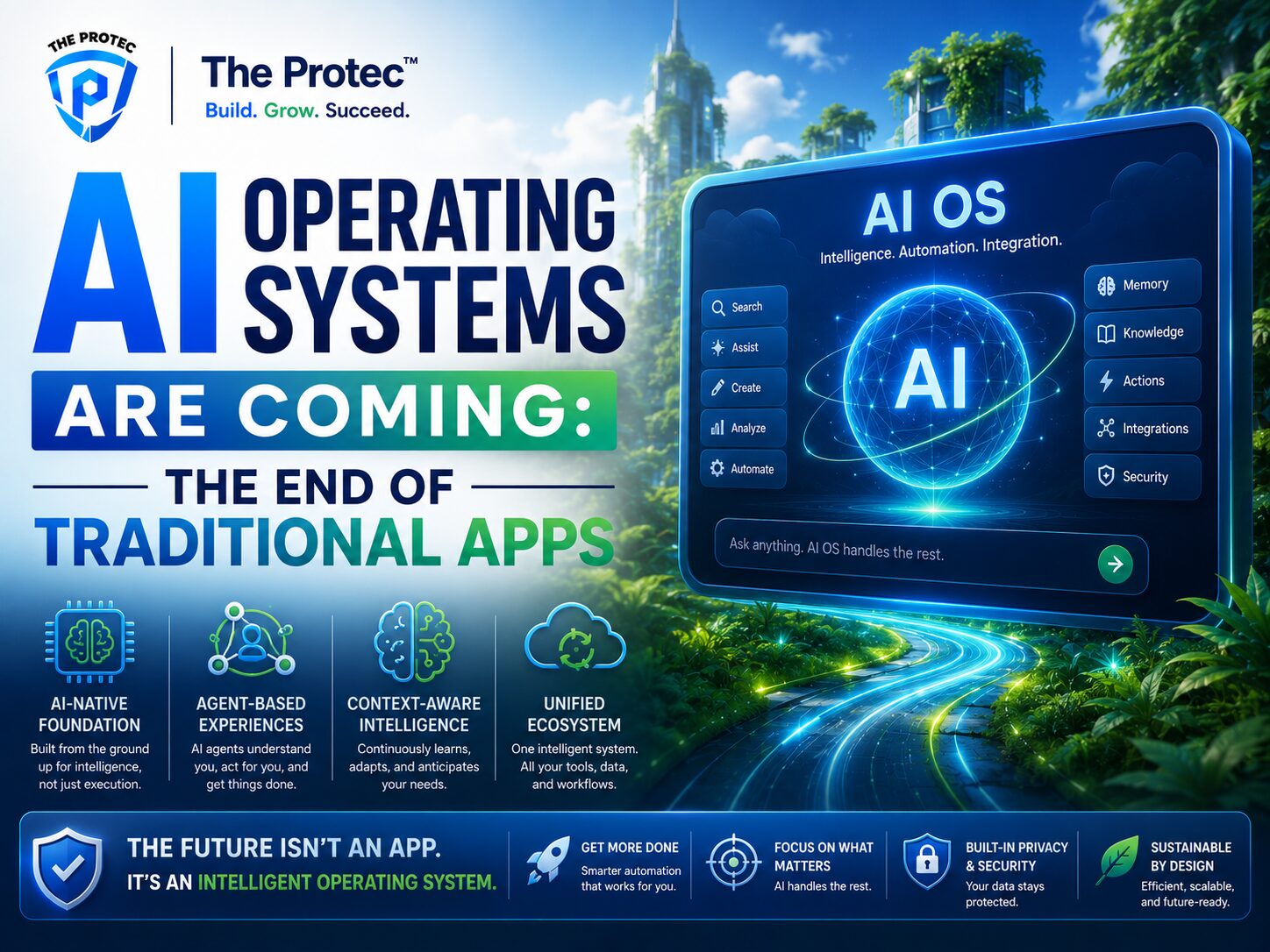
An AI operating system is a computing environment where intelligence is built into the core experience, not bolted on as a feature. Traditional operating systems manage hardware, memory, files, and processes. An AI powered OS adds a layer that understands user goals, context, and patterns of behavior, then uses that understanding to complete tasks more intelligently.
Think of the difference between a traditional OS and an AI-first OS this way:
- A traditional OS helps you access tools.
- An AI operating system helps you achieve outcomes.
Instead of manually opening five apps to research a topic, summarize notes, draft a report, and send a message, you might simply say, “Prepare a client update from this week’s documents and send a draft to the team.” The OS could find the relevant files, extract key points, generate a summary, format it appropriately, and suggest the next action.
This is a profound change in computing architecture. It shifts the primary interaction model from app-centric navigation to agentic orchestration. The computer becomes less like a toolbox and more like a capable collaborator.
Why the Future of Computers Is Moving Beyond Apps
Traditional apps were created for a world where software could only do what users explicitly clicked. That made sense when interfaces were limited and computing power was scarce. But today, users expect faster, more natural, and more context-aware interactions. App-based workflows often create friction because they force people to translate goals into steps.
For example, if a user wants to plan a trip, they may need to switch between maps, travel booking apps, calendars, note-taking tools, messaging apps, and payment systems. Each app holds part of the workflow, but none of them understands the entire intention. The user becomes the integration layer.
The future of computers is likely to remove that burden. AI-first systems can unify fragmented tasks by interpreting the user’s objective and coordinating the right services behind the scenes. This is especially powerful for work that depends on context: writing, scheduling, research, purchasing, collaboration, customer service, and data analysis.
The reason this transition is accelerating now is simple: AI is no longer limited to content generation. Modern models can reason over long contexts, process images, voice, and documents, call tools, and increasingly operate as agents. That makes it possible for operating systems to become task managers rather than mere launchers.
How an AI Powered OS Changes Everyday Computing
An AI powered OS would not just change one or two features. It would reshape the entire daily relationship between people and devices. Here are some of the biggest differences.
Instead of opening apps one by one, users state what they want. The system figures out the sequence of actions required. This reduces cognitive load and makes computing accessible to more people, including those who struggle with complex interfaces.
2. Context becomes persistent
Current apps often operate in silos. An AI operating system can maintain context across tasks, files, communications, and preferences. That means it can remember that a document relates to a meeting, that a spreadsheet belongs to a project, or that a travel request should follow a company policy.
3. Workflows become adaptive
Traditional software follows fixed paths. AI-first systems can adapt to changing conditions. If a meeting is rescheduled, the OS can update the agenda, notify participants, and adjust related reminders automatically.
4. Automation becomes conversational
Rather than configuring complex rules, users can describe automation in natural language. The OS can then convert that request into executable actions. This lowers the barrier to automation dramatically.
5. Interfaces become multimodal
An AI operating system will likely respond to voice, text, touch, images, video, and gestures. Users may snap a photo, ask a question about it, and receive a task-specific answer in the same interface. The OS becomes a universal interaction layer.
The Technical Foundations Behind AI First Operating Systems
AI operating systems are possible because several technologies are converging at once. Each one solves part of the problem.
Large language models
LLMs provide natural language understanding and generation. They allow users to express goals in plain language while the system interprets meaning, context, and intent.
Agentic tool use
Modern AI systems can call tools, query databases, interact with APIs, and chain actions together. This is essential for an AI powered OS because the model must do more than talk; it must act.
Multimodal reasoning
Future operating systems need to understand more than text. Images, screenshots, documents, voice, video, and sensor data all provide useful context. Multimodal AI makes that possible.
On-device inference
Running AI locally improves speed, privacy, and reliability. It also lets the OS personalize behavior without sending every interaction to the cloud. This is becoming increasingly important as devices gain dedicated AI hardware.
Memory and personalization layers
An AI operating system becomes much more valuable when it remembers preferences, recurring tasks, and domain-specific patterns. The system can then anticipate needs instead of waiting for commands.
For a broader technical background on AI assistants and agentic workflows, Google’s overview of generative AI is useful: https://ai.google/discover/generativeai/. Apple’s platform direction also reflects the shift toward on-device intelligence: https://www.apple.com/apple-intelligence/.
What Happens to Traditional Apps?
Traditional apps will not vanish immediately. Some will remain essential because they provide specialized tools, deep controls, or regulated workflows. Creative professionals, engineers, healthcare teams, and enterprise users often need precise interfaces that AI alone cannot replace.
However, the role of apps is likely to change. Instead of being the primary interface, many apps may become back-end services that the AI operating system uses as needed. In other words, the app becomes infrastructure.
This is already visible in early trends. Users increasingly rely on copilots, assistants, and embedded AI features rather than opening separate software for every action. Productivity suites now summarize, draft, search, and analyze. Communication tools generate replies. File systems expose semantic search. Browsers increasingly behave like task surfaces rather than static windows.
The future could look like this:
- Apps still exist, but they are accessed through intelligent orchestration.
- Many routine tasks happen without launching a dedicated app at all.
- Users interact with a unified conversational layer that delegates work behind the scenes.
That means software design will shift from “How do users click through this app?” to “How should the OS complete this task intelligently?”
How AI Operating Systems Could Change Work
The workplace may be the first major arena where AI operating systems become indispensable. Knowledge workers spend enormous amounts of time moving information between tools. Email, documents, CRM systems, spreadsheets, calendars, project boards, and chat apps all need constant coordination.
An AI powered OS can collapse much of that overhead.
- Meetings: The OS schedules, prepares briefs, records notes, identifies action items, and drafts follow-up emails.
- Research: It collects sources, compares findings, and summarizes results in the format the user needs.
- Sales and support: It drafts replies, updates records, and surfaces relevant context from prior interactions.
- Operations: It handles routine approvals, alerts, status checks, and workflow handoffs.
This does not just save time. It changes the economics of digital labor. When a computer can manage repetitive coordination tasks, teams can focus more on judgment, creativity, and strategy. The most valuable skill may shift from operating software to directing intelligent systems.
Benefits of an AI Powered OS
The appeal of AI operating systems is easy to understand. They promise a more natural, efficient, and personalized computing experience.
- Less app switching: Users stay focused on goals instead of jumping between interfaces.
- Faster task completion: Multi-step actions can happen in one request.
- Better accessibility: Voice and natural language reduce interface complexity.
- Personalization: The OS can adapt to habits, preferences, and repeated workflows.
- Improved productivity: Routine work is automated or partially automated.
- Unified context: Files, conversations, schedules, and tasks become part of one intelligent layer.
In a well-designed AI operating system, the user feels less like they are managing software and more like they are directing a capable digital assistant that understands the whole environment.
Challenges and Risks That Still Need Solving
Despite the excitement, the AI operating system model comes with serious challenges. A system that can act on behalf of users must be trustworthy, transparent, and secure.
Privacy concerns
An OS that understands context across files, messages, and apps could become highly invasive if not designed carefully. Local processing, strong permissions, and clear controls will be essential.
Reliability and accuracy
AI systems can make mistakes, misread intent, or take the wrong action. The higher the stakes, the more important it becomes to build confirmation steps and audit trails.
Security risks
If an AI operating system can access tools and data, it becomes a valuable target. Permission boundaries, sandboxing, and robust identity controls will matter more than ever.
User trust
People will only hand over tasks if they believe the system is predictable and reversible. That means the best AI powered OS will not just be smart; it will be explainable.
Interoperability
The OS must work across services, formats, and ecosystems. If a platform is too closed, it may struggle to orchestrate the full range of tasks users expect.
These challenges are not reasons to dismiss the model. They are the design constraints that will determine which AI operating systems succeed.
What This Means for Businesses and Developers
The rise of AI operating systems will affect product strategy, application design, and digital workflows. Businesses should start thinking differently about how software is discovered and used.
Instead of optimizing only for app screens, teams should consider how their services can be understood and invoked by an AI layer. That may involve better APIs, structured data, tool-friendly interfaces, and more semantically rich content.
Developers will need to think in terms of capabilities rather than pages. If an AI powered OS is the front end, your product may need to expose actions such as:
- Search
- Create
- Summarize
- Compare
- Approve
- Schedule
- Notify
Organizations that adapt early will have an advantage. They will be easier for intelligent systems to integrate, recommend, and automate.
The Next Interface Is the OS Itself
The biggest change in the future of computers may be that the operating system becomes the primary interface again. In the app era, the OS faded into the background while software brands fought for attention. In the AI era, the OS becomes the brain that connects everything.
This does not mean the end of software diversity. It means the center of gravity shifts. Users will still need powerful tools, but they will interact with them through a smarter layer that understands what they want and how to get it done.
That is why the AI operating system matters. It is not just another feature category. It is a new computing model. One where the user says what they need, the system figures out the path, and traditional app boundaries become less important.
If that sounds like a small change, it is not. It is the difference between using a computer as a set of tools and using it as an intelligent partner.
FAQ
What is an AI operating system?
An AI operating system is a computing environment that uses built-in intelligence to understand user intent, manage context, and complete tasks across apps and services. It goes beyond traditional operating systems by acting as an orchestration layer.
Will traditional apps disappear?
Not entirely. Many specialized apps will remain important, but they may become secondary to AI-driven workflows. In many cases, users will access app functions through an AI layer rather than opening the app directly.
How is an AI powered OS different from a regular OS?
A regular OS manages files, memory, hardware, and processes. An AI powered OS adds reasoning, personalization, tool use, and task automation. It helps users achieve goals instead of just managing the device.
Why is the future of computers moving toward AI-first systems?
Because users want faster, more natural, and less fragmented workflows. AI-first systems reduce app switching, automate repetitive tasks, and make computing more conversational and context-aware.
Are AI operating systems safe?
They can be safe if they are designed with strong permissions, privacy controls, sandboxing, and user confirmation for sensitive actions. Security and trust will be central to adoption.