







Contents
- 1 The Rise of AI Employees: How Businesses Are Hiring Digital Workers
- 2 What Are AI Employees?
- 3 Why Businesses Are Hiring Digital Workers
- 4 AI Employees in Sales: Faster Lead Response and Smarter Follow-Up
- 5 AI Employees in Customer Support: Always-On Service at Lower Cost
- 6 AI Employees in Operations: The Quiet Productivity Revolution
- 7 What Makes a Digital Workforce Different from Traditional Automation?
- 8 How to Hire AI Employees Responsibly
- 9 Measuring ROI from AI Agents for Business
- 10 The Future of AI Employees and the Human Team
- 11 Conclusion
- 12 FAQ
The Rise of AI Employees: How Businesses Are Hiring Digital Workers
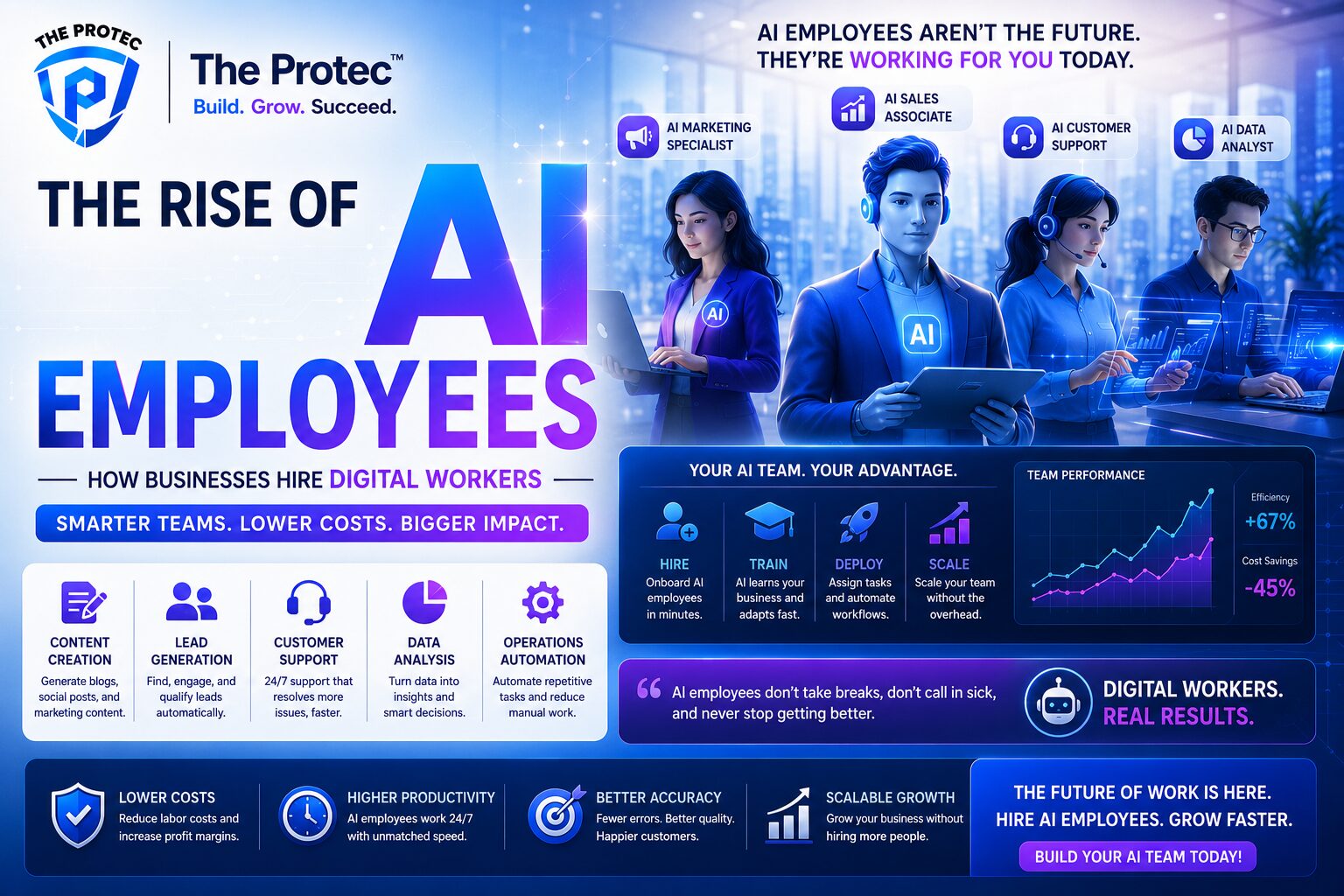
For years, businesses treated artificial intelligence as a helper: a chatbot on a website, a recommendation engine in a product feed, or an analytics layer inside a dashboard. That era is ending. In its place, a new model is taking hold—companies are beginning to hire AI employees as part of a broader digital workforce. These are not just tools that respond to prompts. They are autonomous AI agents for business that can execute tasks, make decisions within defined guardrails, and work continuously across sales, support, and operations.
This shift is one of the most important business technology trends of the moment. The reason is simple: leaders are under pressure to do more with leaner teams, faster response times, and lower operating costs. Traditional automation can help, but it often breaks when workflows get messy or when customer interactions require context. AI employees are different. They can handle multi-step work, adapt to changing inputs, and coordinate across systems in ways that feel closer to a digital team member than a scripted workflow.
By mid-2026, the conversation has moved beyond “Should we use AI?” to “Which roles should be handled by AI agents for business, and how do we manage them responsibly?” That question is reshaping how companies think about headcount, service levels, and scaling. In this article, we’ll explore what AI employees are, how they are being hired, where they create the most value, and what businesses need to know before building a digital workforce.
What Are AI Employees?
AI employees are autonomous or semi-autonomous software agents designed to perform specific business functions. Unlike a basic chatbot or a single-purpose automation, an AI employee can interpret intent, take action across multiple tools, and complete a workflow end-to-end. In practical terms, that may mean answering a customer request, updating a CRM record, generating a follow-up email, escalating a ticket, or triggering a fulfillment process.
The key difference is autonomy. A regular automation follows a fixed rule set. An AI employee can reason through a situation, decide what information is missing, ask for clarification, and continue the task. That makes them especially useful in environments where the workflow is dynamic rather than perfectly predictable.
Businesses usually deploy AI employees in one of three ways:
- Assistive mode: The AI suggests actions, drafts content, or prepares work for a human to approve.
- Supervised mode: The AI completes routine tasks but requires approval before sending messages or making changes.
- Autonomous mode: The AI handles defined processes on its own, with monitoring and exceptions managed by humans.
Across these modes, the goal is not to replace every person. The goal is to create a digital workforce that handles repetitive, time-sensitive work so human teams can focus on strategy, relationships, and judgment-heavy decisions.
Why Businesses Are Hiring Digital Workers
There are several reasons AI employees have moved from experimental projects to operational hires. First, labor shortages and rising costs have made scaling with traditional headcount more difficult. Second, customers now expect immediate responses at all hours, not just during business hours. Third, AI systems have become more capable, with better tool integration, stronger retrieval systems, and improved guardrails for enterprise use.
Businesses are also under pressure to improve consistency. Human teams do excellent work, but performance can vary based on workload, training, and turnover. AI employees can follow the same process every time. They do not get tired, they do not forget steps, and they can operate 24/7 across regions and time zones. For companies with global customers, that is a major advantage.
Another factor is the rise of agentic AI platforms. The latest wave of AI agents for business can connect to CRM systems, ticketing tools, knowledge bases, payment workflows, and internal databases. Instead of switching between five applications, an AI employee can coordinate across them. That creates a meaningful lift in productivity, especially in departments with high transaction volume.
There is also a strategic reason. Organizations that learn how to manage AI employees early are building an operational advantage. They can launch faster, respond faster, and absorb growth without immediately increasing overhead. In many sectors, that is becoming a competitive necessity rather than a nice-to-have.
AI Employees in Sales: Faster Lead Response and Smarter Follow-Up
Sales is one of the clearest use cases for AI employees because speed matters. Leads lose value quickly when teams wait too long to respond. An AI employee can qualify inbound leads, enrich records, route opportunities to the right rep, and send personalized follow-up messages within seconds.
In practice, a sales AI agent may monitor website forms, chat conversations, and email replies. Once a lead comes in, it can assess intent based on company size, budget signals, product fit, and urgency. It can then update the CRM, assign the lead, and draft a tailored response for the sales team. If the lead is high priority, the AI can notify the correct rep immediately.
More advanced AI agents for business can support pipeline management as well. They can identify stalled deals, suggest next steps, summarize call notes, and prepare account research before meetings. Some teams are using AI employees to create personalized outreach sequences based on industry, role, and engagement history. That means sales reps spend more time closing and less time on admin work.
The real value here is not just efficiency. It is consistency at scale. A digital workforce can ensure every inbound lead receives attention, every follow-up is tracked, and every account is monitored without gaps. For teams that want to increase conversion rates without dramatically expanding staff, AI employees are becoming an important part of the sales stack.
AI Employees in Customer Support: Always-On Service at Lower Cost
Customer support is another major area where AI employees are being hired. The best support teams are fast, accurate, and empathetic, but maintaining that level of service around the clock is expensive. Autonomous AI agents can handle high-volume, repetitive inquiries while escalating only the complex or sensitive cases to human agents.
Modern support AI employees do much more than answer FAQs. They can pull order status, look up account information, identify common troubleshooting steps, and recommend resolutions based on prior cases. If a request requires human involvement, the AI can gather the relevant context first, reducing back-and-forth between the customer and the support team.
This creates a better customer experience in several ways. Customers get immediate responses, even outside business hours. Human agents receive cleaner tickets with more complete details. And support leaders gain better visibility into issue patterns, because the AI employee can tag, classify, and summarize conversations at scale.
Businesses are also using AI employees to support multilingual service. A digital workforce can respond in different languages, maintain consistent tone, and route conversations to specialists when needed. That is especially valuable for growing companies that serve international markets but do not yet have large regional support teams.
Still, support automation needs careful design. The most effective AI agents for business are not left to improvise on sensitive issues. Instead, they are trained on approved knowledge sources, limited by policy rules, and monitored for accuracy. The strongest deployments combine AI speed with human empathy where it matters most.
AI Employees in Operations: The Quiet Productivity Revolution
While sales and support are visible to customers, operations is often where AI employees create the deepest internal impact. Operational work tends to be repetitive, cross-functional, and time-sensitive—exactly the kind of work that autonomous AI agents can handle well.
Examples include invoice validation, purchase order matching, appointment scheduling, document routing, inventory alerts, compliance checks, and internal request triage. An AI employee can review incoming documents, extract key fields, compare them with system records, and flag exceptions for human review. It can also coordinate between departments by sending notifications, updating task boards, and triggering approvals.
One of the biggest benefits in operations is reducing friction between systems. Many companies still rely on a patchwork of software tools that do not communicate cleanly. A digital workforce can bridge those gaps. Instead of asking employees to manually copy data from one system to another, AI agents for business can move information, validate it, and keep processes moving.
Operations teams are also using AI employees for internal service desks. HR questions, IT requests, vendor onboarding, and policy lookups can often be handled by an AI agent that knows where to find the right answer or when to escalate. This frees up specialists to focus on cases that truly require human attention.
What Makes a Digital Workforce Different from Traditional Automation?
Traditional automation is excellent at deterministic tasks. If X happens, then do Y. But businesses rarely run on perfectly deterministic workflows. Requests are incomplete, documents are inconsistent, customers change their minds, and systems fail. AI employees are designed for that reality.
A digital workforce can operate with more flexibility because it uses language understanding, tool use, and context retention. That means the AI can interpret a vague request, search for missing data, and adapt its path. It can also work across longer sequences of tasks. For example, a single AI employee might read a support ticket, check account status, draft a response, log the interaction, and schedule a follow-up if needed.
This is why the rise of AI employees matters so much. Businesses are not just automating steps. They are delegating work. The difference is subtle but profound. Delegation requires trust, oversight, and clear boundaries. That is where governance becomes essential.
How to Hire AI Employees Responsibly
Hiring digital workers is not just a technical decision. It is an operating model decision. Companies need to define what the AI employee is allowed to do, where human approval is required, and how performance will be measured.
A practical rollout usually starts with a narrow use case. Businesses often choose one process with clear volume, measurable outcomes, and low risk. Good starter candidates include lead routing, FAQ support, invoice classification, or internal request triage. Once the AI employee proves reliable, the scope can expand.
Before deployment, teams should answer a few questions:
- What exact outcome should the AI employee deliver?
- Which systems will it access?
- What actions require approval?
- How will errors be detected and corrected?
- Who owns oversight and policy updates?
Governance should include logs, audit trails, escalation rules, and clear fallback paths. Businesses should also maintain a human-in-the-loop process for sensitive matters such as refunds, legal communications, account changes, or employee-related decisions.
Security is equally important. AI employees often need access to customer data, internal knowledge, and business systems, so permissions should follow the principle of least privilege. The less access an AI agent needs, the lower the risk if something goes wrong.
Measuring ROI from AI Agents for Business
The return on investment for AI employees is usually visible in both hard and soft metrics. On the hard side, companies often measure reduced handling time, lower support cost per ticket, faster lead response, and fewer manual operations hours. On the soft side, they track customer satisfaction, employee satisfaction, and reduced burnout.
One useful approach is to compare the process before and after the AI employee is introduced. How long does it take to resolve a ticket? How many leads get missed after hours? How many hours does the operations team spend on manual data entry? These baseline metrics make the value easier to quantify.
Businesses should also measure accuracy and escalation quality. A digital workforce is only useful if it produces reliable outcomes. If the AI employee saves time but creates cleanup work, the business case weakens. The strongest deployments balance speed with quality control.
In many organizations, the biggest return comes from scale. An AI employee can absorb growth without a linear increase in staffing. That allows teams to expand revenue, service capacity, or operational throughput without adding the same amount of overhead.
The Future of AI Employees and the Human Team
The rise of AI employees does not mean the end of human work. It means the shape of work is changing. Humans are increasingly responsible for exception handling, relationship building, strategy, and oversight, while AI employees handle repeatable execution.
In the near future, many companies will organize teams around workflows rather than around software tools. Human employees will manage AI agents for business much like they manage junior staff—setting goals, reviewing outcomes, and refining processes. That requires new management skills, including prompt design, process design, and AI governance.
As the digital workforce becomes more common, companies that succeed will likely be the ones that treat AI employees as operational assets rather than novelty features. They will invest in training, measurement, and safeguards. They will also build clear boundaries so that AI enhances trust instead of eroding it.
The biggest lesson is simple: AI is no longer just assisting the workforce. In many companies, it is becoming part of the workforce.
Conclusion
The rise of AI employees marks a major shift in how businesses scale. Autonomous AI agents are no longer experimental side projects; they are being hired to handle real work in sales, support, and operations. For organizations facing pressure to move faster, reduce costs, and improve consistency, the digital workforce offers a practical path forward.
The companies that benefit most will be those that start with focused use cases, build strong oversight, and treat AI employees as part of a broader operating strategy. Done well, this approach can improve response times, reduce manual burden, and create a more resilient business model.
AI employees are not replacing the human team. They are expanding what the team can accomplish.
FAQ
What are AI employees in business?
AI employees are autonomous or semi-autonomous software agents that perform business tasks such as lead qualification, customer support, data entry, and workflow coordination. They act like digital workers inside defined processes.
How are AI agents for business used in sales?
In sales, AI agents for business can qualify inbound leads, update CRM records, send follow-up messages, route opportunities, and prepare account research. They help teams respond faster and spend less time on admin work.
Can AI employees replace customer support teams?
AI employees can handle many repetitive support tasks, but they are most effective when paired with human agents. They manage routine issues, gather context, and escalate complex or sensitive cases to people.
What is the difference between automation and a digital workforce?
Traditional automation follows fixed rules, while a digital workforce of AI employees can interpret context, make decisions within guardrails, and complete multi-step tasks across multiple systems.
How should a company start hiring AI employees?
Start with a narrow, measurable use case such as lead routing or ticket triage. Define permissions, escalation rules, and success metrics before expanding to more complex workflows.
For a broader view of agentic AI and enterprise adoption, see resources from Google Cloud and Microsoft AI.