








Contents
- 1 The silent shift from software that responds to software that acts
- 2 What agentic AI actually means
- 3 Why this shift is happening now
- 4 How AI agents are changing business applications
- 5 What makes agentic AI different from classic automation
- 6 The new architecture of the future of software
- 7 Where the biggest value will come from
- 8 The risks businesses cannot ignore
- 9 How leaders should prepare for autonomous AI agents
- 10 What the next phase looks like
- 11 FAQ
The silent shift from software that responds to software that acts
For decades, business software has followed the same basic pattern: a human enters a command, the system responds, and the workflow continues. Even the most advanced applications still depend on people to click, approve, route, update, compare, and decide. That model is starting to break.
A new class of systems is emerging: agentic AI. Instead of waiting for step-by-step instructions, these systems can interpret a goal, break it into tasks, use tools, make decisions within guardrails, and keep moving until the objective is reached. This is not just a smarter chatbot or a more convenient assistant. It is a fundamental change in how software behaves.
The rise of AI agents marks a shift in the future of software from reactive interfaces to autonomous operations. In practice, that means applications can now do more than answer questions or generate content. They can monitor data, trigger actions, coordinate across systems, and adapt their approach as conditions change. The result is a quieter revolution: software that works without needing a human to steer every move.
This shift matters because the bottleneck in most organizations is not access to information. It is execution. Teams spend enormous time on repetitive coordination work—moving data between tools, checking status, escalating exceptions, drafting responses, and following up. Agentic systems promise to compress that work dramatically by turning intent into action.
What agentic AI actually means
Agentic AI refers to AI systems that can pursue goals with a degree of autonomy. They are called “agentic” because they behave like agents: they perceive context, plan next steps, choose tools, take actions, and learn from outcomes. Unlike traditional automation, which follows fixed rules, agentic systems can handle ambiguity and changing conditions more gracefully.
At a high level, an AI agent usually includes five capabilities:
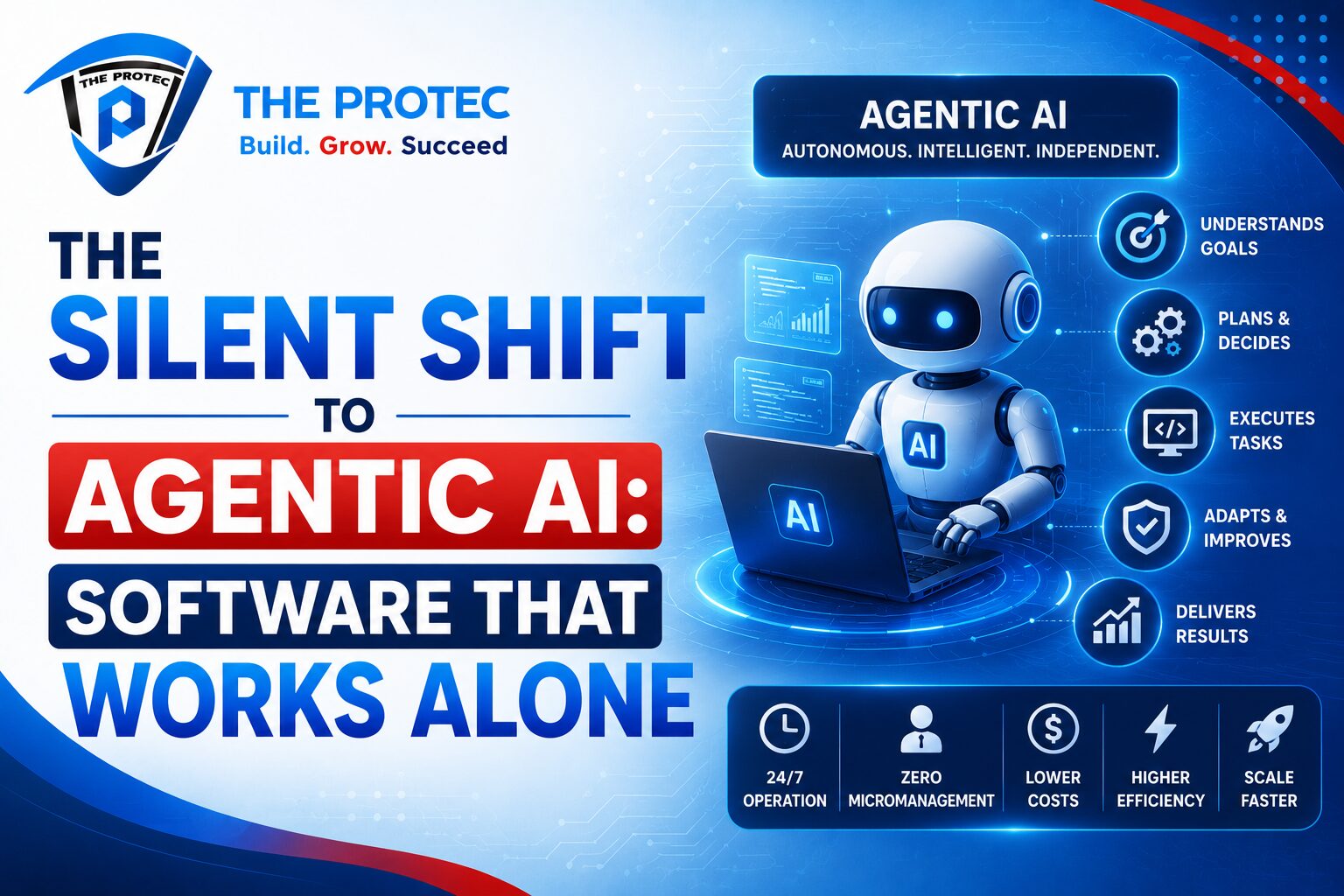
- Goal understanding: the agent interprets a user’s intent rather than just a literal prompt.
- Planning: it decomposes the goal into a sequence of smaller tasks.
- Tool use: it interacts with APIs, databases, browsers, code execution environments, or enterprise systems.
- Memory and context: it retains relevant state so decisions are not made in isolation.
- Feedback loops: it checks results, adjusts course, and continues working.
The best way to think about agentic AI is not as a single model but as a control layer over models, tools, and workflows. The intelligence comes from orchestration. The agent decides what to do next, when to call a tool, when to ask for human input, and when to stop.
That orchestration is what makes agentic AI different from conventional software. Traditional systems wait for instructions. Agentic systems interpret objectives and execute them.
Why this shift is happening now
The move toward autonomous AI agents is being driven by several converging developments. First, foundation models have become better at reasoning, instruction following, and tool use. Second, enterprise software has become more API-driven, which makes it easier for agents to operate across systems. Third, businesses are under pressure to do more with leaner teams, which makes automation attractive not just for cost savings but for responsiveness and scale.
There is also a practical reason this moment matters: companies have already automated the easy parts. What remains is the messy middle—tasks that require judgment, cross-system coordination, and exception handling. That is exactly where agentic AI is strongest.
Recent industry developments show the direction clearly. Major software vendors are embedding AI agents into productivity suites, customer service platforms, developer tools, and analytics stacks. Open ecosystems are also expanding, with agent frameworks and orchestration layers maturing quickly. For background on enterprise AI adoption trends, see McKinsey’s quantumblack AI insights and the ongoing research from Gartner on artificial intelligence.
In short, the technology is finally good enough, the infrastructure is finally connected enough, and the business case is finally urgent enough.
How AI agents are changing business applications
Business applications were built for human interaction. Dashboards, forms, tickets, approvals, menus, and exports all assume that a person will be in the loop. Agentic AI changes that assumption. Instead of being the place where work is manually done, software can become the place where work is initiated, executed, and completed automatically.
1. Customer support becomes proactive
In support environments, AI agents can do far more than draft replies. They can classify incoming issues, retrieve account context, identify likely root causes, check order or billing data, execute refunds or escalations within policy, and follow up after resolution. In advanced setups, an agent can monitor usage patterns or error signals and contact customers before they even file a ticket.
This is a major shift in service design. The goal is no longer just faster responses. It is fewer incidents, shorter resolution paths, and lower cognitive load for support teams.
2. Operations workflows become self-driving
Operations teams often manage repetitive cross-functional work: updating records, reconciling discrepancies, coordinating approvals, and sending reminders. Agentic systems can take over parts of these flows by observing triggers, comparing data across sources, and taking action when predefined conditions are met.
For example, an agent could detect a delayed shipment, notify the right stakeholder, update the CRM, generate a customer-facing message, and create a task for the logistics team. Instead of a person stitching together five systems, the agent completes the workflow end to end.
3. Sales and revenue teams get higher leverage
Sales teams spend enormous time researching accounts, logging activity, drafting follow-ups, and preparing next steps. AI agents can handle much of that administrative burden. They can research companies, summarize account history, recommend outreach timing, generate personalized drafts, and update pipeline stages based on meeting outcomes.
The most important impact is not just efficiency. It is consistency. When agents maintain pipeline hygiene, track signals, and trigger next actions automatically, revenue teams can spend more time on conversations and less time on system upkeep.
4. Finance and procurement gain continuous control
Finance workflows are full of structured but time-sensitive work. Agents can monitor invoices, detect anomalies, verify purchase orders, route approvals, and flag exceptions for review. In procurement, they can compare vendor terms, surface contract risks, and initiate renewal workflows.
Because these processes depend on rules, thresholds, and documentation, they are well suited to agentic automation—provided there are robust controls. The agent should act within policy, not beyond it.
5. Software development becomes more autonomous
Developer tools are among the fastest areas of adoption for AI agents. Agents can now generate code, run tests, open pull requests, inspect logs, update documentation, and fix routine issues. In some environments, they can even monitor production signals and propose or implement low-risk fixes.
This does not replace engineers. It changes what engineers spend time on. More of the day can be dedicated to architecture, review, and high-value problem solving, while agents handle repetitive implementation and maintenance tasks.
What makes agentic AI different from classic automation
Traditional automation is deterministic. If A happens, do B. If B fails, stop or send an alert. That model works well when the process is predictable and the inputs are clean. But business reality is rarely that neat.
Agentic AI introduces flexibility. It can decide which tool to use, how to recover from a partial failure, whether more context is needed, and when to escalate to a human. That makes it better suited to workflows where rules are incomplete or exceptions are common.
Here is the simplest distinction:
- Automation executes predefined instructions.
- Agentic AI interprets goals and chooses actions dynamically.
This flexibility is powerful, but it also introduces new risks. The more autonomy a system has, the more important it becomes to define boundaries, audit behavior, and design for safe failure.
The new architecture of the future of software
The future of software is likely to look less like a set of static applications and more like a network of specialized agents operating over shared tools and data. In this model, the user interface is still important, but it becomes only one layer of interaction. Much of the work happens behind the scenes.
We are already seeing the early version of this architecture:
- Intent layer: the user or system sets a goal.
- Orchestration layer: an agent plans the work.
- Tool layer: the agent uses APIs, services, and databases.
- Policy layer: rules, permissions, and approval gates constrain behavior.
- Audit layer: every action is logged, traceable, and reviewable.
This is a meaningful departure from software built around manual navigation. Instead of asking users to learn every interface, software begins to understand the work itself.
That has implications for product design. User experience will increasingly involve supervision, confirmation, and exception handling rather than repetitive execution. The best products will not simply expose features. They will let humans define intent, inspect agent decisions, and intervene only when needed.
Where the biggest value will come from
The highest-value use cases for AI agents are not flashy. They are the workflows that consume time, involve multiple systems, and require enough judgment to be annoying but not enough to justify constant human attention.
Examples include:
- triaging customer inquiries
- routing internal requests
- reconciling records across systems
- drafting routine communications
- monitoring operational exceptions
- updating CRM and ERP data
- preparing summaries and action items
These tasks are ideal because they combine structure with variability. Agentic AI can handle the structure and adapt to the variability. That is where ROI becomes tangible.
Organizations that succeed with autonomous AI agents will likely start with narrow, measurable workflows. They will not ask an agent to run the company on day one. They will ask it to reduce ticket handling time, speed up approvals, improve data quality, or shorten the time between signal and action.
The risks businesses cannot ignore
Autonomy creates value, but it also creates risk. If an agent can act independently, then mistakes can happen independently too. That means companies need strong governance before scaling these systems.
The main risks include:
- Hallucinated actions: the agent may confidently choose the wrong step or misread context.
- Permission misuse: overly broad access can lead to unintended changes.
- Hidden failure loops: an agent may repeat an ineffective strategy without obvious symptoms.
- Compliance exposure: regulated workflows need traceability and approval logic.
- Data leakage: sensitive information can be exposed if boundaries are weak.
To manage these risks, businesses should use least-privilege access, explicit approval gates for sensitive actions, detailed logs, human escalation paths, and sandbox testing before production rollout. Agentic AI is not a free pass to remove oversight. It is a reason to redesign oversight.
How leaders should prepare for autonomous AI agents
Organizations that want to benefit from the future of software should prepare in a practical, phased way. The goal is not to replace every workflow with an agent. The goal is to identify where autonomy creates real leverage.
Start with repetitive, bounded workflows
Look for tasks that are frequent, measurable, and low risk. These often produce the quickest wins and create the best environment for learning how agents behave in your systems.
Define policies before deploying agents
Agents need rules. They should know what they can do, what they can suggest, and what requires approval. Clear policies reduce ambiguity and make reviews easier.
Instrument everything
Every meaningful agent action should be observable. Teams need logs, decision traces, success metrics, and rollback options. Without visibility, autonomy becomes guesswork.
Redesign roles, not just tools
Agentic AI changes how work is distributed. Managers, operators, analysts, and support staff may spend less time doing manual execution and more time supervising, improving, and handling exceptions. That shift should be planned intentionally.
Measure outcomes, not novelty
The real question is not whether an AI agent can perform a task once. It is whether it improves throughput, accuracy, customer experience, and cost over time. Successful adoption depends on outcomes, not demos.
What the next phase looks like
The silent shift to agentic AI is not about replacing every employee or turning all software into a fully autonomous machine. It is about moving from command-based interaction to goal-based execution. That change sounds subtle, but it is profound.
As AI agents become more reliable, more integrated, and more governed, they will increasingly manage the background work that keeps businesses running. Humans will still set direction, define policy, and handle complex judgment calls. But the software layer in between will become far more capable of acting on its own.
That is why the future of software is being rewritten now. The most valuable systems will not be the ones that wait patiently for a click. They will be the ones that notice what needs to happen, decide how to proceed, and get it done.
The shift is silent because it often happens inside familiar tools. But the impact is anything but quiet. Agentic AI is changing the operating model of business software itself.
FAQ
What is agentic AI?
Agentic AI is a type of AI that can pursue goals with autonomy. Instead of only responding to prompts, it can plan tasks, use tools, take actions, and adjust based on results.
How are AI agents different from chatbots?
Chatbots mainly generate responses in conversation. AI agents can do that too, but they also execute multi-step workflows, interact with software tools, and complete tasks with limited human input.
What business functions benefit most from agentic AI?
Support, operations, sales, finance, procurement, and software development are strong early use cases because they involve repeated workflows, multiple systems, and clear outcomes.
Is agentic AI safe for enterprise use?
It can be, but only with strong controls. Businesses need permission limits, logging, approval gates, exception handling, and human oversight for sensitive actions.
Will agentic AI replace human workers?
It is more likely to reshape jobs than eliminate them outright. Humans will remain essential for strategy, judgment, relationship-building, and oversight, while agents handle more routine execution.