








Contents
- 1 The Future of APIs: Are AI Agents Replacing Traditional REST APIs?
- 2 Why REST APIs Became the Standard
- 3 What AI Agents Change About Backend Architecture
- 4 Are AI Agents Replacing Traditional REST APIs?
- 5 REST API Alternatives Gaining Momentum
- 6 Why AI Agents Need a Different Kind of API Design
- 7 How Backend Teams Are Adapting
- 8 The Business Impact of AI Agents APIs
- 9 What REST Still Does Best
- 10 Practical Guidance for Teams Building AI-Ready APIs
- 11 Where the Future of APIs Is Headed
- 12 FAQ
- 13 Conclusion
The Future of APIs: Are AI Agents Replacing Traditional REST APIs?
For more than a decade, REST APIs have been the default way software systems talk to each other. They are simple to understand, predictable to implement, and widely supported across modern stacks. But the rise of AI-driven applications is forcing a new question: what happens when software no longer needs only request-and-response interfaces, but instead needs systems that can reason, plan, and take action on behalf of users?
This is where the conversation around future APIs gets interesting. AI agents APIs are not just another integration pattern. They represent a shift from static endpoints and tightly scripted flows toward dynamic, goal-oriented software behavior. In many products, the backend is no longer serving only humans or deterministic services. It is increasingly serving agents that can decide which tools to use, which data to retrieve, and how to complete multi-step tasks.
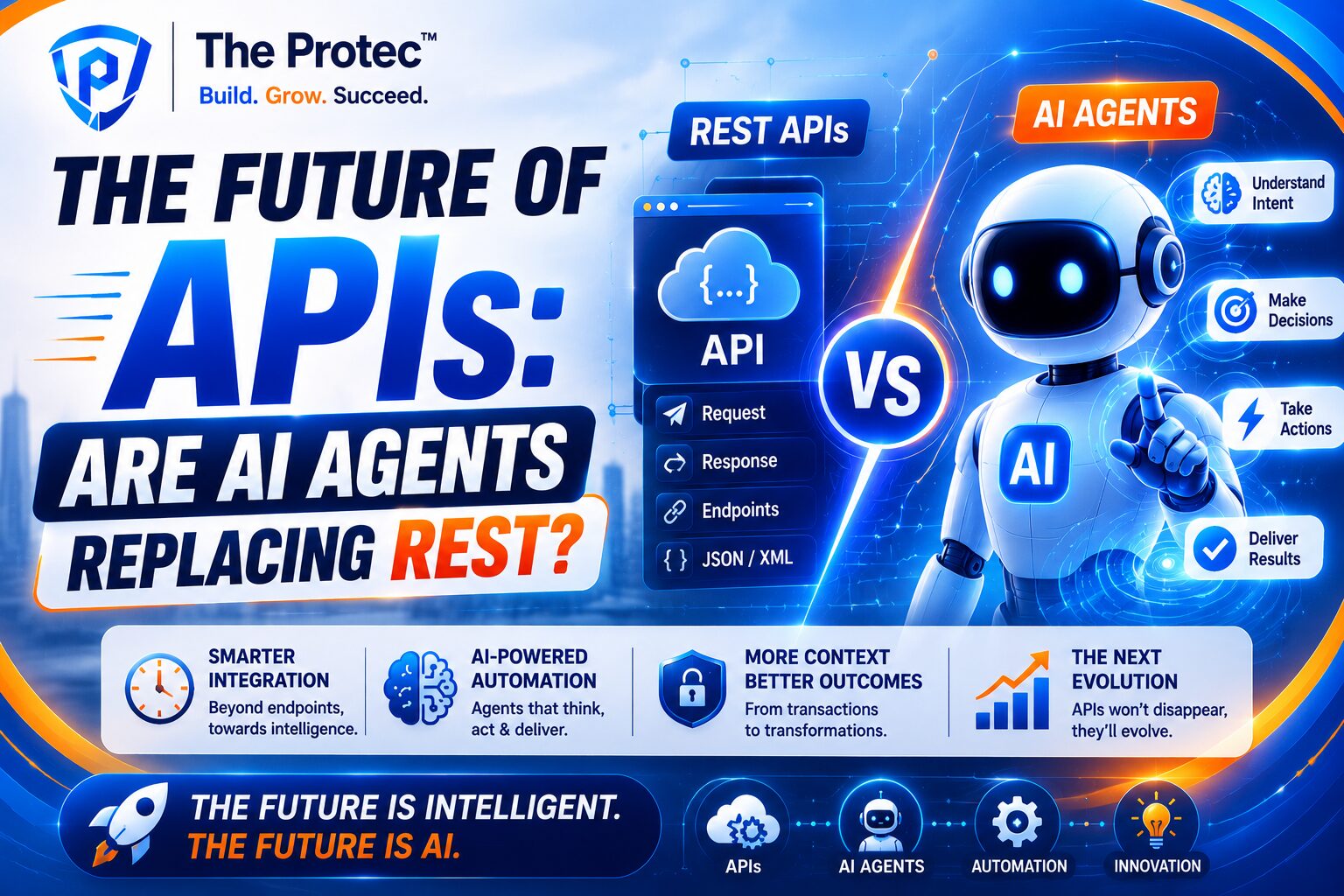
So, are AI agents replacing REST APIs? The short answer is no, not entirely. But they are changing where REST fits, what developers expect from APIs, and how backend architecture is being designed. In some cases, REST is being complemented by new interface layers. In others, it is being abstracted away from the user experience altogether. The result is a more complex but more capable application stack.
Why REST APIs Became the Standard
To understand the shift, it helps to remember why REST became so dominant. REST APIs offered a clean model for exposing resources over HTTP. Developers could create predictable endpoints for users, products, orders, files, messages, and nearly any other domain object. The design was easy to document, easy to cache, easy to debug, and easy to scale.
REST also aligned well with the way most software worked: a client sent a request, the server returned a response, and the flow ended there. That simplicity made REST a natural fit for mobile apps, web apps, microservices, and partner integrations. For many teams, REST became the universal contract between systems.
Even now, REST remains deeply embedded in application infrastructure. It powers public developer platforms, internal service meshes, SaaS integrations, and countless partner workflows. The idea that REST is “going away” is overstated. The real change is that it is no longer the only interface layer that matters.
What AI Agents Change About Backend Architecture
AI agents introduce a different operating model. Instead of a user clicking through screens or a developer writing a fixed sequence of API calls, an agent can receive a goal and then determine the steps needed to complete it. That means backend systems need to support discovery, tool selection, context handling, permissions, state, and verification.
This changes backend architecture in several important ways. First, APIs must often become more semantically understandable. An agent needs to know not only that an endpoint exists, but what it does, when to call it, and what side effects it may produce. Second, the system must support richer metadata. Tool descriptions, schemas, authentication scopes, and response semantics matter more than ever.
Third, state becomes more important. Traditional REST interactions are usually stateless from the server perspective. AI agents, however, often work across multiple steps, switching between tools while maintaining context and intent. That pushes backend teams toward orchestration layers, event-driven workflows, and tool registries that help agents operate safely and efficiently.
In practice, AI agents APIs are often not a replacement for REST but a new layer that sits above it. The agent consumes structured tool interfaces, then invokes classic REST endpoints behind the scenes. This abstraction is one of the biggest shifts in modern software design.
Are AI Agents Replacing Traditional REST APIs?
The most accurate answer is that AI agents are replacing some uses of REST, not REST itself. They are especially disruptive in workflows where users previously had to navigate many screens, chain together multiple calls, or manually move data between systems.
For example, think about customer support, sales operations, procurement, content workflows, and IT automation. In these cases, a person may not care whether an action is performed through a REST endpoint, a GraphQL query, a queue, or a database transaction. They care that the job gets done. AI agents can take on those tasks more naturally than a rigid API workflow exposed directly to the user.
That said, AI agents still depend on APIs. They need access to data, actions, and services. The difference is that the interface is increasingly optimized for machine reasoning rather than human developers alone. This means REST may become less visible to the end user, but more important behind the scenes as the reliable execution layer.
In other words, AI agents are not killing APIs. They are changing what the best API looks like and how much of it should be directly exposed.
REST API Alternatives Gaining Momentum
As AI-driven applications mature, developers are reevaluating REST API alternatives that better support structured reasoning, flexible data retrieval, and high-performance orchestration. Several approaches are gaining traction.
- GraphQL offers precise data fetching, reducing overfetching and underfetching. This is useful when agents need compact, context-rich responses.
- gRPC is attractive for low-latency service-to-service communication and strongly typed contracts in distributed systems.
- Event-driven architectures help agents react to changes asynchronously and coordinate long-running tasks.
- Tool-based interfaces and structured function calling are becoming central to AI agent integration, especially when systems need machine-readable action definitions.
- Workflow orchestration layers such as durable execution engines help manage retries, branching logic, and stateful multi-step processes.
It is important to note that these are not always alternatives to REST in the strict sense. Often, they are complementary patterns. A company might expose REST for public access, use gRPC internally, stream events through a message bus, and provide AI agents with a tool schema layer on top. The future of APIs is likely to be plural rather than singular.
Why AI Agents Need a Different Kind of API Design
Traditional API design assumes a skilled developer will read documentation, understand the contract, and integrate accordingly. AI agents operate differently. They require interfaces that are explicit, discoverable, safe, and easy to interpret in machine-readable form.
This creates new design priorities. Clear schema definitions matter more than vague prose. Action names should reflect intent. Error messages should be structured and actionable. Authentication and authorization need to be scoped carefully so agents can do useful work without overreaching. Rate limits and guardrails need to account for autonomous retry behavior, not just human traffic patterns.
Another major concern is determinism. AI agents can be powerful, but they are not always predictable. That means backend teams need to build systems that validate inputs, constrain outputs, and verify side effects before committing changes. The best AI agents APIs combine flexibility with strong boundaries.
Good API design for agents also means thinking about observability. Teams need logs, traces, and audit trails that show what the agent attempted, which tools it used, how long each step took, and where failures occurred. In AI-driven systems, transparency is not optional. It is essential for trust and debugging.
How Backend Teams Are Adapting
Backend teams are not discarding REST overnight. Instead, they are evolving their architecture to support both human developers and AI agents. One common pattern is to build an internal capability layer that exposes business actions in a more abstract way than raw endpoints. This layer may then map to REST, queues, workflows, or databases behind the scenes.
Many teams are also investing in better API metadata. That includes richer OpenAPI specifications, strongly typed schemas, examples, and machine-readable descriptions that improve how tools and agents discover capabilities. For teams using AI agents APIs, the quality of metadata can directly affect reliability.
Another important adaptation is task decomposition. Rather than offering one endpoint for a broad business process, teams may expose smaller, safer actions that agents can combine. This reduces ambiguity and makes it easier to enforce permissions and validate outcomes. It also helps agents recover from partial failures without re-running an entire workflow.
Some organizations are introducing “agent gateways” or tool brokers. These act as controlled entry points between autonomous systems and backend services. They can enforce policies, transform requests, limit access, and centralize observability. In many architectures, this is becoming the practical bridge between classic APIs and AI-native application design.
The Business Impact of AI Agents APIs
The shift toward AI agents APIs is not only technical. It is changing product strategy, customer experience, and operating costs. Applications that once required several steps of manual input can now complete tasks through natural language or autonomous execution. That can reduce friction, shorten time-to-value, and unlock new user experiences.
For software vendors, this means the product interface is increasingly becoming a competitive differentiator. If an agent can schedule, summarize, recommend, reconcile, or execute actions across systems, the user experience feels less like software navigation and more like collaboration. That is a meaningful shift in how value is delivered.
There are cost implications too. AI agents can reduce repetitive work, but they can also increase backend activity if not carefully governed. A poorly constrained agent may call too many tools, repeat actions, or generate unnecessary load. This makes architecture, monitoring, and policy design critical. The future of APIs is not just about capability; it is about efficiency and control.
Organizations that understand this balance will be better positioned to build durable, AI-ready products. Those that treat agents as simple chat overlays will likely miss the deeper architectural impact.
What REST Still Does Best
Despite all the momentum around AI-driven systems, REST still has clear advantages. It is simple, familiar, and universally supported. For predictable CRUD operations, public developer ecosystems, and straightforward integrations, REST remains a strong choice. It is also a very practical option when you need HTTP semantics, caching behavior, and broad tooling support.
REST is especially strong when the goal is transparency. Developers can inspect a request, understand the response, and reason about the system quickly. That clarity is valuable in regulated industries, mission-critical services, and high-volume platforms where operational stability matters more than flexibility.
The real future of APIs is not about replacing REST everywhere. It is about choosing the right interface for the job. In many cases, REST will remain the execution layer while higher-level interfaces handle orchestration, reasoning, and user intent. That division of labor may be the most important architectural pattern emerging today.
Practical Guidance for Teams Building AI-Ready APIs
If your team is planning for AI-driven applications, there are a few principles worth following.
- Design for machines and humans. Keep your contracts readable, but also make them explicit enough for agents to consume safely.
- Expose clear capabilities. Avoid overly broad endpoints when smaller, well-defined actions will be easier to orchestrate.
- Invest in schemas and metadata. Rich documentation, examples, and machine-readable structures improve agent performance.
- Add guardrails. Use authorization, validation, quotas, and approval flows for sensitive operations.
- Build observability in. Audit logs, traces, and step-by-step execution history are essential.
- Separate intent from execution. Let agents decide what to do, but keep execution controlled and verifiable.
These practices create a more resilient foundation for future APIs. They also help teams avoid the trap of over-automating before the platform is ready.
Where the Future of APIs Is Headed
The future of APIs is likely to be layered. At the bottom, classic interfaces such as REST, gRPC, databases, and events will continue doing what they do best: moving data and executing operations reliably. On top of that, agent-friendly layers will emerge to help AI systems discover capabilities, reason about tasks, and coordinate multi-step actions.
This layered model may become the new normal for backend architecture. Human developers will still work with stable contracts, but AI agents will interact through higher-level abstractions that are designed for autonomy. Over time, some direct API consumption will disappear from the user experience altogether, replaced by agent orchestration and intent-based workflows.
That does not mean APIs become less important. It means they become more foundational. As applications become more intelligent, the reliability, clarity, and safety of backend interfaces matter even more. AI agents are raising the bar for API design, not lowering it.
The most successful teams will not ask whether REST is dead. They will ask how to combine REST, REST API alternatives, orchestration layers, and AI agents APIs into a system that is both robust and adaptive. That is where the real innovation is happening.
FAQ
Are AI agents replacing REST APIs entirely?
No. AI agents are changing how APIs are used and exposed, but REST remains a core backend pattern. In many systems, REST will continue to power execution while agents handle orchestration and task completion.
What are the best REST API alternatives for AI-driven applications?
GraphQL, gRPC, event-driven architectures, workflow engines, and structured tool interfaces are all gaining traction. The best choice depends on whether you need flexible data access, low-latency communication, or multi-step automation.
Why do AI agents need special API design?
AI agents need interfaces that are discoverable, structured, secure, and easy to reason about. They also require strong guardrails, observability, and clear metadata so they can act safely and reliably.
Will REST still matter in the future of APIs?
Yes. REST will remain important for many public and internal services. The bigger change is that it may become less visible to end users as AI agents and orchestration layers sit on top of it.
How should backend teams prepare for AI agents APIs?
Teams should improve schema quality, expose well-defined capabilities, add policy controls, and strengthen observability. Building an architecture that supports both human developers and autonomous agents is the safest path forward.
Conclusion
AI agents are not replacing traditional REST APIs in a one-to-one sense, but they are reshaping the way backend systems are designed, exposed, and consumed. The future of APIs will likely be a hybrid world where REST remains a reliable execution layer, while AI agents interact through richer, more semantic, and more controlled interfaces.
For engineering teams, the opportunity is significant. By embracing AI-ready architecture now, companies can build systems that are more adaptable, more intelligent, and better aligned with how users will expect software to behave. The next generation of applications will not simply call APIs. They will collaborate with them.