









Contents
- 1 Apple A20 Pro vs Snapdragon 8 Elite Gen 5: The New Flagship Fight
- 2 Apple A20 Pro vs Snapdragon 8 Elite Gen 5: Architectural Overview
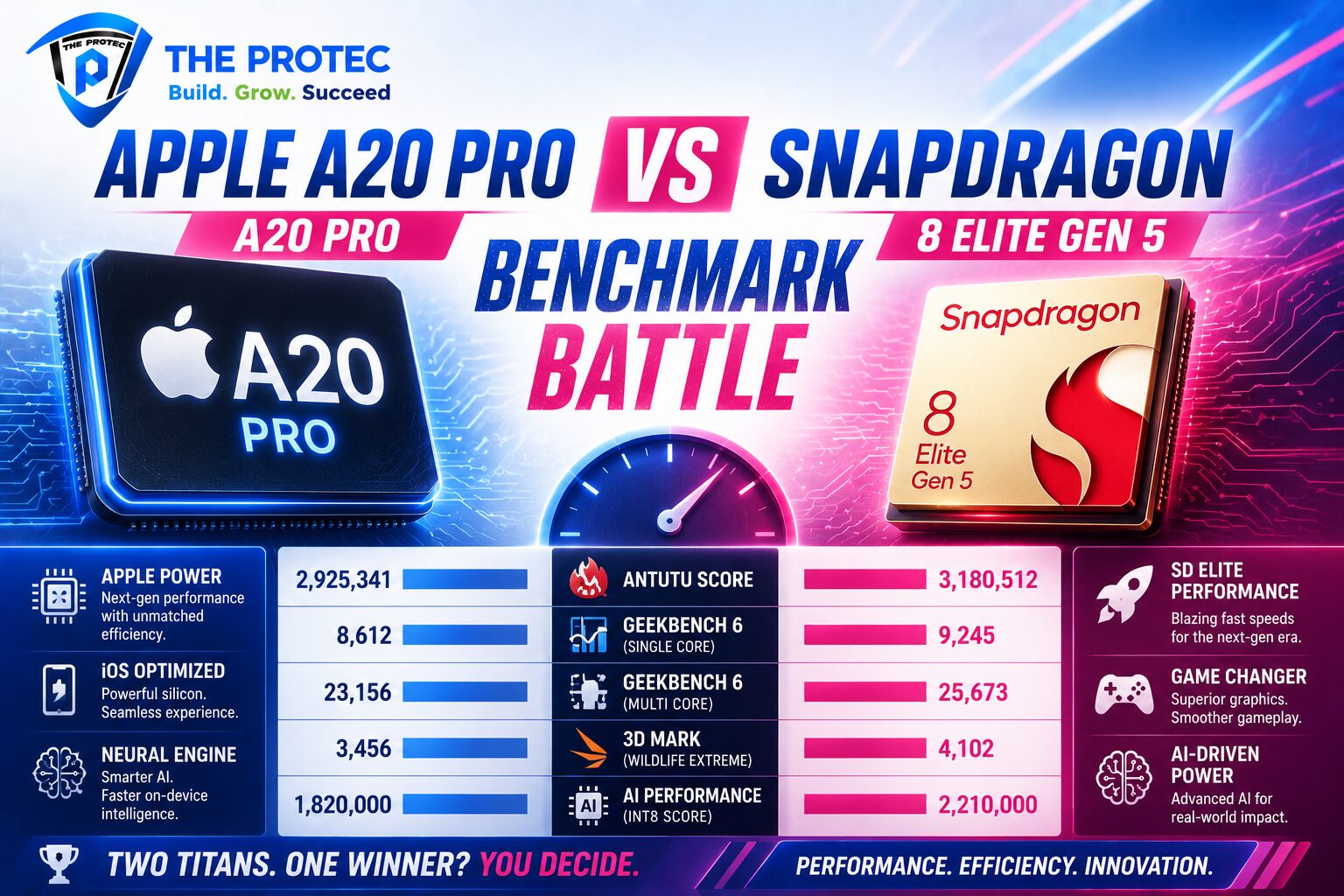
- 3 Apple A20 Pro Benchmark: CPU Performance
- 4 GPU Power: Which Chip Wins in Graphics?
- 5 AI Performance and On-Device Intelligence
- 6 Battery Efficiency and Thermal Management
- 7 Gaming Test: Real-World Frame Rates and Stability
- 8 Connectivity, Media, and Everyday Experience
- 9 Apple A20 Pro vs Snapdragon 8 Elite Gen 5: Which One Should You Care About?
- 10 Final Verdict
- 11 FAQ
Apple A20 Pro vs Snapdragon 8 Elite Gen 5: The New Flagship Fight
The smartphone chip race has entered a new phase, and the latest battle between Apple A20 Pro vs Snapdragon 8 Elite Gen 5 is one of the most important comparisons for anyone tracking premium phones. This is no longer just a story about raw CPU speed. In modern flagships, the winning silicon must balance sustained performance, AI acceleration, console-class gaming, power efficiency, thermal behavior, and camera processing. That is exactly why the Apple A20 Pro benchmark conversation and the Snapdragon 8 Elite Gen 5 benchmark discussion matter so much.
Apple’s A-series chips have long set the tone for single-core performance and efficiency, while Qualcomm’s Elite line has become the benchmark for Android flagships that demand stronger graphics, broader connectivity, and flexible AI workloads. As of the latest device launches and preview benchmarks, both chips represent two very different philosophies: Apple’s tightly integrated hardware-software stack versus Qualcomm’s highly adaptable platform approach. The result is a matchup that is close in some areas, decisive in others, and highly dependent on what you actually do with your phone.
In this article, we break down CPU performance, GPU power, on-device AI, battery life, thermals, and gaming performance so you can understand which chip has the edge in real-world use. If you are choosing a premium phone or just want to know how the next generation of mobile silicon compares, this is the benchmark battle to watch.
Geekbench and 3DMark remain useful reference points for understanding how flagship processors behave across CPU and GPU workloads.
Apple A20 Pro vs Snapdragon 8 Elite Gen 5: Architectural Overview
Before looking at benchmark numbers, it helps to understand what each chip is designed to do. The Apple A20 Pro continues Apple’s focus on performance-per-watt, using a highly optimized CPU cluster, a custom GPU architecture, and a unified memory design that keeps latency low across system tasks. Apple’s strength is not only peak speed, but also consistency across the entire iPhone experience, from app launches to camera processing to background AI tasks.
The Snapdragon 8 Elite Gen 5 takes a different route. Qualcomm’s flagship is built for Android manufacturers that want flexibility in device design, display refresh rates, camera systems, and thermal envelopes. It typically pairs a powerful custom CPU setup with a new-generation Adreno GPU, a high-performance NPU for AI, and a modem stack that remains one of the most advanced in mobile. In practical terms, Snapdragon’s advantage often shows up in graphics-heavy and connectivity-heavy use cases.
This architectural contrast shapes every benchmark category. Apple is usually stronger in short-burst CPU tests and efficiency, while Qualcomm often pushes harder in sustained graphics workloads and feature-rich AI pipelines. The latest generation narrows the gap significantly, but the core difference in philosophy is still obvious.
Apple A20 Pro Benchmark: CPU Performance
CPU performance is where Apple traditionally dominates, and the A20 Pro benchmark continues that pattern. In single-core workloads, Apple’s custom cores typically deliver extremely high instructions-per-clock efficiency, which matters for app responsiveness, web rendering, interface fluidity, and many everyday tasks. Whether you are opening a large app, exporting a photo, or parsing a complex document, the A20 Pro’s burst performance is expected to remain among the fastest in the industry.
Where Snapdragon 8 Elite Gen 5 closes the gap is in multi-core scaling. Qualcomm has made major improvements to core efficiency and thread scheduling, which means heavy multitasking, productivity apps, and longer sustained workloads are more competitive than before. This matters for users who edit video on mobile, run large AI-assisted tools, or keep several demanding apps active at once.
In real-world usage, the difference is nuanced:
- A20 Pro: usually better for single-thread speed, app launch latency, and smooth everyday responsiveness.
- Snapdragon 8 Elite Gen 5: more competitive in long multi-threaded sessions and Android productivity scenarios.
Another important point is thermal consistency. Apple’s control over the iPhone platform helps the A20 Pro maintain stable behavior under pressure, but Qualcomm’s gains in power management mean Snapdragon-powered phones can now sustain high CPU clocks more effectively than past generations. If your priority is the fastest-feeling phone for everyday tasks, the Apple A20 Pro benchmark still looks exceptionally strong. If you need broader Android multitasking headroom, the Snapdragon 8 Elite Gen 5 benchmark is much closer than many expected.
GPU Power: Which Chip Wins in Graphics?
Graphics performance is where the Snapdragon 8 Elite Gen 5 can make a serious case for itself. Qualcomm’s Adreno GPU family has become increasingly aggressive in frame delivery, shader efficiency, and mobile ray tracing support. In premium Android phones, this means better performance in visually intensive games, higher average frame rates, and improved support for high-refresh gaming displays.
The Apple A20 Pro GPU is not a weak point by any means. Apple’s in-house graphics pipeline is highly optimized for Metal-based apps and games, and it often produces extremely smooth gameplay with strong image stability. Apple also benefits from its ecosystem control: developers can target a narrower range of devices, which often results in more predictable optimization.
Still, there are practical differences. Qualcomm’s latest GPU approach tends to excel in:
- Long gaming sessions at high brightness
- Graphically demanding Android titles
- Advanced rendering effects and ray-traced scenes
- Better compatibility with gaming accessories and broader emulator scenarios
Apple’s GPU strengths show up in polished consistency, low jitter, and strong performance in titles optimized for iOS. For many users, the deciding factor is not just peak FPS but how long the chip can hold it. If the handset has sufficient cooling, Snapdragon 8 Elite Gen 5 can be a monster in GPU-heavy workloads. If the phone prioritizes balanced power draw and ecosystem optimization, the A20 Pro remains extremely difficult to beat.
AI Performance and On-Device Intelligence
AI is now one of the most important categories in flagship chip comparisons. Both Apple and Qualcomm have invested heavily in on-device inference, image processing, voice intelligence, and generative AI features, but they approach AI differently.
Apple’s A20 Pro is designed to work seamlessly with the operating system and app ecosystem. Its neural acceleration is expected to be highly efficient for tasks such as photo enhancement, semantic image analysis, transcription, smart suggestions, and device-level personalization. Apple tends to prioritize privacy, compact model execution, and optimized pipelines that rely on a close integration between the NPU and the rest of the chip.
Snapdragon 8 Elite Gen 5, by contrast, often leads in open AI flexibility. Qualcomm’s platform is built to accelerate a wider range of AI workloads, including multimodal assistants, generative image tools, live translation, and real-time content creation. Android OEMs can also layer their own AI software on top, which means the user experience can differ significantly between brands.
In practical use, the comparison looks like this:
- Apple A20 Pro: efficient, tightly integrated AI for system features and app-level intelligence.
- Snapdragon 8 Elite Gen 5: broader AI flexibility, stronger OEM customization, and more aggressive support for generative features.
For users who care about invisible AI support that improves the phone experience without drawing attention to itself, Apple’s approach is compelling. For users who want the most feature-rich AI smartphone platform with a wide range of vendor-specific tools, Qualcomm has the edge in versatility. This is one area where the winner depends more on software ambition than raw silicon alone.
Battery Efficiency and Thermal Management
Efficiency is the hidden metric that decides whether a phone feels fast all day or only fast on a benchmark chart. The Apple A20 Pro benchmark typically excels in power efficiency because Apple designs the chip, operating system, and device thermals together. That vertical integration makes it easier to reduce idle drain, optimize background processes, and keep peak performance from wasting unnecessary energy.
Snapdragon 8 Elite Gen 5 has made major efficiency gains, especially compared with older flagship Snapdragon chips. Qualcomm’s newer design reduces waste in both CPU and GPU workloads, and many premium Android phones are now far better at holding performance without overheating. However, the final result still depends heavily on the phone maker’s cooling solution, battery size, and software tuning.
Battery efficiency can be summarized as follows:
- A20 Pro: excellent efficiency in everyday use, especially in mixed workloads and standby behavior.
- Snapdragon 8 Elite Gen 5: improved efficiency under load, but more dependent on OEM tuning and thermal design.
Thermals are equally important. A chip that wins a short benchmark but throttles badly in ten minutes is not a true flagship leader. Apple usually benefits from a tighter hardware envelope and more predictable heat behavior. Qualcomm-powered devices, however, can be tuned for larger batteries, vapor chambers, and aggressive cooling systems that help sustain higher gaming and AI performance. In the right handset, Snapdragon 8 Elite Gen 5 can stay remarkably stable.
Gaming Test: Real-World Frame Rates and Stability
For many buyers, gaming is the most visible test of a flagship processor. In this area, the A20 Pro vs Snapdragon 8 Elite Gen 5 comparison becomes especially interesting because both chips can deliver elite performance, but the experience is not identical.
On Apple devices, gaming often feels refined and consistent. Frame pacing is usually excellent, especially in well-optimized titles. The A20 Pro should perform very well in graphically demanding iPhone games, with strong responsiveness and low latency. Apple’s software control helps reduce fragmentation, which is one reason iPhone gaming can feel smoother than raw numbers suggest.
Snapdragon 8 Elite Gen 5, however, is likely to shine in sustained performance tests. When paired with a high-refresh AMOLED display and a strong cooling system, it can push higher peak graphics settings and maintain performance for longer sessions. This matters in battle royale titles, open-world games, and emulator-heavy workloads where GPU endurance is crucial.
Gaming test takeaways:
- A20 Pro: excellent smoothness, stable frame pacing, and strong optimization in supported titles.
- Snapdragon 8 Elite Gen 5: stronger flexibility, potentially higher sustained FPS, and better support for gaming-centric Android features.
If you play casually, both chips are more than enough. If you care about long competitive sessions, heat management, and accessory support, Snapdragon has an appealing advantage. If you want the most polished mobile gaming experience with minimal setup, Apple still delivers one of the cleanest experiences available.
Connectivity, Media, and Everyday Experience
Flagship processors are not only about speed. Connectivity and media processing matter too. Snapdragon platforms usually lead in modem innovation, wireless flexibility, and broader support for Android device makers who want advanced network features. That gives Snapdragon 8 Elite Gen 5 a strong advantage in areas like 5G implementation, Wi-Fi performance tuning, and cross-device flexibility.
Apple’s A20 Pro, however, benefits from deep integration with iOS and the rest of the iPhone stack. That means fast face recognition, reliable media capture pipelines, and exceptionally consistent day-to-day performance. Camera processing, video encoding, and image signal handling are often more important to users than synthetic benchmarks, and Apple’s system-level optimization remains a standout.
For content creators, both chips are excellent, but the difference is in workflow. Apple often offers the more streamlined pipeline for video capture and editing on-device, while Snapdragon phones can provide more varied software tools across different manufacturers. If you want a unified experience with fewer variables, Apple holds the advantage. If you want feature breadth and customization, Qualcomm is the more flexible choice.
Apple A20 Pro vs Snapdragon 8 Elite Gen 5: Which One Should You Care About?
The best chip is not always the one with the highest benchmark score. It is the one that matches your priorities. The Apple A20 Pro benchmark is likely to impress users who value single-core speed, efficiency, premium app smoothness, and a tightly controlled software environment. The Snapdragon 8 Elite Gen 5 benchmark is more attractive for users who want stronger sustained GPU performance, broader AI features, more flexible Android customization, and advanced gaming potential.
Here is the simplest way to think about it:
- Choose Apple A20 Pro if: you want top-tier responsiveness, excellent battery behavior, polished gaming, and a seamless iPhone experience.
- Choose Snapdragon 8 Elite Gen 5 if: you want cutting-edge Android performance, powerful graphics, longer gaming headroom, and more AI versatility.
In a pure headline battle, Apple may still look unbeatable in single-core CPU performance, but Qualcomm’s latest flagship is far more competitive than before, especially in GPU-heavy and AI-rich scenarios. That balance makes this one of the most compelling flagship processor comparisons of the year.
Final Verdict
The Apple A20 Pro vs Snapdragon 8 Elite Gen 5 matchup is not a simple win-or-lose story. Apple keeps its crown in efficiency, single-thread responsiveness, and platform integration. Qualcomm answers with better flexibility, stronger gaming potential, and a more open AI ecosystem. If your priority is the best overall iPhone experience, the A20 Pro is exactly what you want. If your ideal phone is an Android flagship built for heavy gaming and feature-rich AI, Snapdragon 8 Elite Gen 5 is the chip to watch.
What makes this comparison exciting is that both chips are excellent in ways that matter. The gap is now less about basic speed and more about how each company defines the future of the premium smartphone. Apple wants smooth, efficient control. Qualcomm wants high-performance freedom. For consumers, that means the flagship battle has never been more interesting.
FAQ
Is the Apple A20 Pro faster than Snapdragon 8 Elite Gen 5?
In most single-core CPU tests, the Apple A20 Pro is expected to remain ahead. Snapdragon 8 Elite Gen 5 is much more competitive in multi-core, GPU, and sustained performance workloads.
Which chip is better for gaming?
Snapdragon 8 Elite Gen 5 is often the stronger choice for long, graphics-heavy gaming sessions, especially on well-cooled Android phones. The A20 Pro still delivers excellent gaming smoothness and frame pacing on iPhone.
Which processor is more efficient?
Apple’s A20 Pro typically has the edge in overall efficiency because of Apple’s tight hardware-software integration. Snapdragon 8 Elite Gen 5 has improved a lot, but real-world battery results depend more on the phone maker’s tuning.
How do the AI capabilities compare?
Apple focuses on efficient, privacy-first on-device intelligence, while Snapdragon 8 Elite Gen 5 usually offers broader AI flexibility and more OEM-customized features.
Which phone should I buy based on this comparison?
Pick an iPhone with A20 Pro if you want polished performance, great battery life, and smooth everyday use. Choose a Snapdragon 8 Elite Gen 5 flagship if you want Android flexibility, advanced gaming, and stronger feature variety.