









Contents
- 1 The Smartphone Upgrade Game Has Changed
- 2 Why Megapixels Stopped Being the Main Story
- 3 How AI Smartphones Deliver Better Photos Than Bigger Sensors
- 4 AI Smartphones Are Smarter Beyond the Camera
- 5 On-Device AI Is the New Performance Benchmark
- 6 Privacy, Security, and AI on the Device
- 7 Why More Megapixels Can Be a Marketing Trap
- 8 The Broader Shift in Smartphone Technology
- 9 What Buyers Should Look For Instead of Just Megapixels
- 10 Conclusion: Intelligence Is the New Spec That Matters Most
- 11 FAQ
The Smartphone Upgrade Game Has Changed
For years, smartphone marketing followed a familiar pattern: bigger camera numbers, faster chip labels, brighter screens, and more memory. Among those, the megapixel count became one of the easiest specs to sell. If a phone had a 108MP, 200MP, or even higher-resolution camera, it sounded better on paper. But as smartphone technology matures, that logic is losing power. The most meaningful improvements in modern devices are not coming from raw hardware inflation. They are coming from AI smartphones that use mobile AI to make every part of the experience smarter, faster, and more useful.
This shift is not just a branding move. It reflects how people actually use their phones. Most users do not need giant image files, extreme zoom numbers, or a spec sheet that looks impressive in a store. They want photos that look better, battery life that lasts longer, calls that sound cleaner, apps that respond instantly, and features that predict what they need. Mobile AI is now the layer that makes all of that possible. In other words, the future of smartphone technology is less about stacking more pixels and more about making the phone understand context.
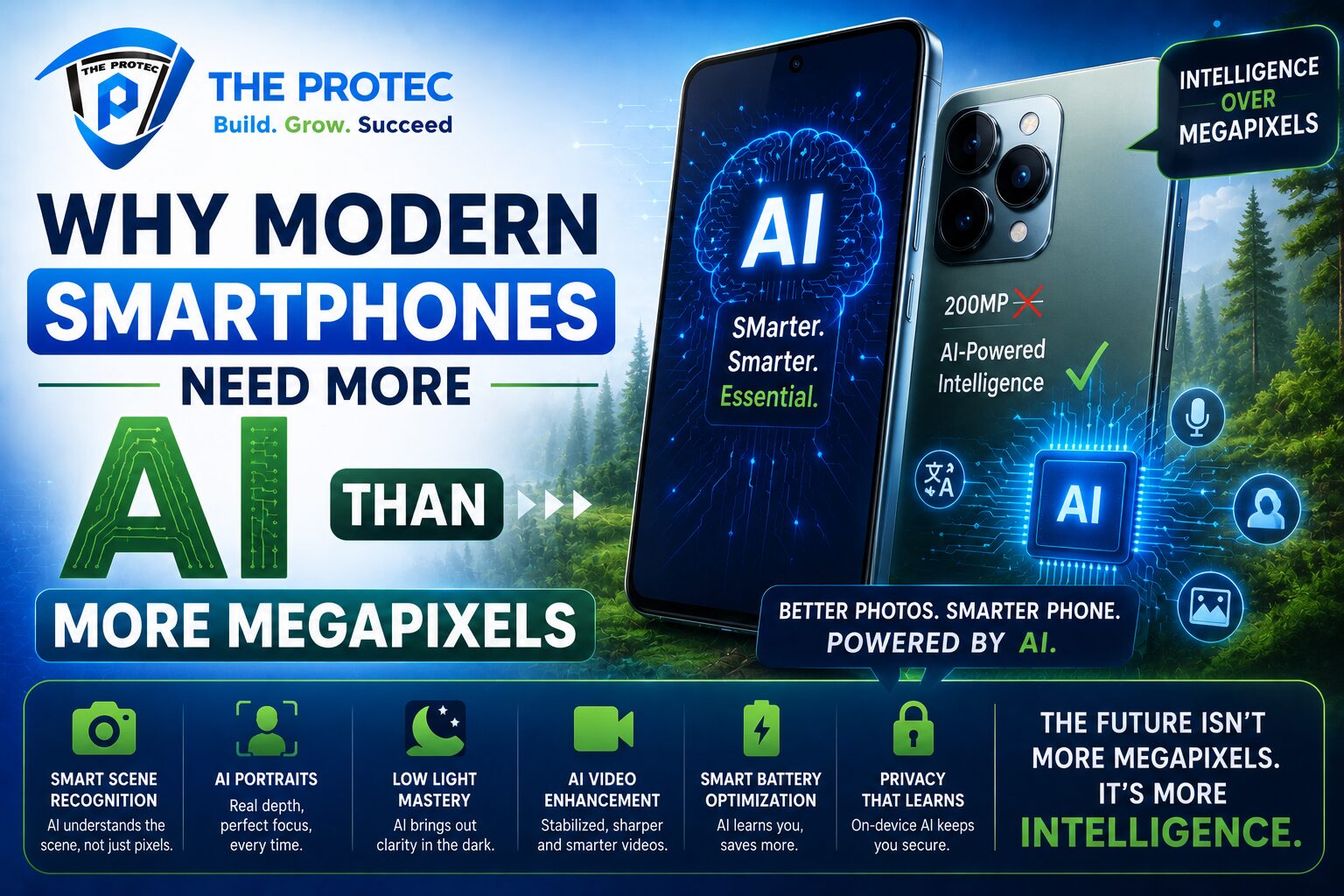
That is why modern smartphones need more AI than more megapixels. AI is no longer a bonus feature. It is becoming the core operating system for how devices capture, process, protect, and personalize the user experience.
Why Megapixels Stopped Being the Main Story
Megapixels are not useless, but they are often misunderstood. A higher megapixel count means a camera sensor can capture more detail under ideal conditions. In theory, that sounds great. In practice, image quality depends on many more factors: sensor size, lens quality, optical stabilization, exposure control, color science, and computational processing. A phone with a huge sensor count can still take mediocre photos if it lacks the intelligence to process the image well.
That is where the limits of the old hardware race show up. Packing more pixels into a tiny smartphone sensor can create noise, reduce light sensitivity, and increase file size without necessarily improving real-world results. Most people view photos on phone screens or social platforms, where aggressive detail gains are barely noticeable. What users actually appreciate is better HDR, natural skin tones, sharper night photos, and reliable focus in difficult conditions. Those are outcomes of software and AI, not just hardware.
Smartphone technology has reached a point where brute-force specs deliver diminishing returns. The next leap is not simply “more.” It is “smarter.”
How AI Smartphones Deliver Better Photos Than Bigger Sensors
Modern cameras are no longer passive tools that just record light. They are active systems that analyze a scene in real time, identify subjects, adjust exposure, and combine multiple frames to create a better final image. This is the essence of AI smartphones: the device does not just capture, it interprets.
Mobile AI improves photography in several ways:
- Scene recognition: The phone can detect whether it is photographing a face, food, text, a sunset, or a moving subject, then optimize settings automatically.
- Computational photography: Multiple frames are merged to reduce noise, increase detail, and expand dynamic range.
- Portrait separation: AI helps distinguish foreground from background for more accurate blur effects and edge detection.
- Night enhancement: Low-light photos are cleaned up with smarter multi-frame processing instead of relying only on sensor size.
- Generative editing: New AI features can remove distractions, extend backgrounds, or refine compositions after capture.
This is why a phone with fewer megapixels can often outperform one with a much higher number. The AI pipeline matters more than the pixel count. A well-tuned 50MP camera with strong processing can easily produce more pleasing results than a 200MP sensor that lacks intelligent optimization.
Consumers already see this difference in everyday use. Indoor portraits, fast-moving kids, food photos in dim restaurants, and travel shots at night all benefit more from smart processing than from extra resolution. That is a major reason why mobile AI has become one of the most important battlegrounds in smartphone technology.
AI Smartphones Are Smarter Beyond the Camera
Focusing only on camera features misses the larger story. AI smartphones are transforming the entire device, not just image capture. The same intelligence that improves photos can also improve battery management, voice commands, security, typing, translation, app organization, and performance tuning.
One of the biggest benefits is personalization. Mobile AI can learn how a user behaves and adapt accordingly. It can prioritize frequently used apps, reduce background power drain, predict the next action, and surface relevant information before the user searches for it. The phone becomes less like a tool that waits for instructions and more like an assistant that anticipates needs.
Other examples include:
- Battery optimization: AI can identify usage patterns and reduce energy waste more effectively than static power modes.
- Smart notifications: Notifications can be filtered and prioritized based on context and importance.
- On-device transcription: Calls, voice notes, and meetings can be processed locally for speed and privacy.
- Live translation: AI can translate speech and text in real time across messaging, calls, and camera-based interactions.
- Accessibility features: Enhanced speech recognition, image description, and adaptive interfaces make phones more usable for more people.
These are not flashy spec-sheet features, but they are the kinds of improvements users feel every day. That is why the conversation around smartphone technology is changing. The most valuable upgrades are increasingly invisible, yet deeply practical.
On-Device AI Is the New Performance Benchmark
As cloud-based services become more common, it is easy to think AI belongs in remote servers. But the most important trend in modern smartphones is on-device AI. Processing directly on the phone reduces latency, improves privacy, and keeps features available even when connectivity is weak. This is especially important for real-time tasks like camera enhancement, voice processing, smart replies, and contextual suggestions.
On-device AI also changes what “fast” means. A phone may not always win benchmark charts based only on CPU or GPU scores, but if it can complete AI tasks instantly while preserving battery life, that is a more meaningful kind of performance. In practical terms, a device that can summarize a note, clean up a photo, detect spam calls, and transcribe a meeting without sending data off-device offers a better experience than a phone that simply has more memory bandwidth or a slightly higher megapixel count.
This is one reason chipset makers now emphasize neural processing units, machine learning accelerators, and AI inference efficiency. The future of smartphone technology is increasingly shaped by how well a device handles AI workloads locally. The phone that can think faster, not just render faster, is the one that stands out.
Privacy, Security, and AI on the Device
Another major reason AI matters more than megapixels is trust. Users are more aware than ever of how their data is collected, processed, and stored. On-device mobile AI can strengthen privacy by keeping sensitive tasks local. This matters for personal photos, health-related features, voice recordings, call summaries, and identity verification.
AI smartphones can detect fraud and spam more intelligently too. Instead of relying on simple filters, they can identify suspicious patterns in calls, messages, and links. They can flag phishing attempts, warn about risky permissions, and help users make safer decisions before opening an app or responding to a message.
In camera features, privacy also matters. A smarter phone can process face recognition, document scanning, and photo organization without constantly uploading data. That improves both security and user confidence. In the long run, consumers may value this more than any marginal gain in image resolution.
The privacy argument strengthens the case for mobile AI because it shows that intelligence is not just about convenience. It is about control. The more a phone can handle locally, the less it has to expose externally.
Why More Megapixels Can Be a Marketing Trap
There is a reason megapixels remain popular in marketing: the number is easy to understand. A bigger number looks better in ads, even when the real-world advantage is minor. But this can mislead buyers into thinking camera quality is mostly about resolution. It is not.
High megapixel counts can be useful for cropping and certain kinds of detail capture, but they do not automatically create better photos. In many cases, they create bigger files, slower processing, and a stronger need for computational correction. That means the true value is not in the megapixels themselves, but in the AI systems that make them usable.
Modern users are catching on. They compare actual results, not just numbers. They care about how a photo looks on social media, how quickly the camera opens, whether face focus is reliable, and whether the phone can handle motion without blur. Those are experience-based measures, not spec-sheet bragging rights.
Smartphone technology has evolved enough that raw resolution is now only one small piece of a much bigger puzzle. The best brands are no longer asking, “How many megapixels can we add?” They are asking, “How intelligently can we process what we capture?”
The Broader Shift in Smartphone Technology
The move toward AI smartphones is part of a broader industry transformation. Phones are becoming more contextual, more adaptive, and more agent-like. Instead of requiring users to do everything manually, they are beginning to predict intent and reduce friction. That affects everything from camera use to writing assistance to device navigation.
This shift is visible in several current trends:
- AI assistants that understand context: Voice and text assistants are getting better at handling complex requests and multi-step tasks.
- Smart photo workflows: Editing, organizing, and searching photos by content is becoming much easier.
- Real-time content generation: Phones can help draft messages, summarize meetings, and rewrite text with user-specific tone.
- Adaptive interfaces: Systems can learn which actions matter most and reduce unnecessary taps.
- Cross-app intelligence: The phone can connect information across apps to make tasks faster and more coherent.
These changes are redefining what people expect from a smartphone. A device is no longer judged only by display quality, battery size, or camera resolution. It is judged by how well it understands the user. That is why mobile AI is becoming the defining feature of modern smartphone technology.
What Buyers Should Look For Instead of Just Megapixels
If camera quality and overall experience matter, buyers should look beyond the headline numbers. A modern phone worth considering should have strong AI processing capabilities, efficient on-device machine learning, and a camera system that combines good hardware with intelligent software.
Here are the most useful signs of a well-designed AI smartphone:
- Fast computational photography: The camera should process images quickly without obvious delay.
- Useful generative tools: Editing features should save time and improve results, not just add novelty.
- Efficient AI acceleration: The phone should handle local AI tasks without overheating or draining battery excessively.
- Practical voice and text intelligence: Transcription, translation, and smart replies should work smoothly in real life.
- Privacy-aware processing: Important tasks should be handled on-device whenever possible.
In other words, consumers should buy for capability, not for a number alone. A phone with moderate megapixels and excellent mobile AI will often outperform a device with a dramatic camera spec but weak software intelligence.
Conclusion: Intelligence Is the New Spec That Matters Most
The smartphone industry is moving past the era where bigger numbers automatically meant a better device. Megapixels still matter, but they are no longer the headline that defines quality. Modern smartphones need more AI because AI is what turns hardware into meaningful user value. It improves photos, extends battery life, streamlines daily tasks, strengthens privacy, and makes devices more responsive to human behavior.
That is the real story behind AI smartphones. The best smartphone technology is not the one with the most aggressive spec sheet. It is the one that quietly solves more problems with less effort from the user. As mobile AI continues to improve, the gap between a phone that merely records and a phone that truly understands will become even wider.
For buyers, creators, and tech enthusiasts alike, the message is simple: do not get distracted by megapixels alone. The future belongs to smartphones that think smarter, not just cameras that count higher.
FAQ
Are megapixels still important in smartphone cameras?
Yes, but only as one part of the overall camera system. Megapixels help with detail and cropping, but image quality depends more on sensor size, lens quality, and AI-driven processing.
Why are AI smartphones better for everyday use?
AI smartphones can adapt to user behavior, improve photos, optimize battery life, provide real-time translation, and make the phone more responsive to context. That creates a better daily experience than a spec bump alone.
Does mobile AI work without the internet?
Many modern mobile AI features do. On-device AI can handle tasks like photo enhancement, transcription, spam detection, and smart suggestions locally, which improves speed and privacy.
Can a lower-megapixel camera outperform a higher-megapixel one?
Absolutely. A lower-megapixel camera with better AI processing, stronger optics, and better tuning can produce more natural and usable results than a higher-megapixel camera with weaker software support.
External references: Qualcomm on-device AI and Google AI