








Contents
- 1 Why Grok Is Useful for SaaS Idea Discovery
- 2 How to Use These Grok Business Prompts
- 3 20 Grok Prompts for Finding Profitable SaaS Business Ideas
- 3.1 1. Find recurring pain points in a niche
- 3.2 2. Surface tasks people still do manually
- 3.3 3. Spot expensive workflow bottlenecks
- 3.4 4. Find underserved customer segments
- 3.5 5. Analyze complaints about existing tools
- 3.6 6. Discover SaaS ideas from regulatory change
- 3.7 7. Turn AI adoption into product opportunities
- 3.8 8. Find monetizable data problems
- 3.9 9. Identify high-value reporting needs
- 3.10 10. Reveal pain points from job descriptions
- 3.11 11. Find tool stacks with weak integration
- 3.12 12. Explore customer support pain points
- 3.13 13. Look for revenue leakage problems
- 3.14 14. Find SaaS ideas from founder communities
- 3.15 15. Generate vertical SaaS opportunities
- 3.16 16. Identify workflows better suited to AI agents
- 3.17 17. Find SaaS ideas from customer onboarding friction
- 3.18 18. Mine reviews for unmet expectations
- 3.19 19. Discover opportunities from small business operations
- 3.20 20. Rank the best ideas by business potential
- 4 What Makes a SaaS Idea Profitable?
- 5 How to Validate AI Startup Prompts Quickly
- 6 Common Mistakes When Using Grok for SaaS Research
- 7 FAQ
- 8 Final Thoughts
Why Grok Is Useful for SaaS Idea Discovery
Finding a profitable SaaS idea is less about having a flashy concept and more about spotting a painful, repeated, and expensive problem. That has always been true, but the way founders discover opportunities has changed. In 2026, the best SaaS ideas often sit at the intersection of AI workflows, niche operators, developer tooling, compliance automation, and industry-specific data problems. That means founders need sharper research methods, not just inspiration.
This is where Grok business prompts become genuinely useful. Grok can help you scan live conversations, emerging pain points, market sentiment, and product gaps faster than traditional brainstorming. Used well, it becomes a research copilot for discovering SaaS idea prompts that surface real opportunities instead of recycled startup clichés.
The key is asking better questions. Generic prompts produce generic ideas. Strong AI startup prompts push Grok to identify underserved segments, recurring complaints, workflow bottlenecks, and monetizable problems with clear buyers. If you are a founder, entrepreneur, or indie hacker, the prompts below are designed to help you think like a market researcher, not just an idea generator.
For more context on prompt design and model behavior, OpenAI’s prompt engineering guidance is a useful reference, and Grok’s real-time orientation makes it especially strong for trend scanning and market discovery. You can also compare broader startup validation methods with resources from Y Combinator at Y Combinator Library and practical prompt design insights from OpenAI at OpenAI Prompt Engineering.
How to Use These Grok Business Prompts
Before jumping into the list, use these prompts with a clear workflow. First, choose a niche or market segment. Second, ask Grok to surface pain points, complaints, and recurring tasks. Third, filter the results by willingness to pay, urgency, and frequency. Finally, validate the strongest ideas with customer interviews, community research, or lightweight landing pages.
These prompts work best when you iterate. If a prompt gives broad answers, ask Grok to narrow it by industry, company size, budget range, or user persona. If a result feels promising, ask follow-up questions about competitors, buyer objections, existing alternatives, and distribution channels. The goal is not to get one perfect answer. The goal is to reveal patterns that point to a viable SaaS opportunity.
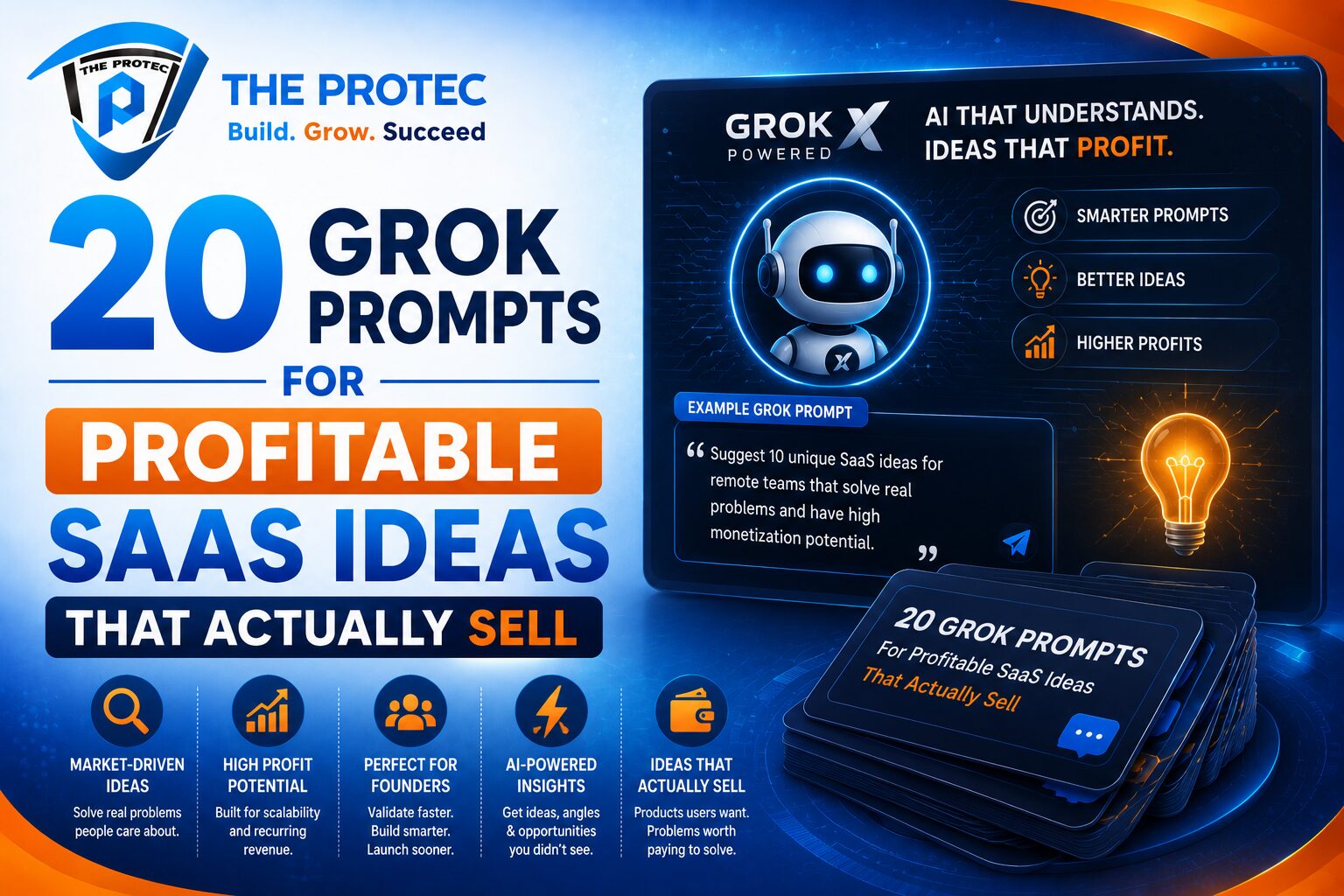
20 Grok Prompts for Finding Profitable SaaS Business Ideas
1. Find recurring pain points in a niche
Prompt: “Identify the top 10 recurring pain points for [specific niche] professionals based on public discussions, reviews, and complaints. Rank them by urgency, frequency, and willingness to pay.”
This is one of the most effective SaaS idea prompts because it starts with pain, not product. A profitable SaaS business usually solves a problem that shows up repeatedly in daily work. Use this prompt for niches like property managers, dental clinics, logistics operators, fractional CFOs, or HR teams.
2. Surface tasks people still do manually
Prompt: “What manual, repetitive tasks in [industry] are still being handled in spreadsheets, email threads, or Slack messages? Explain which of these tasks could be automated with a SaaS product.”
Manual work is often a hidden goldmine. If people are still copying data, chasing approvals, reconciling reports, or formatting documents by hand, there is likely room for automation software. In 2026, the best opportunities often combine workflow automation with AI-assisted decision-making.
3. Spot expensive workflow bottlenecks
Prompt: “List the workflow bottlenecks in [industry] that cause delays, lost revenue, or operational errors. For each one, suggest a SaaS solution that could remove the bottleneck.”
Not every problem is worth solving. This prompt helps you isolate issues that have a clear financial cost. If a bottleneck slows onboarding, increases churn, delays billing, or creates compliance risk, buyers are more likely to pay for a fix.
4. Find underserved customer segments
Prompt: “Within the [broad industry] market, identify underserved customer segments with specific operational needs that current software products ignore.”
Many successful SaaS companies win by serving a narrow segment better than generic tools. This is especially relevant in AI startup prompts because broad AI features are becoming commoditized. Niche depth is often more defensible than generic breadth.
5. Analyze complaints about existing tools
Prompt: “Search for the most common complaints users have about existing software in [category]. Summarize product gaps, feature frustrations, and missing workflows.”
This prompt is excellent for competitive research. Negative reviews and public complaints reveal what users hate enough to switch. If you see repeated frustration around setup complexity, bad integrations, poor reporting, or weak permissions, that may be your opening.
6. Discover SaaS ideas from regulatory change
Prompt: “What upcoming regulatory, compliance, or reporting changes will force businesses in [industry] to adopt new software tools?”
Compliance-driven software often has strong monetization because the buyer is motivated by risk avoidance. In 2026, AI governance, data handling, audit trails, accessibility, privacy, and sector-specific reporting requirements continue to create software demand.
7. Turn AI adoption into product opportunities
Prompt: “How are businesses in [industry] trying to adopt AI right now, and where are they struggling with implementation, trust, integration, or oversight?”
Many companies want AI benefits but lack the expertise to operationalize them. This prompt can reveal opportunity areas such as AI workflow orchestration, human-in-the-loop review, model monitoring, prompt management, and enterprise-safe automation.
8. Find monetizable data problems
Prompt: “What data collection, cleaning, enrichment, syncing, or reporting problems are costing businesses in [industry] time and money? Suggest SaaS solutions for each.”
Data issues are a classic source of SaaS opportunity because they affect every function: sales, finance, ops, marketing, and compliance. If people rely on brittle integrations or manual exports, they are often open to paying for a system that makes data usable.
9. Identify high-value reporting needs
Prompt: “What reports do managers in [industry] need every week but still struggle to create accurately and quickly? Recommend SaaS products that automate those reports.”
Reporting software sells when it saves time and improves decision-making. This is especially attractive for recurring operational reports, board updates, client summaries, KPI dashboards, and performance analytics.
10. Reveal pain points from job descriptions
Prompt: “Analyze job descriptions for [role] and identify repetitive responsibilities, software gaps, and expensive inefficiencies that a SaaS product could solve.”
Job descriptions quietly reveal where work is messy. If teams are hiring people to do coordination, reconciliation, QA, or admin-heavy work, that often signals a process problem that software can compress.
11. Find tool stacks with weak integration
Prompt: “What software tools are commonly used together in [industry], and where do integration failures, duplicate work, or data silos create pain?”
Strong SaaS companies often sit between existing tools. If a market already uses several apps but still relies on manual glue work, there may be room for a lightweight orchestration layer or vertical integration product.
12. Explore customer support pain points
Prompt: “What support issues do businesses in [industry] handle repeatedly, and how could a SaaS product reduce ticket volume, response time, or resolution effort?”
Support workflows are rich with automation opportunities. This can include intelligent triage, AI agents for first response, internal knowledge retrieval, self-serve resolution tools, and structured escalation workflows.
13. Look for revenue leakage problems
Prompt: “Where do companies in [industry] lose revenue due to missed follow-ups, failed renewals, billing errors, abandoned leads, or poor account management?”
Revenue leakage is one of the best angles for profitable SaaS ideas because the buyer can directly connect the software cost to revenue recovered. If you can show the business what it is losing, the purchase becomes easier.
14. Find SaaS ideas from founder communities
Prompt: “Summarize the most common business frustrations mentioned by founders, operators, and indie hackers in recent public discussions. Convert them into product ideas.”
Sometimes the best ideas come from people who are already building. Founder communities are full of repeated complaints about hiring, invoicing, tracking, content operations, lead management, and support. That makes them a useful source of validated pain.
15. Generate vertical SaaS opportunities
Prompt: “Pick one vertical market and identify the five highest-pain workflows that are not served well by generic software. Rank them by market size and urgency.”
Vertical SaaS remains one of the strongest paths to defensibility. The more specific the workflow, the less likely a broad horizontal tool can serve it well. Niches with compliance, scheduling, records, or recurring transactions are especially promising.
16. Identify workflows better suited to AI agents
Prompt: “Which business workflows in [industry] involve repeated decision-making, document handling, or multi-step coordination that could be handled by AI agents with human oversight?”
AI agents are a major theme in 2026, but they are most valuable when tied to a concrete workflow. This prompt helps you discover practical use cases rather than speculative automation. Focus on tasks that are repetitive, bounded, and measurable.
17. Find SaaS ideas from customer onboarding friction
Prompt: “Where do businesses in [industry] struggle during customer onboarding, implementation, or activation? Suggest software products that improve speed to value.”
Onboarding friction is often expensive and visible. If a business loses customers because setup is too slow, too confusing, or too manual, a SaaS product that simplifies activation can have a strong ROI story.
18. Mine reviews for unmet expectations
Prompt: “Analyze reviews of software in [category] and identify unmet expectations, feature requests, and hidden use cases that could inspire a new SaaS product.”
Customer reviews are one of the best sources of product insight. Users often describe exactly what they wanted but could not get. Look for repeated phrases like “I wish it could,” “too hard to,” or “doesn’t support.”
19. Discover opportunities from small business operations
Prompt: “What operational headaches do small businesses in [industry] face that are too small for enterprise software but too important to ignore?”
This prompt is ideal for indie hackers because smaller businesses often need simpler, cheaper, faster tools. They may not want a giant platform, but they will pay for something that removes a daily headache.
20. Rank the best ideas by business potential
Prompt: “Take the SaaS ideas we identified and rank them by urgency, willingness to pay, market size, competition level, ease of building, and distribution potential. Recommend the top 3 to validate first.”
Idea generation is only the first step. This final prompt forces prioritization, which is where many founders fail. The best idea is not the most interesting one. It is the one with the strongest balance of pain, buyer intent, distribution, and buildability.
What Makes a SaaS Idea Profitable?
A profitable SaaS idea usually has a few things in common. The problem is frequent enough to matter, painful enough to motivate action, and expensive enough that the software feels affordable by comparison. The buyer should also be clear: one person or role should strongly care about the outcome and control budget or influence purchase decisions.
When using Grok business prompts, filter for ideas where:
- The problem happens weekly or daily
- The user already spends time or money on a workaround
- The software saves labor, reduces risk, or increases revenue
- The target customer has an obvious budget owner
- The market is specific enough to support focused messaging
In other words, do not chase “cool.” Chase friction.
How to Validate AI Startup Prompts Quickly
Once Grok gives you promising directions, validation should be fast and cheap. Start with a simple landing page that describes the problem and the outcome. Talk to potential users directly. Ask them how they solve the problem today, what it costs them, and what would make them switch.
You can also test demand by posting in relevant communities, cold emailing prospects, or building a tiny workflow demo. If the idea is strong, people will usually respond with detailed objections, feature requests, or interest in early access. That feedback is more valuable than praise.
Do not overbuild before validation. SaaS success often comes from getting the problem right before getting the product fancy.
Common Mistakes When Using Grok for SaaS Research
The biggest mistake is asking for “profitable SaaS ideas” without specifying a market. That produces generic answers that sound smart but are hard to execute. Another mistake is ignoring buyer economics. A painful problem is not enough if the customer cannot pay, the market is too small, or the sales cycle is too long.
Founders also sometimes confuse idea quality with novelty. A familiar problem with a clear buyer is often better than a novel problem nobody is searching to solve. The point of these SaaS idea prompts is to find commercially useful gaps, not just interesting concepts.
Finally, remember that AI can accelerate research, but it cannot replace customer contact. Use Grok to narrow the field, then talk to real people before committing.
FAQ
What are Grok business prompts?
Grok business prompts are structured questions designed to help you use Grok for market research, idea generation, and opportunity discovery. For SaaS founders, they can reveal pain points, workflow gaps, and underserved niches worth exploring.
How do SaaS idea prompts help indie hackers?
SaaS idea prompts help indie hackers focus on problems with real demand instead of random product guesses. They make it easier to identify niches with clear pain, reasonable competition, and a practical path to revenue.
Can AI startup prompts replace customer interviews?
No. AI startup prompts are best used to generate hypotheses and prioritize opportunities. Customer interviews are still necessary to confirm the pain, understand current workarounds, and check whether people will actually pay.
What kind of SaaS ideas are strongest right now?
Strong ideas in the current market often involve workflow automation, AI-assisted operations, compliance, vertical software, data cleanup, reporting, and agentic tools with human oversight. The best opportunities usually solve expensive, repeated problems in a specific niche.
How many prompts should I use before choosing an idea?
Use enough prompts to compare several angles, but not so many that you get stuck in research mode. A good approach is to generate 10 to 20 ideas, then narrow them to the top 3 based on pain, urgency, and feasibility.
Final Thoughts
Great SaaS ideas rarely appear fully formed. They are usually discovered by looking closely at how people work, where they get stuck, and what they are already paying to fix. That is why Grok business prompts are so valuable: they help you move from vague inspiration to market-aware opportunity discovery.
If you use these 20 Grok prompts with discipline, you can uncover SaaS idea prompts that lead to real products, real customers, and real revenue. The winning move is not to ask Grok for a clever startup. It is to ask better questions until the market tells you what is worth building.