








Introduction
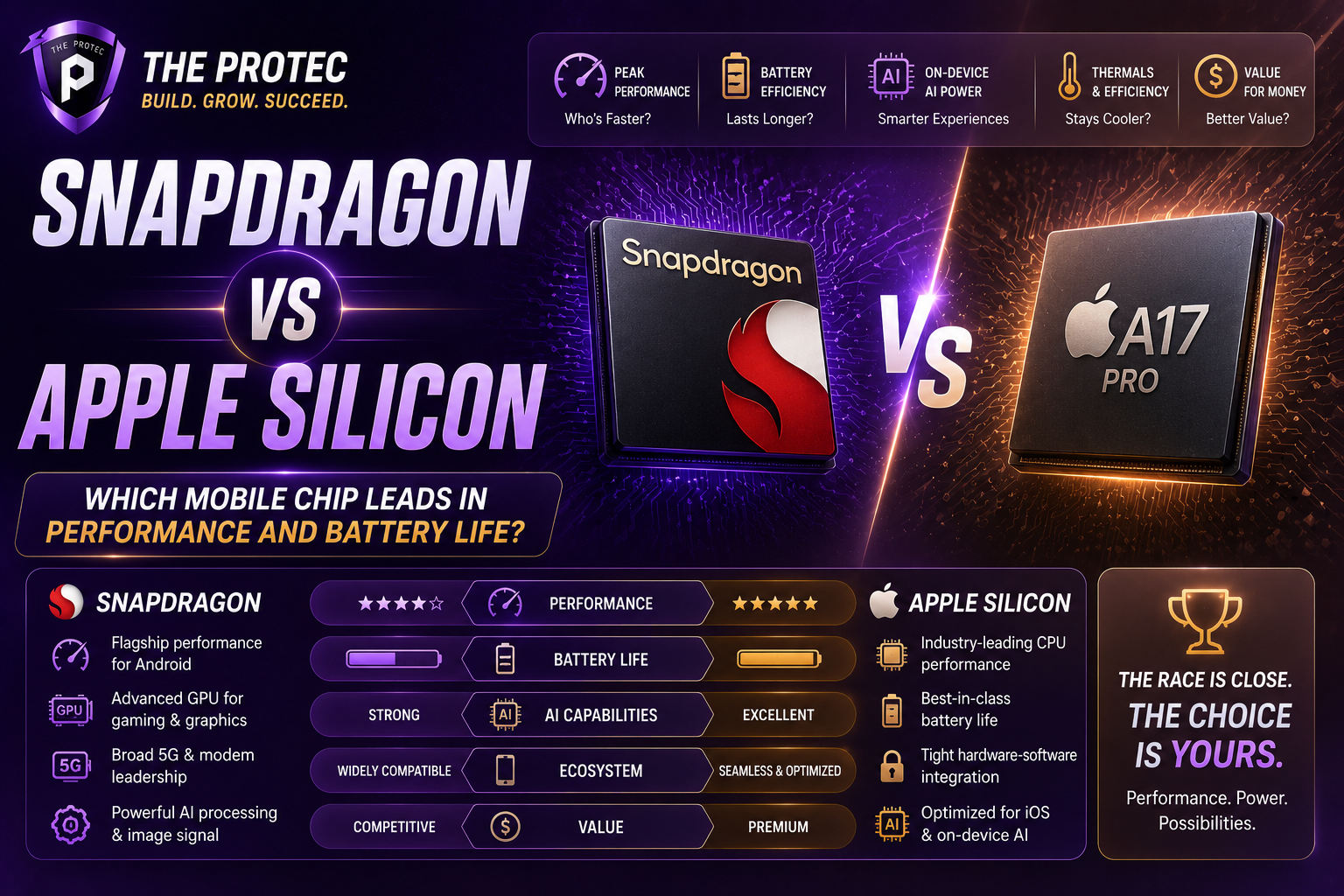
In the rapidly evolving smartphone landscape, mobile processors serve as the beating heart that defines a device’s capabilities. Two giants stand out prominently: Qualcomm’s Snapdragon series and Apple Silicon. As consumers demand more power and longer battery life from their smartphones, the competition between these chipsets intensifies. This article delves into a detailed mobile processor comparison, focusing on performance and battery efficiency to answer the ultimate question: which chip is currently winning the battle for supremacy?
Understanding the Architectures Behind Snapdragon and Apple Silicon
Before diving into benchmarks and battery tests, it’s important to understand the fundamental design philosophies behind these chipsets.
Snapdragon: Versatility and Industry Standard
Snapdragon processors, developed by Qualcomm, power a wide range of Android devices from budget to premium flagships. Leveraging the ARM architecture, Snapdragon chips integrate CPU cores, GPUs, AI accelerators, and modem technologies on a single SoC. The modular approach allows for efficient multitasking and support for diverse functionalities including 5G connectivity.
Apple Silicon: Custom Innovation Tailored for Ecosystem
Apple Silicon, built on an ARM foundation but heavily customized by Apple, represents a deep integration between hardware and software. This vertical integration allows Apple to optimize performance and efficiency tightly with iOS, delivering a seamless user experience. Custom cores and proprietary GPU designs, coupled with a powerful Neural Engine, emphasize raw computational efficiency and AI performance.
Performance Comparison
Performance in mobile chips is multifaceted, covering raw CPU power, graphical capabilities, AI processing, and real-world efficiency. Let’s compare Snapdragon vs Apple Silicon across these critical benchmarks.
CPU Performance
Apple Silicon continues to lead in raw CPU power, thanks to its high-performance cores that deliver substantial single-thread and multi-thread throughput. The tightly controlled thermal envelope in Apple devices enables sustained peak performance, especially in flagship models powered by Apple’s latest A-series silicon.
On the other hand, Snapdragon’s latest generation chips have closed performance gaps considerably. Their multi-core architectures and aggressive clock speeds deliver impressive multi-threaded performance, particularly excelling in tasks optimized for heterogeneous CPU clusters such as gaming and heavy multitasking.
GPU and Graphics Processing
Apple Silicon integrates custom-designed GPUs optimized specifically for iOS applications, offering smooth graphics rendering and efficient battery consumption during heavy workloads. Its GPU performance consistently outpaces Snapdragon in graphics benchmarks, supporting high-refresh-rate displays and sophisticated AR applications.
Qualcomm’s Adreno GPUs, powering Snapdragon chips, are the industry standard for Android devices. Recent iterations show significant improvements in ray tracing support and AI-enhanced graphics rendering, making Snapdragon a formidable competitor in gaming and multimedia processing.
AI and Machine Learning
Apple’s Neural Engine focuses on maximizing AI task efficiency with lower power consumption. This results in swift on-device processing for features like voice recognition, image processing, and augmented reality with minimal battery drain.
Snapdragon incorporates dedicated AI accelerators that excel in real-time AI workloads, especially in Android’s diverse ecosystem, offering competitive performance in image enhancements and voice assistants.
Battery Life and Efficiency
Performance is just half the story; battery efficiency equally shapes user experience. Modern chipsets balance raw power with intelligent power management.
Apple Silicon’s Edge in Efficiency
Apple Silicon’s efficiency cores operate at ultra-low power during everyday tasks, preserving battery life significantly. The synergy between software and hardware extends usage times, often allowing iPhones to outlast competitors during video playback, browsing, and standby.
Snapdragon’s Improvements in Power Management
Qualcomm’s Snapdragon also embraces efficiency through advanced 4nm fabrication nodes and adaptive power management systems. Features such as dynamic voltage and frequency scaling help extend battery longevity while maintaining performance under load.
However, the fragmentation of Android devices with varying battery sizes means that real-world efficiency can fluctuate, though flagship Snapdragon-powered phones consistently deliver competitive battery life.
Real-World Smartphone Chip Benchmark Highlights
Reported smartphone chip benchmarks from industry sources reveal interesting insights:
- Geekbench: Apple Silicon models typically dominate single-core CPU scores, with Snapdragon showing strong multi-core competitiveness.
- 3DMark: Graphics benchmarks favor Apple’s integrated GPU for smooth frame rates and consistent rendering, with Snapdragon’s recent chips narrowing the gap.
- PCMark Work 3.0: Tests that simulate daily multitasking show Apple Silicon handling workloads with greater efficiency, though Snapdragon displays resilience in prolonged high-intensity tasks.
These benchmarks underscore that while Apple Silicon currently holds a slight edge in most tests, Snapdragon’s continuous innovation is meaningful and benefits from broader ecosystem support.
Additional Considerations
When evaluating Snapdragon vs Apple Silicon, ecosystem integration is critical:
- Software Optimization: Apple’s tight software-hardware integration ensures apps run optimally, while Snapdragon chips must support a wider spectrum of devices and Android versions.
- Connectivity: Snapdragon’s latest 5G modems often lead in cellular performance, though Apple has aggressively improved its 5G integration in recent iterations.
- Thermal Management: Apple Silicon’s efficient thermal design enables better sustained performance without throttling compared to many Snapdragon-powered devices.
Frequently Asked Questions
Which mobile chip provides better battery life?
Apple Silicon generally offers superior battery life due to its highly optimized efficiency cores and seamless software integration. However, Snapdragon-driven devices also deliver solid battery performance, especially with recent advancements in power management technology.
Are Snapdragon chips faster than Apple Silicon processors?
Apple Silicon tends to lead in single-core performance and integrated GPU power, offering faster user experiences in many smartphone tasks. Snapdragon chips, however, excel in multi-core workloads and network connectivity, narrowing the performance margin.
What factors should I consider when choosing between these chips?
Beyond raw performance and battery life, consider factors such as operating system preference, device ecosystem, connectivity needs, and the type of applications you prioritize. Both Snapdragon and Apple Silicon represent top-tier mobile chip technology tailored for different user experiences.
Conclusion
Ultimately, the Snapdragon vs Apple Silicon comparison is a reflection of two different approaches to mobile computing. Apple Silicon offers unmatched integration and efficiency that translates into superior performance and battery life in real-world usage. Snapdragon chips, meanwhile, bring versatility, leading-edge connectivity, and robust performance to a broad spectrum of devices.
For users firmly embedded in the Apple ecosystem seeking peak performance and long-lasting battery life, Apple Silicon remains the premier choice. Meanwhile, Snapdragon-powered smartphones cater to a diverse audience craving customization, connectivity, and competitive processing power.
With ongoing advancements on both sides, the mobile processor rivalry remains one of the most exciting tech battles, continuously pushing innovation forward.
For further reading and benchmark details, visit AnandTech.