








USB-C Everywhere: Why the Tech Industry Finally Standardized Charging
For years, charging was one of the most frustrating parts of owning tech. Phones, laptops, earbuds, tablets, cameras, handheld consoles, and accessories all seemed to come with their own cable, their own port, and their own rules. Then USB-C technology started showing up everywhere, and the industry quietly moved toward something users had wanted for a long time: universal charging.
This shift did not happen by accident. It was driven by better engineering, consumer demand, sustainability goals, and increasingly strict regulation. Today, USB-C devices are becoming the default across most major categories, and the result is bigger than convenience. Standardization is changing product design, reducing waste, improving interoperability, and creating new expectations for speed, power delivery, and accessory compatibility.
Here is why the tech industry finally standardized charging, what USB-C actually solves, and what the future may look like as universal charging becomes the norm.
Why charging standards were such a mess for so long
Before USB-C became dominant, every category of device had its own ecosystem. Phones used micro-USB, proprietary connectors, or vendor-specific fast-charging systems. Laptops relied on barrel plugs, custom magnetic chargers, or early USB variants with inconsistent capabilities. Even when a connector fit, it did not always mean it could deliver enough power or transfer data at useful speeds.
This fragmentation created several problems:
- Consumer confusion: People had to track multiple cables and adapters for different devices.
- Accessory waste: Chargers were frequently discarded, replaced, or duplicated.
- Interoperability issues: A cable might charge one device slowly, another quickly, and another not at all.
- Design constraints: Manufacturers had to build around multiple port types and charging circuits.
The result was a market where “plug and play” often meant “plug and hope.” USB-C technology was designed to fix that by combining power, data, and video into one reversible port standard with room to grow.
What makes USB-C technology different
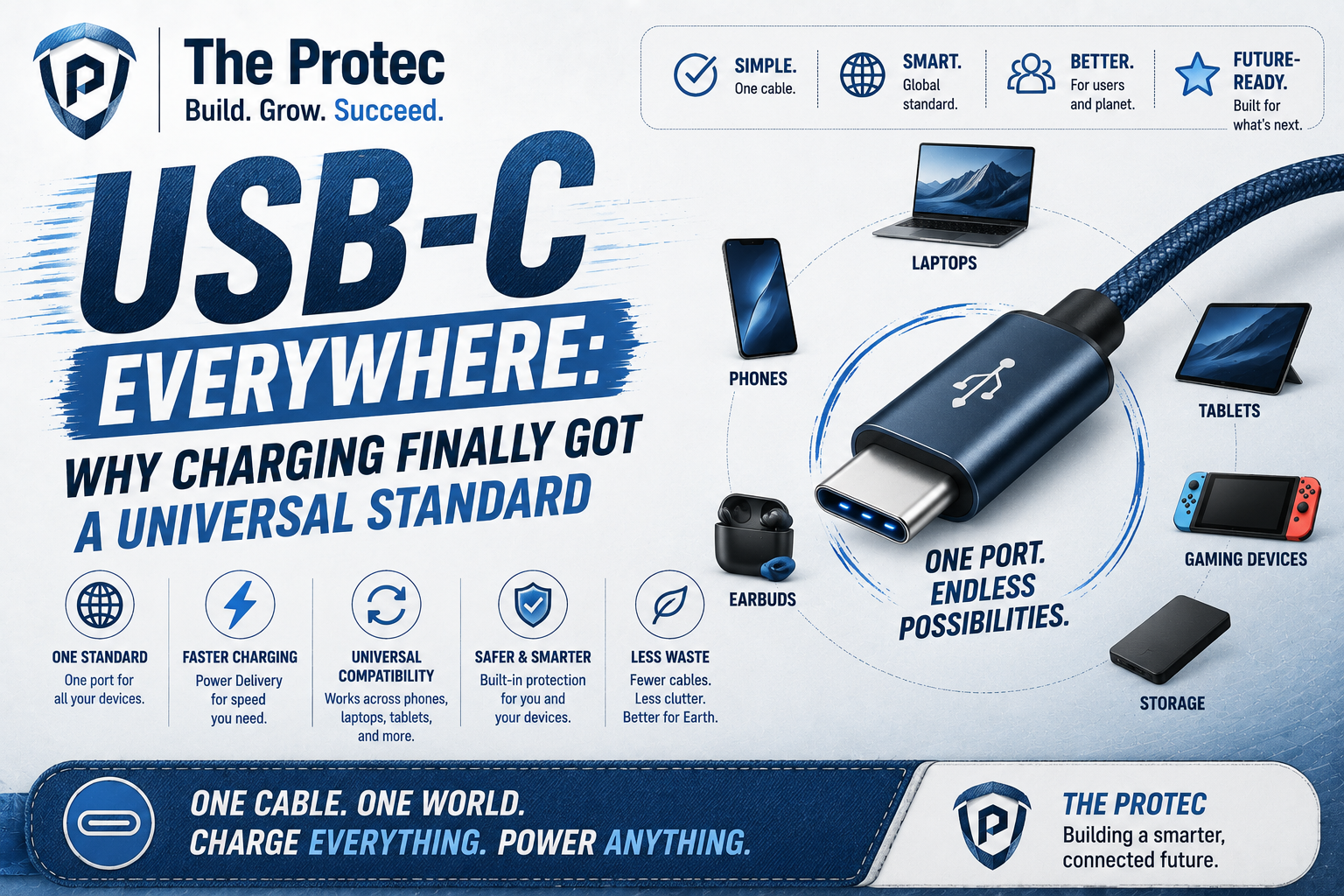
USB-C is more than a port shape. It is a connector standard designed to support modern electronics with greater flexibility than older USB generations. The port is reversible, compact, and capable of carrying far more power than legacy connectors. That combination made it attractive not only for phones, but also for tablets, ultrabooks, monitors, hubs, docks, portable drives, and even some gaming devices.
Its biggest strengths are practical:
- Reversible orientation: Users no longer need to guess which side is up.
- Higher power delivery: USB-C devices can charge everything from earbuds to high-performance laptops.
- Multi-function support: One port can handle charging, data, and video output.
- Scalable performance: The standard can evolve with new specifications without changing the physical connector.
The key to USB-C’s success is that it supports a broad range of use cases while reducing the number of physical ports manufacturers need to include. That simplicity is a major reason universal charging is finally becoming realistic.
The rise of universal charging across USB-C devices
The modern device ecosystem has changed dramatically. A few years ago, USB-C was common but not universal. Today, it is difficult to buy many categories of consumer electronics without seeing USB-C as the default or preferred connector. Phones, tablets, headphones, cameras, wireless accessories, portable monitors, and gaming handhelds increasingly rely on the same cable family. Laptops and docking ecosystems have also embraced it, making the same cable useful at work, at home, and on the move.
That matters because universal charging is not just about convenience. It reduces friction in daily life. A single charger can power a phone in the morning, a laptop during the day, and earbuds at night. For travelers, hybrid workers, students, and families sharing multiple devices, this is a meaningful change. It also makes it easier to replace lost cables or borrow power in an emergency.
For manufacturers, standardization also has benefits. Using fewer connector types simplifies inventory, reduces engineering complexity, and opens the door to slimmer products. Internal space that once went toward proprietary ports and custom charging solutions can be used for larger batteries, better cooling, or additional hardware.
Why the industry accepted USB-C now
The tech industry did not standardize charging simply because it wanted to be nicer to users. It happened because several forces aligned at the same time.
1. USB-C matured as a real platform
Early USB standards often felt limited compared with proprietary charging systems. But USB-C technology matured quickly. Power Delivery, better cable certification, and faster data capabilities made the standard viable for high-performance devices. As implementation improved, USB-C became capable of replacing older charging methods without sacrificing speed or reliability.
2. Consumers demanded less clutter
Most users never wanted a drawer full of cables. They wanted one reliable charging system that worked across devices. As people bought more tech and moved between home, office, and travel, the value of universal charging became obvious. Consumer pressure pushed brands to remove unnecessary friction.
3. Sustainability became a business issue
Electronic waste is now a serious concern for regulators, brands, and consumers. When each device ships with a unique charger, more accessories are manufactured, sold, replaced, and discarded. Standardized charging helps reduce that waste by increasing the likelihood that one charger can serve multiple devices over a longer lifecycle.
4. Regulation changed the cost-benefit equation
The biggest accelerant has been policy. Governments have increasingly pushed the industry toward a common charging interface, especially for mobile electronics. This has turned USB-C from a preference into a compliance requirement in important markets.
Regulations that pushed USB-C into the mainstream
One of the most important developments in charging standardization has been regulation, particularly in markets that prioritize consumer protection and environmental policy. The European Union’s common charger rules have had a major influence on the global market, requiring a common charging port for a wide range of portable devices and pushing the industry toward USB-C adoption. Apple’s transition across its product lines is one of the clearest examples of how regulatory pressure can reshape even the largest hardware ecosystems.
These regulations matter for several reasons:
- They reduce waste: Fewer bundled chargers means less unnecessary hardware entering the market.
- They improve compatibility: More devices can use the same charging accessories.
- They lower consumer costs: Users do not need to buy a different charger for every device.
- They influence product design globally: Companies prefer to build one hardware platform rather than separate regional models.
For a broader policy overview, the European Commission’s guidance on common chargers is a useful reference: European Commission: Common charger for electronic devices.
In practice, regulation has made USB-C less of an optional feature and more of a baseline expectation. Once major brands had to comply in one region, it became inefficient to maintain parallel connector strategies elsewhere.
The benefits of universal charging for users
For most people, the most obvious benefit of USB-C devices is convenience. But the impact goes beyond not having to remember which cable belongs to which gadget.
One charger for many devices
A single USB-C charger can often power a phone, tablet, earbuds, smartwatch, handheld console, and laptop, depending on the wattage and protocol support. That means fewer accessories to carry and fewer points of failure. It is especially helpful for people who travel frequently or work in flexible environments.
Less clutter, less duplication
Standardization cuts down on the number of cables and charging bricks households need to buy. Over time, this reduces clutter in drawers, backpacks, offices, and hotel rooms. It also makes it easier to organize shared charging spaces in workplaces, schools, and public venues.
Better device longevity
When charging accessories are easier to replace, users are less likely to retire perfectly good devices because a proprietary cable is lost or damaged. Universal charging can extend the practical life of electronics by making support and replacement simpler.
More predictable performance
USB-C devices still vary in how quickly they charge, but the ecosystem is more transparent than before. Power Delivery profiles, wattage ratings, and certified cables give consumers a clearer picture of what to expect. That is a major improvement over older systems where compatibility was often a guessing game.
What changed for manufacturers
For brands, switching to USB-C was not just a compliance issue. It also created opportunities to streamline product design and improve user experience. A standardized charging port can reduce internal component variation, simplify packaging, and support sleeker product profiles.
However, the move also introduced new responsibilities. Manufacturers need to ensure that their devices support the right charging protocols, use properly certified cables, and communicate wattage and data limitations clearly. A USB-C port alone does not guarantee a good experience. The implementation matters just as much as the connector.
This is one reason the industry has had to become more precise about labeling. Consumers now need to distinguish between:
- Charging-only support
- Basic USB-C power delivery
- High-wattage laptop charging
- Data transfer performance
- Video output compatibility
The universal connector helps, but the ecosystem still depends on good implementation. That is where quality certification and clearer product documentation become essential.
USB-C is not the end of charging innovation
Even as USB-C becomes the default, it is not the final word in charging technology. Instead, it is becoming the foundation for the next stage of device design. We are already seeing improvements in cable durability, faster power delivery, smarter power negotiation, and more integrated docking ecosystems. In professional and mobile workflows, USB-C hubs and monitors are turning a single port into a full workstation.
There is also growing interest in higher-wattage USB-C charging for more demanding laptops and portable workstations. At the same time, many accessories are becoming more efficient, which means they need less power than before. Together, those trends reinforce the idea that one standard can support a broad range of needs.
For technical readers who want to explore the current capabilities of the standard, USB Implementers Forum provides detailed resources on USB specifications and power delivery: USB-IF official site.
Future implications of USB-C standardization
The move to universal charging will shape the next generation of consumer electronics in several important ways.
1. Fewer proprietary accessories
As more categories converge on USB-C, proprietary charging accessories will become harder to justify. This will likely reduce accessory fragmentation and make third-party ecosystems more competitive.
2. More compact devices
Standard ports can simplify hardware design. In some product categories, that may lead to slimmer devices, fewer openings, and better water and dust resistance. Manufacturers can spend more effort optimizing performance instead of reinventing the charging interface.
3. Better cross-device ecosystems
As USB-C devices become the default, ecosystems will increasingly be defined by software and services rather than by cable types. That helps users move between phones, laptops, tablets, and accessories with fewer barriers.
4. New expectations for transparency
Consumers are becoming more informed about charging speed, power budgets, and cable quality. That means brands will need to provide clearer specs and better certification. In the long run, the market may reward products that make charging behavior easier to understand.
5. A stronger case for repairability and reuse
Universal charging makes it easier to keep accessories in service longer. That supports repair culture, reduces redundant purchases, and makes it simpler to donate, resell, or repurpose older equipment.
What users should know when buying USB-C devices
Even though USB-C is now the standard, not every USB-C device is equal. Consumers still need to pay attention to the details.
- Check wattage: A charger that works for earbuds may not be enough for a laptop.
- Look for certification: Certified cables are more likely to perform safely and reliably.
- Understand protocol support: Data, charging, and video capabilities may differ by device.
- Match the use case: Fast charging, travel charging, and desktop docking may require different accessories.
Universal charging is powerful because it simplifies the baseline experience, but the best results still come from matching the right charger, cable, and device configuration.
Conclusion: USB-C became the standard because the world was ready for it
USB-C technology won because it solved a real problem at the right time. It gave manufacturers a flexible, modern connector that could handle power, data, and video. It gave users a simpler, more universal charging experience. And it gave regulators a practical way to reduce waste and improve interoperability across the electronics market.
The shift to USB-C devices is more than a connector upgrade. It represents a broader move toward universal charging, where convenience, sustainability, and standardization finally align. The industry spent years resisting simplicity because proprietary systems were profitable and familiar. But the market has changed. Today, the default expectation is clear: one cable should do more, and it should work across more devices.
That expectation will only grow stronger as USB-C becomes embedded in more products and use cases. The standard is no longer just the future of charging. It is the present.
FAQ
Is USB-C the same as universal charging?
Not exactly. USB-C is the physical connector and broader technology standard that makes universal charging possible. Universal charging is the result of multiple devices adopting the same port, power system, and compatibility expectations.
Do all USB-C devices charge at the same speed?
No. Charging speed depends on the device, charger wattage, cable quality, and supported power delivery profile. Two USB-C devices may use the same cable but charge very differently.
Why did regulations matter so much for USB-C adoption?
Regulations made standardization harder to avoid. Once major markets required a common charging port for certain devices, manufacturers had a strong incentive to adopt USB-C across more of their product lines to reduce complexity and cost.
Can USB-C also handle data and video?
Yes. One of USB-C’s biggest advantages is that it can carry charging power, data transfer, and video output through the same connector, depending on device support and cable type.
Is USB-C the final charging standard?
Probably not the final one, but it is the most important current standard. Future improvements will likely build on USB-C rather than replace it, especially as power delivery and accessory ecosystems continue to evolve.