




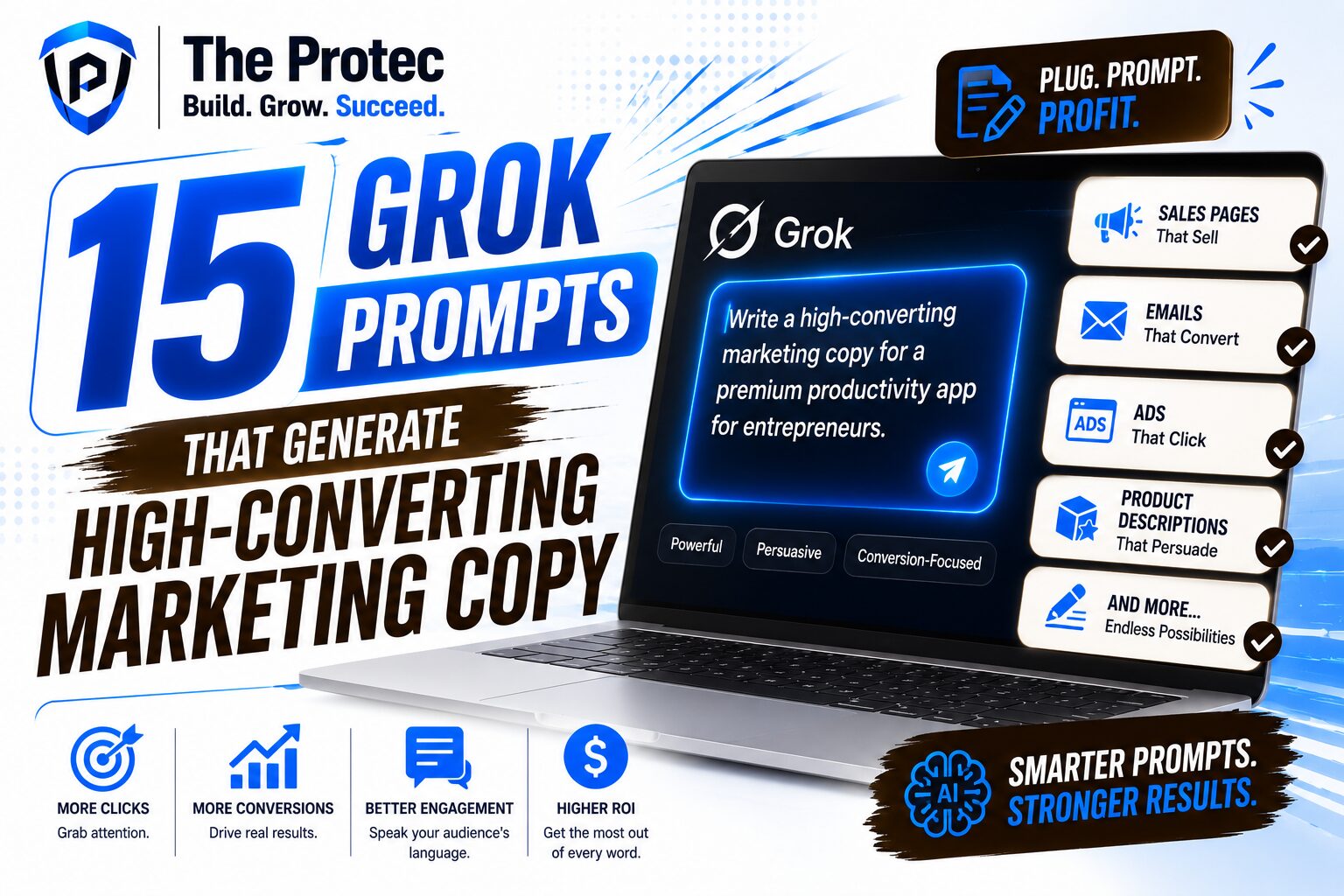
15 Grok Prompts That Generate High-Converting Marketing Copy
Great marketing copy is not just persuasive. It is precise. It speaks to a specific audience, addresses a real pain point, and presents an offer in a way that feels relevant, timely, and easy to act on. That is exactly why marketers are turning to marketing copy AI prompts to speed up ideation and improve performance across ads, landing pages, and email campaigns.
Among today’s AI tools, Grok stands out for fast brainstorming, strong contextual awareness, and a conversational style that helps marketers shape sharper angles quickly. When used well, Grok copywriting prompts can turn a blank page into a conversion-ready draft in minutes. The key is knowing what to ask for and how to structure the prompt so the output is rooted in audience insight, offer clarity, and conversion psychology.
This guide gives you 15 practical AI sales prompts designed specifically for high-converting marketing copy. You will find prompts for paid ads, landing pages, email sequences, headlines, CTAs, objection handling, and offer framing. Each prompt is written to help you generate better copy faster, while still leaving room for human editing, brand nuance, and strategic testing.
Before diving in, it helps to remember one thing: the best AI-generated copy does not sound AI-generated. It sounds like a smart marketer who understands the customer, the offer, and the moment of decision. Use these prompts as a starting point, then refine the output with your brand voice, proof points, and campaign data.
Why Grok Works Well for Conversion-Focused Copy
Grok is especially useful when your goal is not just content volume, but speed-to-variant. In modern performance marketing, teams often need dozens of versions of a headline, angle, or email subject line before they find the winner. Grok can help produce those options quickly, especially when the prompt includes audience context, desired outcome, and format constraints.
In recent marketing workflows, AI copy tools are increasingly used for:
- Rapid ad angle generation for Meta, Google, and X campaigns
- Landing page section drafts based on a core offer and audience pain points
- Email subject lines and preview text variations for A/B testing
- Offer positioning and objection handling for higher conversion rates
- Repurposing one core message into multiple channel-specific formats
According to OpenAI’s guidance on prompt quality, specificity and structured instruction significantly improve output relevance and usefulness, which applies equally well across modern AI writing tools like Grok. See OpenAI’s prompting best practices here: Prompt engineering guide.
How to Use These Grok Prompts for Better Results
Each prompt below is designed to be modified. Replace the bracketed details with your actual offer, audience, and brand specifics. The more context you include, the more useful the output will be.
For best results, add these details to every prompt when possible:
- Audience: Who the message is for
- Pain point: The problem your product solves
- Offer: What you are selling
- Proof: Testimonials, results, stats, or differentiators
- Goal: Click, sign-up, trial, purchase, or reply
- Tone: Direct, premium, friendly, urgent, or bold
Also, ask Grok to generate multiple variations, not just one answer. High-converting copy usually comes from testing options, not settling for the first draft.
1. Prompt for a Core Conversion Angle
Prompt: “Act as a direct-response copywriter. Based on this product: [product], for this audience: [audience], generate 10 conversion angles that focus on different motivations such as saving time, reducing risk, increasing revenue, or achieving a faster result. For each angle, include a one-sentence explanation of why it may convert. Keep the language sharp, specific, and benefit-driven.”
This prompt helps you uncover the strongest messaging direction before writing ads or landing pages. It is ideal when you know your product but need a clearer reason for why someone should care right now.
2. Prompt for High-CTR Ad Headlines
Prompt: “Write 20 short ad headlines for [product] aimed at [audience]. Make them curiosity-driven, benefit-led, and suitable for paid social ads. Include a mix of emotional hooks, problem-solution headlines, and direct-response offers. Keep each headline under 10 words.”
Use this when testing ads on Meta, X, LinkedIn, or display placements. The best headlines often combine specificity with a subtle promise. If your ad platform rewards fast attention, this prompt is one of the most practical Grok copywriting prompts to keep in your toolkit.
3. Prompt for Scroll-Stopping Ad Primary Text
Prompt: “Write 5 versions of ad primary text for [product] that speak directly to [audience pain point]. Use a conversational tone, a strong first line, and a clear call to action. Each version should highlight a different angle: urgency, transformation, simplicity, proof, and objection handling.”
This is useful for paid ads where the first sentence must stop the scroll. Ask Grok to lead with the pain or the desired outcome, then connect that to your offer in one tight sequence.
4. Prompt for Landing Page Hero Copy
Prompt: “Create 5 landing page hero section options for [offer]. For each one, include a headline, subheadline, and CTA button text. The headline should communicate the main result, the subheadline should add clarity and proof, and the CTA should reduce friction. Focus on conversion, not cleverness.”
Your hero section carries most of the burden on a landing page. This prompt is especially useful for refining clarity. A strong hero section often improves both engagement and downstream conversion because visitors instantly understand what they are getting.
5. Prompt for Benefit-Driven Feature Translation
Prompt: “Take these features of [product]: [list features]. Rewrite them as customer-focused benefits for [audience]. For each feature, explain what it means emotionally and practically to the buyer. Make the benefits specific and conversion-oriented.”
Too many brands talk in features. Buyers convert on outcomes. This prompt helps Grok translate technical or product-heavy language into persuasive copy that connects with real-world use cases.
6. Prompt for Objection-Handling Copy
Prompt: “List the top 10 objections a buyer might have before purchasing [product]. Then write concise response copy for each objection in a reassuring, credible, and non-pushy tone. Include proof-oriented language where appropriate.”
Objection handling is one of the most overlooked conversion levers in landing pages and emails. Whether the concern is price, time, complexity, trust, or fit, this prompt helps you address resistance before it becomes a bounce.
7. Prompt for CTA Variations That Increase Clicks
Prompt: “Generate 25 call-to-action lines for [offer] tailored to [audience]. Include direct CTAs, curiosity CTAs, low-friction CTAs, and outcome-based CTAs. Avoid generic phrases like ‘Learn More’ unless you can improve them with context.”
Small CTA changes can produce meaningful lift. A stronger CTA makes the next step feel simpler and more relevant. This is especially valuable for buttons, email links, and ad end cards.
8. Prompt for Email Subject Lines and Preview Text
Prompt: “Write 15 email subject lines and matching preview text options for a campaign promoting [offer] to [audience]. Prioritize open rates by using curiosity, urgency, specificity, and relevance. Avoid spammy language. Include a mix of short and medium-length options.”
Email remains one of the highest-ROI channels in digital marketing, but only if the message gets opened. This prompt helps you generate testable subject line ideas quickly while keeping the tone natural and credible.
9. Prompt for a Full Email Sales Sequence
Prompt: “Create a 5-email sales sequence for [offer] targeting [audience]. Email 1 should build awareness, email 2 should deepen the pain point, email 3 should present the solution, email 4 should handle objections, and email 5 should create urgency and drive action. Include suggested subject lines and key talking points for each email.”
This prompt is ideal for launches, webinars, lead magnets, and limited-time promotions. It structures the sequence so the offer feels earned, not forced.
10. Prompt for AIDA-Based Ad Copy
Prompt: “Write 3 ad variations for [product] using the AIDA framework: Attention, Interest, Desire, Action. Make each version sound natural and highly persuasive. Keep the copy concise, focused on the main benefit, and tailored to [audience].”
Framework-based prompts remain effective because they give Grok a clear persuasive structure. AIDA is especially useful for short-form ads where every line has to do work.
11. Prompt for PAS Landing Page Sections
Prompt: “Write a Problem-Agitate-Solve landing page section for [product]. Start by describing the buyer’s problem in plain language, intensify the frustration or cost of inaction, then introduce [product] as the solution. Keep it persuasive but not exaggerated.”
PAS works well when the audience already feels the pain. It is particularly effective for services, software, and offers that solve expensive or recurring problems.
12. Prompt for Social Proof Integration
Prompt: “Turn these testimonials and results: [paste proof] into persuasive marketing copy for [product]. Create 5 ways to weave social proof into a landing page or ad without sounding forced. Show how to use proof to reduce doubt and increase trust.”
Proof is often the difference between interest and conversion. This prompt helps you transform raw testimonials into strategic messaging. If you need stronger proof assets, pairing AI output with real customer evidence is one of the most effective ways to improve response.
13. Prompt for Offer Positioning
Prompt: “Position [offer] against the common alternatives available to [audience]. Highlight what makes it faster, easier, safer, or more valuable. Write 5 positioning statements that clearly explain why this offer is the better choice.”
Strong positioning is a conversion multiplier. It helps the buyer understand not just what the product does, but why it is the better decision compared to doing nothing or choosing another solution.
14. Prompt for Long-Form Sales Page Copy
Prompt: “Write a conversion-focused outline for a long-form sales page for [offer]. Include sections for the hero, problem, promise, features, benefits, proof, objections, offer stack, risk reversal, FAQs, and CTA sections. For each section, provide a short draft paragraph optimized for clarity and persuasion.”
This prompt is useful when you need a full-page structure quickly. It is especially effective for high-consideration offers where a longer sales argument is necessary to build trust and move the reader toward action.
15. Prompt for Multi-Channel Campaign Consistency
Prompt: “Take this core message for [product]: [message]. Adapt it into copy for a paid ad, a landing page hero section, a welcome email, and a follow-up reminder email. Keep the value proposition consistent across all channels, but tailor the tone and length to each format.”
Campaign consistency matters more than ever. When the ad promise, landing page message, and email follow-up align, users experience less friction and more confidence. This prompt is excellent for building a cohesive funnel instead of isolated assets.
Best Practices for Using Grok Copywriting Prompts
To get better output from Grok, treat prompts like strategy inputs, not magic commands. The quality of your result depends on the quality of your context. The most effective marketers use AI to accelerate the process, then apply judgment to sharpen the final draft.
- Give audience detail: Industry, role, awareness level, and pain point
- Specify the channel: Ad, landing page, email, SMS, or retargeting
- State the goal: Click, opt-in, purchase, reply, or demo request
- Request multiple variants: Testing requires options
- Ask for tone control: Direct, premium, playful, urgent, or expert
- Review for brand fit: AI should support your voice, not replace it
It also helps to think in terms of conversion psychology. The strongest copy usually reinforces one of five forces: relevance, desire, trust, urgency, or simplicity. If your prompt does not help Grok produce one of those, refine it until it does.
Common Mistakes to Avoid
Even excellent AI sales prompts can produce weak copy if the input is vague. Avoid asking for “great marketing copy” without context. That usually leads to generic output with broad claims and predictable phrasing.
- Do not overload the prompt with too many unrelated goals
- Do not skip the audience description
- Do not forget proof, differentiators, or constraints
- Do not publish AI draft copy without editing for clarity and brand voice
- Do not ignore testing; even strong copy needs data validation
For teams building modern campaigns, the winning approach is usually hybrid: AI for speed, humans for strategy. That balance is especially important in a market where customer attention is fragmented and message relevance matters more than ever.
FAQ
What are the best marketing copy AI prompts for conversions?
The best prompts focus on a specific channel, audience, and goal. Prompts for ad headlines, landing page hero copy, objection handling, and email subject lines tend to perform especially well because they directly influence clicks and purchases.
How do Grok copywriting prompts differ from generic AI prompts?
Grok copywriting prompts are most effective when they include conversion context, such as buyer pain points, offer positioning, proof, and CTA goals. Generic prompts often produce broad, unremarkable copy, while conversion-focused prompts guide the model toward persuasive output.
Can AI sales prompts replace a human copywriter?
No. AI can generate strong first drafts, ideas, and variations, but human copywriters are still needed to sharpen strategy, protect brand voice, and make judgment calls based on real customer insight and campaign performance.
What should I test first in high-converting marketing copy?
Start with the headline, offer angle, and CTA. These elements often have the biggest impact on attention and conversion. After that, test supporting proof, objection handling, and email subject lines.
How can I make AI-generated copy sound more human?
Use real audience language, keep sentences varied, remove filler, and add concrete details. Also, edit the output to match your brand voice and avoid overly polished phrasing that feels generic or machine-made.
Final Thoughts
High-converting copy does not come from inspiration alone. It comes from understanding the audience, framing the offer clearly, and testing messaging systematically. The 15 prompts above are designed to help you do exactly that with Grok. Whether you are building ads, landing pages, or email campaigns, these marketing copy AI prompts can help you move faster without sacrificing quality.
The smartest use of AI is not to replace strategic thinking, but to amplify it. Use these prompts to generate stronger angles, cleaner copy, and more persuasive sales messages. Then refine the output, test the variants, and let the data tell you what converts.