







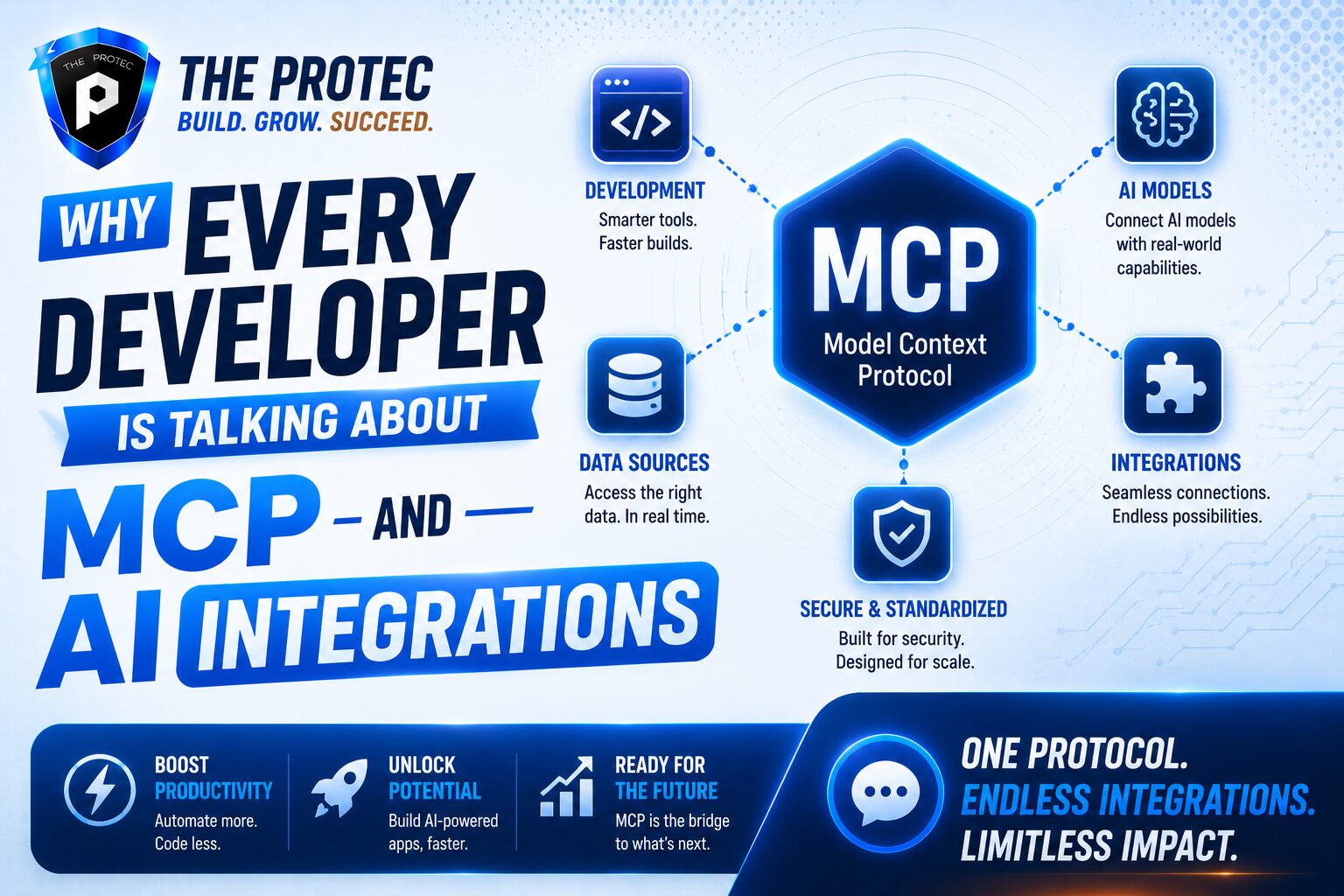
Why Every Developer Is Talking About MCP
Developer conversations around AI have shifted fast. At first, the focus was on prompts, then on agents, and now on something more practical: how AI systems actually connect to the tools, data sources, and workflows developers use every day. That is where Model Context Protocol, or MCP, has entered the spotlight.
MCP AI is not another chatbot trend. It is a protocol designed to make AI integrations cleaner, more reusable, and far less brittle than custom one-off connections. In simple terms, MCP gives AI systems a standard way to discover and use external tools and services. Instead of building a new integration for every app, model, or assistant, developers can expose capabilities once and let multiple AI clients use them in a consistent way.
That idea matters because the modern software stack is already fragmented. Teams use cloud databases, CRMs, internal APIs, file systems, ticketing platforms, analytics tools, and code repositories. AI becomes far more useful when it can act inside that environment instead of sitting outside it. MCP is gaining traction because it offers a shared language for that interaction.
In this article, we will unpack what Model Context Protocol is, why developers are adopting it so quickly, how it changes AI integrations, and where it fits in the broader move toward tool-using AI systems.
What Is Model Context Protocol?
Model Context Protocol is an open protocol that standardizes how AI applications connect to external systems. Rather than tying a model to a specific API integration or custom plugin, MCP defines a common interface for tools, resources, and prompts that an AI client can discover and use.
The easiest way to think about MCP is this: it works like a universal connector for AI systems. If a traditional API is a single custom cable, MCP is the adapter standard that lets many devices plug into many services in a predictable way.
At a high level, MCP enables an AI assistant or agent to:
- discover available tools and services
- request structured data from external systems
- invoke actions such as creating tickets, querying records, or updating files
- access context from documents, databases, and internal knowledge sources
- operate with less custom glue code
For developers, the value is not just convenience. It is architectural consistency. A standard protocol reduces integration sprawl and makes AI systems easier to maintain as the ecosystem evolves.
Why MCP AI Is Catching On So Quickly
The rise of MCP AI is tied to a simple reality: AI is becoming more useful when it can do work, not just generate text. Developers no longer want isolated assistants that summarize a file or draft an email. They want systems that can check inventory, inspect logs, fetch customer history, open pull requests, or trigger a workflow in a business app.
That shift creates a scaling problem. Every external tool has its own API, authentication model, data shape, and error behavior. If each AI product builds its own custom integrations, the result is duplicated effort and fragile code. One product update can break multiple connections.
MCP addresses that pain by turning integrations into a protocol problem instead of a bespoke engineering problem. Once a service exposes an MCP server, multiple AI clients can interact with it in a standardized way. This makes it easier to build ecosystems around tools rather than isolated point solutions.
Developers are also paying attention because MCP aligns with the current direction of AI product design. The most advanced systems now rely on tool use, retrieval, multi-step reasoning, and controlled action execution. MCP fits naturally into that stack because it gives the model a structured way to ask for context and perform operations.
How Model Context Protocol Works in Practice
To understand why this matters, it helps to look at how MCP works in a typical AI integration. Instead of manually wiring every action into a model-specific workflow, a developer exposes capabilities through an MCP server. The AI client then connects to that server and can learn what is available.
In practical terms, an MCP setup often includes three major concepts:
- Tools: Actions the AI can request, such as querying a database, sending a message, or generating a report.
- Resources: Readable context like documents, records, files, or structured data.
- Prompts: Reusable instructions or templates that help guide the AI for a specific workflow.
Imagine a support team using an AI assistant. Through MCP, the assistant can check a ticketing system for open cases, pull customer notes from a CRM, read product documentation, and draft an informed reply. The developer does not need to create a separate custom integration for each model or assistant. The protocol handles the interaction model.
This also improves portability. If you change the AI client later, the same MCP server can often continue to work with minimal reconfiguration. That is especially attractive in a market where model providers, agent frameworks, and enterprise AI platforms are changing quickly.
Why Developers Prefer Standards Over One-Off Integrations
Developers have seen this pattern before. In every major platform shift, the winners usually provide a standard way to connect systems. The internet grew around HTTP. Authentication became easier with OAuth. Observability improved with standardized logging and tracing conventions. MCP is attractive for the same reason: it reduces friction by making integration behavior predictable.
Without a standard like MCP, AI integrations often suffer from the same problems:
- duplicated code across apps and assistants
- different schemas for the same kind of tool
- inconsistent authentication flows
- hard-to-debug failures when APIs change
- limited portability between model providers
With MCP, the integration layer becomes more modular. A developer can focus on exposing the right business capability once, rather than rewriting the same connector for every AI product. That modularity is a major reason the protocol is gaining so much attention in engineering teams building modern AI integrations.
There is also a strategic benefit. Standardization creates optionality. Teams do not want to be locked into a single assistant, model, or vendor-specific integration framework. MCP gives them a path to build AI systems that can evolve as the landscape changes.
How MCP Changes AI Integrations
AI integrations used to mean adding a handful of API calls into a custom workflow. That approach still works for simple use cases, but it becomes difficult when you want dynamic tool discovery, reusable context, and multiple AI clients interacting with the same backend systems.
MCP changes the design of AI integrations in several important ways.
1. It separates capability from client
Instead of embedding integration logic into one app, MCP lets you expose capabilities in a way that many clients can reuse. That is useful for internal platforms, agent frameworks, and enterprise assistants.
2. It improves composability
Because tools and resources are standardized, developers can compose richer workflows. A model can retrieve context from one source, call a tool in another system, and use the output to complete a task without each step being hardcoded into one app.
3. It supports more maintainable architecture
Once integrations are protocol-based, they are easier to document, test, version, and monitor. That reduces the maintenance burden that often comes with custom AI automation.
4. It makes AI systems more enterprise-friendly
Enterprises need control over permissions, context boundaries, and operational consistency. MCP’s structured approach helps teams build more governed integrations than ad hoc prompt-based workflows.
In other words, MCP is not just about convenience. It is about creating a more reliable integration layer for AI systems that need to operate in production environments.
Where MCP Fits in the Bigger AI Landscape
The current AI landscape is crowded with agent frameworks, retrieval systems, workflow engines, and model hosting platforms. MCP stands out because it is not trying to replace all of them. Instead, it provides a common connective layer between models and the outside world.
That role is increasingly important as AI systems become more tool-dependent. A model by itself has limited utility in a business setting unless it can interact with live systems. Retrieval-augmented generation, function calling, and tool use all point in the same direction: useful AI needs context and actions.
MCP complements that direction by making tool access more standardized. In practice, this means:
- agent frameworks can plug into external services more consistently
- tool providers can publish capabilities once and support multiple clients
- developers can mix and match AI apps without rebuilding every connector
- organizations can centralize integration governance
This is why the protocol is becoming part of the broader conversation around AI infrastructure. Developers are not only asking, “What can the model generate?” They are asking, “How does the model safely and consistently interact with the systems that run the business?” MCP is one of the clearest answers so far.
Real-World Use Cases Driving Adoption
The growing popularity of MCP AI is easier to understand when you look at where it creates immediate value.
Developer productivity
Engineering teams can connect AI assistants to code repositories, issue trackers, package registries, CI systems, and documentation. That makes it possible for an assistant to summarize pull requests, surface failing builds, or explain a code path using real project context.
Customer support
Support workflows benefit from access to CRM records, ticket history, product manuals, and account details. With MCP, an AI assistant can gather the right information before drafting a response, reducing back-and-forth and improving accuracy.
Operations and internal automation
Operations teams can use AI to query dashboards, pull incident data, inspect logs, and trigger common tasks. The advantage of MCP is that the same structure can be reused across multiple internal tools.
Knowledge management
Organizations have valuable information scattered across documents, drives, databases, and internal portals. MCP helps AI systems access that context without requiring a custom ingestion flow for every source.
Sales and revenue workflows
Sales assistants can use MCP-connected systems to retrieve account history, draft follow-ups, update deal records, or prepare meeting summaries based on live customer data.
These use cases share one theme: AI becomes more valuable when it can work with current, trusted context. MCP enables that more cleanly than fragmented integration approaches.
Security and Control in MCP AI Systems
Whenever AI systems can take actions or access data, security becomes central. That is one reason developers are cautious and selective about how they adopt new integration patterns. MCP does not eliminate security concerns, but it gives teams a more structured way to manage them.
Key security considerations include:
- Least privilege: expose only the tools and data an assistant actually needs.
- Authentication: ensure access to services is properly authorized and scoped.
- Context boundaries: prevent the model from seeing sensitive data unnecessarily.
- Tool governance: control which operations can be invoked and under what conditions.
- Logging and auditing: keep records of tool usage for monitoring and compliance.
A well-designed MCP deployment can be safer than a maze of bespoke integrations because the interaction surface is clearer. Instead of scattering API keys and logic across many scripts, teams can manage access through a more central protocol layer.
For background on AI application security and system design, the OpenAI documentation on tool use is useful context: https://platform.openai.com/docs. The broader protocol discussion also connects to the official MCP information hub: https://modelcontextprotocol.io/.
What Developers Should Consider Before Adopting MCP
Even though MCP is getting a lot of attention, thoughtful adoption matters. Developers should not treat it as a magic fix for every AI integration problem. It is best seen as an enabling layer that works well when you already know which capabilities you want to expose.
Before adopting MCP, teams should ask:
- Which systems should the AI be allowed to access?
- What actions should be read-only versus write-enabled?
- How will authentication and permission management work?
- What audit trail is needed for compliance or debugging?
- Which integrations should be exposed as reusable services?
It is also important to start with narrow, high-value use cases. A focused internal workflow, such as pulling documentation and creating a summary for support staff, can be a better first step than trying to wire every business system into an AI assistant at once.
Teams should also evaluate how MCP fits alongside existing infrastructure. In some cases, a direct API integration is still the simplest option. MCP is most compelling when you want reusable tool access across multiple AI clients or when you are building a broader AI platform strategy.
The Future of AI Integrations Looks More Protocol-Driven
The rise of MCP suggests a broader trend: AI infrastructure is becoming more standardized. As models get better at reasoning and tool use, the bottleneck shifts from raw intelligence to system design. The question is no longer whether an AI can generate a response. The question is whether it can reliably interact with the tools that make that response useful.
That is why Model Context Protocol is resonating with developers. It offers a path toward AI systems that are less brittle, more interoperable, and easier to maintain. It helps turn AI from a standalone interface into a connected layer within existing software ecosystems.
Over time, the most successful AI products are likely to be those with strong integration foundations. MCP may not solve every challenge in the AI stack, but it addresses one of the most important ones: structured, reusable access to external context and actions.
As the ecosystem matures, expect MCP AI to become part of normal engineering conversations alongside API gateways, observability, and authentication. That is usually what happens when a technology moves from hype to infrastructure.
FAQ
What is Model Context Protocol in simple terms?
Model Context Protocol is a standard way for AI systems to connect to tools, data sources, and services. It helps AI assistants discover capabilities and use them without requiring custom integrations for every app.
Why are developers interested in MCP AI?
Developers like MCP because it simplifies AI integrations, improves portability between clients, and makes tool-connected AI systems easier to maintain. It reduces the need to build separate connectors for each model or assistant.
How does MCP differ from normal API integrations?
Traditional API integrations are usually custom-built for one application. MCP provides a shared protocol so multiple AI clients can access tools and context in a standardized way, which makes the integration more reusable and scalable.
Is MCP only useful for large enterprises?
No. While enterprises benefit from governance and reuse, smaller teams can also use MCP to reduce integration overhead and build AI workflows that connect to real tools more cleanly.
Does MCP replace function calling or agent frameworks?
Not exactly. MCP complements them. Function calling and agent frameworks handle orchestration and reasoning, while MCP focuses on the standardized connection between AI systems and external tools or services.
Final Thoughts
Every developer is talking about MCP because it solves a problem the AI industry can no longer ignore: how to connect intelligent systems to the tools that make them useful. Model Context Protocol gives teams a cleaner, more scalable way to build AI integrations that reach beyond prompts and into real workflows.
If the last wave of AI was about generating content, the next wave is about taking action with context. MCP is one of the most important building blocks in that transition, and that is exactly why it is becoming a major topic in developer circles.