








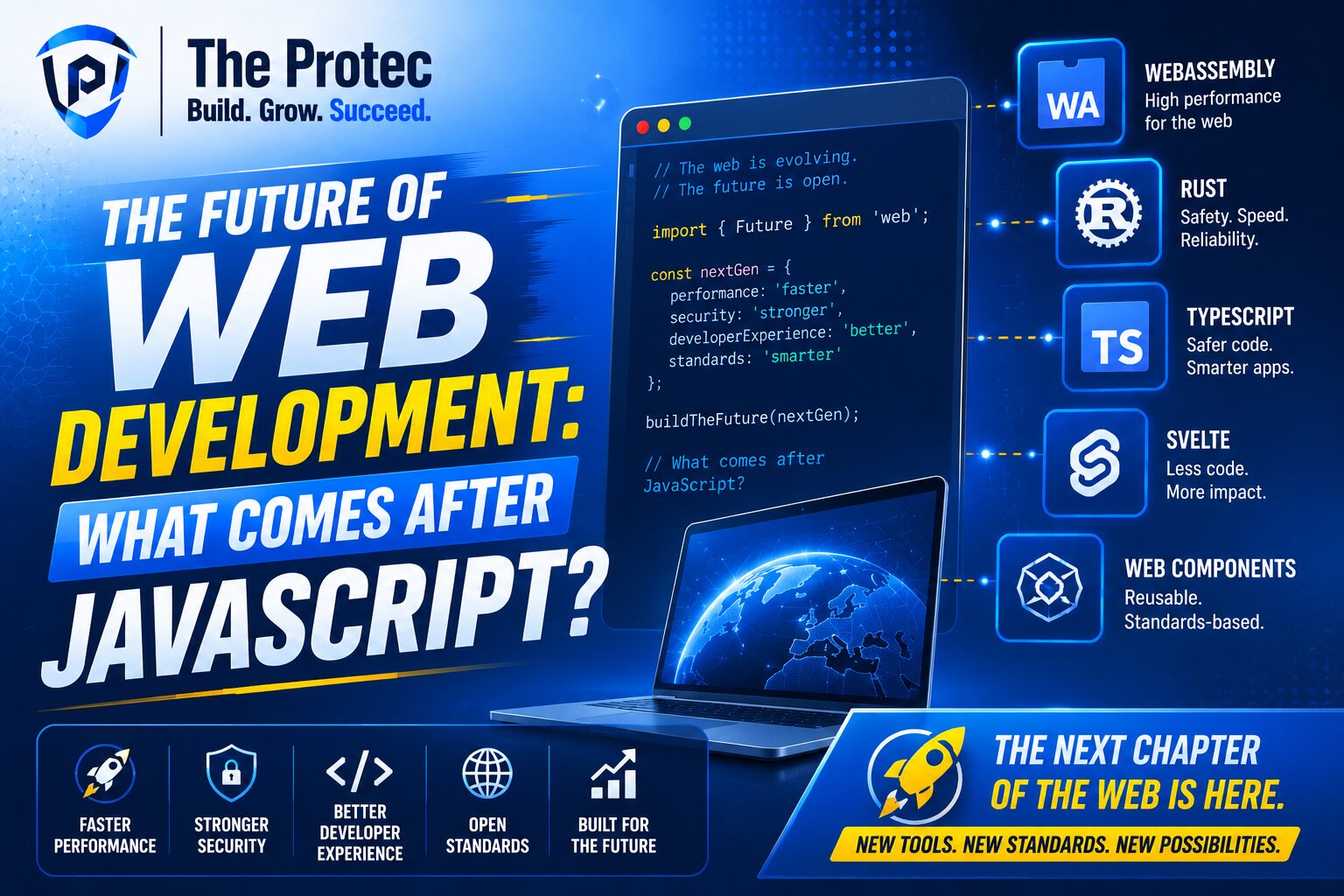
The Future of Web Development: What Comes After JavaScript?
JavaScript has been the backbone of the modern web for nearly three decades. It powers interactive interfaces, real-time applications, and full-stack frameworks that define how users experience the internet today. But the conversation in web development is changing. As applications become more ambitious, teams are asking a bigger question: what comes after JavaScript?
The answer is not a clean replacement. JavaScript is still deeply embedded in browsers, tooling, and developer workflows. Yet the future of web development is already being shaped by technologies that reduce JavaScript’s dominance, complement it, or move critical workloads into more efficient environments. WebAssembly, server-side rendering advances, edge runtimes, AI-assisted code generation, and new language ecosystems are all part of that shift.
This article explores the most important JavaScript alternatives and emerging technologies that could reshape how modern web applications are built, deployed, and experienced. If you want to understand where the web is heading, the signs are already visible.
Why JavaScript Is Still Dominant
Before discussing what comes next, it helps to understand why JavaScript remains so resilient. The browser runtime is built around it, every major frontend framework depends on it, and the ecosystem around npm is enormous. That network effect is difficult to beat.
JavaScript also benefits from being flexible, approachable, and universally supported. It allows teams to build everything from simple landing pages to highly interactive web apps without worrying about browser compatibility at the language level. In practice, that makes it the default language of the web.
Still, JavaScript has limitations. Large applications can become difficult to optimize. Main-thread performance bottlenecks affect responsiveness. Bundle sizes grow quickly. And as developers push more logic into the browser, they run into constraints around memory, startup time, and maintainability. These pressures are driving demand for alternatives and complementary technologies.
WebAssembly Is the Strongest JavaScript Alternative
If there is one technology most likely to reshape the future web development landscape, it is WebAssembly. WebAssembly, often called Wasm, is a low-level binary instruction format designed to run at near-native speed in the browser and beyond. It does not replace JavaScript entirely, but it enables new classes of performance-sensitive applications to run on the web.
WebAssembly has matured significantly, and its appeal is no longer limited to niche use cases. It is increasingly used for graphics-heavy apps, video and audio processing, CAD tools, scientific visualization, cryptography, and language runtimes. Developers can compile code from languages like Rust, C++, Go, and increasingly other modern languages into Wasm and run them in a web environment.
The important shift is not just speed. WebAssembly gives teams a way to move heavy computation off JavaScript without leaving the browser. That means better performance for complex workflows, less pressure on the main thread, and more options for building applications that once required native desktop software.
Why WebAssembly Matters for the Future of Web Development
Performance: Wasm can execute compute-heavy tasks more efficiently than typical JavaScript code.
Language flexibility: Teams can use languages better suited for systems programming or performance-critical logic.
Portability: Applications can run consistently across modern browsers and server environments.
Security model: Wasm runs in a sandboxed environment, which supports safer execution of untrusted code.
One of the most important developments is the growing support for WebAssembly outside the browser. Server-side environments, edge platforms, and embedded systems are adopting Wasm as a lightweight execution layer. That expansion makes it more than a browser feature; it is becoming a general-purpose portable runtime.
To understand the technical direction of WebAssembly, the official WebAssembly project is a useful reference for current standards and ecosystem progress.
JavaScript Alternatives Are Emerging in New Ways
It is unlikely that one language will simply dethrone JavaScript. Instead, the future web development stack is becoming more polyglot. Developers are increasingly using different languages for different layers of the application, especially where performance, maintainability, or developer experience matter most.
Several JavaScript alternatives are gaining attention, not because they eliminate JavaScript, but because they solve specific problems better.
TypeScript as the Practical Default
TypeScript is not a replacement for JavaScript in the runtime sense, but it has already become the default development language for many teams. Its static typing, improved tooling, and better refactoring support reduce bugs and make large-scale projects easier to maintain. In many ways, TypeScript represents the most successful evolution of JavaScript itself.
The rise of TypeScript signals a broader trend in the future of web development: teams want safer abstractions, stronger compiler feedback, and more predictable codebases. That expectation is influencing every major framework and build tool.
Rust for High-Performance Frontend and Tooling
Rust is one of the most important JavaScript alternatives in the broader ecosystem. It is not typically used to write entire browser applications directly, but it is increasingly used to power WebAssembly modules, build tools, linters, bundlers, and performance-critical backend services.
Its strict memory safety model and high performance make it especially attractive for the kinds of infrastructure that support modern web apps. The browser-facing result may still be JavaScript or TypeScript, but the underlying engine is often Rust-based. This is a subtle but meaningful shift in how the web stack is built.
Other Languages Joining the Web Stack
Languages like Go, Kotlin, C#, and Swift are also appearing in web-adjacent workflows through compilation targets, Wasm support, and cross-platform frameworks. None of them is likely to replace JavaScript broadly, but they widen the pool of viable options for teams with specific performance or code-sharing goals.
The real pattern is clear: the future is not one language winning outright. It is a web platform that can host multiple languages efficiently while keeping the user experience seamless.
New Runtimes Are Changing Where Web Code Runs
Another major force in the future web development landscape is the rise of new runtimes. For years, frontend code lived in the browser and backend code lived on the server. That boundary is becoming much less rigid.
Modern edge and serverless runtimes let developers run JavaScript, TypeScript, and even Wasm closer to the user. This reduces latency and allows teams to distribute logic across regions more intelligently. It also supports a new generation of applications where interactivity, personalization, and performance are tightly connected.
At the same time, runtimes are becoming more specialized. Some are optimized for low-latency edge execution, others for long-running background jobs, and others for secure sandboxed workloads. As these environments mature, developers will choose execution targets based on workload, not just language.
What This Means for Web Architecture
Rendering can happen closer to the user for faster page loads.
Business logic can be split across browser, edge, and server environments.
Wasm modules can be deployed as portable compute units across platforms.
Frontend and backend boundaries become more fluid and composable.
This architectural flexibility is one of the biggest reasons the future of web development will look different from the JavaScript-heavy stacks of the past. The question is no longer whether code runs in the browser, but where the best place is for each piece of logic.
AI Is Accelerating the Shift in Web Development
Artificial intelligence is not a JavaScript alternative, but it is changing how web applications are built and what developers expect from their tools. AI-assisted coding, automated testing, design-to-code workflows, and intelligent refactoring are already speeding up delivery cycles.
That matters because it reduces the friction of adopting new languages and runtimes. If a team can generate boilerplate, translate code, or scaffold components faster, the cost of experimenting with Rust, Wasm, or newer frameworks goes down. AI also helps developers navigate more complex stacks, where different languages and runtimes coexist.
AI is also influencing user-facing web apps. More applications now include embedded assistants, semantic search, document understanding, and natural-language interfaces. These features often rely on backend inference, edge logic, or WebAssembly-based performance optimizations. So the AI trend is indirectly accelerating the move beyond a JavaScript-only mindset.
Frameworks Are Moving Toward Less JavaScript, Not No JavaScript
One of the most important trends in modern frontend development is the push to ship less JavaScript to the browser. Frameworks increasingly focus on partial hydration, server components, static-first rendering, and resumability. The goal is simple: improve performance by reducing client-side execution overhead.
This is not the same as abandoning JavaScript. Instead, it reflects a more nuanced future web development philosophy: use JavaScript where it adds value, and avoid it where it creates unnecessary cost.
Several approaches point in this direction:
Server-first rendering: More HTML is generated on the server to reduce the work required in the browser.
Resumability: Applications can restore state without re-executing large amounts of client code.
Islands architecture: Interactive components are isolated so only small parts of a page need JavaScript.
Partial hydration: Only the necessary interactive areas are activated on the client.
These patterns reflect a broader engineering principle: the browser should do less unnecessary work. That principle aligns perfectly with the rise of WebAssembly, edge execution, and performance-focused architecture.
WebAssembly and JavaScript Will Coexist
For all the excitement around JavaScript alternatives, it is important to be realistic. JavaScript is not going away any time soon. WebAssembly is powerful, but it still depends on JavaScript for many browser interactions, and most web APIs are exposed through JavaScript bindings. That means the future is likely to be hybrid rather than replacement-driven.
In practice, many applications will use JavaScript or TypeScript for UI logic and orchestration, while delegating compute-heavy tasks to Wasm modules. The browser will remain the universal runtime, but the execution model will become more layered.
This coexistence is a strength, not a weakness. It allows developers to choose the right tool for the right job instead of forcing every problem into one language. That may be the most realistic vision for the future of web development: not a post-JavaScript world, but a post-JavaScript-only world.
What Developers Should Learn Next
If you are planning for the next phase of your career or your team’s architecture, the best strategy is to broaden your stack without abandoning what works. JavaScript remains essential, but the most future-ready developers will understand how to work across multiple runtimes and execution models.
Skills Worth Investing In
TypeScript mastery: Still the most practical upgrade for modern web development.
WebAssembly fundamentals: Understand how Wasm modules are built, loaded, and integrated.
Rust basics: Especially valuable for performance-sensitive tooling and Wasm development.
Edge and serverless architecture: Learn how distributed runtimes change latency and deployment choices.
Performance engineering: Measure real-world impact instead of assuming faster code equals better UX.
AI-assisted workflows: Use AI to accelerate prototyping, testing, and code transformation responsibly.
Developers who understand these areas will be better equipped to work in a web ecosystem that is becoming more modular, distributed, and performance-driven.
The Real Future of Web Development
So what happens after JavaScript? The simplest answer is that JavaScript stays, but its monopoly ends. The next era of web development is not about replacing one dominant language with another. It is about choosing the best runtime, the best compilation target, and the best execution environment for each part of the stack.
WebAssembly is the clearest sign of that future. It opens the door to more languages, better performance, and portable execution across browser and server environments. Meanwhile, TypeScript, Rust, edge runtimes, and AI-assisted tooling are making the web more capable than ever.
The future of web development will likely be defined by three things: less unnecessary client-side work, more flexible runtime choices, and stronger performance at every layer. JavaScript will remain central, but it will increasingly share the stage with technologies that make the web faster, more scalable, and more expressive.
That is the real story after JavaScript: not the end of the web as we know it, but its next major evolution.
FAQ
Will JavaScript be replaced by WebAssembly?
Probably not in the near term. WebAssembly is better understood as a complementary technology. It is ideal for performance-heavy tasks, but JavaScript still handles most browser interactions and UI logic.
What are the best JavaScript alternatives for web development?
The most practical alternatives depend on the use case. TypeScript is the easiest step up for most teams, while Rust, Go, and other languages become attractive when compiled to WebAssembly or used in tooling and infrastructure.
Is WebAssembly only useful in the browser?
No. WebAssembly is increasingly used outside the browser in server, edge, and embedded environments. Its portability is one of the reasons it matters so much for the future of web development.
Should developers stop learning JavaScript?
Absolutely not. JavaScript remains fundamental to the web platform. The smarter move is to deepen JavaScript and TypeScript skills while also learning how WebAssembly, Rust, and modern runtimes fit into the broader ecosystem.
External sources: WebAssembly and Rust