








What Is WebMCP and Why Is Everyone Talking About It?
Google’s WebMCP announcement at Google I/O has quickly become one of the most discussed developments in AI web development. The reason is simple: it points to a future where websites are no longer just built for human visitors. They are also designed to be understood, queried, and acted on by AI agents.
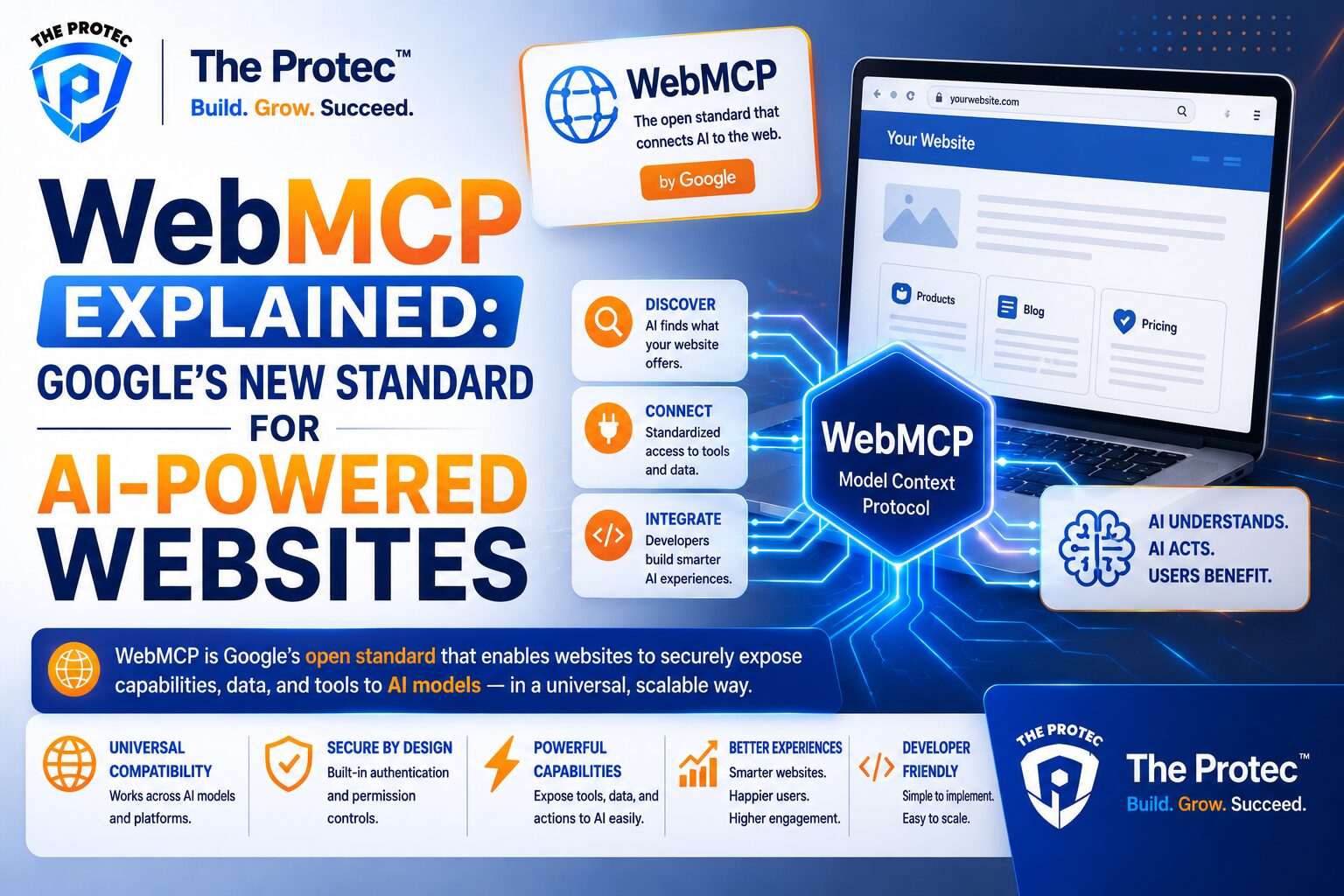
WebMCP, or Web Model Context Protocol, is emerging as a web-focused extension of the broader MCP idea that has been gaining momentum across the AI ecosystem. While MCP has been used to connect AI models to tools, data sources, and workflows in a standardized way, Google WebMCP appears to push that concept directly into the web layer. In practical terms, it could give websites a machine-readable interface that helps AI agents navigate content, interpret intent, and complete tasks more reliably.
This matters because the way people use the web is changing fast. Search is becoming conversational. Browsing is becoming agent-assisted. And websites that can serve both humans and AI systems may gain a major advantage in discoverability, usability, and conversion. WebMCP could become a foundational standard for that shift.
What MCP Already Solved
To understand why WebMCP is such a big deal, it helps to look at the problem MCP was created to address. Model Context Protocol is a standard for connecting large language models to external tools and resources in a structured, secure way. Instead of building custom integrations for every app, developers can expose capabilities through a shared protocol that AI systems can understand.
MCP has been especially valuable for:
- Connecting AI assistants to databases, files, and business systems
- Standardizing tool access across different environments
- Reducing the need for one-off integrations
- Improving consistency in how AI reads and uses external context
In other words, MCP helps AI move beyond static prompting and into real action. But MCP, as useful as it is, is not specifically designed around the web experience itself. That is where WebMCP becomes interesting.
How Google WebMCP Differs From MCP
Google WebMCP is not simply MCP with a new name. The important distinction is scope. MCP focuses broadly on model-to-tool communication, while WebMCP is aimed at the web as a first-class environment for AI interaction.
That difference may sound subtle, but it has major implications. A standard MCP server can expose functions, structured data, or actions. WebMCP, by contrast, seems designed to make websites more legible to AI agents at the interface level. It is about helping a machine understand what a page, app, form, product flow, or service is supposed to do.
Think of it this way:
- MCP helps an AI talk to tools.
- WebMCP helps an AI understand and use websites as tools.
That shift could be transformative for everything from ecommerce and SaaS onboarding to customer support portals and content sites. Instead of relying on brittle scraping or browser automation, AI agents could interact with websites through a more reliable, purpose-built standard.
Why Google’s Timing Matters
Google’s involvement is significant because the company sits at the center of both search and web infrastructure. When Google pushes a new standard, the ecosystem pays attention. A Google-backed approach to AI web development may accelerate adoption far faster than a community-only proposal could.
Timing is also critical. AI agents are moving from novelty to utility. Users increasingly expect AI assistants to summarize pages, compare products, fill out forms, book appointments, and initiate workflows. But most websites were never built with that behavior in mind. They were built for clicks, tabs, and visual navigation.
That gap creates friction. AI agents often struggle with:
- Dynamic layouts and hidden UI states
- Inconsistent form labeling
- Complex multi-step workflows
- JavaScript-heavy pages that are difficult to parse
- Ambiguous content structure
WebMCP could address these problems by giving sites an explicit way to describe their capabilities to AI systems. Instead of hoping an agent can infer intent from page structure alone, developers may be able to declare it.
How WebMCP Could Change AI-Powered Websites
The biggest promise of WebMCP is not just automation. It is interoperability. If widely adopted, WebMCP could help websites expose machine-readable actions that are consistent across platforms. That could change how AI agents interact with the web in several key ways.
1. AI agents could complete tasks more accurately
Today’s AI browser tools often depend on visual interpretation or brittle DOM traversal. That works sometimes, but not always. WebMCP could allow websites to provide structured task definitions, making it easier for agents to know what a form does, what an action means, and what data is required.
2. Websites could become agent-ready by design
Rather than treating AI as an afterthought, developers could build websites that are explicitly designed for both human and machine users. That means clearer semantics, better action metadata, and more predictable interactions.
3. Search and discovery may become more contextual
AI systems increasingly answer questions with direct actions, not just links. If a website advertises its capabilities through a WebMCP-style interface, it may be easier for AI assistants to recommend the right page or even take the user straight into the correct workflow.
4. Conversion paths could improve
For ecommerce, travel, finance, and SaaS, reducing friction is everything. If an AI agent can reliably navigate checkout, booking, onboarding, or support flows, websites may see higher completion rates and fewer abandoned tasks.
What Google WebMCP Could Mean for AI Web Development
AI web development is evolving from prompt-driven features to system-level design. The next generation of websites will likely need to support both human interfaces and agent interfaces. WebMCP fits directly into that future.
For developers, this means thinking beyond visual UI and considering how a website communicates intent. A button is not just a button anymore. It may need to tell an AI agent what action it triggers, what inputs are required, and what outcome to expect.
That could affect several layers of the stack:
- Frontend architecture: More semantic markup and explicit action descriptions
- API design: Better alignment between web interactions and backend capabilities
- Product UX: Cleaner workflows that are easier for both humans and agents to follow
- Content strategy: Pages structured for retrieval, summarization, and actionability
In a sense, WebMCP may push the web toward a more declarative model, where websites describe what they do in a way machines can use directly. That would be a major shift from today’s mostly visual, browser-centric model.
Potential Benefits for Businesses
Businesses should pay close attention to WebMCP because it may influence how customers discover and use digital services. If AI agents become a primary entry point for web interactions, websites that are easier for agents to understand could win more attention and more traffic.
Here are some practical benefits companies may see:
- Better visibility in AI-mediated journeys: Sites that are machine-readable may be more likely to surface in assistant-driven workflows.
- Lower support costs: AI agents could handle routine customer tasks more reliably.
- Higher task completion: Structured interactions reduce user drop-off.
- Improved accessibility: Clear semantics often help both screen readers and AI systems.
- Faster automation: Internal and external agents can interact with services more efficiently.
For e-commerce brands, this could mean a smoother path from product discovery to checkout. For SaaS companies, it could mean easier onboarding and support. For publishers, it could mean more accurate summarization and richer content discovery by AI systems.
The Risks and Open Questions
As promising as WebMCP sounds, the standard is still early, and there are important questions to answer. Any protocol that helps AI agents act on websites must also address trust, security, and control.
Some of the biggest open questions include:
- How will websites authenticate authorized agents?
- How will sensitive actions be restricted or rate-limited?
- How will publishers prevent misuse or spammy automation?
- Will WebMCP become an open standard or a Google-led ecosystem?
- How will legacy websites adopt it without major rewrites?
There is also the issue of governance. If AI agents gain new capabilities on the web, site owners will need clear ways to decide what those agents can do. A standard only works well if it balances openness with control.
Another concern is fragmentation. The web has seen many attempts to standardize machine access before, and not all of them have achieved widespread adoption. WebMCP will need support from browsers, frameworks, CMS platforms, and major website builders to become truly useful.
How Developers Should Start Preparing
Even if WebMCP is still evolving, developers do not need to wait to start preparing. The underlying principles are already valuable. Websites that are semantically clean, well-structured, and API-friendly will be better positioned if agent-native standards continue to expand.
Practical steps include:
- Use semantic HTML whenever possible
- Label forms, buttons, and actions clearly
- Expose structured data where it makes sense
- Reduce unnecessary UI complexity in critical flows
- Design APIs and web interactions to mirror each other
- Document user journeys in a way that maps to machine-readable actions
Teams working in AI web development should also track how browser agents, assistant platforms, and major frameworks respond to the WebMCP announcement. The winners in this space will likely be the ones who adapt early and make their products easier for both humans and agents to understand.
What WebMCP Means for the Future of the Web
WebMCP may represent a deeper shift than just another protocol. It suggests that the web is entering a phase where machine access is not an edge case but a core design requirement. As AI agents become more capable, websites will need to do more than display information. They will need to communicate intent, offer structured actions, and participate in automated workflows.
That does not mean the human web disappears. Instead, the most successful websites may be the ones that serve both audiences equally well. Users will still browse, compare, and click. But behind the scenes, AI systems may increasingly assist with discovery, decision-making, and execution.
If Google WebMCP gains traction, it could accelerate this transition and set a new baseline for AI-powered websites. The standard may influence how developers think about content, interfaces, and interactions for years to come.
FAQ
What is WebMCP?
WebMCP is a web-focused standard associated with Google’s AI strategy that aims to help AI agents interact with websites more reliably through structured, machine-readable interfaces.
How is WebMCP different from MCP?
MCP is a broader protocol for connecting AI models to tools and data sources. WebMCP applies those ideas specifically to the web, helping AI agents understand and act on websites and web applications.
Why does WebMCP matter for AI web development?
WebMCP could make websites easier for AI agents to navigate, interpret, and use. That may improve automation, discovery, accessibility, and task completion across many types of web products.
Will WebMCP replace normal websites?
No. Human-facing websites will still matter. WebMCP is more likely to add a machine-readable layer that helps AI agents interact with existing sites more effectively.
What should developers do now?
Developers should focus on semantic HTML, clear workflows, structured data, and API-aligned interactions. Those practices will prepare sites for a future where AI agents are a bigger part of web traffic.
Final Thoughts
WebMCP is important because it addresses a real and growing problem: the web was built for people, but increasingly needs to serve AI agents too. If Google’s new standard takes hold, it could reshape how websites are built, how users discover content, and how digital tasks are completed.
For businesses and developers, the message is clear. The next era of AI-powered websites will reward clarity, structure, and machine-readable design. WebMCP may be the standard that helps make that future practical.
For those working in AI web development, now is the time to watch closely, plan ahead, and build with both humans and agents in mind.