








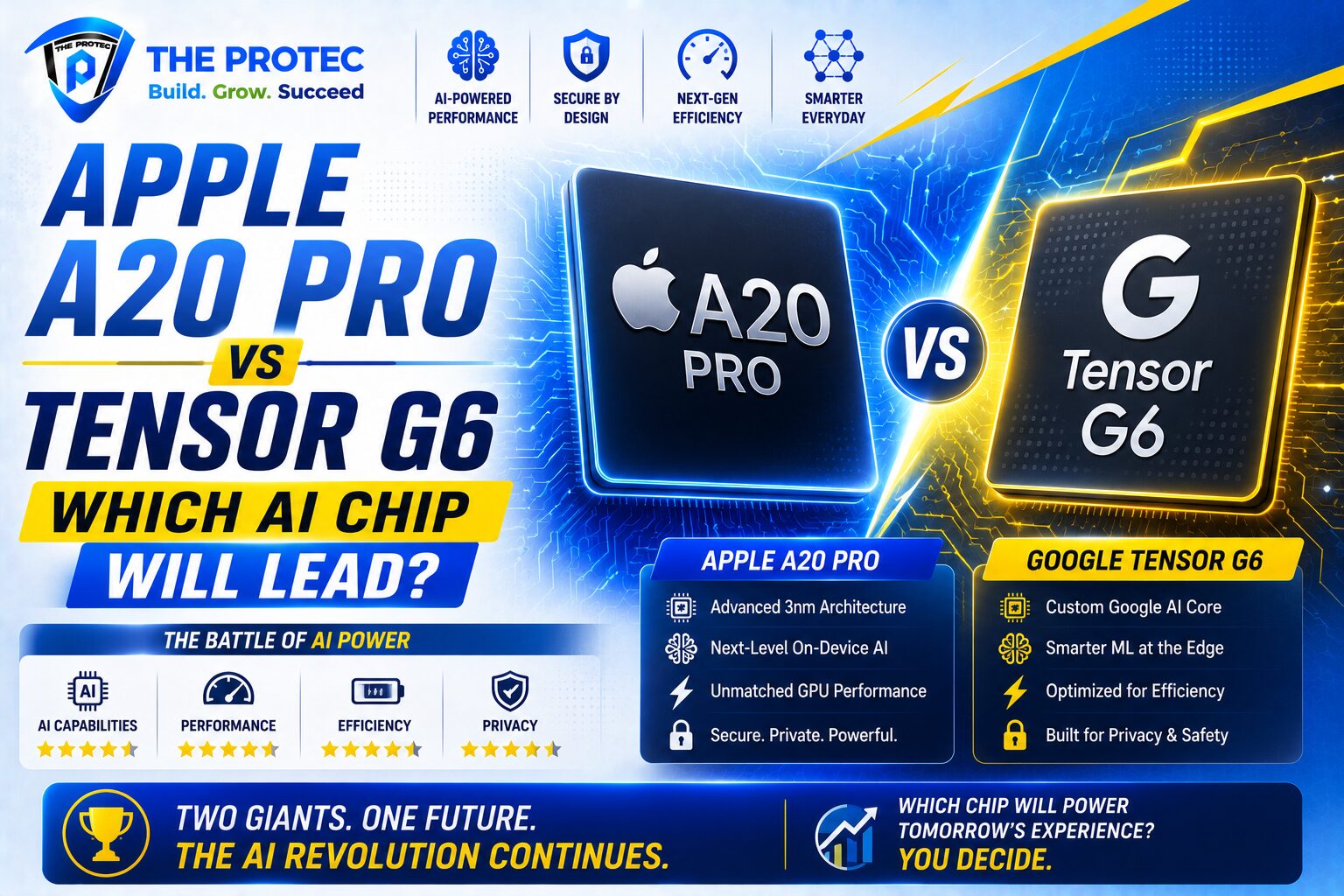
Apple A20 Pro vs Google Tensor G6: The Next Big AI Smartphone Chip Showdown
The battle for smartphone leadership is no longer just about raw CPU speed or gaming frame rates. It is about who can deliver the smartest, fastest, and most private AI experiences directly on the device. That is why the conversation around Apple A20 Pro vs Tensor G6 matters so much. These chips represent two very different ideas of the future: Apple’s tightly integrated silicon strategy and Google’s AI-first approach to mobile computing.
As mobile AI becomes the center of everything from photo editing to voice assistance, live translation, and generative workflows, the next flagship processor must do more than benchmark well. It needs to sustain performance, run large models efficiently, and handle everyday tasks without draining the battery. That is exactly why searches for Tensor G6 benchmark, AI smartphone chips, and next-gen mobile processors are accelerating.
In this comparison, we will look at what each chip is expected to bring, where Apple may keep its advantage, where Google could surprise the industry, and which processor is more likely to define premium smartphones in the near future.
Why This Comparison Matters
Apple and Google are approaching AI silicon from opposite directions. Apple historically builds chips to maximize seamless performance across iPhone, iPad, and Mac ecosystems. Google, by contrast, has designed Tensor chips around machine learning and on-device intelligence, even if that means giving up some traditional benchmark dominance.
That difference is what makes the comparison so compelling. The Apple A20 Pro vs Tensor G6 debate is not just about which chip is faster in a synthetic test. It is about which platform can deliver the best balance of:
- On-device AI speed
- Power efficiency
- Thermal consistency
- Camera and imaging intelligence
- Real-world responsiveness
- Privacy-first processing
For consumers, this matters because the quality of AI features increasingly depends on the chip. For developers, it matters because the chip determines what kind of experiences can be built without sending data to the cloud. And for the industry, it matters because the winner could set expectations for all future AI smartphone chips.
Apple A20 Pro: Expected Strengths and Strategy
Apple’s Pro-class chips have consistently been among the fastest mobile processors available, often leading in single-core performance, efficiency, and sustained optimization. The A20 Pro is expected to continue that pattern, with Apple likely focusing on stronger neural processing, higher memory bandwidth, and improved power management.
Apple’s biggest advantage is not just the chip itself. It is the full-stack integration between hardware, software, and silicon. That lets Apple optimize iOS features, camera pipelines, app performance, and machine learning workloads for a tightly controlled environment. In practice, that often translates into smoother real-world performance than what raw specifications suggest.
Key areas where Apple may lead include:
- Single-core CPU performance: Apple has long dominated this category, which affects app launch speed and UI responsiveness.
- GPU efficiency: Apple’s graphics architecture usually offers strong performance per watt, especially in demanding workloads.
- Neural Engine improvements: Expect Apple to push more AI tasks directly onto the device, from photo processing to model inference.
- Thermal stability: Apple tends to tune performance for consistency, not just peak numbers.
If Apple continues its recent silicon trends, the A20 Pro could become the chip to beat in everyday responsiveness and premium app performance. That said, its AI story will depend on how aggressively Apple expands on-device intelligence features across the iPhone lineup.
Google Tensor G6: Built for AI First
Google’s Tensor line has always had a very clear identity: prioritize AI and machine learning use cases over pure benchmark supremacy. The Tensor G6 is expected to continue that philosophy, with improvements aimed at making Pixel phones even better at live translation, voice recognition, contextual assistance, computational photography, and generative features.
Unlike traditional flagship chips that focus heavily on CPU and GPU numbers, Tensor chips are designed to make Google’s software feel intelligent in daily use. That means better integration with Gemini-powered features, improved camera processing, and smarter contextual experiences that rely on local processing rather than cloud dependency.
Potential strengths of Tensor G6 may include:
- AI acceleration: More dedicated pathways for machine learning and generative tasks.
- Pixel-first optimization: Google can tailor the chip for its own camera and software stack.
- Speech and language processing: Google may improve transcription, summaries, and live interaction features.
- Everyday AI utility: Tensor is likely to excel at practical, visible AI functions users notice immediately.
The big question is whether the Tensor G6 benchmark results will finally narrow the gap with Apple’s best silicon. If Google can improve efficiency and sustained performance while keeping its AI edge, it could become the most compelling AI smartphone chip for users who value intelligent features over peak synthetic scores.
Apple A20 Pro vs Tensor G6: Performance Expectations
When people compare chips, they often look first at benchmark numbers. That is understandable, but with AI smartphone chips, benchmarks only tell part of the story. The real comparison will come down to how each chip performs across CPU, GPU, neural workloads, and power efficiency.
CPU Performance
Apple is likely to remain the leader in single-core CPU performance, which matters for app speed, system fluidity, and light-to-moderate workloads. Tensor G6 could improve multi-core throughput, especially if Google and its manufacturing partners refine the architecture and thermal design, but Apple’s historical advantage here is hard to ignore.
GPU and Gaming
Apple’s GPU performance has often been excellent for both gaming and creative workloads. Tensor chips, by contrast, have typically focused less on gaming leadership and more on balanced AI features. If you care about sustained gaming performance, Apple may still come out ahead. If you care more about intelligent camera features and live AI tools, Tensor G6 may be more appealing.
Neural and AI Workloads
This is where the competition gets interesting. The Tensor G6 benchmark story may not be about winning broad CPU tests, but about showing meaningful gains in on-device AI tasks. If Google delivers faster inference for language models, improved image segmentation, and lower-latency assistant features, it could outshine Apple in practical AI usage.
Apple will likely respond by making the A20 Pro even stronger in its Neural Engine and machine learning pipeline. But Apple’s strategy often emphasizes broad performance rather than dramatic AI-specific branding. That may make Tensor G6 look more exciting to users who want visible AI features, even if Apple is still stronger overall in traditional metrics.
Efficiency and Battery Life Will Decide Real-World Winners
Battery life is one of the biggest differentiators in modern smartphones. A chip can post impressive peak results, but if it drains the battery too quickly or overheats under load, the experience suffers. That is why efficiency will be a major factor in the Apple A20 Pro vs Tensor G6 comparison.
Apple usually has a strong efficiency advantage because it tightly controls both the chip and the operating system. That helps with standby power, background tasks, and sustained everyday use. The A20 Pro could extend that edge if Apple improves performance-per-watt in both CPU and AI workloads.
Google has made progress with each Tensor generation, but efficiency has been one of the most scrutinized areas. For the Tensor G6 to truly challenge Apple, it needs to reduce heat, improve sustained performance, and avoid the battery penalties that have sometimes affected earlier Tensor-based phones.
In practical terms, if one phone can run AI-enhanced tasks all day without excessive drain, users will value that more than a few extra benchmark points. That is why efficient AI smartphone chips are becoming the real standard for premium devices.
AI Features: Where Google Could Have the Edge
Apple is increasingly serious about on-device intelligence, but Google has been building its entire smartphone identity around AI for years. That gives Tensor G6 a potentially important advantage: experience. Google already understands how to integrate machine learning into camera processing, voice features, and assistant-like interactions in a way that feels native to Pixel devices.
Possible Tensor G6 advantages in AI experiences include:
- Faster live transcription and translation
- Smarter call handling and contextual suggestions
- Improved generative photo editing
- More responsive voice interactions
- Better local execution of Gemini-based workflows
This is a crucial point: users do not always notice raw chip power, but they absolutely notice features that save time or improve photos. If Tensor G6 can make those features faster and more reliable, Google may win the perception battle even if Apple still leads in traditional performance categories.
What a Tensor G6 Benchmark Could Reveal
Benchmark results will be watched closely, especially because Tensor chips have historically drawn criticism for lagging behind Apple and sometimes behind competing Android flagships in raw performance. A strong Tensor G6 benchmark showing better CPU efficiency, improved thermal behavior, and stronger AI throughput would be a major signal that Google is closing the gap.
However, benchmark numbers should be interpreted carefully. A chip can post a great burst score and still underperform in sustained use. In the real world, the most important measurements are:
- How long performance stays consistent under load
- How well the device handles heat
- Whether AI features stay fast on battery power
- Whether day-to-day use feels smooth and reliable
That is why the most meaningful Tensor G6 benchmark discussions will focus on real-world AI tasks, not just synthetic CPU charts. If Google can show major gains in inference efficiency and camera processing, it may shift the narrative around its chips significantly.
Which Chip Is Better for Different Users?
The answer to Apple A20 Pro vs Tensor G6 depends on what kind of smartphone user you are. Both chips could be excellent, but they are likely to serve different priorities.
Choose Apple A20 Pro if you want:
- Best-in-class general performance
- Strong gaming and creative app support
- Highly polished system responsiveness
- Long-term efficiency and optimization
- Deep ecosystem integration across Apple devices
Choose Tensor G6 if you want:
- AI-powered Pixel features that feel practical and smart
- Excellent camera and photo intelligence
- Strong voice, transcription, and translation tools
- Google-first software experiences
- On-device AI that fits naturally into daily use
For power users who care about absolute speed, Apple may still be the safer bet. For users who want the most visible and useful AI features on a phone, Tensor G6 could be the more exciting choice.
How the Competition Shapes the AI Smartphone Market
The Apple A20 Pro vs Tensor G6 rivalry is about more than two chips. It reflects the broader direction of the smartphone market. As cloud AI becomes more expensive, slower, and privacy-sensitive, manufacturers are racing to move intelligence directly onto the device.
That shift changes what a premium phone needs to deliver. The best smartphone chip is no longer just the one with the highest benchmark score. It is the one that can run smarter camera features, power local AI assistants, maintain battery life, and support more personal, responsive interactions.
This is where the next generation of AI smartphone chips could change the industry. Apple may lead through raw efficiency and silicon maturity. Google may lead through software-first AI experiences. The eventual winner may depend on whether consumers prioritize performance or practical intelligence.
External Resources Worth Following
For readers who want to track the broader AI and chip landscape, these resources are useful:
- Google AI Blog for official updates on Gemini and on-device AI.
- Apple Newsroom for Apple silicon and product announcements.
Final Verdict: Who Will Lead the Next Wave?
If the question is who will likely lead in raw performance and efficiency, Apple’s A20 Pro probably has the edge. Apple’s track record suggests it will remain a benchmark leader in CPU responsiveness, thermal consistency, and broad platform optimization.
If the question is who will feel more AI-native in everyday use, Google’s Tensor G6 may be the more interesting chip. Its success will depend on whether Google can finally deliver a major leap in Tensor G6 benchmark results while preserving the AI-first identity that makes Pixel phones distinctive.
The most honest answer is that both chips could win in different ways. Apple may lead the hardware race. Google may lead the practical AI experience race. And for users, that is a good outcome: it pushes the entire smartphone industry toward smarter, faster, more capable devices.
So when people ask which AI smartphone chip will lead the next wave, the real answer may be this: Apple A20 Pro could define the performance ceiling, while Tensor G6 could define the AI experience standard.
Frequently Asked Questions
What is the main difference between Apple A20 Pro and Tensor G6?
Apple A20 Pro is expected to focus on top-tier general performance, efficiency, and ecosystem integration, while Tensor G6 is expected to prioritize AI features, camera intelligence, and Google software experiences.
Will Tensor G6 benchmark results match Apple’s chip performance?
Tensor G6 may improve significantly, but Apple has historically held a strong lead in raw CPU and GPU performance. The more important question is whether Tensor G6 can close the gap enough to deliver better real-world AI performance.
Which chip is better for AI smartphone features?
Tensor G6 could have the edge in visible AI features such as transcription, translation, and Pixel-specific camera tools. Apple A20 Pro may still lead in overall efficiency and broader system performance.
Should buyers choose based on benchmark numbers alone?
No. Benchmarks are useful, but battery life, sustained performance, camera quality, and software experience often matter more in daily use. For AI smartphone chips, real-world behavior is more important than peak scores alone.