








Why React Alternatives Are Gaining Serious Momentum
React still dominates a huge share of the frontend ecosystem, but the conversation around modern JavaScript frameworks has changed. More developers are asking a practical question: if React is powerful, why are so many teams exploring other options? The answer is not that React is broken. It is that the needs of modern product teams have shifted. Faster load times, smaller bundles, simpler state management, better server-side rendering, and less boilerplate now matter more than ever.
As web apps become more interactive and performance-sensitive, the appeal of React alternatives is growing. Many teams are no longer optimizing only for developer familiarity. They are optimizing for shipping speed, maintainability, edge performance, and user experience. That is where newer frontend frameworks are finding room to shine. Some reduce runtime overhead. Others simplify component logic. A few blur the line between static sites and app-like experiences. Together, they are reshaping what developers expect from a frontend stack.
This shift is not happening in a vacuum. The rise of edge deployment, partial hydration, server-first rendering, and smaller client footprints has made teams reevaluate whether React is always the best default. In 2026, the most interesting frontend trends are centered on frameworks that help developers do more with less.
The Most Talked-About React Alternatives Right Now
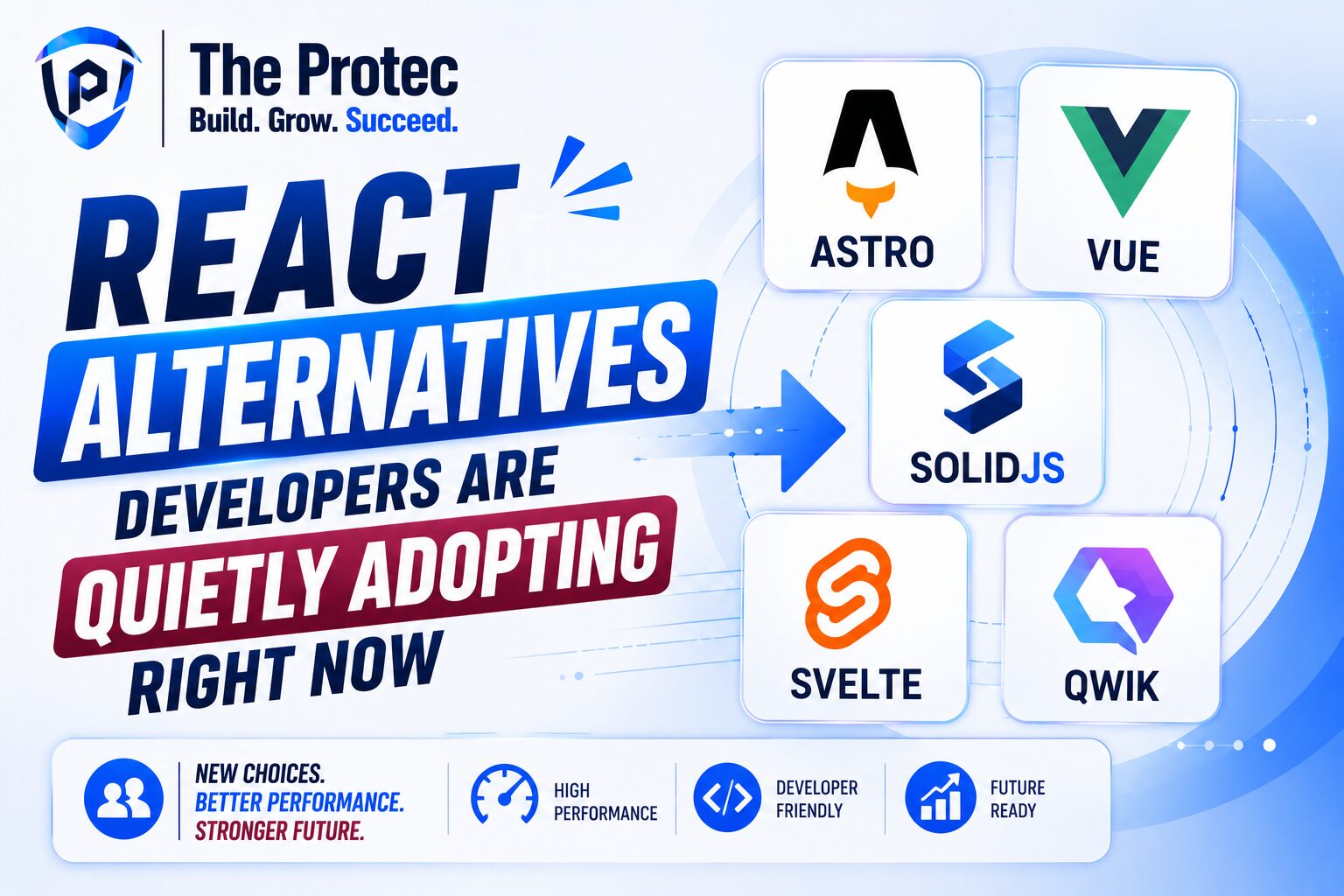
Not every React alternative solves the same problem. Some are best for highly interactive dashboards. Others are ideal for content-heavy sites, marketing pages, or full-stack products. The frameworks below are the ones developers are quietly adopting because they feel modern, efficient, and practical.
1. Svelte: Less Code, Less Complexity, Better Ergonomics

Svelte remains one of the most compelling React alternatives because it takes a fundamentally different approach. Instead of shipping a large runtime to the browser, Svelte compiles components at build time. That means less client-side work and often smaller bundles. For many teams, that alone is enough to justify a closer look.
What developers love most is the simplicity. Svelte components are concise, readable, and easy to reason about. State updates feel natural, reactivity is built in, and there is far less boilerplate than in many traditional frontend frameworks. For teams tired of managing hooks, memoization, and state libraries, Svelte can feel refreshing.
SvelteKit has also matured into a serious full-stack solution. It supports server rendering, routing, endpoint logic, and strong deployment flexibility. That makes Svelte a practical choice for products that need both performance and developer speed.
Why teams switch:
- Smaller bundles and less runtime overhead
- Cleaner component syntax
- Built-in reactivity without extra abstractions
- Strong fit for product teams that value speed and simplicity
2. Vue: The Stable Choice That Keeps Evolving

Vue is not new, but it continues to gain mindshare as teams look for frontend frameworks that feel approachable without sacrificing capability. It offers a balanced middle ground: powerful enough for large applications, yet easier to adopt than more opinionated ecosystems. In 2026, that balance still matters.
Vue’s composition model, mature tooling, and strong documentation make it a favorite for teams that want a smooth developer experience. It is especially appealing to organizations with mixed skill levels, because new developers can become productive quickly while experienced engineers can still build sophisticated architecture.
Vue also benefits from a rich ecosystem around Nuxt, the framework’s full-stack counterpart. Nuxt has become a strong option for teams building content-driven sites, SaaS products, and hybrid rendering applications. For many businesses, Vue is the safest React alternative because it combines familiarity, stability, and modern capabilities.
Why teams switch:
- Gentle learning curve and clear patterns
- Excellent documentation and community support
- Flexible enough for small and large apps
- Nuxt provides a strong path into server rendering and hybrid apps
3. SolidJS: React-Like Syntax Without the React Overhead
SolidJS is one of the most interesting modern JavaScript frameworks because it feels familiar to React developers while offering a radically different performance model. It uses fine-grained reactivity instead of a virtual DOM, which can lead to extremely efficient updates. For developers building highly interactive interfaces, that performance profile is attractive.
Solid’s API looks close enough to React that migration feels less intimidating, but the underlying behavior is leaner and more direct. There is no reconciliation overhead in the same way React developers are used to, and that can translate into smoother runtime performance. In practical terms, this makes Solid appealing for applications where every millisecond matters.
SolidStart is also pushing the ecosystem into more full-stack territory. While the ecosystem is smaller than React’s, it has a strong reputation among performance-focused engineers who enjoy modern primitives and predictable rendering behavior.
Why teams switch:
- React-like developer experience with better runtime efficiency
- Fine-grained reactivity for fast UI updates
- Very strong performance characteristics
- Ideal for teams wanting a lighter, more precise mental model
4. Qwik: Built for Instant Loading and Resumability

Qwik has become one of the most discussed frontend frameworks because it challenges the traditional idea of hydration. Instead of eagerly loading and booting the entire app on page load, Qwik focuses on resumability. The browser receives enough information to continue where the server left off, which can dramatically reduce initial JavaScript execution.
This approach is especially compelling for teams building large, content-heavy, or performance-critical applications. In a world where web vitals and conversion rates are closely tied to loading speed, Qwik’s architecture stands out. It is not just about being fast after the app loads. It is about being useful almost immediately.
Qwik City adds routing and app structure, making it more viable for real-world projects. It is still newer than some of the more established frameworks, but its ideas are influencing broader conversations about how modern JavaScript frameworks should work.
Why teams switch:
- Excellent initial load performance
- Resumability reduces hydration cost
- Strong fit for performance-first experiences
- Useful for large sites where every script matters
5. Astro: The Content-First Framework That Keeps Winning
Astro has become a standout choice for marketing sites, blogs, documentation platforms, and content-rich digital experiences. Its core idea is simple but powerful: ship less JavaScript by default. Astro renders static HTML first and lets developers opt into interactivity only where needed. That makes it one of the most practical React alternatives for teams trying to maximize speed and SEO.
Astro’s island architecture continues to resonate with developers who want modern frontend capabilities without overloading the browser. It also has a flexible approach to components, allowing teams to use React, Vue, Svelte, Solid, or plain HTML within the same project. That interoperability makes Astro a strategic choice for organizations that want to evolve gradually rather than rewrite everything at once.
For many teams, Astro is not a replacement for app frameworks like React. It is a better fit for content-led experiences where most of the page does not need heavy client-side interactivity. That distinction is exactly why it is growing so quickly.
Why teams switch:
- Minimal JavaScript by default
- Excellent performance and SEO outcomes
- Component flexibility across multiple ecosystems
- Ideal for content-driven and hybrid sites
Why Developers Are Moving Away From React in Specific Projects
Most teams are not abandoning React entirely. Instead, they are choosing React alternatives for the right kind of project. This is the biggest shift in the frontend world: framework choice is becoming more contextual. React is still a strong default for many apps, but it is no longer the automatic answer for every use case.
One major reason is complexity. As React applications grow, so do the patterns, abstractions, and dependencies around them. State management, memoization strategies, data fetching layers, and rendering decisions can create a significant mental load. In contrast, many newer frontend frameworks offer a more opinionated path that reduces architectural drift.
Performance is another major driver. React can absolutely power fast applications, but it often requires more deliberate optimization to keep bundles small and interactions snappy. Frameworks like Svelte, SolidJS, Qwik, and Astro are winning attention because they make high performance easier to achieve by default.
Finally, teams are paying closer attention to what users actually experience. A framework that feels elegant in development but ships too much JavaScript may not be the best choice for mobile users, global audiences, or SEO-dependent products. That reality is pushing developers to explore modern JavaScript frameworks with a better built-in performance story.
Choosing the Right Frontend Framework for the Job
The best React alternative depends on the kind of product you are building. There is no universal winner, and that is good news for teams that want to choose intentionally rather than follow hype.
- Choose Svelte if you want highly readable code, less boilerplate, and a strong balance between simplicity and capability.
- Choose Vue if you want a polished, stable framework with a large community and a smooth learning curve.
- Choose SolidJS if your team cares deeply about performance and likes a React-adjacent developer experience.
- Choose Qwik if instant loading and resumability are central to your product goals.
- Choose Astro if your site is content-first and you want to minimize JavaScript while preserving flexibility.
It is also worth considering your team structure. A startup with a small engineering team may benefit from Svelte or Astro because they reduce complexity. A larger company with existing React knowledge may find Vue or SolidJS easier to adopt incrementally. For content-heavy businesses, Astro can deliver outsized gains without forcing a full rewrite. The point is not to chase novelty. The point is to match the framework to the business problem.
What This Means for the Future of Frontend Development
The rise of React alternatives signals a broader maturation in frontend development. Developers are no longer choosing frameworks based only on popularity or ecosystem size. They are evaluating runtime performance, build output, rendering strategy, and long-term maintainability. That is a healthy change.
It also suggests that the future of frontend is not one framework dominating everything. Instead, we are moving toward a more specialized ecosystem where different tools solve different problems well. React will remain important, but so will frameworks that optimize for specific use cases. In many ways, this is exactly what modern engineering should look like: thoughtful tradeoffs instead of default repetition.
For teams building products in 2026, the real question is not whether React is good. It is whether a different framework can deliver a better result for the project at hand. In more cases than ever, the answer is yes.
FAQ: React Alternatives and Modern JavaScript Frameworks
Are React alternatives actually replacing React?
Not across the board. React remains one of the most widely used frontend frameworks, but alternatives are increasingly chosen for specific projects where performance, simplicity, or content-first rendering is a better fit.
Which React alternative is best for performance?
SolidJS and Qwik are often praised for performance, while Astro excels at minimizing JavaScript on content-heavy sites. The best option depends on whether you need a highly interactive app or a fast-loading content experience.
Is Vue still relevant compared with newer frameworks?
Yes. Vue remains highly relevant because it is stable, approachable, and backed by a mature ecosystem. It is often the practical choice for teams that want modern capabilities without a steep learning curve.
Should teams using React consider switching?
Only if there is a clear advantage for the project. Switching frameworks has costs, so the best approach is to evaluate whether a React alternative offers meaningful gains in performance, developer experience, or maintainability.
What is the best React alternative for content websites?
Astro is often the strongest choice for blogs, documentation, marketing sites, and other content-first experiences because it prioritizes speed and ships very little JavaScript by default.
Final Takeaway
React alternatives are not a fad. They are a response to real pressure in modern web development: smaller bundles, faster loads, simpler code, and better user experience. Svelte, Vue, SolidJS, Qwik, and Astro each represent a different answer to those demands, which is why they are gaining momentum among developers who want more targeted tools.
If your team is evaluating frontend frameworks, the smartest move is to think in terms of outcomes. Do you need less complexity? Better runtime performance? Faster content delivery? A more maintainable architecture? The framework that answers those questions best is the one worth adopting. In 2026, that may not always be React.
For developers and businesses alike, the shift toward modern JavaScript frameworks is less about leaving React behind and more about building the right experience with the right tool.