








Why the Future of Web Hosting Is Changing Fast
The web hosting market is no longer defined only by storage, uptime, and price. Hosting buyers today expect more: faster page loads, smarter automation, stronger security, lower energy use, and infrastructure that can scale globally without sacrificing performance. That shift is driving the next wave of future web hosting, where AI hosting, edge delivery, and green cloud hosting are becoming the new baseline rather than premium extras.
For website owners, this matters because hosting directly affects search visibility, user experience, conversion rates, and operating costs. A slow site loses traffic. An unstable platform hurts revenue. An inefficient infrastructure can raise costs and carbon impact at the same time. The best hosting providers are responding with intelligent platforms that optimize resources in real time, push content closer to users, and reduce waste across the stack.
If you are evaluating hosting for a business website, ecommerce store, SaaS product, or content-heavy brand, the future is about choosing infrastructure that is not only fast today but also adaptable for what comes next.
What Future Web Hosting Really Means
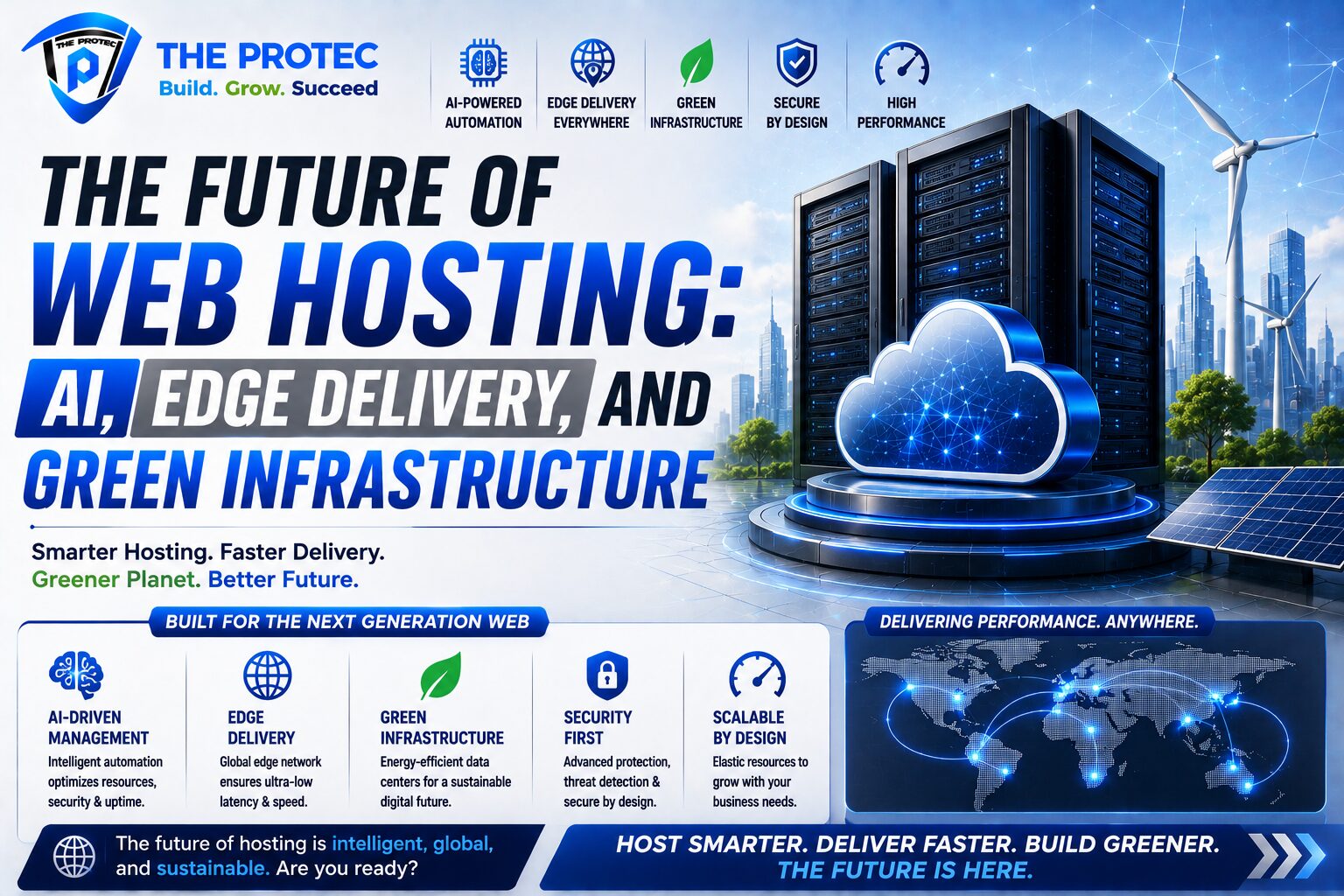
Future web hosting is not a single product or a buzzword. It is the combination of three major shifts happening at once: artificial intelligence managing performance and security, edge infrastructure reducing latency, and sustainable cloud design lowering power consumption and emissions. Together, these changes are redefining what buyers should expect from a hosting provider.
In practical terms, this means hosting platforms are becoming more predictive, more distributed, and more efficient. Instead of reacting to traffic spikes after they happen, AI systems can forecast demand and allocate resources in advance. Instead of serving every request from a centralized region, edge delivery moves content and logic closer to users. Instead of relying on oversized, inefficient data centers, green cloud hosting focuses on renewable energy, better utilization, and smarter cooling.
This evolution benefits both technical teams and non-technical site owners. You get better uptime, faster response times, and simpler management with less manual tuning. For commercial websites, that combination can translate into more conversions and lower total cost of ownership.
AI Hosting: Smarter Performance, Security, and Operations
AI hosting is one of the biggest forces shaping the hosting market. It uses machine learning and predictive analytics to improve how infrastructure is monitored, provisioned, protected, and optimized. Rather than depending entirely on static rules or manual intervention, AI-driven systems can identify patterns and make adjustments in near real time.
For website owners, the most visible benefit is performance optimization. AI hosting can analyze traffic behavior, cache usage, CPU load, database activity, and response times to detect bottlenecks before they become user-facing problems. That means dynamic scaling can happen automatically during traffic surges, while underused resources can be reduced to save cost when demand drops.
Security is another major advantage. AI-powered threat detection can identify abnormal login behavior, suspicious request patterns, brute-force attempts, and DDoS activity more quickly than traditional thresholds alone. In a market where attacks are increasingly automated, this kind of defense is becoming essential rather than optional.
AI also improves day-to-day operations. It can recommend configuration changes, flag inefficient plugins or workloads, and surface actionable insights for teams managing multiple sites. In managed hosting environments, this reduces the burden on support teams and helps customers solve problems faster.
Where AI Hosting Delivers the Most Value
Traffic forecasting: Predicts spikes and scales resources before performance drops.
Load balancing: Routes requests intelligently based on current server health and demand.
Security monitoring: Detects suspicious behavior and automated attacks faster.
Resource optimization: Reduces waste by matching capacity to real usage patterns.
Operational insight: Helps teams identify the cause of slowdowns without endless manual analysis.
For buyers comparing providers, the best question is not whether a host uses AI at all. It is whether the AI is actually improving performance, security, and efficiency in measurable ways.
Edge Delivery: Faster Experiences Closer to Users
Edge delivery is transforming how content reaches visitors. Traditionally, hosting and content delivery relied on centralized data centers, which meant every request had to travel to a primary location or a small number of regional hubs. That model still works, but it can create latency for users far from the origin.
Edge delivery solves that problem by placing content, logic, or both closer to the end user. This can happen through distributed caching, edge compute, regional points of presence, or serverless functions that execute near the visitor. The result is faster page rendering, lower latency for dynamic content, and a more responsive user experience.
For commercial websites, edge delivery is especially valuable because speed affects revenue. Ecommerce pages, landing pages, and app interfaces all benefit from reduced delay. Even a small improvement in load time can reduce bounce rates and support higher engagement.
Edge architecture also improves resilience. When workloads are distributed across many locations, the failure of a single node or region is less likely to take down the entire experience. That makes edge delivery attractive for businesses that need reliability across markets.
How Edge Delivery Supports Modern Websites
Reduced latency: Visitors receive content from a nearby location instead of a distant origin server.
Better global consistency: International audiences get a more uniform experience.
Dynamic personalization: Content can be adjusted at the edge based on location, device, or behavior.
Improved resilience: Distributed delivery reduces dependence on a single centralized point.
Lower origin load: Caching and edge compute reduce pressure on core infrastructure.
The rise of edge delivery is especially important as websites become more interactive. Instead of treating the server as the only place where logic runs, modern hosting increasingly moves some of that work closer to the user. That shift is a major part of the future web hosting model.
Green Cloud Hosting: Performance Without the Waste
Green cloud hosting is no longer a niche buying preference. It is becoming a serious procurement criterion for companies that care about operating costs, brand reputation, and long-term sustainability. At its core, green cloud hosting aims to reduce energy consumption and environmental impact while maintaining strong performance and reliability.
This is not simply about using renewable energy, although that is an important part of the picture. It also involves better data center efficiency, smarter workload placement, improved cooling systems, higher server utilization, and reducing idle resource waste. When infrastructure is used more efficiently, the same business output can be delivered with less energy.
Website owners increasingly want hosting partners that can demonstrate sustainability claims with real action. That may include renewable-powered facilities, energy-efficient hardware, transparent emissions reporting, and architecture designed to avoid overprovisioning. For many businesses, especially those with public ESG goals or brand-sensitive audiences, this matters as much as raw performance.
Green cloud hosting also aligns with cost control. Wasteful infrastructure tends to be expensive infrastructure. By improving utilization and reducing excess capacity, providers can often deliver a better balance between performance and cost efficiency.
What to Look for in Green Cloud Hosting
Renewable energy sourcing: Data centers powered by wind, solar, or other low-carbon sources.
Efficient infrastructure: Modern hardware and cooling systems that reduce power usage.
Smart scaling: Capacity that expands and contracts based on demand instead of sitting idle.
Transparent reporting: Clear information about energy use, emissions, and sustainability practices.
Low-waste architecture: Platforms designed to avoid unnecessary compute and storage overhead.
For buyers, the strongest green cloud hosting offerings combine sustainability with real business value. They do not force a tradeoff between eco-conscious infrastructure and performance. Instead, they optimize both.
How AI, Edge, and Green Infrastructure Work Together
The future of web hosting is not about choosing one trend and ignoring the others. The real opportunity comes when AI hosting, edge delivery, and green cloud hosting are combined into a single strategy.
AI makes infrastructure smarter by predicting demand, improving security, and reducing waste. Edge delivery makes the experience faster and more resilient by moving content and compute closer to users. Green infrastructure makes the entire stack more efficient and sustainable by lowering energy use and emissions. Together, they create a hosting environment that is faster, more adaptive, and more responsible.
For example, AI can determine where traffic is likely to come from, then help route workloads to the most efficient edge location. That reduces latency while also avoiding unnecessary compute in oversized central regions. Similarly, green cloud principles can guide where and how infrastructure is expanded, ensuring growth does not lead to excessive power use.
This convergence is especially powerful for businesses with seasonal traffic, international audiences, or resource-intensive websites. A hosting platform that can adapt intelligently, distribute load globally, and operate efficiently gives those businesses a real competitive advantage.
Commercial Benefits for Hosting Buyers and Website Owners
When evaluating hosting providers, it is easy to focus on headline specs such as storage limits, CPU cores, or bandwidth. But those numbers alone do not tell you how well a platform will perform under pressure. The more important question is whether the hosting environment is designed for the way modern websites actually operate.
Future web hosting offers several commercial benefits that directly affect business outcomes:
Better conversion rates: Faster load times and more reliable performance reduce friction for visitors.
Lower support overhead: AI monitoring and automation reduce time spent resolving routine issues.
Scalable growth: Edge and intelligent scaling help websites handle traffic without major infrastructure changes.
Improved brand trust: Strong uptime and sustainability commitments support credibility.
Potential cost savings: Efficient infrastructure can reduce waste and improve long-term spend management.
For ecommerce brands, agencies, SaaS companies, and publishers, these gains can be meaningful. Hosting is not just an IT expense; it is part of the revenue engine.
How to Evaluate a Hosting Provider in This New Era
Choosing a provider for future web hosting requires more than comparing introductory pricing. Buyers should assess how well a host supports AI hosting capabilities, edge delivery options, and green cloud hosting practices. The goal is to find a platform that can support growth without sacrificing user experience or sustainability.
Start by asking how the provider handles automation. Does it offer intelligent scaling, predictive monitoring, and security automation? Next, look at delivery architecture. Does it use edge nodes or CDN-style distribution to reduce latency for global users? Finally, review its sustainability posture. Does it publish energy or emissions data? Does it operate efficient facilities or use renewable energy sources?
It is also worth asking about visibility. A strong hosting provider should make it easy to understand performance trends, resource usage, and incident response. When a platform is truly modern, it should reduce complexity rather than adding more of it.
Buyer Checklist for Future Web Hosting
Does the host use AI to improve performance, security, or capacity planning?
Is edge delivery available for static and dynamic content?
Are sustainability claims backed by transparent reporting?
Can the platform scale efficiently during traffic spikes?
Does the provider offer clear monitoring and actionable insights?
If the answer is yes to most of those questions, the provider is likely better aligned with the future of hosting than one focused only on basic server specifications.
What’s Next for Web Hosting
The next phase of hosting will likely bring even deeper automation, more distributed compute, and tighter sustainability expectations. AI will continue to improve orchestration and security. Edge delivery will expand beyond static content into richer application logic. Green infrastructure will become a stronger differentiator as businesses look for ways to cut emissions without slowing growth.
We are also likely to see more hosting platforms integrate these capabilities into simpler managed experiences. That means buyers will not need to be infrastructure experts to benefit from advanced technology. Instead, the best providers will package AI optimization, edge performance, and sustainable operations into solutions that are easy to adopt and easy to scale.
For website owners, the message is clear: hosting is becoming strategic. The providers that win in this market will be the ones that deliver speed, intelligence, and responsibility together.
Conclusion: The Smartest Hosting Choices Are Already Evolving
The future web hosting market is being shaped by three forces that are hard to ignore: AI hosting, edge delivery, and green cloud hosting. Each one solves a different problem, but together they create a more powerful foundation for modern websites. AI brings intelligence. Edge delivery brings proximity. Green infrastructure brings efficiency and sustainability.
For buyers, this means the old checklist of storage and uptime is no longer enough. The best hosting decisions now account for how well a platform predicts demand, serves global users, and manages resources responsibly. If you want your website to stay fast, resilient, and competitive, choosing a provider built for this new era is one of the most important decisions you can make.
As hosting continues to evolve, the winners will be the businesses that invest in infrastructure capable of adapting to change, not just surviving it.
FAQ
What is future web hosting?
Future web hosting refers to modern hosting platforms that combine automation, distributed delivery, and sustainability. It typically includes AI-driven optimization, edge-based performance improvements, and green infrastructure practices.
How does AI hosting improve website performance?
AI hosting analyzes traffic patterns, resource use, and system health to optimize scaling, detect issues early, and improve security. This helps websites stay fast and stable with less manual intervention.
Why is edge delivery important for businesses?
Edge delivery reduces latency by serving content and logic closer to users. That improves page speed, supports global audiences, and can help increase conversions for commercial websites.
Is green cloud hosting slower than traditional hosting?
Not necessarily. Green cloud hosting focuses on efficiency, better utilization, and renewable-powered infrastructure. In many cases, it can deliver equal or better performance while reducing waste.
What should I prioritize when choosing a hosting provider?
Look for a provider that offers measurable performance optimization, edge capabilities, transparent sustainability practices, strong security, and scalable infrastructure that fits your business needs.
For deeper technical background on edge computing and distributed delivery, see Cloudflare’s overview of edge computing: Cloudflare Edge Computing Guide. For sustainability context in cloud infrastructure, Google’s data center efficiency resources are also useful: Google Sustainability in Operations.