






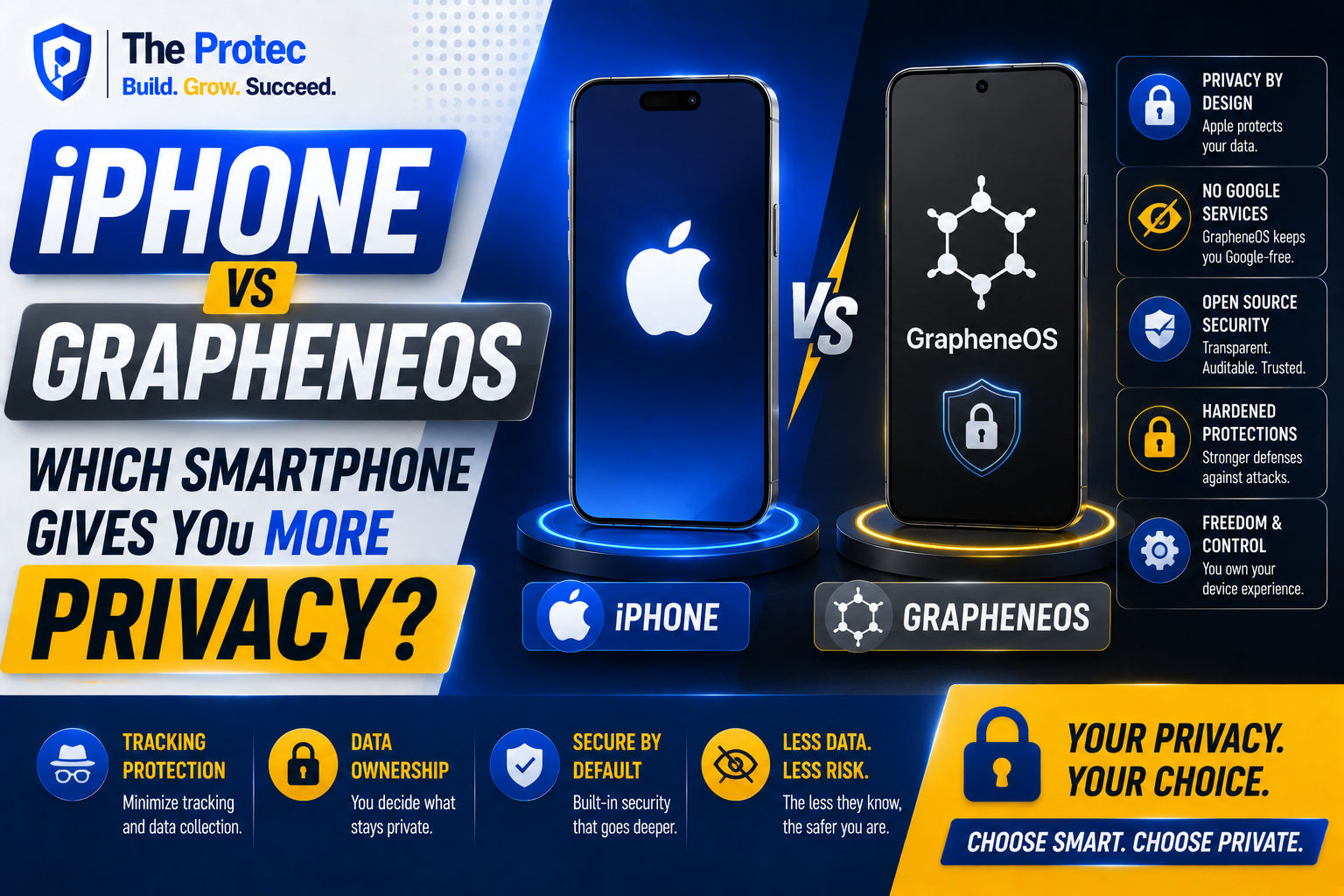
Choosing a private smartphone is no longer as simple as comparing Android with iOS. Apple has spent years turning privacy into a defining feature of the iPhone, adding stronger tracking controls, on-device processing, encrypted communications, and tightly managed hardware and software. GrapheneOS takes a different route: it starts with Android, hardens the operating system, minimizes privileged services, and gives users unusually granular control over what apps can access.
That makes the iPhone vs GrapheneOS debate especially relevant as of September 2026. Both can be among the best privacy phone options, but they approach trust from opposite directions. Apple asks users to trust an integrated ecosystem with strong defaults. GrapheneOS aims to reduce how much trust any app or service requires in the first place.
The practical question is not simply which is the most secure smartphone. It is whether Apple’s privacy-focused ecosystem or GrapheneOS’s hardened Android model gives you the right balance of control, protection, compatibility, and convenience.
iPhone vs GrapheneOS: Two Different Privacy Models
An iPhone is a vertically integrated product. Apple controls the hardware, operating system, security updates, App Store rules, and many cloud services. This coordination enables secure boot, reliable encryption, long-term updates, and consistent privacy features. It also concentrates substantial power in one company.
GrapheneOS is an open-source, security-hardened mobile operating system built from the Android Open Source Project. It officially supports selected Google Pixel devices because they provide the hardware security capabilities and update infrastructure the project requires. Although the hardware comes from Google, GrapheneOS does not bundle Google Play services as privileged system components.
The philosophical difference is important. iPhone privacy generally relies on carefully designed defaults inside Apple’s ecosystem. GrapheneOS privacy emphasizes user control, service isolation, reduced data collection, and stronger defenses against app exploitation.
App Tracking and Advertising
Apple’s App Tracking Transparency framework requires apps to request permission before tracking users across apps and websites through certain identifiers. When a user selects “Ask App Not to Track,” the app loses access to the system advertising identifier and is prohibited by App Store policy from using alternative tracking methods for the same purpose.
This creates a meaningful barrier, but it does not make every iPhone app anonymous. Apps can still collect information generated through direct use, including account details, purchases, searches, IP addresses, and interactions. Enforcement also depends partly on Apple detecting policy violations. App Tracking Transparency is a valuable privacy control, not a universal tracker blocker.
GrapheneOS approaches tracking through Android’s application sandbox and additional controls. Apps remain isolated from one another unless the user grants access or they communicate through permitted operating-system mechanisms. Users can deny network access to an app entirely, a capability that is particularly useful for offline tools that have no legitimate reason to connect to the internet.
GrapheneOS does not magically remove tracking from an app after a user signs in. Instagram, a banking app, or a shopping service can still associate activity with an account. Its advantage is that users can reduce background access, isolate apps in separate profiles, and prevent unnecessary network communication.
Telemetry, Accounts, and Cloud Dependence
Both platforms can be used with less cloud integration than their default experiences suggest, but GrapheneOS makes that separation easier.
An iPhone can be configured without an Apple Account, although doing so limits access to the App Store, iCloud, device synchronization, and other major services. Most owners therefore sign in. Apple provides controls for analytics, personalized advertising, location services, and iCloud features, yet the device still operates as part of a largely proprietary ecosystem. Apple publishes extensive information about its privacy model on its official privacy website.
GrapheneOS does not require a GrapheneOS account, a Google account, or a connection to a vendor cloud. Its built-in apps and operating-system services are designed to work without Google Play. This makes it a practical Google-free phone for users willing to select independent email, navigation, backup, and synchronization services.
However, “Google-free” does not automatically mean private. Replacing Google with several poorly vetted providers may spread data rather than protect it. The benefit of GrapheneOS is choice, but users remain responsible for choosing trustworthy services.
Google Play Services: Privileged or Sandboxed?
One of GrapheneOS’s most significant real-world features is optional sandboxed Google Play. On conventional Android phones, Google Play services receive extensive system-level integration. On GrapheneOS, users can install Google Play through the operating system’s app repository, but it runs as ordinary sandboxed applications without special access.
This arrangement allows many apps that depend on Google frameworks, push notifications, or Play Store licensing to function while keeping Google Play subject to the same permission model as other apps. It can be installed only in a particular user profile, allowing someone to keep Google-dependent applications separate from more sensitive activity.
Compatibility is strong but not perfect. Some banking, corporate, streaming, or anti-cheat applications may rely on device certification or integrity checks that do not behave as expected. Prospective users should verify their essential apps rather than assuming every Android application will work.
The iPhone avoids this specific issue because Google services are optional applications rather than core iOS components. An owner can use Gmail, Google Maps, and YouTube—or avoid them. Apple services, however, remain deeply integrated into the platform.
Permissions and Everyday Data Control
Both systems offer mature permission controls for the camera, microphone, location, contacts, photos, Bluetooth, and local network. Both also display indicators when sensitive sensors are active.
iPhone privacy controls are generally easier to understand. Users can provide approximate rather than precise location, grant access to selected photos, limit contact sharing where supported, and review permissions from a centralized settings interface. Apple’s consistency is a major advantage for people who want sensible protection without regularly maintaining the device.
GrapheneOS adds controls intended for more demanding threat models. Depending on the permission and app, users can provide scoped access, revoke network connectivity, or use compatibility features that present an empty data set instead of granting genuine access. Storage Scopes and Contact Scopes, for example, can let an app behave as if it received broad access while exposing only user-selected information.
GrapheneOS also supports multiple user profiles with strong separation. A privacy-conscious owner might place personal communications in one profile, workplace apps in another, and invasive social applications in a third. This is more powerful than ordinary home-screen organization because each profile has separate application data and accounts.
Sandboxing, Exploit Protection, and Device Security
Modern iPhones and GrapheneOS devices both use application sandboxing, verified boot, hardware-backed key storage, exploit mitigations, and encryption. For most people, either is substantially safer than an unsupported phone running outdated software.
Apple’s strength comes from integration. The Secure Enclave protects cryptographic material and biometric data, while secure boot verifies trusted software during startup. Apple also offers Lockdown Mode for people facing highly targeted attacks. Its tightly controlled app distribution and code-signing model reduce some opportunities for malware, although malicious or deceptive apps can still appear.
GrapheneOS builds on Pixel hardware security while adding operating-system hardening. Its defenses include a hardened memory allocator, stronger application sandboxing, attack-surface reduction, and tighter restrictions around dynamic code and sensitive interfaces. Technical readers can review the project’s current security and privacy features in the official GrapheneOS documentation.
Neither platform makes a user invulnerable. Phishing, weak passwords, compromised accounts, malicious attachments, and unsafe communication partners can bypass many device-level protections. A secure phone cannot compensate for giving credentials to a convincing fake website.
Encryption and Backups
Both platforms encrypt local user data when a strong passcode protects the device. A longer alphanumeric passcode provides more resistance than a short numeric code, regardless of platform.
The larger distinction appears in backups and synchronization. Apple makes iCloud convenient, and Advanced Data Protection can extend end-to-end encryption to additional categories of cloud data when enabled. Some information and metadata may still be handled differently because of interoperability, recovery, or service requirements. Users should review the current protection status of each iCloud category rather than treating “encrypted” as a single all-or-nothing label.
GrapheneOS does not tie the user to a mandatory cloud backup provider. That reduces centralized data exposure but places more responsibility on the owner. Backups may require deliberate configuration, and recovery can be less seamless than buying a new iPhone and restoring from iCloud. Maximum control often creates additional work.
Software Updates and Long-Term Support
Fast security updates are essential to any privacy focused smartphone. Apple has an excellent record of delivering updates directly to supported iPhones, often across many device generations. That consistency is one reason an iPhone is a safe mainstream recommendation.
GrapheneOS also provides prompt security updates, but support depends on the underlying Pixel device receiving full vendor firmware and security maintenance. Once the hardware vendor’s support ends, GrapheneOS cannot safely replace every missing firmware update. Buyers should therefore choose a currently supported device with a long remaining update window rather than installing GrapheneOS on an old bargain handset.
GrapheneOS updates are designed for routine use and do not require enthusiasts to rebuild the operating system. Still, hardware selection is narrower than with iPhone, and users must pay attention to official support status.
Usability and Ecosystem Trade-Offs
The iPhone wins on convenience for many users. Setup is polished, backups are straightforward, accessories work predictably, and services such as AirDrop, Find My, Apple Watch, and iCloud integrate smoothly. Strong defaults make iPhone security accessible without requiring a deep understanding of mobile operating systems.
That ecosystem can also create lock-in. Moving photos, messages, passwords, wearables, or family services to another platform may be inconvenient. Users receive privacy protections, but Apple determines many of the boundaries within which those protections operate.
GrapheneOS feels familiar to anyone comfortable with Android, but achieving a highly private setup takes planning. Users must choose alternatives for cloud storage, calendars, maps, messaging, and device discovery. Sandboxed Google Play can restore much mainstream compatibility, although installing it also reintroduces communication with Google for the apps and services that use it.
Everyday privacy also depends on social reality. If family members use FaceTime, an employer requires a specific management app, or a bank rejects the device, theoretical control may become less valuable than dependable access. A privacy phone that forces its owner to carry a second, less secure device may not be the best practical solution.
Which Privacy-Conscious User Should Choose Each?
Choose an iPhone if you want:
- Strong privacy and security defaults with minimal configuration.
- Reliable application, banking, workplace, and accessory compatibility.
- Long-term updates delivered through a tightly integrated platform.
- Convenient encrypted services without assembling your own ecosystem.
- Advanced protections such as Lockdown Mode for elevated risk.
Choose GrapheneOS if you want:
- More control over network access, profiles, permissions, and app isolation.
- A phone that does not require a platform account.
- The option to operate without Google services or install them in a sandbox.
- Open-source operating-system code and transparent technical documentation.
- Additional hardening designed to reduce exploitability and attack surface.
High-risk professionals may appreciate GrapheneOS’s compartmentalization, but device choice should follow a professional threat assessment. In some organizations, a managed iPhone may be better supported and monitored than a personally configured alternative.
The Verdict: Control Versus Convenience
There is no universal winner in GrapheneOS vs iOS. GrapheneOS offers more granular control and can disclose less data to a default platform account because no such account is required. For technically confident users who are willing to manage profiles, services, and occasional compatibility problems, it is arguably the stronger privacy architecture.
The iPhone is often the better private smartphone for mainstream users. Its protections are enabled within a cohesive product that people can use without becoming mobile-security specialists. Apple still requires trust, and its ecosystem is not free from telemetry or commercial incentives, but good defaults applied consistently can outperform advanced controls that an owner finds too difficult to maintain.
The best privacy phone is therefore the one that matches your threat model. Choose iPhone for dependable privacy with convenience. Choose GrapheneOS for deeper control, reduced platform dependence, and stronger compartmentalization.
Frequently Asked Questions
Is GrapheneOS more private than an iPhone?
GrapheneOS can be more private when configured carefully because it requires no vendor account, makes Google Play optional and sandboxed, supports separate profiles, and provides granular controls such as per-app network access. An iPhone may deliver better practical privacy for users who prefer strong defaults and are unlikely to maintain a customized setup.
Can GrapheneOS run normal Android apps?
Yes. GrapheneOS runs standard Android applications, and optional sandboxed Google Play improves compatibility with apps that depend on Google services. Some banking, workplace, media, or integrity-sensitive apps may still have limitations, so users should check essential software before switching.
Is an iPhone completely private if app tracking is disabled?
No. Disabling tracking limits certain forms of cross-app and cross-site tracking, but apps can still collect data produced through direct use, account activity, purchases, network connections, and voluntary submissions. Permission reviews and careful app selection remain important.
Can GrapheneOS be installed on any Android phone?
No. GrapheneOS officially supports selected Pixel models that meet its hardware security and update requirements. Unofficial ports should not be treated as equivalent because they may lack the project’s complete security model and reliable updates.
Which phone is better for someone facing targeted surveillance?
It depends on the attacker, required apps, organizational support, and the user’s ability to operate the device safely. GrapheneOS provides powerful compartmentalization and hardening, while iPhone offers Lockdown Mode and a mature managed-device ecosystem. People facing credible targeted threats should seek specialized security guidance rather than relying on a platform label alone.