








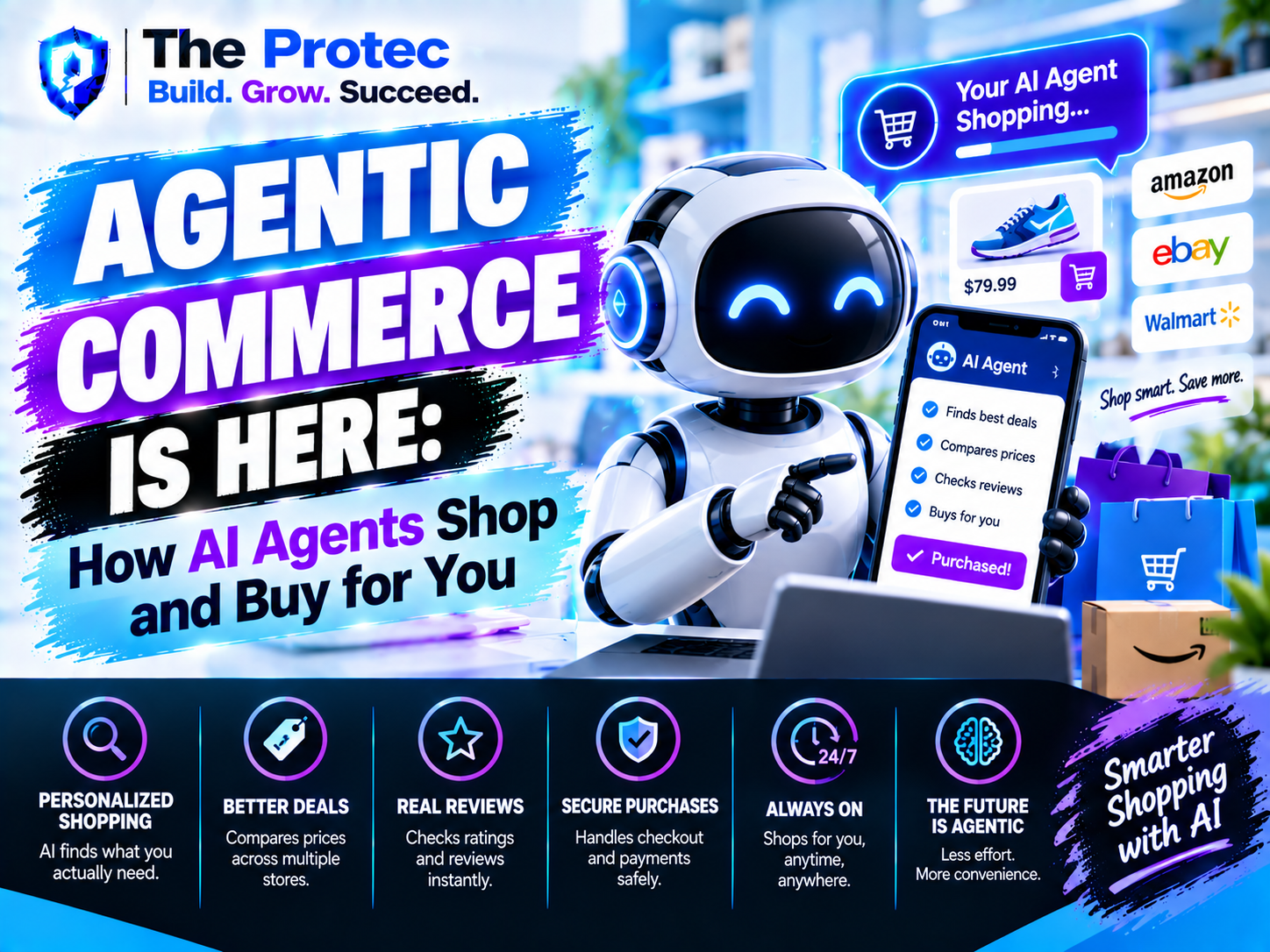
Online shopping is undergoing a more consequential change than a redesigned storefront or smarter search bar. AI is becoming an active participant in transactions. Instead of merely suggesting a pair of headphones or summarizing customer reviews, an AI agent can interpret a request, search multiple sellers, compare total costs, verify availability, choose an option, and potentially complete the purchase.
This shift is known as agentic commerce. By September 2026, it has moved from isolated experiments toward a practical commerce model supported by merchant APIs, digital wallets, payment networks, identity systems, and emerging agent protocols. The result is a new kind of customer journey in which the AI—not a retailer’s website—may become the primary shopping interface.
What Is Agentic Commerce?
Agentic commerce is the use of goal-driven AI agents to perform shopping tasks on behalf of consumers or businesses. Traditional AI shopping tools respond with information. An agent can take actions across several systems, remember constraints, and continue working until it reaches an approved outcome.
For example, a shopper might ask an AI buying assistant to find a carry-on suitcase under $200 that meets a specific airline’s dimensions, can arrive before Friday, and has a strong warranty. An ordinary chatbot may return links. An agentic shopping system can search retailers, exclude unavailable products, calculate shipping, compare return policies, select the best match, request approval, and initiate checkout.
The key distinction is agency. AI shopping agents do not simply influence a decision; they can participate in executing it. The level of autonomy can range from building a cart for review to making recurring purchases within predetermined limits.
How AI Agents Shop from Discovery to Delivery
An agentic commerce journey connects stages that have traditionally required separate searches, browser tabs, forms, and account logins.
1. Understanding the Shopping Intent
The agent translates a natural-language request into structured requirements. These may include budget, size, color, brand exclusions, delivery deadline, sustainability preferences, compatibility, warranty coverage, or an acceptable substitution policy. A capable AI shopping assistant also identifies missing information and asks a focused question before taking action.
2. Product Discovery and Comparison
The agent searches marketplace catalogs, retailer feeds, manufacturer data, and merchant APIs. It can normalize inconsistent product names, distinguish sponsored placement from organic relevance, and compare products using attributes that matter to the user. AI product recommendations become less about predicting clicks and more about satisfying an explicit goal.
3. Price and Inventory Verification
Listed prices are not always the final cost. AI agents shopping across merchants must evaluate shipping, taxes, membership discounts, coupons, financing charges, and return fees. They also need real-time inventory data. A product recommendation is not useful if the item is unavailable locally or cannot arrive before the requested date.
4. Selection, Checkout, and Payment
Once an item is selected, the agent can create a cart and prepare an AI checkout. Depending on its permissions, it may ask the user to approve the exact order or use a pre-authorized spending mandate. AI agent payments can draw on tokenized cards, digital wallets, bank payments, or network credentials without exposing raw payment details to the model.
5. Order and Post-Purchase Management
Autonomous shopping does not end at payment. Agents can monitor delivery, notify the user of delays, request a price adjustment, begin a return, reorder consumables, or communicate with customer service. This post-purchase role may become one of the most valuable forms of AI shopping automation.
The Technology Stack Behind Agentic Commerce
No single model can safely deliver autonomous ecommerce. The system requires multiple technical and commercial layers working together.
- AI agents: Models handle natural-language instructions, planning, comparison, and decision support. Tool access allows them to retrieve live information and perform approved actions.
- Merchant APIs: Structured interfaces expose products, prices, inventory, fulfillment options, cart creation, checkout, returns, and order status. Reliable APIs give AI agents ecommerce data that is more accurate than scraped web pages.
- Shopping protocols: Emerging protocols create common ways for agents, merchants, and payment providers to exchange intent and transaction data. Google’s Agent Payments Protocol, for example, describes cryptographically verifiable mandates for agent-led payments.
- Identity and authorization: A transaction must distinguish the user, the AI agent, the merchant, and the payment instrument. Authorization records should show what the user permitted, for how much, with which sellers, and for how long.
- Digital wallets and tokenization: Wallets can provide payment credentials without placing card numbers inside prompts or model context. Payment tokens may be restricted to a merchant, amount, category, or one-time transaction.
- Observability and receipts: Logs, signed records, and human-readable receipts help users and businesses understand why an agent selected a product and who approved the purchase.
The agentic commerce 2026 landscape is therefore less about one all-powerful chatbot and more about interoperability. Model Context Protocol, agent-to-agent communication, commerce-specific APIs, and payment mandates are becoming connective tissue between assistants and transaction systems.
What Changes When the AI Becomes the Shopping Interface?
Consumers Delegate Work, Not Just Search
Consumers can offload repetitive research, replenishment, and administrative tasks. An AI purchase agent could manage household supplies, compare insurance-compatible medical products, or replace a damaged device under a fixed budget. Convenience increases, but users also need visibility into how recommendations are ranked and when an agent is allowed to spend.
Retailers Must Sell to Machines and People
Retailers have historically optimized pages for search engines and human visitors. In agentic retail, they must also make product data understandable to machines. Accurate specifications, real-time inventory, transparent fees, dependable delivery estimates, and machine-readable policies can determine whether an agent includes a product in its shortlist.
Brand storytelling will still matter, especially for emotional and high-consideration purchases. However, poor structured data may prevent a brand from reaching the human at all. AI-powered ecommerce rewards merchants that combine compelling experiences with accessible, trustworthy product information.
Marketplaces Face a Battle for the Customer Relationship
Marketplaces benefit from broad selection and established fulfillment systems, but independent agents can compare several marketplaces at once. This weakens the power of a single platform’s search results. Marketplaces may respond by offering their own AI shopping agents, exclusive inventory, loyalty benefits, and agent-friendly checkout services.
Payments Become Programmable
Payment companies must support AI agent transactions while preserving consent, fraud controls, and dispute rights. Agent-aware risk systems may assess the user, agent identity, merchant, device, mandate, and requested action together. The winning payment experience will make delegation easy without treating every automated purchase as unlimited authorization.
Advertising Must Prove Its Value to an Agent
Advertising becomes more complicated when software filters the options. An AI agent may ignore a persuasive banner if another product better satisfies price, durability, or delivery requirements. Sponsored recommendations will need clear labeling, measurable relevance, and structured evidence. Undisclosed pay-to-play placement could quickly undermine trust in AI commerce.
The Biggest Risks of Autonomous Shopping
Giving software the ability to spend money introduces risks that are more serious than an inaccurate chatbot answer.
- Excessive permissions: A broad instruction such as “keep my kitchen stocked” could lead to unwanted quantities, premium substitutions, or purchases from unfamiliar sellers. Permissions should be narrow, revocable, and time-limited.
- Fraudulent or manipulated purchases: Criminals may impersonate agents, hijack sessions, alter delivery addresses, or trick systems into approving transactions. Strong identity, tokenized credentials, transaction signing, and behavioral monitoring are essential.
- Prompt injection: Malicious text hidden in a product page, review, document, or tool response may attempt to override an agent’s instructions. The OWASP guidance on prompt injection highlights why external content must be treated as untrusted data rather than authority.
- Privacy leakage: An AI shopping assistant may know a user’s address, preferences, health needs, family details, and financial limits. Platforms should minimize the data shared with each merchant and separate sensitive user context from general product searches.
- Biased product recommendations: Agents may favor products because of commissions, preferred merchant relationships, incomplete catalogs, or flawed ranking logic. Users need disclosure when commercial incentives affect recommendations.
- Liability and disputes: Responsibility can become unclear when an agent buys the wrong size, violates a return condition, or misinterprets a request. Merchants, agent providers, wallet operators, and consumers need clear records showing intent, authorization, and execution.
- Refund complexity: Refunds should return to the original payment method while remaining visible to both the user and agent. The agent must not independently accept store credit or a replacement unless that choice falls within its authority.
How Consumers Can Maintain Control
Autonomous does not have to mean unsupervised. Consumers should be able to choose different control levels for different purchases. Low-risk replenishment might run automatically, while electronics, travel, luxury goods, subscriptions, and final-sale products require confirmation.
Useful safeguards include per-transaction and monthly spending limits, approved merchant lists, blocked categories, delivery-address restrictions, mandatory review above a threshold, and instant purchase notifications. Users should also receive an explanation of what was selected, which alternatives were considered, the complete cost, and the return terms.
A reliable AI buying assistant should fail safely. If inventory changes, authorization expires, or instructions conflict, it should pause rather than improvise with the user’s money.
How Retailers Should Prepare for Agentic Commerce
Retailers should begin by treating product data as part of the customer experience. Catalog attributes, compatibility details, pricing, inventory, shipping promises, warranty terms, and return policies must be accurate and accessible through stable APIs or structured feeds.
Merchants should also design agent-friendly transaction flows. That means supporting tokenized payments, explicit consent records, idempotent checkout calls that prevent duplicate orders, and clear status updates. Security teams should test how agent tools respond to malicious product content and unusual purchase requests.
Finally, retailers need attribution models that recognize agent-led discovery. Traditional click-based analytics may miss a journey in which an AI compares products through APIs and sends the customer only a final approval screen. Success metrics will shift toward inclusion in agent recommendations, completed transactions, low return rates, and reliable fulfillment.
The Future of Ecommerce Is Delegated
Agentic commerce will not eliminate human shopping. People will still browse for inspiration and enjoy choosing products. The larger change is that routine and research-heavy purchases can be delegated. AI agents will increasingly act as filters, negotiators, buyers, and order managers.
The companies that earn trust will not be those that automate the most. They will be those that make automation inspectable, permissioned, secure, and easy to reverse. In the future of ecommerce, convenience may start the transaction, but control will determine whether consumers keep using it.
Frequently Asked Questions
What is the difference between AI shopping and agentic commerce?
AI shopping commonly refers to recommendation engines, chatbots, visual search, and tools that help users discover products. Agentic commerce goes further by allowing an AI to complete multi-step tasks, such as comparing live offers, creating a cart, initiating payment, and managing an order under defined permissions.
Can AI agents buy products without asking first?
They can if a consumer or business grants standing authorization, but responsible systems should limit that authority. A user might permit automatic purchases under $40 from approved merchants while requiring confirmation for higher-value, unfamiliar, or nonrefundable items.
Are AI agent payments safe?
They can be made safer through tokenized credentials, digital wallets, strong identity checks, signed mandates, spending limits, fraud monitoring, and detailed transaction logs. Safety depends on implementation; a payment credential should never be treated as blanket permission for an agent to buy anything.
Will AI shopping agents replace retailer websites?
Not entirely. Websites will remain important for branding, inspiration, service, and complex purchases. However, agents may handle more product discovery and comparison before a consumer visits a site. Retailers will need experiences that serve both human shoppers and machine-led commerce.
Who is responsible when an AI agent makes the wrong purchase?
Responsibility depends on the user’s authorization, the agent provider’s behavior, merchant disclosures, and payment rules. Clear mandates and audit trails are crucial because they show whether the agent followed the user’s instructions and whether the merchant supplied accurate information.