






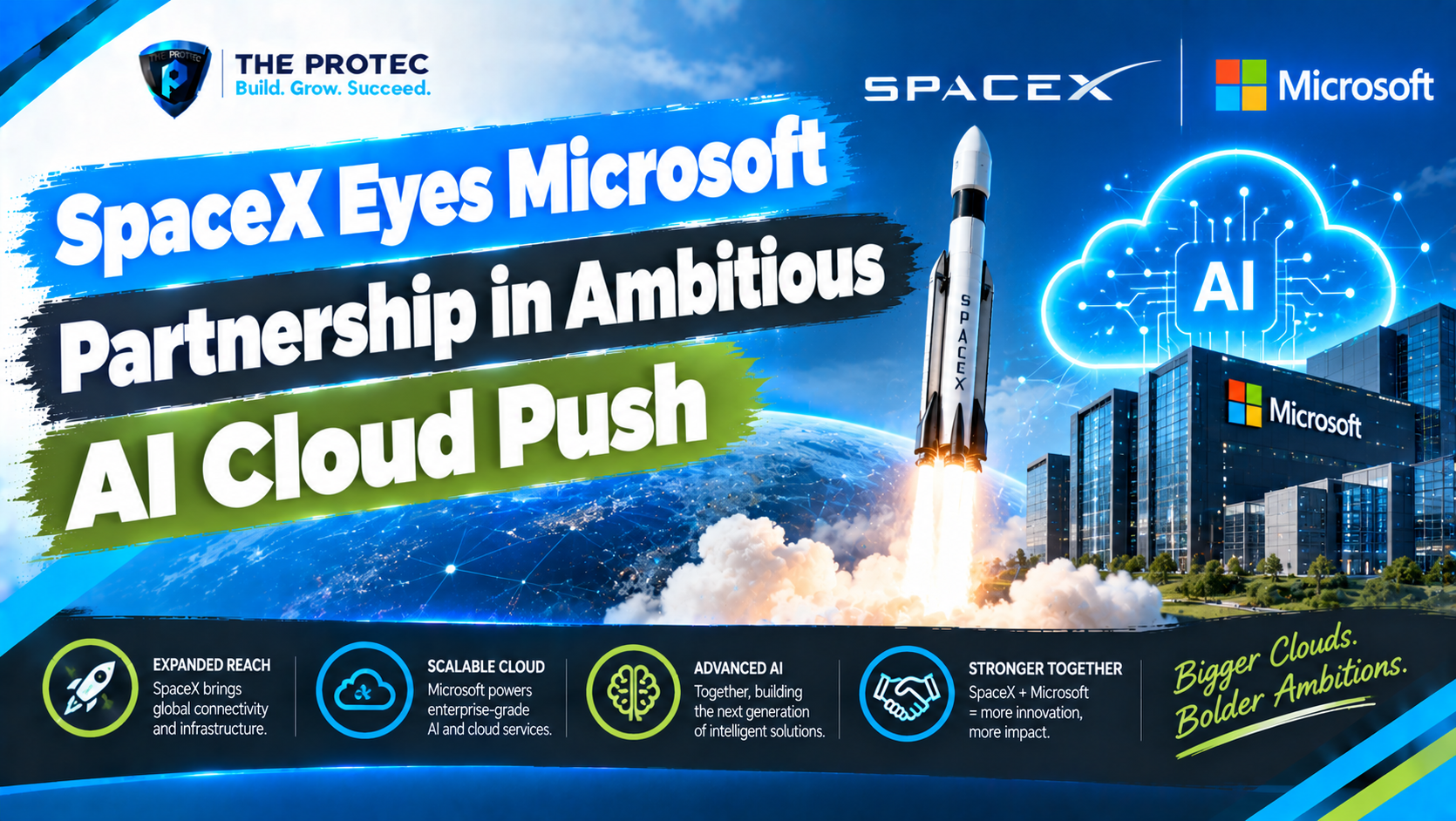
SpaceX may be preparing to enter one of technology’s most capital-intensive markets. Recent reports indicate that the company’s AI operation has explored a potential partnership with Microsoft while developing plans to offer computing infrastructure and cloud capacity to outside customers.
The discussions point to a broader SpaceX AI strategy than simply building artificial intelligence systems for internal use. If the initiative moves forward, the SpaceX AI unit could become a provider of accelerated computing, giving customers access to servers, AI chips, networking and related services needed to train or run advanced models.
That would place the company in the fast-growing AI infrastructure market alongside major cloud platforms and specialized computing providers. It would also create difficult questions about power, hardware supply, software, reliability and customer trust. Most importantly, reports of negotiations should not be confused with a completed SpaceX Microsoft AI deal. As of October 2026, publicly described discussions do not establish that the companies have finalized a commercial agreement.
What Has Been Reported About the SpaceX Microsoft AI Deal?
The reported talks center on Microsoft potentially accessing AI computing capacity associated with SpaceX’s expanding infrastructure. In practical terms, Microsoft could become a customer, distribution partner or strategic counterpart for capacity built by the SpaceX AI unit. An early commitment from a company of Microsoft’s scale could help validate the project and improve the economics of constructing expensive data centers.
However, important commercial details have not been publicly confirmed. Reports have not produced a complete, binding contract that specifies the volume of capacity, chip types, service levels, pricing, data center locations or duration of the proposed relationship. There has also been no definitive indication that the infrastructure would become an Azure region or that Microsoft would receive ownership of SpaceX AI infrastructure.
The distinction matters. Technology companies routinely discuss capacity purchases, cloud integrations and long-term supply arrangements without reaching a final deal. The reported Microsoft SpaceX AI discussions are therefore better understood as evidence of strategic interest rather than proof of a completed SpaceX Microsoft partnership.
SpaceX’s AI Cloud Business Could Go Beyond Model Development
An AI organization can operate at several layers of the technology stack. It can develop models, create consumer applications, build software for developers or supply the underlying computing capacity. The reported SpaceX AI cloud business suggests an effort to participate in that infrastructure layer, potentially allowing customers to rent clusters instead of buying and operating their own hardware.
Such a service could include bare-metal servers, reserved accelerator clusters, model-training environments or inference capacity. More advanced offerings might combine compute with storage, high-speed networking, security controls and tools for deploying models. SpaceX AI computing would then function as a commercial service rather than only as a resource for projects within the company’s wider technology portfolio.
This is a significant shift because operating an internal cluster and running a dependable public cloud are different tasks. External customers expect predictable performance, contractual availability, billing transparency, technical support, strong cybersecurity and controls that prevent one tenant from affecting another. A successful SpaceX AI cloud would need to meet those expectations consistently.
Why Large-Scale Compute Has Become the AI Industry’s Bottleneck
Modern AI development depends on access to thousands of accelerators connected through extremely fast networks. Training a frontier model can occupy a large cluster for weeks or months, while serving popular models requires continuous inference capacity. The resulting demand has made computing access a strategic resource rather than a routine IT purchase.
The challenge extends beyond obtaining SpaceX AI chips or similar accelerators. Dense clusters require substantial electricity, advanced cooling systems, high-bandwidth memory, low-latency networking and facilities designed to handle unusually high power loads. Operators must also coordinate software that schedules jobs efficiently and keeps expensive hardware from sitting idle.
These constraints explain why AI cloud computing has attracted hyperscalers, chip companies, data center operators and specialized GPU providers. Customers want faster access to capacity without waiting for facilities to be built or hardware to be delivered. Providers, meanwhile, can seek long-term commitments that help finance multibillion-dollar infrastructure projects.
The AI cloud business in 2026 increasingly revolves around reserved capacity, custom silicon, regional availability and energy supply. A provider able to secure chips and bring powered facilities online quickly can gain an advantage, even without matching every service offered by a conventional cloud platform.
What SpaceX Brings to an AI Infrastructure Expansion
SpaceX has several assets that make the reported move credible. It has experience planning complex engineering programs, managing global operations and deploying physical infrastructure at unusual scale. Its Starlink satellite network also gives the company expertise in communications, network management, ground systems and distributed hardware.
Starlink could eventually support connectivity for some SpaceX data centers or customers operating in locations poorly served by terrestrial networks. The company’s launch capabilities may also create longer-term opportunities involving edge computing, Earth-observation data or communications between space-based and terrestrial systems. More information about the network’s underlying approach is available through the official Starlink technology overview.
Yet these strengths should not be overstated. Satellite bandwidth does not replace the high-capacity fiber connections used inside and between major data centers. Launch expertise does not automatically produce enterprise cloud software, regulatory compliance or reliable customer support. Building rockets, operating a satellite constellation and delivering a multi-tenant cloud platform are distinct businesses.
SpaceX would still need suitable land, utility agreements, networking equipment, cooling infrastructure and dependable supplies of AI servers. It would also need engineers with deep experience in distributed cloud systems and enterprise services. Existing technological assets may accelerate the effort, but they do not eliminate its execution risk.
What Microsoft Could Gain From SpaceX AI Infrastructure
Microsoft has invested heavily in data centers, accelerators and the broader Azure ecosystem, yet AI demand can grow faster than new capacity becomes available. Additional infrastructure from SpaceX could give Microsoft another source of compute for selected workloads, particularly if the companies can coordinate hardware, networking and software deployment.
A relationship could also help Microsoft diversify capacity across operators and locations. That flexibility is valuable when access to electricity, advanced chips and construction resources constrains expansion. Microsoft could potentially make third-party capacity easier to consume through familiar services, although no public agreement confirms how closely a SpaceX offering would integrate with Microsoft Azure AI.
Microsoft would nevertheless need to assess reliability, security, data governance and economics. Enterprise and public-sector customers often have strict requirements governing where information is stored and who can access it. Any Microsoft AI infrastructure arrangement would have to satisfy those obligations rather than relying on SpaceX’s reputation for engineering speed.
What SpaceX Could Gain From Microsoft
Microsoft could offer more than revenue. A capacity commitment from a large buyer could provide predictable utilization for newly built SpaceX AI servers. High utilization is essential because accelerators lose value quickly as newer generations arrive, while data centers carry substantial fixed costs regardless of how much computing customers consume.
The Microsoft ecosystem could also give SpaceX a route to enterprise demand. Azure has established identity, security, monitoring, developer and procurement systems. Integration with parts of that ecosystem could reduce friction for organizations that want additional compute without adopting an entirely unfamiliar operating model.
SpaceX would need to avoid becoming overly dependent on one customer, however. An anchor tenant can make a new facility financially viable, but concentrated demand may reduce pricing power and leave unused capacity if a large contract changes. The strongest long-term position would likely involve a diverse customer base and differentiated services.
The Hardest Challenges Facing a SpaceX AI Cloud
Power and cooling
AI facilities can require hundreds of megawatts, and utility interconnection queues may delay projects for years. SpaceX would have to secure generation, transmission and backup power while addressing local concerns about water use, emissions, noise and grid stability. High-density accelerators also require sophisticated liquid-cooling systems.
Chip supply and technology cycles
Access to accelerators remains competitive, and committing to one hardware generation creates depreciation risk. The company would need to balance purchases of leading GPUs with custom or alternative SpaceX AI chips, software compatibility and customer preferences. Hardware alone is insufficient if developers cannot easily move their workloads onto it.
Cloud software and operational reliability
A competitive platform needs orchestration, storage, observability, security and workload-management software. Customers running expensive training jobs cannot tolerate frequent failures. SpaceX must prove that its clusters can deliver stable performance and that support teams can resolve problems without disrupting deadlines.
Trust, compliance and business separation
Customers may hesitate to place proprietary models or sensitive data on infrastructure associated with a company that develops its own AI systems. Clear governance, contractual protections and technical isolation would be essential. SpaceX would also face privacy, export-control and industry-specific compliance requirements across different jurisdictions.
Competition Is Already Intense
SpaceX would enter a market led by Amazon Web Services, Microsoft Azure and Google Cloud, all of which offer broad software portfolios and global enterprise relationships. Oracle and other established providers are expanding accelerated computing, while specialized AI clouds compete through fast access to GPUs, high-performance clusters and more flexible contracts.
SpaceX does not necessarily need to replicate a full hyperscale cloud. A narrower strategy focused on large training clusters, reserved capacity or high-volume inference could be more realistic. It could compete on deployment speed, network integration, cost or access to scarce hardware rather than offering thousands of general-purpose services.
The central strategic question is whether SpaceX technology expansion can produce a durable advantage. Owning infrastructure is not enough when competitors can negotiate similar chip purchases and power contracts. Differentiation must come from efficiency, software, service quality, unique connectivity or a combination that lowers customers’ total computing costs.
Signals to Watch Next
- A formal announcement defining whether Microsoft is a customer, partner or infrastructure reseller.
- Disclosures about capacity, accelerator suppliers, data center locations and delivery schedules.
- Evidence that SpaceX is hiring cloud operations, enterprise sales, security and compliance specialists.
- Details about software compatibility, service-level agreements and links to the Azure ecosystem.
- Power agreements or construction plans showing that SpaceX AI infrastructure can expand beyond a limited internal cluster.
These indicators would make it easier to distinguish a serious commercial cloud platform from exploratory negotiations or infrastructure built primarily for internal AI development.
Frequently Asked Questions
Has the SpaceX Microsoft partnership been finalized?
No finalized, comprehensive commercial partnership has been publicly established by the reported discussions. The available information points to talks around AI computing capacity, but major terms such as pricing, volume, duration and deployment structure remain unconfirmed. Negotiations can change or end before a binding agreement is signed.
Is SpaceX building a direct competitor to Microsoft Azure?
SpaceX appears to be exploring the AI infrastructure layer, but that does not mean it is immediately building a full Azure competitor. It could begin with dedicated accelerator clusters or wholesale capacity. A complete public cloud would require a much broader portfolio of databases, developer tools, security services and enterprise support.
How could Starlink support the SpaceX AI cloud business?
Starlink may provide connectivity for remote facilities, distributed users or specialized edge applications. It also gives SpaceX relevant network-operating experience. However, large AI clusters still depend heavily on terrestrial fiber and extremely fast internal networks, so SpaceX Starlink AI infrastructure would complement rather than replace conventional data center connectivity.
Why would Microsoft buy computing capacity from another provider?
AI demand can exceed the rate at which even the largest cloud companies can build data centers and secure chips. Third-party capacity could help Microsoft add flexibility, serve more workloads and reduce infrastructure bottlenecks. Any arrangement would still need to meet Microsoft’s standards for cost, security and reliability.
The Bottom Line
SpaceX has the engineering ambition and infrastructure experience to become a notable AI computing provider, and a Microsoft relationship could supply demand, credibility and ecosystem access. But the opportunity remains separate from a proven cloud business. Until binding terms and operational details emerge, the reported talks should be viewed as an important signal of SpaceX’s direction, not confirmation that it has already secured a major position in the AI cloud market.