






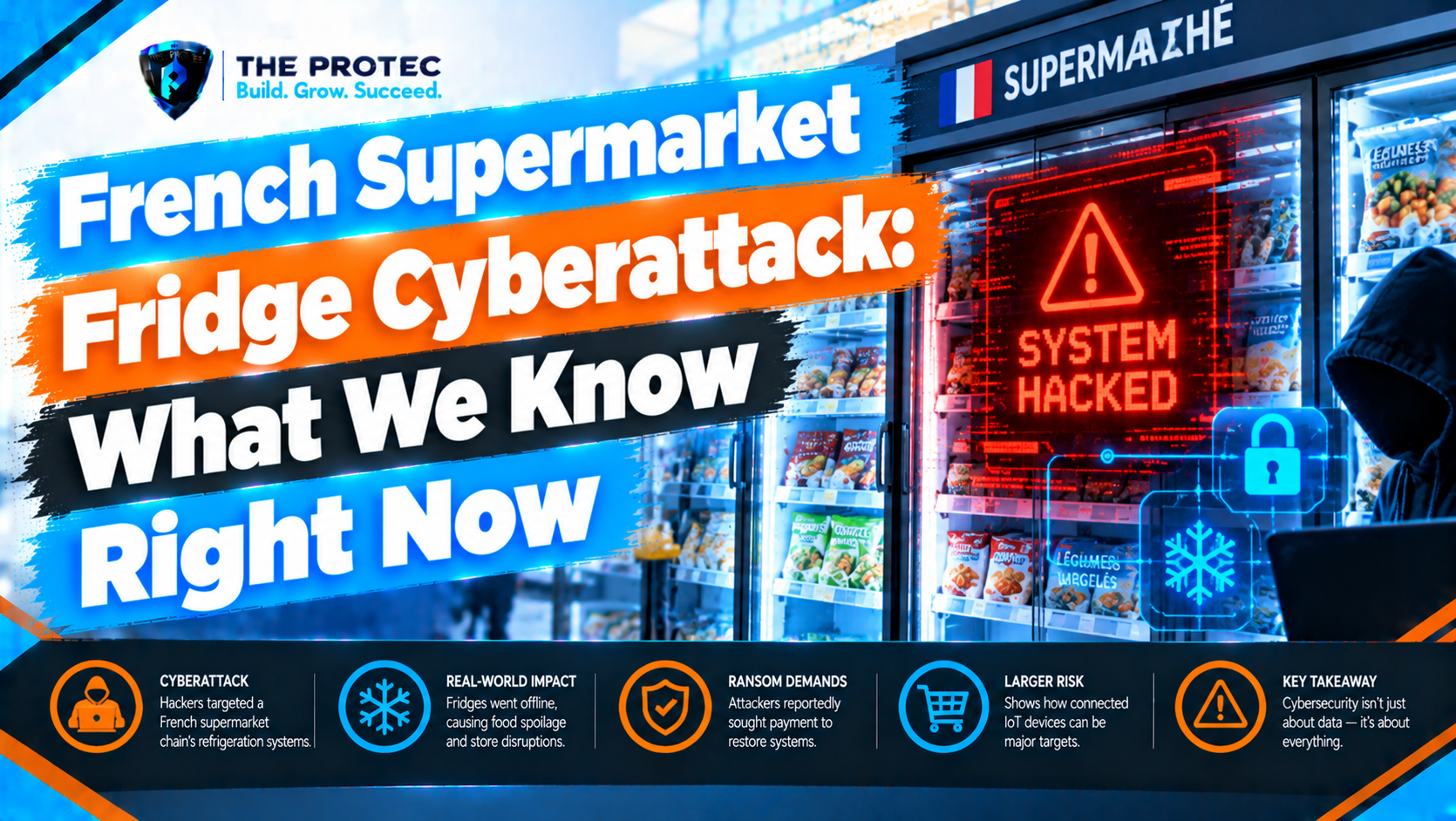
A refrigerator displaying 50°C is more than an alarming technical fault for a supermarket. It can signal an immediate threat to food safety, store operations and thousands of euros in perishable inventory. That is why reports of a French supermarket cyberattack affecting refrigeration systems have attracted attention far beyond the retail sector.
Claims circulating in October allege that attackers interfered with connected cooling controls at hundreds of French supermarket locations. Intermarché, Coopérative U and E.Leclerc have been named in reports, while images and accounts shared online suggest that some refrigeration interfaces displayed temperatures or setpoints as high as 50°C. The alleged result was widespread food spoilage and emergency disposal of chilled and frozen products.
Important details remain preliminary, however. Public information does not yet establish the exact number of affected stores, whether cabinets physically reached 50°C, which controller models were involved or how access was obtained. There is also no verified public attribution. Until retailers, manufacturers or French investigators publish technical findings, claims about the attackers, malware or an underlying product flaw should be treated cautiously.
What is known about the reported French supermarket cyberattack?
The central allegation is that supermarket cooling systems were hacked and remotely manipulated, interrupting refrigeration across a large number of stores in France. Early accounts describe abnormal temperature settings, disabled cooling or altered controller behavior. Some reports characterize the incident as hackers heating fridges to 50 degrees, although that wording may oversimplify what happened inside the affected equipment.
A displayed value of 50°C could represent a malicious setpoint, a falsified sensor reading, a controller parameter or an actual measured temperature. Those scenarios have very different technical and food-safety implications. A refrigeration cabinet normally cannot warm its contents to 50°C immediately merely because compressors stop. Reaching that temperature would generally require time, unusually warm surroundings or activation of equipment such as defrost heaters. Investigators therefore need controller logs, sensor histories and physical measurements before concluding that products themselves reached the displayed value.
Reports have associated the event with Intermarché, Coopérative U and E.Leclerc supermarket locations. That does not prove that each retailer suffered the same intrusion, that every reported outage shared one cause or that corporate networks were breached. Franchise structures, regional operators, service contractors and independently managed building systems can create significant differences between stores carrying the same brand.
The absence of complete public confirmation is not evidence that nothing happened. It means the scope and mechanism remain under investigation. France’s national cybersecurity authorities, retailers, refrigeration vendors, insurers and food-safety teams may all hold information that cannot be released while containment and forensic work continue.
How supermarket refrigeration controls could be compromised
Modern supermarkets depend on operational technology, or OT, to coordinate compressors, condensers, display cabinets, cold rooms, alarms and energy use. Danfoss refrigeration controllers and products from other industrial vendors can be integrated into supervisory platforms that allow technicians to monitor temperatures, schedule defrost cycles and diagnose faults from a central dashboard.
This connectivity improves efficiency but expands the attack surface. A supermarket refrigeration system security vulnerability does not necessarily mean a defect in the controller itself. Unauthorized control could result from several weaknesses:
- Internet-exposed management interfaces or gateways that were never intended to be publicly reachable.
- Stolen, reused or default credentials for remote maintenance accounts.
- Unpatched firmware, operating systems or supervisory software.
- Weak separation between corporate IT, vendor access and refrigeration networks.
- Compromise of a service provider with access to multiple customer locations.
- Insecure protocols that lack strong authentication or encryption.
- Misconfigured cloud dashboards, virtual private networks or remote desktop tools.
Once an attacker reaches a supervisory system, possible actions could include changing alarm thresholds, disabling compressors, forcing defrost cycles or manipulating telemetry. These are general technical possibilities, not confirmed descriptions of the France supermarket refrigeration attack. A fault, configuration error or compromised third-party account can resemble exploitation of a firmware vulnerability until forensic evidence separates the causes.
Why refrigeration disruption becomes a food-safety emergency
Cold-chain operations depend on maintaining defined temperature ranges from production and transport through storage and retail display. When cooling fails, meat, seafood, dairy products, prepared meals and other perishable foods can enter unsafe temperature zones. Frozen products may thaw, lose quality or become unsuitable for refreezing.
Store teams cannot rely on appearance or smell to determine safety. They must review calibrated temperature records, estimate the duration of exposure and follow applicable food-safety procedures. If reliable monitoring data were altered during a 50°C refrigerator cyberattack, managers may be unable to prove that stock remained safe. Disposal can then become the only defensible option, even where some products still feel cold.
This makes integrity as important as availability. A cooling unit that stops is dangerous, but an apparently normal dashboard showing false readings can delay intervention. Independent sensors and local alarms are therefore critical safeguards.
The financial and environmental cost of spoiled food
French supermarkets facing food spoilage would incur costs extending well beyond replacing inventory. Stores may need to close chilled departments, bring in technicians, hire refrigerated trailers, conduct safety inspections and dispose of large quantities of food under controlled conditions. Business interruption, lost customer confidence and insurance disputes can amplify the damage.
The environmental consequences can also be substantial. Spoiled food represents wasted water, energy, packaging, transportation and agricultural inputs. Disposal creates additional emissions, particularly when organic waste is sent to landfill rather than anaerobic digestion or another recovery process. Emergency refrigeration and replacement deliveries add further energy and transport demands.
Calculating French supermarket food losses requires verified data on affected locations, product volumes and outage duration. Multiplying an assumed loss by an unconfirmed number of stores can produce dramatic but unreliable estimates. Any credible assessment should separate discarded stock, operational recovery, equipment damage, lost sales and longer-term remediation.
Danfoss refrigeration system vulnerability claims need evidence
References to Danfoss refrigeration controllers have led some commentary to describe the incident as a Danfoss refrigeration system vulnerability. That conclusion should not be made without a technical advisory or forensic finding identifying a specific product, firmware version and exploitation path.
Industrial control system cyberattacks often involve an ecosystem rather than one device. A controller may operate exactly as designed after receiving authenticated commands from a compromised management server. Alternatively, an exposed gateway, installer laptop, remote-access platform or poorly protected account may be the initial entry point. Firmware exploitation is only one possibility.
Manufacturers can reduce risk through signed firmware, secure boot, strong authentication, vulnerability disclosure programs and clear support lifecycles. Operators are responsible for secure deployment, credential management, patching and access control. Integrators must avoid unsafe defaults and document data flows. Effective supermarket operational technology security depends on all three groups.
Organizations seeking official guidance should monitor France’s ANSSI cybersecurity portal and relevant vendor security advisories rather than relying on screenshots or unattributed social posts.
Practical defenses for supermarket cooling systems
The reported incident demonstrates why refrigeration can no longer be managed as isolated facilities equipment. Connected cooling is part of the food supply chain and should be protected as a business-critical OT environment.
Segment refrigeration from corporate and public networks
Controllers should sit in dedicated network zones protected by firewalls. Only approved management systems and protocols should cross those boundaries. Store Wi-Fi, point-of-sale systems, office devices and guest networks should not have direct routes to refrigeration equipment. Segmentation limits the damage if an endpoint elsewhere in the business is compromised.
Restrict and monitor remote access
Remote maintenance should be disabled when unnecessary. Where it is operationally required, retailers should use managed gateways, phishing-resistant multifactor authentication, individual accounts and time-limited approval. Shared vendor credentials and permanently exposed interfaces create disproportionate risk. Every session should be logged and attributable to a person or service organization.
Build a defensible firmware process
Retailers need an inventory of controller models, firmware versions, gateways and support status across every location. Security teams should validate updates in a representative environment before deployment, verify digital signatures and retain rollback procedures. Unsupported products should be isolated or replaced according to risk, not left indefinitely because they still cool correctly.
Detect unsafe changes quickly
Monitoring should alert on unusual setpoint changes, disabled alarms, unexpected defrost activity, repeated logins and commands issued outside maintenance windows. Independent temperature sensors should send alerts through a separate path so that compromise of the main controller does not erase operational visibility. Physical inspections and manual thermometers remain valuable during an incident.
Prepare for safe manual operation
Incident-response plans should define who can isolate remote connections, place systems into local control, move stock and authorize disposal. Stores need current contact details for refrigeration engineers, IT responders, food-safety specialists and waste contractors. Exercises should test whether staff can maintain safe temperatures when cloud dashboards or central management systems are unavailable.
Assess supply-chain access
Retail groups should identify every integrator, contractor and platform with access to cooling systems. Contracts should require prompt incident notification, secure authentication, vulnerability handling and log retention. European guidance on critical infrastructure and supply-chain resilience is available from the European Union Agency for Cybersecurity.
What investigators need to establish next
A credible France cybersecurity investigation must determine whether the reported incidents share common infrastructure, credentials, software or service providers. Investigators will need controller audit logs, remote-access records, firewall data, firmware images, cloud account histories and trusted temperature measurements.
They must also establish whether the 50°C values were commands, setpoints, sensor readings or manipulated displays. That distinction will shape both food-loss calculations and technical remediation. Public attribution should wait for evidence connecting activity to a specific actor; motive cannot be inferred merely from the disruption caused.
The broader lesson is already clear. A cyberattack on the food supply chain does not need to touch payment systems or customer records to cause serious harm. Manipulating the machines that keep food cold can turn a digital intrusion into a physical, financial and environmental crisis.
Frequently asked questions
Were hundreds of French supermarket fridges definitely hacked?
Reports allege disruption across hundreds of locations, but the total has not been conclusively established in publicly available technical findings. Some events may prove related, while others could have different causes. Retailer statements and forensic results are needed to confirm the final scope.
Did the supermarket fridges physically reach 50°C?
That remains unclear. A controller displaying 50°C may show a setpoint, measured temperature or falsified value. Investigators must compare controller data with independent sensors and product temperatures before determining how hot the cabinets or food became.
Was a Danfoss controller vulnerability responsible?
No publicly established evidence cited in the early claims proves that a Danfoss firmware flaw caused the incident. Compromised credentials, exposed remote access, insecure integration or another component could also explain unauthorized control. A specific vulnerability should not be named without a vendor advisory or forensic confirmation.
How can supermarkets prevent a similar refrigeration attack?
The strongest measures are network segmentation, tightly restricted remote access, multifactor authentication, maintained firmware, independent temperature monitoring and rehearsed manual-response procedures. Retailers should also audit third-party access and preserve detailed logs so abnormal commands can be detected and investigated quickly.