








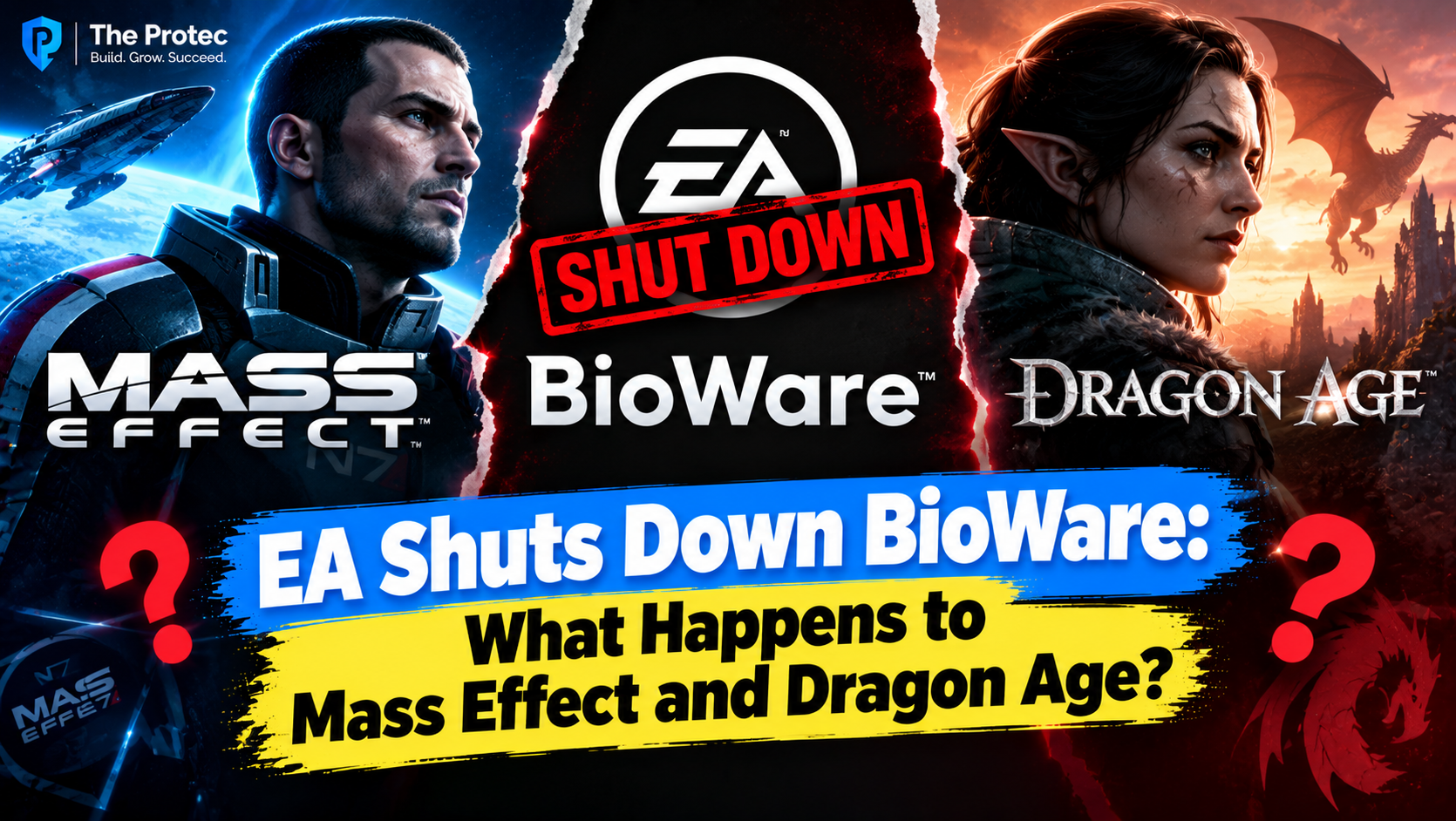
Does the BioWare shutdown mean the end of Mass Effect and Dragon Age, or can Electronic Arts keep both franchises alive without the studio that created them?
That is the central question following EA’s confirmed decision to close BioWare after more than three decades. The announcement, made on October 21, 2026, also ended early development on the next Mass Effect game. For fans who had waited years for another trip through the Milky Way, the news is devastating—but it does not automatically cancel every franchise, adaptation, or live service associated with the BioWare name.
The clearest way to understand the BioWare closure is to separate what EA has confirmed from what remains undecided. The next Mass Effect project is cancelled, and BioWare is shutting down. EA has not, however, announced that it is permanently retiring the Mass Effect or Dragon Age intellectual properties. Nor has the company tied the closure to the cancellation of Star Wars: The Old Republic or the planned Mass Effect television adaptation.
EA Shuts Down BioWare After More Than 30 Years
EA disclosed the studio closure through its official news channel, framing the decision as part of a wider restructuring intended to concentrate investment on fewer projects. BioWare’s farewell message, published through the studio’s official blog, reflected on its teams, communities, and long history of story-driven games.
Reputable reporting around the Electronic Arts BioWare shutdown indicates that the broader restructuring affects approximately 400 positions across EA. About 50 of those jobs were reportedly associated with BioWare, although workforce figures can vary depending on whether transferred roles, vacancies, and contractors are included. The distinction matters: EA layoffs in 2026 extend beyond a single studio, while the BioWare positions represent one part of the company-wide cuts.
The closure ends the institutional life of a developer established in Edmonton, Canada, in 1995. The BioWare Edmonton studio became synonymous with cinematic conversations, companion-driven storytelling, moral choices, and role-playing worlds that responded to player decisions. EA acquired BioWare in 2007, placing one of the industry’s most respected RPG developers inside a much larger publishing organization.
What Is Confirmed, Ongoing, and Still Unknown?
The announcement has generated misleading claims online, particularly around searches for “Mass Effect 5 cancelled” and “Dragon Age next game.” Here is the current position:
Confirmed
- EA is closing BioWare after more than 30 years.
- Development has ended on the next Mass Effect project.
- The cancelled game was in early development, not approaching release.
- The closure forms part of broader EA restructuring and reported workforce reductions.
Not confirmed as cancelled
- The Mass Effect franchise as a permanent EA property.
- The possibility of a future Dragon Age game developed elsewhere.
- Ongoing operation of Star Wars: The Old Republic.
- The planned Mass Effect television series.
Still unanswered
- Whether EA will assign Mass Effect or Dragon Age to another internal or external team.
- Whether concepts, characters, or technology from the cancelled project could be reused.
- How long EA intends to leave either franchise dormant.
Was Mass Effect 5 Cancelled?
Yes—but the terminology requires clarification. “Mass Effect 5” was an unofficial shorthand used by fans and media for the next Mass Effect game. EA and BioWare had not confirmed that as the project’s final title. Calling it Mass Effect 5 was a convenient way to distinguish the project from the original trilogy and Mass Effect: Andromeda, not evidence that the game had reached a numbered, production-ready form.
The cancelled Mass Effect sequel was still in early development. That means fans should not imagine a nearly complete game being placed in a vault weeks before launch. Early development can involve narrative planning, concept art, technical prototypes, staffing decisions, and experiments with gameplay systems. Although teasers and developer comments had established creative expectations, the project had not reached the point where EA had announced a release date, platforms, or a full gameplay reveal.
The cancellation therefore ends this specific attempt to make the next Mass Effect game. It does not necessarily establish the permanent Mass Effect franchise future. EA continues to own the intellectual property and could commission another project years from now, transfer development to a different team, or license the franchise under a new arrangement. None of those possibilities has been announced, so they should not be mistaken for active plans.
There is also no guarantee that another studio could simply resume BioWare’s work. A future team would need access to the project’s assets and documentation, but it might choose—or be instructed—to begin again with a different creative direction. In practical terms, the BioWare shutdown resets the franchise’s game-development outlook even if EA eventually returns to the series.
What Is the Future of Dragon Age?
The Dragon Age future is less definite because EA’s announcement did not reveal another game or identify a replacement developer. As of October 21, there is no publicly confirmed Dragon Age sequel in development and no announcement that the franchise has been assigned to another EA studio.
That uncertainty should not be presented as either a confirmed cancellation or proof of an imminent revival. EA owns the brand, its characters, and its setting. The company could revisit Thedas with another internal team, work with an external developer, pursue adaptations, or leave the property inactive. For now, the honest answer to “Is there a Dragon Age next game?” is that EA has not announced one.
Any continuation would also face a creative challenge. Dragon Age is strongly associated with BioWare’s approach to companions, branching dialogue, romance, lore, and consequential decisions. Another studio could build within that universe, but it would need to decide whether to preserve that design philosophy or reinterpret the franchise. The legal ability to continue a series is not the same as preserving the team culture that shaped it.
Star Wars: The Old Republic Is a Separate Situation
Star Wars: The Old Republic belongs in a different category from the cancelled next Mass Effect game. BioWare developed and launched the MMO in 2011, making it an important part of the studio’s history. However, primary development and operation moved to Broadsword Online Games in 2023, years before the BioWare studio closure.
That transfer means “BioWare shutting down” and “SWTOR shutting down” are not equivalent statements. EA’s October announcement did not, by itself, confirm the end of the MMO, its servers, or future updates. The Star Wars: The Old Republic future depends on decisions involving its current operator, EA, and the relevant licensing relationships—not on BioWare continuing to exist as an operating studio.
Players should rely on official service announcements for changes to content plans or server availability. Unless Broadsword or EA says otherwise, reports that the BioWare closure automatically terminates SWTOR go beyond the confirmed facts.
The BioWare RPG Legacy Changed the Genre
The scale of the reaction reflects BioWare’s extraordinary influence. The studio’s early work on Baldur’s Gate helped modernize computer role-playing games by combining tactical combat, memorable party members, and expansive storytelling. Neverwinter Nights extended that ambition with multiplayer tools and user-created adventures.
Star Wars: Knights of the Old Republic demonstrated that a licensed universe could support a deeply personal RPG with meaningful choices and one of gaming’s best-known narrative twists. Its influence can still be seen in cinematic dialogue systems, morality mechanics, and companion-centered storytelling.
BioWare later created its two defining original franchises. Dragon Age offered dark fantasy shaped by politics, history, and player relationships. Mass Effect brought similar principles to science fiction, allowing choices to carry across a trilogy while turning squad members such as Garrus, Tali, Liara, and Wrex into enduring characters.
Not every BioWare game succeeded equally, and its later years included changing leadership, lengthy development cycles, and projects that struggled to match expectations. Even so, the BioWare RPG legacy is larger than any one release. Modern narrative RPGs routinely use techniques the studio popularized: dialogue wheels, loyalty missions, romance arcs, reactive companions, and decisions designed to make players feel ownership over a story.
Why Did EA Close BioWare?
EA’s stated explanation centers on concentrating resources and investment on fewer opportunities. That reflects a broader industry trend in which large publishers are reducing project portfolios as development costs rise, production cycles lengthen, and competition for player attention intensifies.
Reporting has also placed the BioWare studio closure in the context of EA’s recent release challenges and expectations for major games. Analysts and journalists may interpret the decision as a response to commercial performance, escalating budgets, or doubts about the next project’s trajectory. Those interpretations should be attributed to reporting rather than presented as EA-confirmed motives.
The available facts support a narrower conclusion: EA reviewed its portfolio, chose to end the early Mass Effect project, and closed the team as part of a wider restructuring. It has not publicly supplied a complete internal accounting of every financial, creative, and production factor behind the decision. Claims that one specific game or executive decision single-handedly caused the closure simplify a much more complicated business history.
Is the Mass Effect TV Series Still Happening?
The planned Mass Effect television adaptation is not the same project as the cancelled game. Screen development involves separate producers, rights agreements, schedules, and financial decisions. Consequently, the end of BioWare does not automatically cancel the show.
As of the closure announcement, there had been no confirmed statement saying the Mass Effect TV series was cancelled because of the studio shutdown. Its ultimate status will depend on the companies developing and distributing the adaptation. The loss of a new game could affect franchise strategy or potential cross-promotion, but that is a business consideration—not evidence that television development has ended.
Fans should also avoid assuming that the series will adapt Commander Shepard’s story exactly or connect directly to the cancelled game. Plot, casting, format, and release timing remain subject to official announcements.
What Happens Next for BioWare Games?
In the immediate future, former employees and their next steps deserve as much attention as dormant franchises. Studio closures disperse decades of expertise across the industry. Some BioWare veterans may join other established developers, while others could form independent teams and carry forward the studio’s character-focused approach under new names.
For EA, ownership keeps the door open to remasters, licensing arrangements, adaptations, or entirely new games. Yet there is currently no replacement BioWare, no confirmed Dragon Age developer, and no active successor to the cancelled Mass Effect project. Fans can reasonably hope these worlds return while recognizing that hope is not an announced production plan.
BioWare’s closure ends a remarkable studio, but it does not erase its games or guarantee that every franchise dies with it. The most accurate conclusion is narrower and more painful: this version of the next Mass Effect is over, BioWare will no longer build future RPGs, and EA has not yet explained who—if anyone—will inherit its most famous worlds.
Frequently Asked Questions
Did EA officially confirm the BioWare shutdown?
Yes. EA confirmed the closure on October 21, 2026, as part of a broader restructuring. BioWare also published a farewell message reflecting on its teams, players, and more than 30-year history.
Is Mass Effect 5 officially cancelled?
The early-development next Mass Effect project is cancelled. “Mass Effect 5” was never confirmed as its official title; it was an informal label used by fans and media. The project was not a finished game close to release.
Does the BioWare closure mean there will never be another Dragon Age game?
No permanent end has been announced. EA has not confirmed another Dragon Age game or named a new developer, but it retains ownership and could revisit the franchise later.
Is Star Wars: The Old Republic closing?
EA’s BioWare announcement did not confirm an SWTOR shutdown. Broadsword Online Games has handled the MMO’s primary development and operation since 2023, making its situation separate from the closure.
Was the Mass Effect television series cancelled too?
No cancellation was confirmed as part of the BioWare news. The television adaptation is a separate production, and its future will depend on announcements from the companies involved.