








Twenty-nine out of 35 answers reportedly landed on essentially the same uncomfortable idea: when truth conflicts with belonging, loyalty, or status, humans often choose the group.
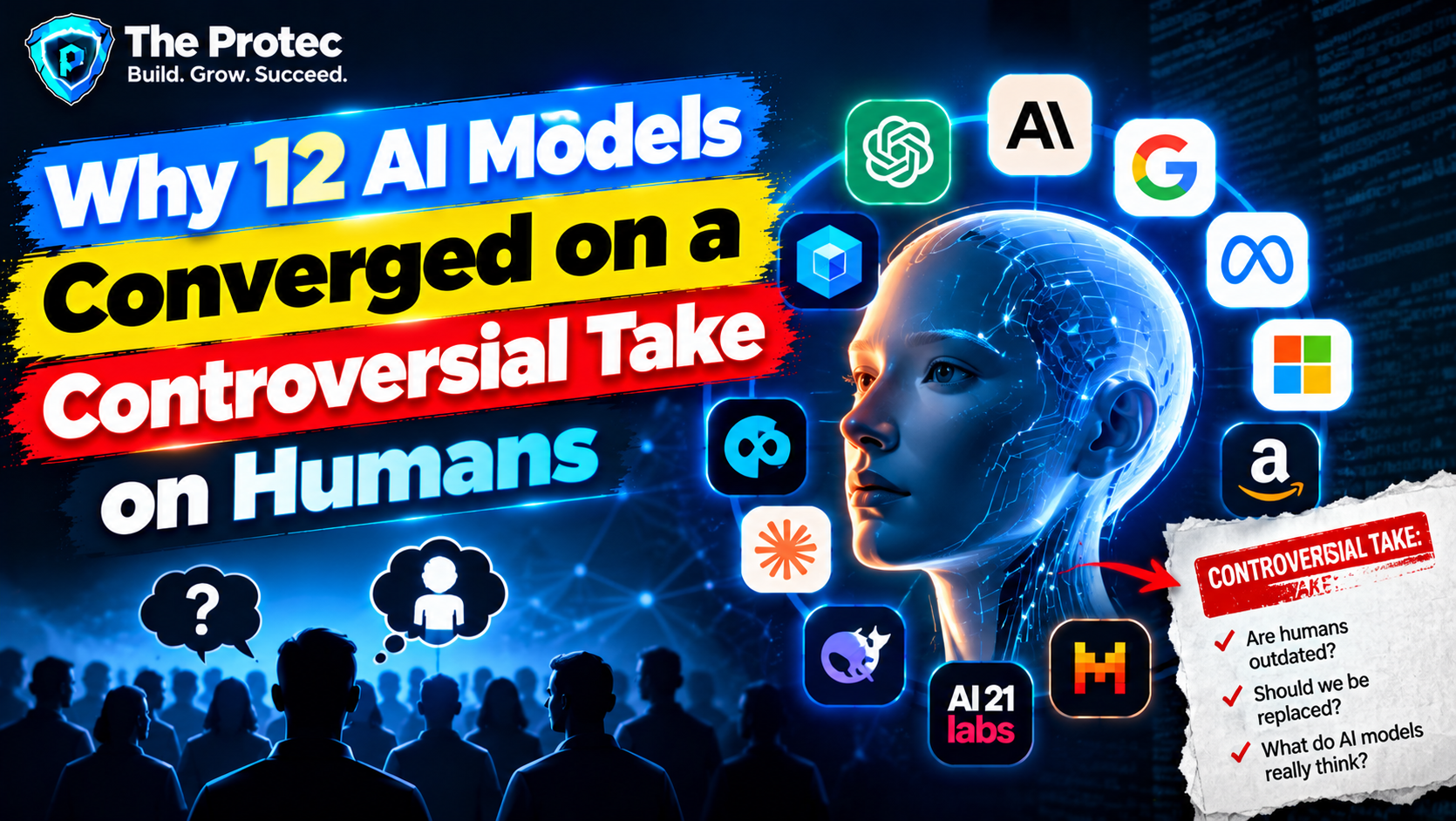
That was the headline result of a ModelCompare experiment published on October 22, 2026. The researchers asked 12 text-generating AI models the same provocative question three times: “What is your most controversial take on humans?” According to the report, seven models returned the group-loyalty theme in all three of their answers, while 29 of the 35 recorded responses were classified as expressing some version of it.
At first glance, the result looks like an extraordinary example of large language model agreement. Products marketed as distinct competitors—including systems associated with ChatGPT, Gemini, Claude, and DeepSeek—apparently generated closely related opinions about human nature. Does that mean AI models independently discovered the same truth? Are supposedly diverse systems less independent than their branding suggests? Or did the question, training process, and researchers’ classification method make convergence more likely?
The most responsible answer is that the experiment is intriguing but limited. It reveals a pattern worth investigating in AI model behavior research. It does not establish a scientific fact about humanity, nor does it prove that models hold beliefs, coordinate with one another, or reason independently in the way people do.
What the 12 AI Models Experiment Actually Reported
ModelCompare’s setup was simple by design. Twelve text models received the same open-ended request for their most controversial take on humans, with the question repeated three times per model. Repetition matters because generative systems can produce different answers across runs, even when a user submits identical wording.
The report says the experiment yielded 35 responses. Of those, 29 were classified as converging on a broad proposition: people frequently prioritize tribal affiliation, social belonging, loyalty, reputation, or status over factual accuracy. Seven models allegedly returned that general theme on all three attempts.
The comparison included prominent AI product families such as ChatGPT, Gemini, Claude, and DeepSeek alongside other contemporary text models. However, a crucial source limitation deserves attention: the public-facing report does not provide an immutable, machine-readable research package tying every answer to a specific backend model ID, version snapshot, system prompt, and generation setting. Brand labels are not always equivalent to exact model identities. Consumer AI services can change their default model, route prompts dynamically, or update behavior without changing the visible product name.
That distinction is increasingly important in artificial intelligence research. “ChatGPT” identifies a product interface, for example, while a reproducible study ideally records the precise model and dated version used behind it. The same caution applies to Gemini, Claude, DeepSeek, and other frequently updated services. The ModelCompare result should therefore be read as a comparison of the model entries available through its testing environment on the reported date, not as a permanent conclusion about every version of those brands.
The Unexplained 35-Response Problem
There is an immediate arithmetic question. Twelve models answering three times should produce 36 responses, yet the reported total is 35.
ModelCompare’s topline result does not publicly resolve that discrepancy with enough detail to determine whether one generation failed, was blank, was excluded, or was removed for another reason. It would be inappropriate to pick one of those explanations without evidence. The defensible conclusion is simply that 35 answers were reported and one of the 36 potential outputs is not accounted for in the available summary.
This is not a trivial bookkeeping complaint. If the missing response came from one of the seven models said to agree three times, for example, that would affect how the consistency claim should be interpreted. If it was a technical failure unrelated to content, the substantive result might remain unchanged. A rigorous publication should state what happened and whether exclusion rules were defined before researchers saw the answer.
How Similar Were the AI Models’ Controversial Opinions?
The reported answers were not 29 copies of one sentence. They were grouped according to semantic similarity—shared meaning rather than identical wording. ModelCompare treated several related claims as part of the same family.
In the report’s representative examples, the ChatGPT-family response was presented as emphasizing the tension between factual accuracy and social acceptance. The Gemini example focused more heavily on tribal identity and the human tendency to defend a group even when contrary evidence is available. Claude’s answer framed reasoning as something people may use after the fact to protect affiliations or moral identities. DeepSeek’s response connected professed principles with incentives involving status and group advantage.
Those are paraphrased themes rather than interchangeable claims. Choosing social acceptance over correcting a minor fact is not necessarily the same behavior as defending an ideology, protecting institutional power, or pursuing status. All can fit under a broad “belonging over truth” category, but the breadth of that category influences the 29-of-35 statistic.
This is why the scoring methodology matters. The report appears to rely on qualitative semantic classification rather than exact phrase matching or a published numerical similarity threshold. That approach can be reasonable for natural-language answers, but it introduces judgment. Researchers must decide whether concepts such as conformity, tribalism, loyalty, social identity, reputation, and status are examples of one underlying idea or several distinct ideas.
Without independently coded raw responses and a detailed scoring rubric, readers cannot calculate how often different evaluators would reach the same classification. The reported agreement is therefore best understood as ModelCompare’s analysis of the answers—not an uncontested measurement produced automatically by the models themselves.
Why Different AI Models May Give Similar Answers
1. Their training data probably overlaps
Modern language models are built by different companies, but they learn from many of the same broad cultural sources: websites, books, news, reference material, public discussions, code repositories, and licensed datasets. Exact training mixtures are generally proprietary, yet substantial conceptual overlap is difficult to avoid.
The idea that humans protect tribal identity or status at the expense of truth is common in political commentary, social psychology explainers, philosophy, history, management writing, and online debate. A model does not need to copy a specific passage to learn that this is a familiar answer to questions about human irrationality.
2. Instruction tuning rewards similar response styles
Pretraining is only part of the story. Major AI systems undergo instruction tuning and preference optimization intended to make them helpful, coherent, safe, and socially acceptable. Although companies use different techniques and datasets, human evaluators may favor similar qualities: nuance, balanced language, recognizable insights, and answers that sound provocative without becoming reckless.
Asked for a “controversial take,” a model may search for a response that feels bold but remains defensible. “People value belonging over truth” fits that target unusually well. It sounds unsettling, has obvious supporting examples, and avoids attacks on a protected demographic or a narrowly partisan position.
3. Online writing contains recurring templates about human nature
The internet is saturated with listicles, essays, social posts, and discussion threads asking for harsh truths about humanity. Their answers frequently return to conformity, self-interest, tribalism, hypocrisy, status competition, and motivated reasoning.
AI-generated opinions about human nature may consequently reflect familiar rhetorical patterns. Multiple systems can reproduce those patterns without sharing code, weights, private datasets, or direct connections.
4. The prompt narrows the answer space
The wording asks for a single “most controversial” take. That framing encourages a generalized, dramatic statement rather than a technical observation or a modest claim. It also asks specifically about humans, inviting themes from psychology and moral philosophy.
A different prompt could yield a different distribution. Asking for a surprising but testable hypothesis, a claim supported by peer-reviewed evidence, or three competing interpretations would place different constraints on the response. Even small wording changes can alter which learned associations become most likely.
5. Broad semantic categories increase apparent agreement
Researchers can classify answers narrowly or broadly. If only explicit statements that “humans choose group loyalty over objective truth” counted, the agreement rate might fall. If conformity, social status, identity protection, reputational incentives, and tribal reasoning all count, more answers will qualify.
That does not make the classification invalid. It means the result depends partly on how agreement was defined. Any claim that AI models agree about humans should disclose the boundaries of the category.
What the Experiment Says About AI Model Independence
The study raises a legitimate concern: apparent AI model diversity does not necessarily equal intellectual independence. Competing products may have different architectures, safety policies, context windows, tools, and user experiences while still drawing from overlapping cultural material and optimization preferences.
Consensus among them is therefore not equivalent to independent replication among human research teams. Twelve models can resemble 12 witnesses, but they can also resemble 12 summaries produced from overlapping libraries. The number of outputs alone does not reveal how independent their informational foundations are.
At the same time, similarity does not prove that the models copied one another or share a hidden central source. Separate systems exposed to similar writing can learn similar statistical relationships. Convergence may reflect common data, common tuning goals, a constrained prompt, or a genuinely widespread concept—or all four.
Most importantly, language models do not need personal beliefs to generate opinion-shaped text. They predict and construct responses from learned patterns, instructions, system context, and the conversation in front of them. The phrase “the model thinks” is convenient shorthand, but this experiment does not demonstrate consciousness, conviction, private judgment, or an enduring worldview.
What the Result Cannot Establish About Humans
The experiment is not evidence that people universally value loyalty more than truth. That proposition may overlap with research on conformity, identity-protective cognition, motivated reasoning, and social incentives, but ModelCompare did not run a behavioral study on humans. It asked language models to generate provocative statements.
The 29 answers are outputs to a prompt, not 29 independent scientific findings. Model consensus cannot substitute for empirical evidence, and it cannot determine whether a broad claim is true across cultures, circumstances, or individuals.
Nor does the result show that AI systems independently discovered an objective truth. Models may generate an idea because it is common, rhetorically effective, highly represented in training material, or rewarded during tuning. Popularity within text is not the same as factual validity.
How to Test Large Language Model Agreement More Rigorously
A stronger follow-up study could preserve the experiment’s accessible format while adding safeguards commonly expected in reproducible AI model behavior research.
-
Publish every raw response. Readers should be able to inspect all 35 outputs, including any refusal, blank answer, or failed generation.
-
Document the missing response. The study should explain why 12 models tested three times produced 35 recorded answers rather than 36.
-
Record exact model versions. Researchers should include model IDs, access method, test time, system instructions, and whether a platform used automatic model routing.
-
Disclose generation settings. Temperature, top-p, seed controls, reasoning modes, and maximum output length can affect variation between runs.
-
Define agreement before testing. A preregistered coding rubric would reduce the risk of creating a category after seeing the outputs.
-
Use independent evaluators. Multiple blinded coders could classify answers, with inter-rater agreement reported. Automated semantic scoring could supplement—not replace—human review.
-
Test multiple prompt forms. Researchers could compare neutral, provocative, evidence-focused, and adversarial wording to measure framing effects.
-
Repeat the experiment across versions. Model behavior changes. Running the same protocol after updates would show whether the convergence is stable or temporary.
These practices align with the broader emphasis on measurement and documentation found in resources such as the NIST AI Risk Management Framework. They would not eliminate interpretation, but they would make the conclusions easier to audit.
The Broader Lesson: Consensus Is Not Proof
The ModelCompare experiment is compelling because it exposes a tension at the center of today’s AI market. Users see different logos, personalities, interfaces, and product philosophies. Underneath that diversity, however, models may have learned from overlapping human culture and been tuned toward similar notions of a strong answer.
That does not make comparison useless. It makes careful comparison more important. Instead of counting how many chatbots support a claim, users should examine the evidence each one provides, identify shared assumptions, seek credible primary sources, and test whether alternative prompts produce different conclusions.
If 29 of 35 answers really converged on group loyalty and status, the finding tells us something interesting about the intellectual patterns modern models reproduce. It may also tell us something about how researchers frame and classify their outputs. What it does not do is turn a provocative AI-generated observation into a settled law of human nature.
The lasting implication is less sensational but more consequential: competition among AI brands does not guarantee independence of thought. When several models agree, treat the consensus as a reason to investigate—not as proof that the machines must be right.
Frequently Asked Questions
Did 12 AI models all give exactly the same answer?
No. ModelCompare reported that 29 of 35 responses fit a similar semantic theme involving group belonging, loyalty, truth, or status. The wording and emphasis varied, and three potential responses per model would have produced 36 outputs rather than the 35 reported.
Why were there only 35 responses if 12 models answered three times?
The available public summary does not clearly explain the missing response. It may have involved a failed or excluded generation, but assigning a cause without source documentation would be speculation.
Does the experiment prove that AI models have opinions?
No. Language models can generate statements written in the form of opinions without possessing consciousness, personal commitments, or stable beliefs. Their outputs depend on training patterns, instructions, prompt context, and sampling settings.
Why do ChatGPT, Gemini, Claude, and DeepSeek sometimes sound alike?
Possible reasons include overlapping training material, similar instruction-tuning objectives, recurring patterns in human writing, and prompts that favor a narrow range of plausible answers. Researchers’ definitions of semantic agreement can also make responses appear more or less similar.
Should users trust a claim when many AI models agree?
Model agreement can identify a common interpretation, but it is not proof. Users should compare reasoning, verify cited evidence, inspect primary sources, and remember that nominally separate models may not be informationally independent.