








The street you walk every morning may have witnessed a political protest, inspired an artist, housed a groundbreaking inventor, or followed a route that existed centuries before the surrounding buildings. Most neighborhoods contain stories like these. The problem is that they are scattered across plaques, archives, local websites, and Wikipedia pages that people rarely think to search for.
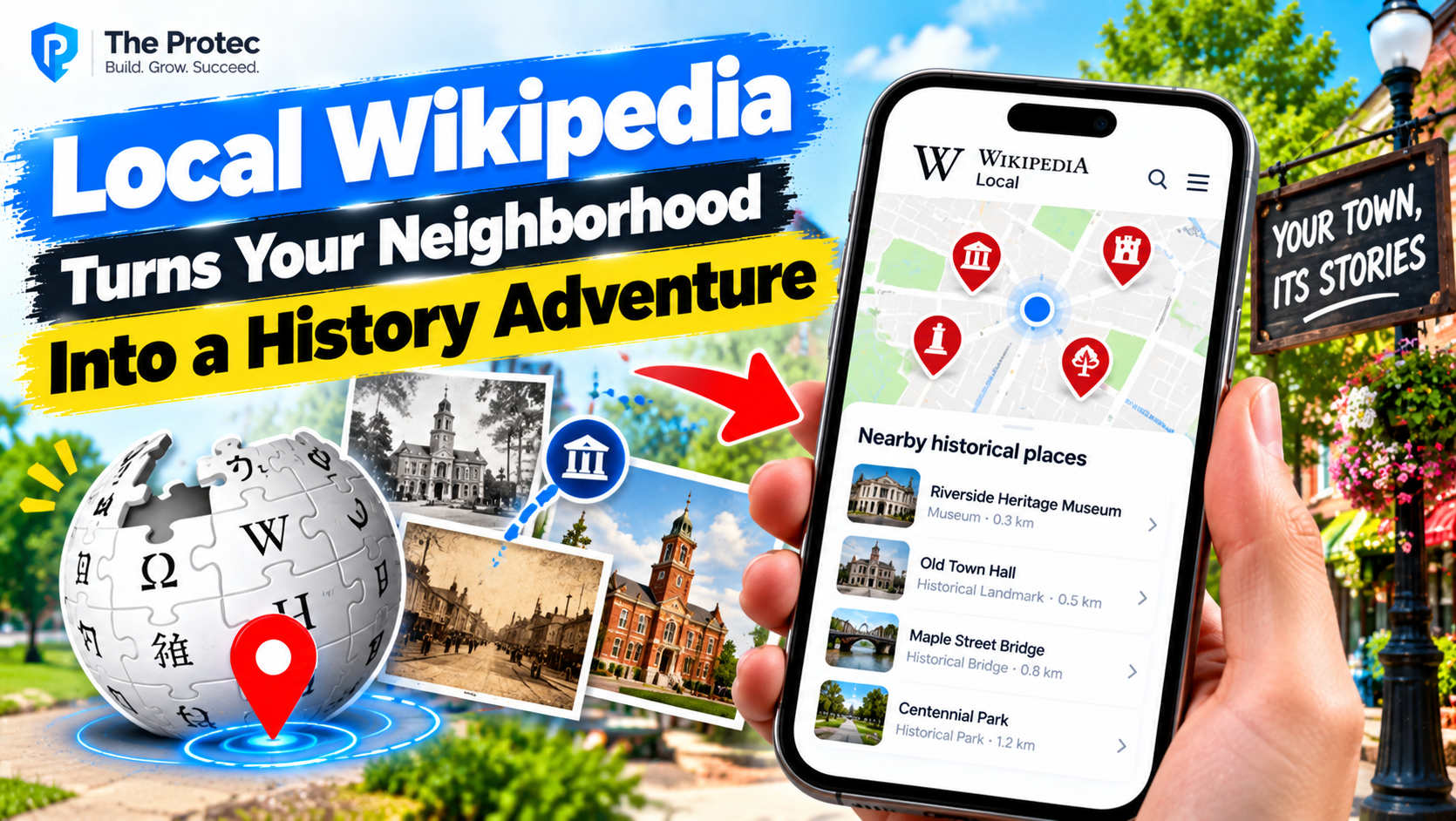
Local Wikipedia approaches that problem from the opposite direction. Instead of asking you to know what to search, the website starts with a location and looks for Wikipedia articles connected to places nearby. The result is a simple form of geographic browsing: choose an area, inspect the available entries, and discover why an otherwise ordinary building, park, station, monument, or street matters.
That makes Local Wikipedia part local-history guide, part travel discovery tool, and part reminder that useful websites do not always need complicated features. It repackages existing public knowledge around a question people naturally ask: what interesting things are near me?
What Is Local Wikipedia?
Local Wikipedia is a free website for exploring cities and neighborhoods through geographically tagged Wikipedia articles. It uses a location as the starting point, then surfaces entries associated with coordinates in the surrounding area. Those entries might describe historic buildings, museums, public artworks, religious sites, transportation infrastructure, natural features, notable institutions, or events linked to a particular place.
The project is best understood as a discovery layer rather than a separate encyclopedia. It does not replace Wikipedia or create a new database of local facts. It reorganizes geolocated Wikipedia articles so that proximity, rather than a conventional text query, drives exploration.
Local Wikipedia is also an independent project. It should not be confused with an official Wikipedia feature, and there is no reason to assume that it is affiliated with, operated by, or endorsed by the Wikimedia Foundation unless the website explicitly states otherwise. When you open an article, the underlying information still comes from Wikipedia and remains subject to Wikipedia’s usual editing practices and limitations.
How the Local Wikipedia Website Works
The central idea is refreshingly direct. You provide an area, the site identifies articles carrying nearby geographic coordinates, and the interface gives you a collection of places and stories to investigate. Depending on the current version of the website and the device being used, location may be selected manually or obtained through the browser’s location permission system.
The service relies on the coordinates attached to Wikipedia pages. Wikimedia’s geographic search tools can find pages around a latitude and longitude, but only when those pages contain suitable location data. The technical foundation is documented through the MediaWiki Geosearch API, although Local Wikipedia presents the results in a friendlier discovery experience.
At the time of review, the core experience was location-led and combined geographic orientation with browsable nearby results. It was designed for opening article entries, not for turn-by-turn navigation. Users should therefore think of it as an interactive local history map and reading tool, rather than a full mapping platform.
How many results should you expect?
There is no dependable universal number. A historic city center may produce dozens of potential entries because many buildings, monuments, institutions, and public spaces have geocoded pages. A residential suburb, small settlement, or poorly documented region may return only a handful. Some areas can produce no useful entries at all.
The displayed total can also change as Wikipedia articles are created, edited, merged, removed, or given more accurate coordinates. Search radius and interface limits may further affect how many results appear at once. Any claim that Local Wikipedia always finds a specific number of nearby places would therefore be misleading.
Where is Local Wikipedia supported?
The website is not limited in the same way as a travel guide with a fixed list of supported destinations. Its practical coverage follows Wikipedia’s geocoded content. It can potentially work across countries and cities wherever relevant articles and usable coordinates exist, but the depth of coverage varies sharply by region and language.
Large cities and well-documented heritage areas will generally offer the richest experience. Places with fewer Wikipedia contributors, limited digitized records, or sparse geographic metadata may feel noticeably empty. International availability should not be mistaken for uniform worldwide coverage.
A Quick Hands-On Walkthrough
You do not need to create an itinerary or install a dedicated travel app. A first exploration takes only a few steps:
- Open the Local Wikipedia website in a modern browser.
- Enter a town, neighborhood, or other location manually when that option is available.
- Alternatively, allow browser location access if you are comfortable using your current position.
- Browse the nearby entries presented in the map or results list.
- Select an unfamiliar landmark, building, person, or event to see its connection with the area.
- Follow the relevant entry to Wikipedia when you want the complete article, citations, and related links.
A good way to test the concept is to begin with a place you think you already know. Search around your home, workplace, or nearest town center. Familiar landmarks provide useful context, while unfamiliar results reveal whether the tool can tell you something genuinely surprising.
You can then repeat the process with a travel destination. Browsing before a trip may uncover a historic market, former industrial site, architectural detail, or small museum that would not rank prominently in a conventional list of attractions.
Why This Is More Than Another Map Website
Google Maps and similar services excel at practical questions. They can locate restaurants, calculate routes, show opening hours, and help drivers avoid traffic. They are less consistent at explaining why a place exists, who shaped it, or what happened there decades ago.
Local Wikipedia is not a complete alternative to Google Maps for navigation, but it can be an alternative to Google Maps for discovery. Its value lies in historical and cultural context rather than commercial listings. A railway station becomes part of a transportation story. A statue leads to a biography. A plain office building may turn out to be a protected architectural work or the former site of a significant institution.
This difference changes the browsing experience. Instead of being guided toward popular businesses or heavily reviewed attractions, users encounter whatever the local encyclopedia coverage happens to reveal. The unpredictability is part of the appeal.
Useful Ways to Explore Wikipedia Places Nearby
Turn an ordinary walk into a self-guided tour
Open the site before leaving home, choose several nearby entries, and build a loose walking route around them. It is a low-effort way to add purpose to a weekend walk without committing to a formal tour.
Research local history
Students, writers, genealogists, and amateur historians can use the results as starting points. An article may identify earlier building uses, prominent residents, major events, or sources worth investigating. Wikipedia should not be the final authority for serious research, but it can supply names, dates, terminology, and citations that make deeper research easier.
Plan less predictable travel
Travel search results tend to repeat the same famous attractions. Local Wikipedia can expose secondary landmarks and neighborhood stories outside those lists. It works especially well when you want context rather than another ranking of photogenic destinations.
Understand familiar streets
Residents often know how to move through their neighborhood without knowing how it developed. Nearby Wikipedia articles can connect street names, parks, schools, bridges, and civic buildings to larger historical patterns.
Explore remotely
You do not have to be standing in a location to enjoy it. If manual place entry is available, the site can support armchair exploration, trip planning, classroom activities, and research into a former hometown. This also makes it useful as a free travel discovery website when a trip is still only an idea.
Location-aware websites deserve scrutiny. A browser permission prompt means the page is requesting access to coordinates provided by the device or browser. It does not, by itself, prove that the coordinates remain exclusively on the device, nor does a browser-based interface establish whether related requests, IP addresses, analytics events, or server logs are retained.
Local Wikipedia has been presented around a lightweight, browser-oriented location experience. However, readers should consult the site’s current privacy notice and permission behavior before accepting categorical claims that location is never transmitted, logged, or stored. Implementations, hosting providers, analytics settings, and policies can change.
If you prefer not to share your precise current location, deny the browser request and use manual search when supported. Entering a nearby town, district, landmark, or approximate location can provide useful results without disclosing your exact position. You can also review site permissions afterward and revoke location access through your browser settings.
Local Wikipedia Review: Strengths and Limitations
The strongest part of Local Wikipedia is the simplicity of its premise. Wikipedia already contains an enormous amount of geographic knowledge, but conventional search makes much of it difficult to encounter accidentally. Reordering those articles by distance creates an experience that feels different without requiring a new content platform.
- It is free and does not require a dedicated travel application.
- It can reveal overlooked history close to home.
- It supports spontaneous browsing rather than demanding a precise query.
- It is useful for walks, travel planning, research, and remote exploration.
- It gives familiar places historical, cultural, and biographical context.
The limitations largely come from the underlying data. An important site may be missing because nobody has written an article about it. An article may exist but lack coordinates, use coordinates for the wrong point, or describe a broad subject that is only loosely connected to the displayed location.
Wikipedia content can also be incomplete, outdated, disputed, or inaccurate. Article quality varies, and smaller local subjects may receive less editorial attention. Readers should inspect citations and confirm important facts through primary records, heritage registers, museums, municipal archives, or other reliable sources.
There is also a visibility bias. Places that already attract editors and institutions are more likely to appear, while histories belonging to underrepresented communities may remain absent. Local Wikipedia makes geographic gaps in Wikipedia easier to notice, but it cannot correct those gaps on its own.
What About Hacker News and Reddit Attention?
Local Wikipedia fits the kind of focused experiment often shared among people following Hacker News trending websites, independent web projects, and useful-site communities on Reddit. Still, the existence of a post or discussion does not establish widespread adoption.
No claim that the project is viral or significantly popular should be made without confirming the original submissions, their dates, engagement, and relationship to the current website. Reposts and screenshots can strip away that context. For that reason, social attention is best treated as evidence of interest in the idea, not proof of a large audience or lasting momentum.
Why Lightweight Discovery Tools Still Matter
Much of the modern web attempts to predict what users want through recommendations, commercial rankings, and personalized feeds. Local Wikipedia offers a quieter model. It takes a location, connects it with existing knowledge, and lets curiosity do the rest.
That is enough to make an ordinary neighborhood feel less ordinary. A quick search can transform a familiar walk into a chain of biographies, architectural stories, forgotten events, and unexpected landmarks. Coverage will never be equally rich everywhere, and the information still requires judgment, but the website demonstrates how much value can come from placing old knowledge in a new context.
For anyone searching for things to discover near me, nearby historical places online, or websites to explore your neighborhood, Local Wikipedia is a compelling experiment. It makes the web feel exploratory again without demanding an account, a complex itinerary, or another dedicated travel app.
Frequently Asked Questions
Is Local Wikipedia an official Wikipedia service?
No. Local Wikipedia should be treated as an independent discovery project unless its operators explicitly document an official relationship. It uses or points to Wikipedia content, but that does not mean the Wikimedia Foundation endorses the website.
Does Local Wikipedia work everywhere?
Its potential reach is broad, but useful coverage depends on geolocated Wikipedia articles. Historic city centers may have many results, while rural areas and less-documented neighborhoods may have few or none.
Can I use it without sharing my current location?
Use manual location entry when the current interface supports it. Searching for a nearby town, neighborhood, or approximate point can protect your precise location while still producing relevant discoveries.
Is Local Wikipedia a replacement for Google Maps?
Not for navigation, business information, or live traffic. It is better viewed as a discovery alternative focused on history, people, landmarks, and cultural context.
Are all nearby Wikipedia results accurate?
No. Results depend on article quality and coordinate accuracy. Check citations and consult authoritative local sources before relying on an entry for academic, historical, or travel decisions.