







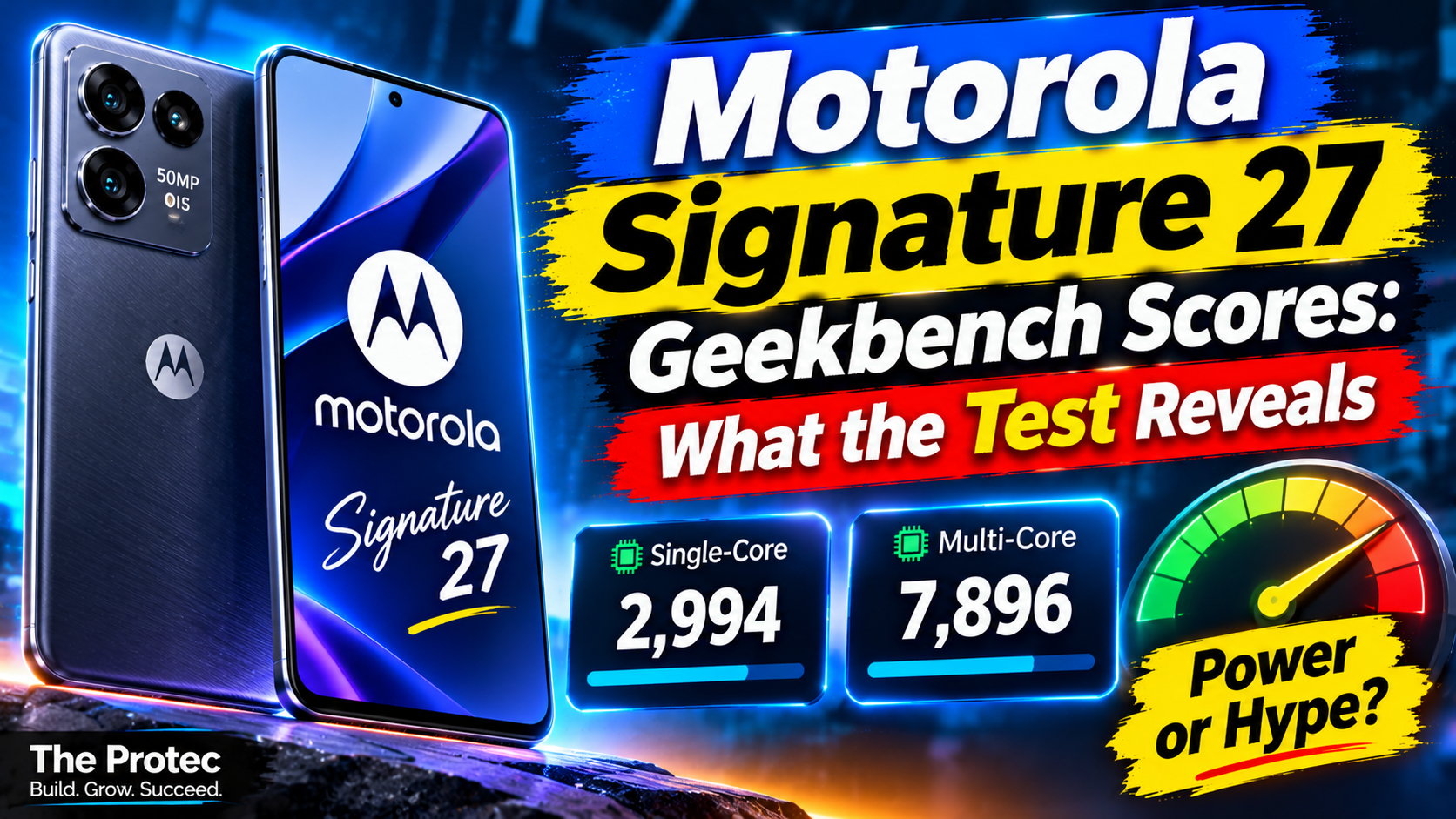
Another anticipated flagship has appeared in an early benchmark database, giving smartphone enthusiasts a preliminary set of numbers to examine. The reported Motorola Signature 27 Geekbench entry lists a 3,313 single-core score and an 11,088 multi-core result, alongside Android 17 and approximately 12GB of RAM. Those details offer an early look at Motorola’s upcoming device, but they come from a pre-release benchmark entry rather than an independently tested retail phone.
The timing makes the listing particularly notable. Motorola has announced a November 5, 2026 launch date for the Signature 27 and officially identifies its processor as the Snapdragon 8 Elite Extreme Gen 6. With the announcement approaching, the Geekbench result provides useful context about the phone’s apparent development state. It does not, however, establish its final performance, battery life, gaming ability, or position relative to other flagship phones.
What the early Motorola Signature 27 Geekbench entry reports
According to Notebookcheck News, the benchmark entry associated with the Signature 27 contains the following details:
- Single-core score: 3,313
- Multi-core score: 11,088
- Operating system: Android 17
- Memory: approximately 12GB of RAM
- Status: pre-release benchmark listing
The scores represent one reported test run under conditions that have not been independently documented. Notebookcheck’s account of the listing should therefore be distinguished from information Motorola has announced itself. The benchmark database is the source of the scores, operating-system reference, and apparent memory configuration; those details are not equivalent to a finalized retail specification sheet.
The reported RAM figure may also appear differently in a benchmark than it does in product marketing. Diagnostic tools often display the memory available to the operating system rather than a rounded commercial capacity. It is safest to describe the entry as showing roughly 12GB without making assumptions about other memory variants.
What Motorola has officially confirmed
Motorola’s official materials confirm two important points: the Signature 27 is scheduled to launch on November 5, 2026, and the company names its chipset the Snapdragon 8 Elite Extreme Gen 6. That exact wording matters because shortened, rearranged, or speculative processor names can spread quickly when an unreleased phone appears in a benchmark database.
The official launch information and chipset branding are separate from Notebookcheck’s report about the benchmark entry. Readers can consult Motorola’s official website for the company’s product announcements. As of late October 2026, details not disclosed in those materials—including pricing, sales regions, storage options, and broader availability—should not be assumed from the Geekbench listing.
What Geekbench actually measures
Geekbench is a synthetic benchmark designed to evaluate processor performance through a collection of short computational tasks. Its single-core result measures how quickly one CPU core handles the benchmark’s workloads, while its multi-core result reflects work distributed across multiple CPU cores.
That distinction is useful because mobile software does not use a processor in one uniform way. Some interactions depend heavily on fast single-threaded execution, while workloads such as media processing or certain productivity tasks may benefit from several cores operating together.
- Single-core performance can help indicate CPU responsiveness in tasks that cannot be divided efficiently among many cores.
- Multi-core performance can offer a view of the processor’s combined throughput when a workload is able to use multiple cores.
Neither score measures every part of a smartphone. Geekbench CPU results do not directly establish display quality, camera processing consistency, modem reception, storage speed, charging behavior, speaker performance, or battery endurance. They also do not provide a complete assessment of graphics performance, which is central to demanding mobile games.
A benchmark number is consequently best treated as one data point. It can show that a device completed a defined set of workloads under a particular combination of hardware and software, but it cannot reproduce the full range of conditions encountered during weeks or months of normal use.
How to interpret the 3,313 and 11,088 scores
The reported 3,313 single-core and 11,088 multi-core scores suggest that the tested Signature 27 sample was able to complete Geekbench’s CPU workloads at those performance levels. They do not, by themselves, prove how every Signature 27 unit will perform when the phone reaches consumers.
It would also be premature to convert this result into a definitive performance ranking. A meaningful comparison requires devices running the same Geekbench version, with appropriate software, comparable test conditions, and enough repeated runs to identify normal variation. One database entry cannot establish that the Signature 27 is faster or slower overall than another flagship.
Even valid CPU comparisons have limits. A phone that produces a strong result in a short benchmark may behave differently during an extended gaming session, prolonged video export, navigation in direct sunlight, or repeated camera use. Those situations introduce heat, power consumption, background activity, and battery-management decisions that a brief score cannot fully capture.
Why the retail phone may produce different results
Pre-production hardware can change
Benchmark appearances before launch may come from engineering samples or other non-retail devices. Firmware, component tuning, and power profiles can still be under development. The listing does not reveal whether the tested unit matches the hardware and configuration that will be sold.
Android 17 and Motorola software may not be final
The entry reports Android 17, but the build running on the test device may be pre-release software. Operating-system updates, drivers, schedulers, and Motorola’s own performance management can all affect benchmark behavior. Launch software may improve performance, reduce it to control heat, or simply produce more consistent results.
Temperature and power conditions matter
Smartphone processors can adjust their speed according to temperature, power limits, and battery conditions. A cool device may record a different result from one that has just completed several demanding tasks. Room temperature, charging state, case use, and the number of consecutive runs can also influence the outcome.
Short bursts do not show sustained performance
Geekbench is informative about CPU execution, but a single run does not reveal how the Signature 27 handles a long workload. Sustained performance depends on the phone’s thermal design and software limits. Independent testing will need to examine whether performance remains stable as heat builds.
These variables do not make the reported result meaningless. They explain why an early benchmark should be interpreted as a development snapshot rather than a final verdict. Multiple tests on retail hardware are needed before drawing firm conclusions.
What the listing tells us—and what remains unknown
The available information can be separated into three categories. Motorola has officially announced the November 5 launch date and the Snapdragon 8 Elite Extreme Gen 6 name. Notebookcheck reports that the pre-release Geekbench entry shows Android 17, roughly 12GB of RAM, and the two CPU scores. Everything beyond those points requires additional evidence.
Important unanswered questions include:
- How retail units perform across repeated benchmark runs
- Whether approximately 12GB of RAM represents the only memory configuration
- How the phone manages heat during extended workloads
- What battery life users can expect in everyday conditions
- How the graphics processor performs in demanding games
- Whether launch software changes the reported CPU results
- What pricing, regional availability, and sales schedule Motorola will announce
The listing also does not provide a reliable basis for filling gaps in the Motorola Signature 27 specs. Camera hardware, display characteristics, battery capacity, charging specifications, storage options, dimensions, and connectivity features should remain unconfirmed unless Motorola publishes them or they are verified through independent retail-device testing.
What to watch at the November 5 launch
Motorola’s launch should provide the complete context that a benchmark entry lacks. The key points to watch will be the finalized specification sheet, software commitments, available configurations, and Motorola’s explanation of how the Snapdragon 8 Elite Extreme Gen 6 is implemented in the phone.
After launch, independent reviews will be necessary to evaluate the Motorola flagship under controlled and real-world conditions. Useful testing should include repeated CPU and graphics benchmarks, sustained gaming, thermal measurements, battery endurance, camera analysis, and ordinary daily use. Those results will show whether the early numbers are representative of shipping hardware.
Frequently asked questions
What are the reported Motorola Signature 27 Geekbench scores?
The pre-release entry reported by Notebookcheck shows a single-core score of 3,313 and a multi-core score of 11,088. These are early benchmark results, not guaranteed scores for retail devices.
Which chipset will the Motorola Signature 27 use?
Motorola’s official materials name the processor as the Snapdragon 8 Elite Extreme Gen 6. That exact name comes from Motorola, while the benchmark scores and reported memory details are attributed to Notebookcheck’s coverage of the listing.
Does the Geekbench entry confirm Android 17 and 12GB of RAM?
The reported entry identifies Android 17 and approximately 12GB of memory on the tested device. It does not confirm that every retail model will have the same RAM configuration or that the tested software is the final launch build.
Is the Signature 27 the fastest Android phone?
No such conclusion can be drawn from one result. A performance ranking would require comparable tests across retail devices, repeated runs, finalized software, and analysis of sustained CPU and graphics performance.
When is the Motorola Signature 27 launching?
Motorola has announced November 5, 2026 as the launch date. Pricing, market availability, and the timing of retail sales should not be inferred unless Motorola confirms them separately.
The bottom line
The early listing offers a focused preview of the Signature 27’s CPU performance, reporting 3,313 in single-core testing and 11,088 in multi-core testing. Combined with Android 17, roughly 12GB of RAM, and Motorola’s officially named Snapdragon 8 Elite Extreme Gen 6 chipset, it provides a useful first snapshot ahead of November 5.
It remains only a snapshot. Pre-production hardware, unfinished software, temperature, power management, and benchmark conditions can all change the outcome. Retail performance, sustained gaming, battery life, thermals, and overall user experience will remain open questions until independent reviewers can test the final phone.