








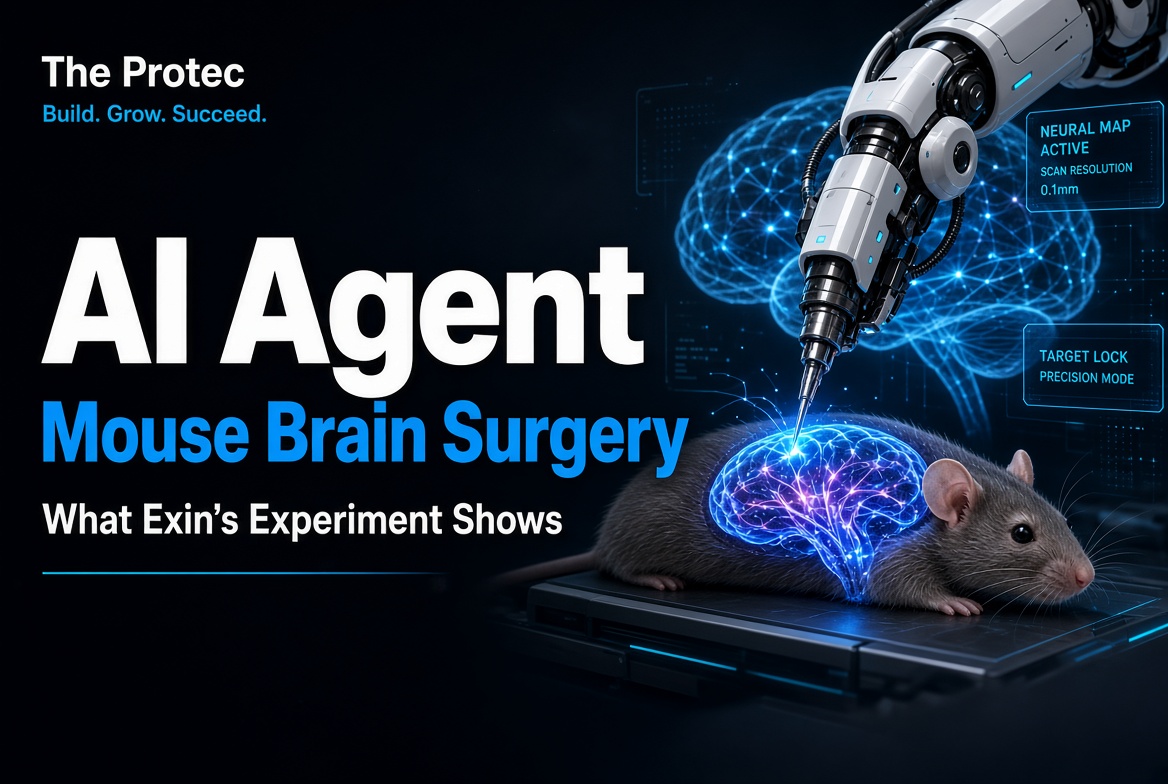
A laboratory demonstration involving an AI-directed robot and a living mouse quickly acquired a much bigger label online: AI agent mouse brain surgery. Exin Therapeutics says an artificial intelligence agent selected a gene therapy and guided its injection into a mouse’s brain through a robotic rig. That is a notable experiment in laboratory automation, but it was not an AI independently operating on a person—or even a fully autonomous animal operation from preparation through recovery.
The distinction matters. The reported procedural result was that the system completed a defined injection task under human supervision. It did not show that the gene therapy reduced seizures, establish that the procedure was safe and repeatable, or provide evidence that the treatment would benefit human patients. Here is what the experiment appears to demonstrate, how responsibilities were divided, and what researchers still need to prove.
What Exin Therapeutics reported
According to the company’s public description, the experiment combined an AI agent with a robotic system capable of carrying out a targeted brain injection in a mouse. The scientific context was gene-therapy research related to seizures. The agent selected a gene-therapy candidate and directed the robotic injection process, while human researchers defined the broader experiment and handled essential animal-care and surgical responsibilities.
The most defensible reading of the report is narrow: software made a research selection within a human-created project and controlled or generated instructions for a motorized injection rig. The rig then moved the injection hardware to deliver material at a specified location and depth. The disclosure does not support the broader claim that AI independently diagnosed epilepsy, invented an unrestricted treatment plan, or performed every stage of surgery without people.
Public statements from Exin Therapeutics are the primary source for the company’s characterization of the demonstration. As of November 1, 2026, the reported injection should be treated as a company-described research milestone rather than evidence of therapeutic benefit. The reporting available about the event had not yet evaluated whether the injected therapy changed seizure frequency or severity.
How the AI-guided brain injection workflow worked
It helps to separate the workflow into scientific planning, physical execution and animal oversight. Calling the entire sequence “AI surgery” blurs important boundaries between those stages.
1. People established the research objective and constraints
Human scientists determined the experimental goal: investigate a gene-therapy approach relevant to seizure research and place it into a particular region of a mouse brain. People also supplied the research environment, candidate information, equipment and procedural constraints in which the AI agent operated.
The agent was therefore not confronting an unknown patient and deciding what disease was present. Nor was it exercising the legal or ethical authority of a physician. It worked inside an animal-research protocol created and overseen by humans.
2. The AI agent selected the gene-therapy approach
Exin’s account attributes selection of a gene therapy to the AI agent. That makes the experiment more than conventional robotic motion control: the agent participated in choosing what experimental intervention to deliver.
However, “selected” should not be confused with unconstrained clinical judgment. The public account does not establish that the agent independently discovered a therapy, validated its biological mechanism or chose among every possible treatment. The selection took place within a scientific task, data context and set of options or constraints supplied by researchers. People remained responsible for deciding that the experiment could proceed.
This is a central limitation of the “AI chose the treatment” shorthand. A software agent can compare research options and propose or select an action without having the authority, evidence base or contextual understanding required to prescribe treatment to a patient.
3. Humans prepared the animal and procedure
The demonstration did not eliminate trained personnel. Human researchers prepared the experiment and the material to be injected. Reporting also described the continued involvement of a surgeon and veterinary oversight. Animal preparation, anesthesia, access to the injection site, monitoring and welfare decisions remained human responsibilities rather than tasks delegated wholesale to the AI.
Veterinary oversight is especially important in live-animal research. A mouse cannot be treated as another component in an automated workstation. Qualified personnel must monitor anesthesia and physiological condition, recognize distress, apply humane endpoints and intervene when necessary. The relevant protocol and institutional approvals also remain the responsibility of people and research organizations.
4. The robotic rig executed the targeted injection
Once the experiment was prepared, the robotic system supplied the physical precision. A motorized rig positioned and advanced the injection apparatus according to the planned coordinates and delivered the payload into the mouse brain. In practical terms, the AI provided high-level direction or control commands, while motors, positioning hardware and an injection mechanism carried out the movement and deposition.
This resembles a highly structured stereotactic procedure, in which a three-dimensional coordinate system helps place a fine needle or cannula in a small brain target. The robot did not need a humanlike understanding of anatomy to move accurately; it needed a defined coordinate framework, calibrated equipment and a controlled setup.
That is still technically meaningful. Mouse brain targets are small, and minor positioning errors can deliver material to the wrong tissue or produce inconsistent experiments. Automating repeatable movements could reduce some forms of manual variability. Yet a completed injection alone does not establish that the payload reached every intended cell, avoided unintended tissue, expressed correctly or produced a beneficial biological effect.
Why this was not fully autonomous surgery
Autonomy is not a single on-or-off property. A system may autonomously execute one bounded task while the larger procedure remains dependent on people. In this experiment, the AI-directed robotic injection was nested inside a human-designed and human-supervised workflow.
- The AI did not diagnose a patient. This was a laboratory mouse in a predefined research experiment.
- It did not independently authorize treatment. Humans designed and approved the protocol.
- It did not perform the complete operation. Researchers, a surgeon and veterinary personnel remained involved in setup, animal preparation, oversight and care.
- It did not establish success by clinical criteria. Completion of an injection is a procedural endpoint, not proof that seizures improved.
- It was not human brain surgery. The anatomy, scale, regulation and risk profile are fundamentally different.
“AI-guided robotic brain injection in a mouse” is less dramatic than “AI performs brain surgery,” but it is considerably more accurate. The achievement lies in integrating agentic software with a physical research instrument—not in replacing an operating-room team.
Why combine AI neuroscience research with robotics?
Modern neuroscience experiments can involve literature review, therapy selection, anatomical targeting, instrument programming, data collection and repeated procedures across many animals. Researchers are exploring whether AI agents can connect some of these stages while robotics standardizes the physical work.
Potential research advantages include:
- More consistent placement: Calibrated robotic movement may reduce variation caused by fatigue or differences in manual technique.
- Reproducible records: Software-controlled actions can create detailed logs of coordinates, timing, volumes and equipment commands.
- Faster iteration: Agents may help researchers compare literature, organize candidate interventions and configure experiments more efficiently.
- Closed-loop research: Future systems could use measured results to recommend the next experiment, subject to scientific review and animal-welfare controls.
- Remote or standardized execution: Shared protocols could make it easier to reproduce the same robotic procedure in different laboratories if hardware and calibration are equivalent.
Those are possibilities, not conclusions established by one injection. Automation can also reproduce errors at scale. Incorrect coordinates, flawed assumptions, contaminated material or a software failure could make every automated run consistently wrong. Useful systems therefore need validation, error detection, audit trails, human override and clear assignment of responsibility.
Procedure completed does not mean therapy worked
The Exin Therapeutics AI experiment has at least four separate evidentiary questions. They should not be collapsed into a single claim of “success.”
- Procedural performance: Did the robot reach the intended location and complete the planned injection?
- Technical repeatability: Can it reproduce comparable placement and delivery across multiple animals, operators and laboratories?
- Biological activity: Did the gene therapy reach relevant cells, express as intended and alter the target biological pathway?
- Therapeutic benefit and safety: Did seizures improve without unacceptable tissue damage, inflammation, off-target effects or other harms?
The report addresses primarily the first question. At the time described, seizure outcomes had not been evaluated in the reporting. It would therefore be inaccurate to call the experiment a cure, a successful seizure treatment or proof of clinical benefit.
Even apparently accurate placement requires evidence. Researchers would ordinarily examine targeting error, injection volume, tissue distribution, leakage, device performance and adverse events. For gene therapy, longer-term questions include expression levels, immune response, durability and effects outside the intended cells.
Why mouse results do not establish a human treatment
Mouse-brain studies can reveal whether a biological idea is plausible in a living nervous system. Researchers can study delivery, gene expression, neural activity, seizure-related behavior and tissue responses under controlled conditions. These experiments often provide information that cannot be obtained from cell cultures alone.
But a mouse brain is not a miniature human brain. The species differ in size, circuitry, immune responses, metabolism and disease complexity. Delivery distances and doses also change dramatically when moving to people. A method that accurately targets a mouse brain may require different imaging, planning, instruments and safeguards in a human neurosurgical setting.
Translation would require extensive preclinical evidence, manufacturing controls, toxicology work, regulatory review and phased human trials. Animal-research reporting should also provide enough methodological detail to assess bias and reproducibility. The ARRIVE guidelines outline widely used standards for transparent reporting of in vivo experiments.
What evidence should come next?
To assess the scientific importance of this robotic brain injection, researchers and outside experts would need more than a demonstration narrative. The next evidence should include:
- Published methods and results describing the therapy, target, robotic hardware, software version, calibration, injection parameters, human interventions and predefined endpoints.
- Seizure-outcome evaluation using appropriate controls and blinded or otherwise bias-resistant measurements.
- Technical validation showing targeting accuracy, failure rates, tissue effects and repeatability across multiple animals.
- Independent replication by researchers who were not involved in building the AI or robotic platform.
- Safety and biological studies examining distribution, expression, immune responses, adverse effects and durability.
- Eventually, regulated human studies only after sufficient preclinical safety and efficacy evidence supports clinical investigation.
Exin’s demonstration points toward a future in which AI agents help coordinate sophisticated laboratory equipment. Its immediate lesson, however, is narrower: an agent can be connected to a robotic rig to help choose and execute a defined mouse-brain injection while people retain control of the broader scientific, surgical and welfare process.
Frequently asked questions
Did an AI perform brain surgery on a mouse by itself?
No. The AI agent reportedly selected a gene therapy and guided or controlled a robotic injection task. Human researchers designed and prepared the experiment, a surgeon remained involved in the procedure, and veterinary personnel provided animal oversight. It was task-level automation, not an end-to-end autonomous operation.
Was this an experiment on a human patient?
No. It was an animal research experiment involving a mouse. Descriptions that omit the species or imply that AI operated on a human brain are misleading.
Did the gene therapy stop the mouse’s seizures?
That had not been established in the reporting. Completing the injection showed a procedural capability, but the therapy’s effect on seizures had not yet been evaluated there. No claim of a cure or effective treatment is justified from the injection alone.
What did the robot do that the AI did not?
The AI handled the software-level selection and direction attributed to it, while the robotic rig produced the physical motion and delivery. Motors positioned and advanced the injection apparatus; the AI itself did not physically manipulate tissue.
Could this approach eventually be used in people?
Possibly, but that is a long-term research question rather than a demonstrated capability. Human use would require published evidence, independent replication, extensive safety testing, regulatory authorization and clinical trials. Mouse-scale robotic performance cannot simply be transferred to human neurosurgery.