








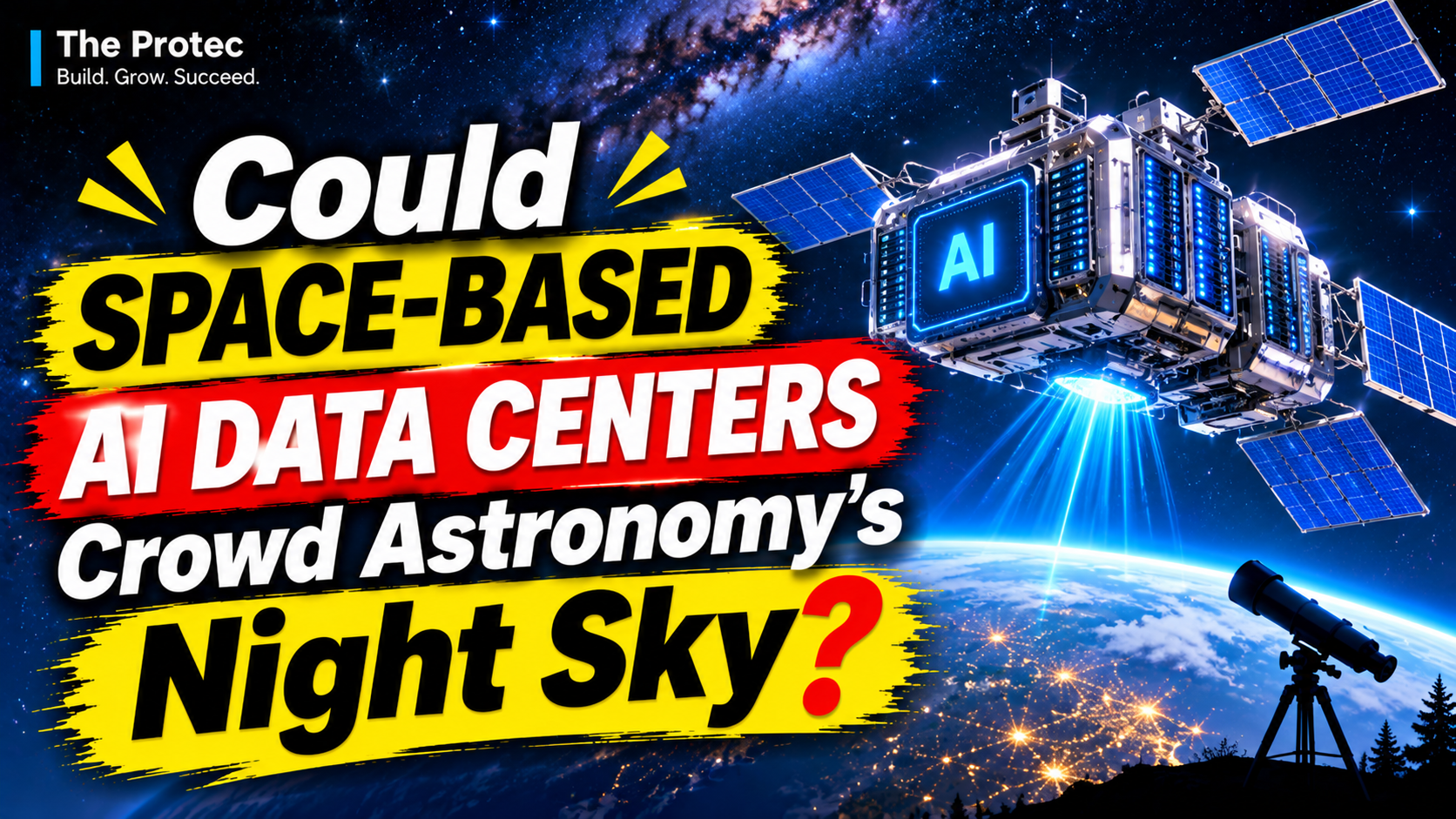
Artificial intelligence’s appetite for electricity is pushing engineers to consider increasingly unconventional infrastructure. Among the most ambitious ideas are space-based AI data centers: networks of computing satellites powered by abundant sunlight and linked to users on Earth. A Columbia-led analysis, highlighted by Axios on November 15, 2026, asks what would happen if that idea expanded from a handful of demonstrations into a meaningful share of global AI capacity. Its answer is not a prediction, but it is a warning: some theoretical buildouts could transform low Earth orbit, interfere with astronomy and demand an unprecedented launch industry.
The appeal of orbital computing is understandable. AI infrastructure requires enormous amounts of power, suitable land, cooling equipment and new electrical connections. Space appears to offer sunlight without competition for terrestrial real estate. Yet orbit is not an empty industrial zone, and solar power does not eliminate the need to dispose of heat. Before orbital data centers can become practical, their advocates must confront economics, radiation, networking, maintenance, launch emissions, space debris and the scientific value of a dark and quiet sky.
Why technology companies are looking beyond Earth
Modern AI systems depend on clusters of specialized processors operating around the clock. As models and user demand grow, so does AI energy consumption. Terrestrial developers may face years-long waits for grid connections, local resistance to new transmission lines and concerns about water use, electricity prices and emissions. In densely developed regions, finding large sites near both power supplies and fiber networks can also be difficult.
Orbital data centers promise a different arrangement. Solar arrays can generate electricity directly in space, and some orbits receive sunlight for much of each day. Companies could theoretically assemble modular computing platforms without acquiring large tracts of land. Optical links might move data between satellites, while radio or laser terminals connect the constellation to ground stations.
Those advantages remain conditional. Satellites still pass through eclipses in many orbits, requiring batteries or another source of power. Solar panels degrade, launches are expensive and bandwidth to Earth is finite. An orbital facility also needs extensive radiators because its processors turn most of their electricity into waste heat.
What the Columbia-led report actually projects
The research associated with Columbia University examines scenarios rather than documenting a fully funded deployment. It asks how many computing satellites and rocket launches might be needed if a significant portion of future data-center capacity were moved into orbit. The totals vary dramatically with assumptions about processor efficiency, satellite power, payload mass, launch capacity, useful life and the percentage of global computing assigned to space.
In high-deployment cases, the modeled satellite population rises well beyond today’s orbital computing experiments and proposed pilot systems. Some scenarios would place enough objects in orbit to exceed the several thousand stars visible to the unaided eye from a dark location at one time. That comparison is useful for communicating scale, but it does not mean every satellite would be bright enough to see, illuminated simultaneously or positioned above one observer. Astronomical cameras are also far more sensitive than human eyes, so satellites can disrupt research even when casual stargazers cannot identify them.
The launch calculation is similarly sensitive to design choices. A large orbital computing industry could require many thousands of launches over its construction and replacement cycle; assumptions involving smaller rockets, heavier shielding or short-lived hardware can push modeled requirements toward tens of thousands. That would represent a launch cadence far beyond recent global activity. These figures are stress-test scenarios, not scheduled missions or inevitable outcomes.
It is especially important to separate three categories: satellites already operating, constellations authorized by regulators and concepts described in corporate presentations or technical studies. As of mid-November 2026, no hyperscale fleet of orbital AI data centers comparable with the report’s upper scenarios has been deployed. Small computing experiments, planned demonstrations and proposed constellations should not be counted as though they were operating infrastructure.
Why astronomers are concerned about satellite megaconstellations
Optical images can be crossed by reflected sunlight
Satellites reflect sunlight before dawn, after dusk and, at some altitudes, during much of the night. In a long astronomical exposure, a moving object creates a bright streak that can obscure faint galaxies, contaminate measurements or generate artifacts. Software can identify and mask many trails, but masking removes data and cannot always repair saturated pixels or observations of brief events.
Large survey telescopes are particularly vulnerable because they repeatedly photograph wide areas of sky. A vast population of orbital data centers could produce more trails, while large solar arrays and thermal radiators might present substantial reflective surfaces. Brightness depends on altitude, orientation, materials and operational attitude, so satellite numbers alone do not determine the impact.
Radio astronomy faces a different form of pollution
Radio telescopes listen for extremely weak signals from distant objects. Satellite transmitters are vastly stronger by comparison, and interference can enter through unintended emissions, side lobes or aggregate signals from many spacecraft. Protected frequency bands help, but they do not solve every problem, particularly for observations near band boundaries or satellites communicating through multiple high-capacity links.
Orbital computing would require networking as well as processing. Moving workloads, software updates and results between Earth and space could create substantial communications traffic. Researchers therefore want system-level radio studies before licensing, not only compliance tests for individual satellites considered in isolation.
Environmental and safety costs beyond astronomy
More satellites create more conjunctions—close approaches requiring tracking and, sometimes, collision-avoidance maneuvers. Automated maneuvering can reduce satellite collision risks, but coordination becomes harder when operators use different data, decision rules or propulsion systems. A collision can generate fragments that remain dangerous long after the original spacecraft stops operating.
Replacement cycles matter because computing hardware becomes obsolete quickly. If companies attempt to refresh orbital processors at a pace resembling terrestrial AI infrastructure, frequent launches and disposals could increase space debris and reentry traffic. Responsible designs would need reliable deorbit systems, passivation of batteries and fuel tanks, transparent tracking data and reserves of propulsion for end-of-life disposal.
Rocket exhaust also reaches atmospheric layers rarely affected by ground transportation. Depending on the propellant and vehicle, launches can deposit black carbon, water vapor, chlorine compounds or other substances in the upper atmosphere. Reentering spacecraft and rocket stages add metal-containing particles. Scientists are still quantifying the cumulative effects on ozone, atmospheric chemistry and climate, which makes an enormous increase in launch cadence an environmental uncertainty rather than a free externality.
Orbital data centers versus facilities on Earth
- Energy availability: Space offers strong solar resources without terrestrial land competition, but satellites need large arrays, energy storage and power-management hardware. Ground facilities can combine grids, renewables, batteries and firm generation.
- Cooling: Earth-based centers use air, water or liquid cooling and can transfer heat into the surrounding environment. Space is cold in everyday language, but it is a vacuum. With no air for convection, heat must travel through the spacecraft and radiate away from large surfaces. Radiator area, temperature and orientation become fundamental design constraints.
- Latency and bandwidth: Low Earth orbit can provide relatively short signal paths, but workloads still encounter ground gateways, routing and limited communications capacity. Training jobs that constantly exchange enormous datasets may be less suitable than tasks that process information already collected in orbit.
- Maintenance: A technician can replace a failed terrestrial server. Most orbital hardware must tolerate failures, repair itself through redundancy or be replaced by another launch. Robotic servicing could help, but it adds cost and operational complexity.
- Radiation: High-energy particles can corrupt memory, damage electronics and shorten component life. Shielding increases mass, while radiation-hardened processors often trail the performance and efficiency of the newest commercial AI chips.
- Cost and upgrades: Launch prices have fallen, but mass remains expensive to place in orbit. Ground operators can install a new generation of accelerators without replacing buildings, power connections and cooling systems. An orbital operator may need to launch an entirely new platform and safely dispose of the old one.
These differences suggest that orbital computing may initially make more sense for specialized applications. Processing Earth-observation data before downlink, operating autonomous spacecraft or analyzing information generated in orbit can reduce communications demands. Replacing a large fraction of terrestrial AI infrastructure is a much more difficult proposition.
Are large-scale space data centers economically realistic?
The answer depends on assumptions that have not yet been demonstrated at hyperscale. Advocates need extremely efficient processors, lightweight radiators, inexpensive launch services, long component lifetimes and high-value workloads. A business case can deteriorate quickly if radiation shielding adds mass, launch schedules slip or hardware becomes obsolete before recovering its cost.
There is also a circular capacity problem. A huge orbital computing sector would depend on a much larger launch sector, manufacturing base, tracking network and disposal system. Those supporting industries would carry financial and environmental costs of their own. Falling launch prices may enable prototypes, but they do not prove that thousands of complex computing satellites can outperform continuously improving terrestrial facilities.
How regulation could reduce astronomy light pollution
Researchers are not necessarily calling for every orbital computing experiment to be prohibited. Their central recommendation is to evaluate cumulative effects before satellite megaconstellations are deployed. Licensing one spacecraft at a time can miss the combined optical, radio, debris and atmospheric impact of an industrial-scale network.
Useful safeguards could include:
- Enforceable brightness limits: Operators should model and measure apparent brightness across operating orientations, then publish the results. Dark coatings, sunshades and attitude changes can help, although they may conflict with thermal or power requirements.
- Coordination with observatories: Accurate, timely ephemerides would let telescopes anticipate some trails. Operators should consult optical and radio astronomers during constellation design rather than after launch.
- Aggregate radio assessments: Regulators should examine the combined interference from an entire network, including unintended emissions and gateway traffic.
- Debris and disposal guarantees: Licenses could require maneuverability, data sharing, short post-mission disposal timelines and financial responsibility for failed spacecraft.
- Environmental review: Launch and reentry effects should be evaluated across the constellation’s full life cycle, including replacement launches—not just the initial deployment.
- International standards: Orbits and radio waves cross national boundaries. Common brightness, traffic-management and debris rules would reduce the incentive to seek the least demanding jurisdiction.
Frequently asked questions
Are space-based AI data centers already operating at hyperscale?
No. Computing has long been performed aboard satellites, and orbital processing demonstrations exist, but that is different from a hyperscale AI data center. The very large populations discussed in the Columbia-led analysis are modeled scenarios or proposed concepts, not fleets already launched and functioning.
Would orbital data centers really outnumber visible stars?
Some high-growth scenarios produce satellite counts greater than the number of stars a person can see at one time from a dark site. The comparison illustrates potential scale; it does not establish that every satellite would be visible simultaneously. Sensitive telescopes can nevertheless detect much fainter objects.
Does space provide free cooling for AI chips?
No. A vacuum prevents the convective cooling used on Earth. Heat must be conducted away from processors and emitted as infrared radiation, requiring radiators whose size can become a major engineering constraint.
Could regulation make orbital computing compatible with astronomy?
Regulation can reduce harm through brightness limits, radio coordination, transparent orbital data and enforceable disposal plans. It cannot make an unlimited satellite population impact-free. Compatibility will depend on constellation size, altitude, spacecraft design and whether cumulative effects are considered before deployment.
A warning to plan before launching
Space-based computing may prove valuable for selected tasks, especially when data originates in orbit. The Columbia-led scenarios do not show that a sky crowded with AI satellites is unavoidable. They show why policymakers, engineers and astronomers should establish limits and standards before speculative orbital data centers become a launch race whose scientific and environmental costs are difficult to reverse.