








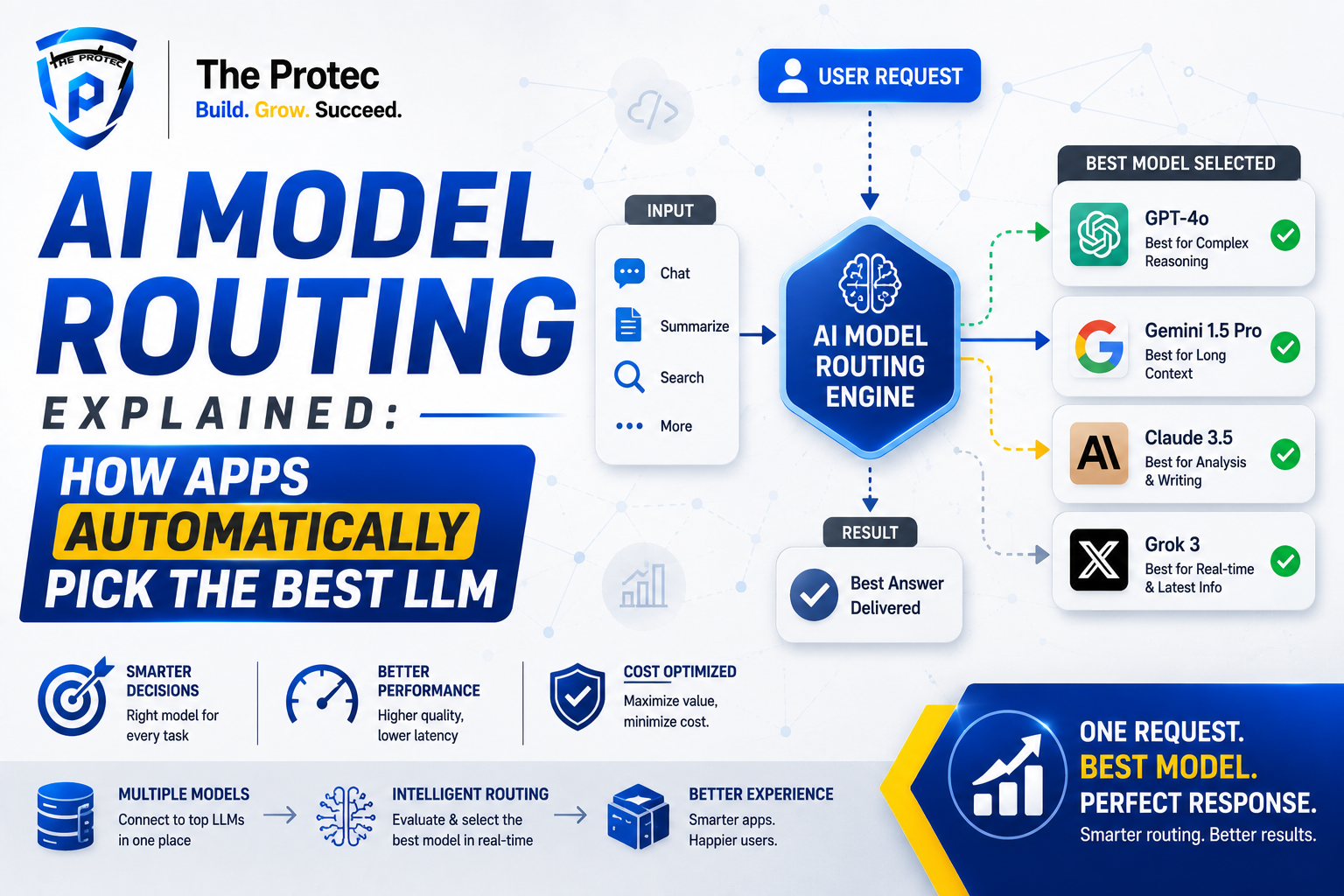
Modern AI applications rarely depend on a single large language model. A fast, inexpensive model may be perfect for classifying support tickets, while a reasoning-focused model is better suited to debugging code or analyzing a contract. A long-context model might be required to process a large document, and a multimodal model becomes essential when a request includes images, audio, or video.
AI model routing is the decision layer that makes those choices automatically. Instead of sending every prompt to the biggest or most expensive model, an application evaluates the request and directs it to the model most likely to meet its quality, latency, cost, and capability requirements.
This approach is becoming a core part of production AI infrastructure. As model catalogs expand to include frontier systems, open-weight models, small language models, specialized reasoning engines, and multimodal services, effective routing helps applications deliver better results without letting costs or response times spiral out of control.
What Is AI Model Routing?
AI model routing is the process of selecting an AI model for a particular request. An AI model router sits between the application and a pool of available models. It inspects information about the request, applies routing logic, and sends the request to an appropriate provider, endpoint, or locally hosted model.
The concept is similar to traffic routing in a network, but the decision is based on more than availability. An LLM routing system can consider semantic complexity, required tools, input length, expected output format, privacy rules, service-level objectives, and the price of processing the prompt.
Routing may happen before generation, during a multi-step workflow, or after an initial response. For example, an inexpensive model can attempt a task first, with a stronger model called only when confidence is low. In an agentic application, separate models may be selected for planning, tool use, coding, vision, and final answer verification.
Why Applications Use More Than One LLM
No model leads across every dimension. Larger models often provide stronger reasoning and instruction following, but they may cost more and respond more slowly. Smaller models can deliver excellent results for narrow or repetitive tasks. Specialized models may outperform general-purpose systems in coding, translation, document extraction, or multimodal understanding.
Model availability also changes. Providers experience outages, impose rate limits, update model versions, and adjust pricing. A multi-model architecture gives an application alternatives when its preferred endpoint is unavailable or no longer meets a requirement.
The result is a practical portfolio approach: use premium capability where it creates measurable value and efficient models everywhere else. LLM routing turns that principle into an automated, request-level decision.
Signals an AI Model Router Uses
Task Type
The router first needs to understand what the user is asking. Common categories include summarization, extraction, classification, code generation, conversational support, translation, image analysis, and complex reasoning. A lightweight classifier, rules engine, embedding comparison, or LLM can identify the task and match it with models that perform well on that category.
Request Complexity
Simple prompts do not need the same compute as difficult ones. A router can estimate complexity from prompt length, vocabulary, number of constraints, requested reasoning depth, attached data, or similarity to previously evaluated tasks. Straightforward requests can go to a small model, while ambiguous or multi-step problems are escalated to a more capable system.
Cost and Token Economics
Routing policies frequently include a maximum cost per request, user, or workflow. The router estimates input and output tokens, accounts for cached tokens where supported, and compares provider pricing. It may choose a model that is slightly less accurate when the quality difference is small but the cost difference is substantial.
Speed and Latency
Interactive products need fast first-token and completion times. Batch jobs may tolerate slower responses in exchange for higher quality or lower cost. Routers can use live latency measurements, queue depth, geographic location, and time-to-first-token targets rather than relying only on published benchmarks.
Context Requirements
A request containing a long conversation, source repository, or collection of documents must fit within the model’s context window. The router considers total tokens after system instructions, retrieved passages, tool definitions, and output reservations are included. It can then select a long-context model or trigger chunking, retrieval, or summarization before generation.
Capabilities, Privacy, and Reliability
Some requests require structured JSON, function calling, citations, vision, audio, or a specific language. Others contain regulated or confidential data that must remain within a region, private cloud, or self-hosted environment. Capability filters and governance policies remove ineligible models before cost or quality scoring begins. Real-time health checks can also exclude endpoints with elevated errors or rate limits.
How LLM Routing Works Step by Step
A production routing pipeline generally begins by normalizing the request and identifying its constraints. It records the input modality, token estimate, task class, tenant permissions, latency target, and required capabilities. Hard constraints are applied first so that an unsuitable model is never selected merely because it is cheap.
The remaining candidates are scored. A typical score combines predicted answer quality, estimated cost, current latency, historical reliability, and policy preferences. The weights can change by use case: a customer-facing assistant may prioritize speed, while a legal review workflow may emphasize accuracy and context handling.
- The router classifies the request and extracts requirements.
- Policy checks eliminate models that fail privacy or capability rules.
- Candidate models receive quality, cost, and latency scores.
- The highest-ranked eligible model receives the prompt.
- The response is validated for format, safety, and confidence.
- If validation fails, the system retries, falls back, or escalates.
- Outcome data feeds evaluations and future routing decisions.
This feedback loop matters because static benchmark rankings rarely predict application performance perfectly. The best router learns from representative production tasks and continuously compares its choices with actual outcomes.
Common AI Model Routing Strategies
Rule-Based Routing
Rule-based routing uses explicit conditions such as task type, customer plan, context length, or data sensitivity. It is predictable, auditable, and easy to launch. However, large rule sets become difficult to maintain as providers and model capabilities change.
Semantic and Classifier-Based Routing
A classifier can infer request intent and complexity from the prompt. Embedding-based systems route requests by comparing them with labeled examples, while a small LLM can produce a structured routing decision. This approach adapts better to natural-language variation but must be evaluated for misclassification and added latency.
Cascade Routing
A cascade sends the request to an efficient model first. If the answer fails a confidence threshold, format check, or evaluator test, the application escalates to a stronger model. Cascades can reduce average cost significantly, although poorly designed retries may increase total latency and token use.
Predictive and Learned Routing
Learned routers estimate which model will produce an acceptable answer for each prompt. They can be trained from preference data, task evaluations, or model comparisons. Research such as the RouteLLM framework demonstrates how routing can balance performance and cost instead of selecting one model universally.
Fallback and Load-Aware Routing
Fallback routing switches providers when an endpoint is unavailable, slow, or rate-limited. More advanced implementations distribute requests according to live health and capacity while preserving capability requirements. This makes routing part of both AI quality management and operational resilience.
AI Model Routing Trends Shaping Modern Applications
As of August 2026, routing is moving beyond simple comparisons between a cheap model and a premium model. Applications increasingly route among small language models, open-weight deployments, multimodal systems, long-context models, and reasoning models with adjustable compute budgets.
Reasoning effort has become another routing variable. An application can decide not only which model to use but also how much inference effort a task deserves. Easy requests receive quick responses, while difficult prompts trigger deeper reasoning, verification, or multiple candidate answers.
Agentic workflows are also making routing more granular. A single user request may involve a planner, retriever, code model, vision model, tool-calling model, and evaluator. The router therefore operates at each stage rather than making one decision at the start.
Another important development is quality-aware optimization based on application-specific evaluations. Teams are replacing broad leaderboard assumptions with test sets drawn from real support conversations, documents, codebases, and user journeys. This produces routing policies aligned with business outcomes instead of generic benchmark scores.
How to Build an Effective AI Model Router
Start with a small pool of models that have clear roles. Define a baseline model, a fast low-cost option, a high-capability option, and any required specialist or private deployment. Too many candidates make evaluation and observability harder without guaranteeing better decisions.
- Create a representative evaluation set for each important task.
- Measure answer quality, latency, token usage, errors, and total cost.
- Separate hard requirements from preferences used for scoring.
- Log the routing decision, model version, response, and fallback path.
- Use shadow tests or controlled experiments before changing traffic.
- Set budgets and service-level targets for different products or users.
- Re-evaluate whenever models, prompts, prices, or provider behavior change.
Human review remains valuable for high-impact tasks and for calibrating automated evaluators. Governance should also cover retention, access control, model approvals, and incident response. The NIST AI Risk Management Framework offers a useful foundation for organizing these controls.
Challenges and Trade-Offs
A router adds an extra system that can fail. Classification consumes time, model scoring can become stale, and fallback chains may create unpredictable bills. Provider models can also change behavior after updates, making yesterday’s optimal policy less effective today.
Quality measurement is the hardest issue. Confidence scores are not always calibrated, and an eloquent response can still be wrong. Strong implementations combine deterministic checks, task-specific evaluators, sampled human review, and production feedback. They also monitor routing bias so that cost optimization does not quietly degrade results for certain languages, customers, or task categories.
Frequently Asked Questions
What is the difference between AI model routing and a model gateway?
A model gateway provides a common interface for accessing multiple models and often handles authentication, logging, rate limits, and provider abstraction. AI model routing is the decision logic that selects which model should handle a request. Many platforms combine both functions, but a gateway can exist without intelligent routing.
Does LLM routing always choose the cheapest model?
No. Cost is only one signal. The selected model must satisfy capability, privacy, context, quality, and latency requirements. The goal is usually to choose the least expensive model that can meet the required service level, not the cheapest model under all circumstances.
Can an AI model router work with self-hosted models?
Yes. A router can choose among third-party APIs, private endpoints, edge models, and self-hosted open-weight models. It may prefer local infrastructure for sensitive data or predictable workloads and use external models when specialized capabilities or additional capacity are needed.
How does a router know when to escalate a request?
Escalation can be triggered by low predicted confidence, failed schema validation, missing citations, safety concerns, tool errors, or disagreement between evaluators. Some systems estimate difficulty before generation, while cascades judge the initial answer and retry with a stronger model when necessary.
The Bottom Line
AI model routing transforms a collection of models into a coordinated application platform. By matching each request with an appropriate model, teams can control cost, improve responsiveness, protect sensitive data, and reserve advanced reasoning for tasks that genuinely require it. The most effective router is not the one with the most complicated algorithm; it is the one grounded in reliable evaluations, clear policies, live operational data, and measurable user outcomes.