







The Shift Away from Traditional Servers
Businesses are under more pressure than ever to process data faster, reduce infrastructure costs, and support digital services closer to where they are used. That pressure is one of the biggest reasons edge computing is moving from a niche architecture to a mainstream strategy. Instead of sending every request back to a centralized data center, companies are deploying compute power closer to users, devices, stores, factories, and branch locations. For many organizations, this change is not just about technology preference. It is about solving very practical business problems with a more flexible model.
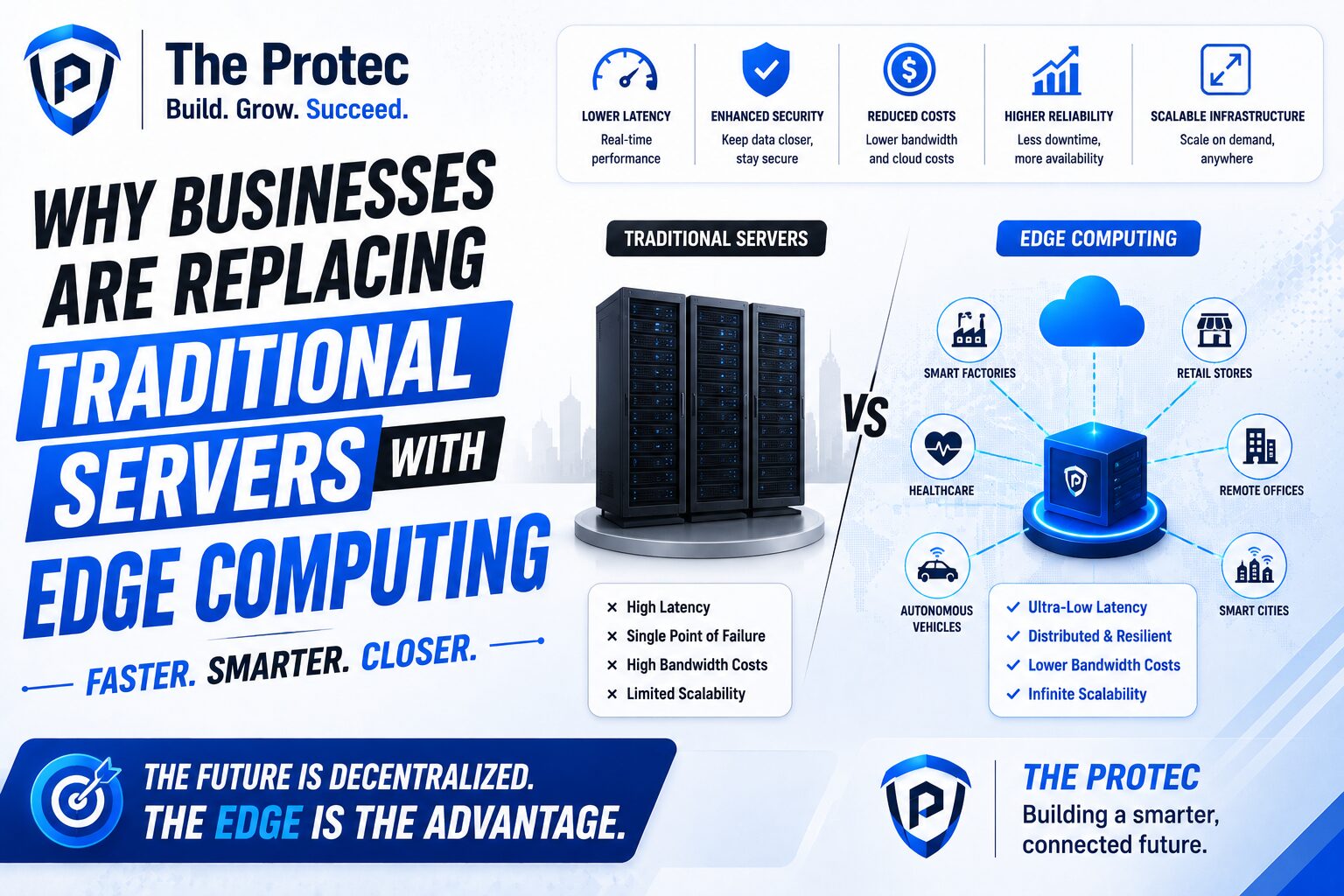
Traditional servers still have a place in many environments, especially for centralized workloads and long-term storage. But the old model struggles when applications need real-time responsiveness, constant uptime, and distributed operations. In an edge computing business environment, delays can affect customer experience, industrial output, logistics, security, and revenue. That is why more leaders are evaluating edge servers as part of a modern IT infrastructure strategy rather than relying solely on legacy server rooms or centralized hosting.
The shift is also being shaped by current digital trends: AI at the edge, IoT expansion, 5G and private wireless networks, retail automation, smart manufacturing, and increasingly distributed workforces. All of these trends create more data at the edge of the network, where it is often more efficient to process information locally instead of sending it across long distances.
What Edge Computing Means for Business IT
Edge computing refers to distributing compute, storage, and analytics resources closer to the source of data. In practical terms, that can mean edge servers in a retail store, a warehouse, a factory floor, a healthcare clinic, a branch office, or even a remote site. The goal is to reduce latency, limit unnecessary bandwidth use, and improve resilience.
For businesses, this changes the role of infrastructure. Traditional architectures often assume a central location where workloads are run and managed. Edge architectures spread intelligence across many locations. That makes the system more adaptable, especially for organizations with multiple sites or with applications that depend on instant decision-making.
This is not just a technical upgrade. It is a business model shift. Companies adopting edge computing are looking for lower operating costs, faster service delivery, better data control, and easier expansion into new locations. In many cases, the edge also supports compliance requirements because sensitive data can be filtered, processed, or anonymized locally before it ever leaves the site.
Why Cost Is a Major Driver
One of the strongest reasons businesses are replacing traditional servers is cost. At first glance, centralized infrastructure can seem simpler because everything is housed in one place. But once an organization begins scaling across locations, data volumes, and workloads, the economics change quickly.
Lower bandwidth and data transfer costs
Traditional server setups often require large amounts of data to travel back and forth between endpoints and a central location. That traffic can become expensive, especially for businesses running video analytics, machine telemetry, point-of-sale systems, AI inference, or continuous monitoring. Edge servers reduce the need to move raw data long distances by processing it locally and sending only useful results to the cloud or core data center.
Reduced downtime and operational disruption
Downtime is costly. When a branch office, production line, or retail location depends on a distant server, even small network interruptions can cause immediate business impact. Edge computing can keep local operations running even if connectivity to the core is degraded. That resilience can reduce lost sales, production delays, and support costs.
More efficient infrastructure scaling
Instead of overbuilding a central environment to handle every possible workload, companies can distribute compute resources where they are actually needed. This avoids a common issue in traditional server environments: expensive overprovisioning. With edge deployments, businesses can add capacity incrementally, which improves capital planning and reduces waste.
Long-term operational savings
Edge computing business strategies often lower labor and maintenance overhead too. Modern edge platforms can be managed remotely, standardized across locations, and integrated with automation tools. That means fewer on-site interventions, faster updates, and better control over distributed infrastructure. When combined with virtualization and container orchestration, edge servers can support more workloads with fewer physical resources.
For businesses comparing the total cost of ownership, the edge often wins not because hardware is cheaper on day one, but because it reduces hidden costs tied to bandwidth, latency, outages, and inefficient scaling.
Why Speed Matters More Than Ever
Speed is another major reason businesses are moving away from traditional servers. In many modern use cases, milliseconds matter. Customers expect instant responses, employees need real-time tools, and automated systems require immediate decisions. A centralized server model introduces distance, and distance creates latency.
Real-time processing at the point of need
Edge servers can process data where it is generated. That is especially valuable in environments like manufacturing quality control, smart cameras, healthcare monitoring, retail checkout, and industrial automation. If an application has to wait for a round trip to a remote server, the result can be slower response times and less reliable performance. Edge computing removes that bottleneck.
Better customer experience
Speed directly affects customer satisfaction. Faster digital interactions make applications feel more reliable and responsive. In retail, this can improve checkout performance and personalization. In hospitality, it can support smoother guest services. In logistics, it can accelerate routing and tracking updates. In each case, edge computing helps deliver a more seamless experience.
Support for AI at the edge
One of the strongest current trends is the move toward AI inference near the data source. Businesses are increasingly using edge servers to run models for image recognition, anomaly detection, predictive maintenance, and local automation. Sending every frame, event, or sensor reading to a distant server is inefficient and often too slow. Edge processing enables near-instant action.
For businesses adopting modern IT infrastructure, this combination of low latency and local intelligence is a major advantage. It allows them to deploy applications that were difficult or impractical under the old centralized server model.
How Edge Computing Improves Scalability
Scalability is not only about handling more traffic. It is also about expanding intelligently without creating a management nightmare. Traditional servers can scale vertically by adding more power to a central system or horizontally by adding more servers in a data center. But those approaches do not always work well for distributed organizations.
Scaling across locations, not just within one data center
A business opening new branches, retail sites, clinics, or warehouses needs infrastructure that can be deployed consistently. Edge servers make it easier to standardize services at each location while still maintaining centralized oversight. This is especially useful for companies with dozens, hundreds, or thousands of endpoints.
Modular growth
Edge architectures are naturally modular. Businesses can start with a small deployment and expand site by site, workload by workload. This reduces the risk of large upfront investments and gives IT teams more control over rollout timing. If a location needs additional capacity for video analytics, local automation, or secure application hosting, the edge environment can be expanded without redesigning the entire infrastructure.
Better fit for hybrid and distributed cloud strategies
Most businesses today use some combination of cloud, on-premises systems, and edge resources. The edge fills an important gap by handling time-sensitive or bandwidth-heavy tasks locally while passing long-term storage, analytics, or orchestration to the cloud. That makes the overall architecture more scalable and more practical than relying only on traditional servers.
In this model, edge computing is not replacing every centralized system. It is replacing the parts of the infrastructure that are least efficient when centralized. That distinction matters because it allows businesses to grow without sacrificing performance or control.
Where Traditional Servers Fall Short
Traditional servers were built for a different era of computing. They work well when workloads are centralized, predictable, and dependent on a stable network. But many modern business applications no longer fit that profile.
Latency-sensitive applications suffer
Applications such as industrial control, real-time monitoring, local analytics, and interactive customer experiences are often degraded by network latency. A centralized server may still process the request correctly, but if the response arrives too late, the business value is lost.
Central points of failure create risk
When too much depends on one core location, the impact of an outage grows. Even with redundancy, network issues, maintenance windows, or overload can affect operations across the organization. Edge servers distribute the workload and reduce concentration risk.
Bandwidth-heavy workloads become inefficient
Video streams, sensor feeds, and machine data can create large traffic loads. Sending all of that raw data to a central server can be inefficient and expensive. Edge computing processes data locally first, which cuts unnecessary transmission and keeps networks from becoming congested.
Legacy models are harder to adapt
Traditional server environments can be rigid, especially when businesses need to support new sites or rapidly deploy digital services. As organizations embrace automation, AI, and real-time analytics, the limitations of old architectures become more obvious. Edge computing provides a more adaptable foundation for these workloads.
Why Edge Servers Fit Modern IT Infrastructure
Modern IT infrastructure is increasingly defined by distributed systems, automation, observability, resilience, and the ability to support business outcomes rather than just host applications. Edge servers align with that reality.
They allow businesses to place compute where it is most useful, support local autonomy, and integrate with centralized management tools. This combination is especially valuable in environments where security, uptime, and performance all matter at once. It also supports current operational priorities like data sovereignty, compliance, and real-time analytics.
Another reason edge servers are gaining traction is that they simplify the deployment of digital services in remote or constrained environments. Not every business location has ideal connectivity. Some sites are mobile, rural, temporary, or operationally sensitive. Edge infrastructure can keep critical applications running even when the network is unreliable.
For IT leaders, this means the edge is becoming a strategic layer in the infrastructure stack. It complements cloud and core data center resources rather than competing with them. Businesses that understand this are building more resilient and future-ready systems.
Industries Leading the Transition
While nearly any business can benefit from edge computing, some industries are moving faster than others because their workloads demand immediate action and distributed deployment.
- Retail: Supports localized inventory, smart checkout, video analytics, and personalized customer experiences.
- Manufacturing: Enables predictive maintenance, quality inspection, and machine monitoring on the production floor.
- Healthcare: Helps process patient data locally, support connected devices, and improve responsiveness in clinical settings.
- Logistics: Improves fleet tracking, route optimization, and warehouse automation.
- Financial services: Supports secure branch operations, local compliance controls, and faster digital interactions.
- Energy and utilities: Enables monitoring and control in remote or distributed environments.
Across these industries, the common pattern is clear: the closer the business action is to the data source, the more valuable edge computing becomes.
Security and Governance Considerations
Security is often part of the conversation when businesses consider moving away from traditional servers. Edge computing changes the attack surface, but it does not inherently make systems less secure. In fact, it can improve governance when deployed correctly.
By processing sensitive data locally, businesses can reduce the amount of information that needs to move across networks. That can lower exposure and support compliance goals. However, distributed infrastructure also requires strong device identity, patch management, access control, encryption, and centralized monitoring.
Modern edge platforms increasingly support zero-trust principles, remote orchestration, and security automation. That is important because a distributed environment can become difficult to manage if every edge server is treated like a standalone system. The best implementations are governed with the same rigor as core infrastructure, but with policies tailored to local conditions.
What Business Leaders Should Evaluate Before Migrating
Replacing traditional servers with edge computing should not be treated as a wholesale rip-and-replace project. The most successful businesses evaluate workloads carefully and migrate where the benefits are strongest.
- Identify applications that are latency-sensitive or bandwidth-heavy.
- Map locations where local processing would reduce costs or improve uptime.
- Assess whether compliance, privacy, or data residency requirements favor local processing.
- Determine which workloads can remain centralized and which should move to the edge.
- Plan for remote monitoring, standardized deployment, and lifecycle management.
This approach helps businesses build a practical roadmap rather than chasing a trend. Edge computing delivers the best results when it is matched to the right use cases.
Conclusion: A Smarter Architecture for Growth
Businesses are replacing traditional servers with edge computing because the old model no longer matches the demands of modern operations. The advantages are clear: lower costs through reduced bandwidth and better resource use, faster performance through local processing, and stronger scalability through distributed deployment. For organizations building a modern IT infrastructure, edge servers are becoming an essential part of the architecture.
The move to edge computing is not about abandoning centralized systems entirely. It is about placing compute in the right place for the right job. That is what makes edge computing business strategies so compelling: they are practical, efficient, and built for the way digital operations work now. Companies that adopt the edge thoughtfully are positioning themselves to respond faster, scale smarter, and operate more resiliently in a connected world.
To explore the broader role of edge and distributed systems in modern networking, see Cloudflare’s overview of edge computing and IBM’s edge computing resource.
FAQ
What is edge computing in a business environment?
Edge computing in a business environment means processing data closer to where it is created, such as a store, factory, branch office, or remote site, instead of sending everything to a centralized server.
Why are businesses replacing traditional servers with edge servers?
Businesses are moving to edge servers to improve speed, reduce bandwidth costs, increase resilience, and scale infrastructure more efficiently across distributed locations.
Does edge computing replace the cloud?
No. Edge computing usually works alongside the cloud. The edge handles local, time-sensitive tasks, while the cloud supports centralized management, storage, and analytics.
Which businesses benefit most from edge computing?
Retail, manufacturing, healthcare, logistics, financial services, and utilities often benefit the most because they rely on real-time data, distributed operations, or local decision-making.
Is edge computing difficult to manage?
It can be if deployed without a clear strategy. But modern orchestration, remote monitoring, and standardized edge platforms make it much easier to manage than older distributed systems.