







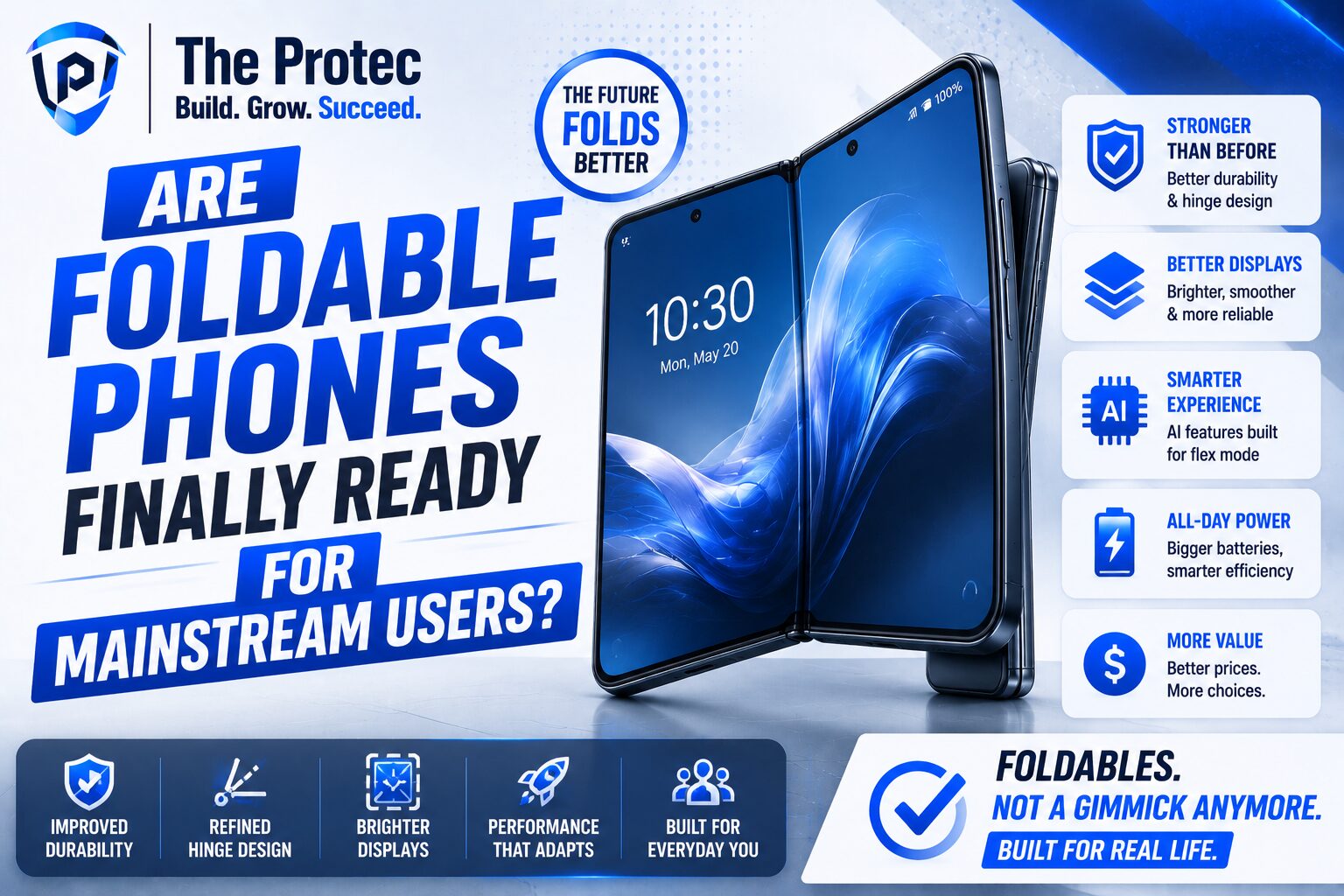
Foldable Phones and the Big Question: Mainstream or Still Niche?
Foldable phones have spent years living in a strange middle ground. They’ve been exciting enough to turn heads, yet expensive enough to keep most buyers away. They’ve looked like the future smartphones promised in concept videos, but early models also came with obvious compromises: fragile inner displays, thick bodies, visible creases, short battery life, and software that often felt like it was catching up to the hardware.
Now the conversation has changed. As foldable phones 2026 models arrive, the category looks noticeably more mature. The biggest brands have pushed harder on durability, slimmer designs, better multitasking, and more polished app behavior. At the same time, prices are still high, repairs remain a concern, and not every foldable is equally practical for daily use. So the real question is no longer whether foldables are impressive. It’s whether they are finally ready for mainstream users.
The answer is more nuanced than a simple yes or no. For some people, a foldable is now the best foldable smartphone option available because it meaningfully changes how they work, read, watch, and multitask. For others, the premium cost and lingering trade-offs still make a traditional flagship more sensible. To understand where the category stands, it helps to look closely at the three areas that matter most: durability, software, and real-world usability.
Durability: The Biggest Barrier Is Much Smaller Now
Durability used to be the first reason people dismissed foldables, and for good reason. Early devices were delicate, with display issues and hinge concerns that made them feel experimental. Today, the hardware is much more convincing. The latest foldables use stronger hinge mechanisms, improved dust and water resistance ratings, better ultra-thin glass layers, and reinforced frames that reduce the anxiety of everyday handling.
That said, “better” does not mean “indestructible.” Foldable phones are still more mechanically complex than slab phones. The hinge is a moving part, and moving parts always introduce risk. The inner display remains more vulnerable than a standard smartphone screen, especially because it is designed to flex repeatedly. Even with stronger materials, foldables still demand a bit more care than a conventional flagship.
What has changed is the level of confidence. Many users no longer need to baby the device just to get through a normal day. Modern hinge designs close more flush, reduce dust ingress better than earlier generations, and create a tighter, more refined feel when opening and closing. Creases are still visible on most models, but they are less distracting than they once were and often disappear in typical viewing conditions.
Battery durability is another part of the conversation. Foldables are asked to power larger and brighter screens, yet manufacturers have improved chip efficiency and power management enough that many models now last comfortably through a full day for average users. Heavy multitaskers and mobile gamers may still need a top-up, but that is increasingly true of premium smartphones in general.
Repairability remains a weak point. A cracked inner display on a foldable still tends to cost significantly more than a standard screen replacement. If you are rough on your phone, work in dusty environments, or frequently expose your devices to drops and impacts, a foldable may still require more caution than a typical flagship.
For more background on how foldable hardware is engineered, Samsung’s official foldable overview is a useful reference: Samsung Galaxy foldables.
Software Has Quietly Become the Real Breakthrough
If hardware made foldables possible, software made them useful. That distinction matters. A foldable phone can have the best hinge in the world, but if apps stretch awkwardly, multitasking feels clumsy, or the interface fails to adapt smoothly, the device becomes a novelty instead of a productivity tool.
The software experience has improved dramatically. Android has become much better at supporting large, flexible displays, and major manufacturers have layered on more mature features for split-screen use, taskbars, drag-and-drop workflows, and app continuity. When you unfold the device, apps are more likely to reopen cleanly in the same state you left them. When you rotate the phone or move between cover and inner displays, transitions are smoother and less disruptive.
This matters because the real promise of foldable phones 2026 is not just that they open. It’s that they change the way the phone is used. Reading articles on a larger screen feels closer to using a small tablet. Messaging while viewing a document or map becomes more practical. Video calls, note-taking, calendar management, and email are easier when the screen can split into usable zones.
App optimization is still uneven, though. Many popular apps behave well, but some third-party apps continue to treat the foldable aspect ratio as an afterthought. That can lead to wasted space, strange cropping, or interfaces that do not take advantage of the extra screen real estate. The good news is that the ecosystem has matured enough that these problems are less common than they were two or three generations ago.
Manufacturer-specific software also plays a major role. The best foldable smartphone experiences often come from brands that have invested in custom multitasking tools, floating windows, gesture controls, and task continuity. These features are not flashy, but they reduce friction throughout the day. On a foldable, tiny conveniences add up quickly because the device is meant to serve multiple roles at once.
In other words, software has moved foldables from “interesting demo” to “serious productivity device.” That may be the most important reason the category is closer than ever to mainstream acceptance.
Real-World Usability: Does the Foldable Format Actually Help?
For mainstream users, the deciding factor is not spec sheets. It is whether the phone improves real life enough to justify the trade-offs. This is where foldables have made the most convincing case, but also where the limits remain easiest to see.
The biggest everyday advantage is versatility. A foldable can behave like a normal phone when you need pocketability, then transform into a larger display when you want comfort and multitasking. That flexibility is genuinely useful in daily routines. Commuters can read more comfortably. Professionals can handle documents, emails, and calendar tools more efficiently. Parents can keep a video call open while checking notes. Travelers can use maps and messaging without constantly switching screens.
For content consumption, the appeal is obvious. Watching videos on a larger inner display is more immersive than on a standard phone, and some book or article readers appreciate the taller, more tablet-like layout. For social media and shopping, the larger canvas makes browsing less cramped. For mobile photography, the outer screen can double as a high-quality selfie preview using the main camera, which is often a practical advantage over conventional phones.
Still, usability cuts both ways. Foldables are heavier than many traditional smartphones, and that extra weight can matter after a long day. The thickness when folded is better than it used to be, but it is still noticeable in a pocket. Some users also find the narrow cover screen on certain models less comfortable for typing, especially if they rely heavily on one-handed use. The form factor asks users to adapt their habits, and not everyone wants to do that.
There is also the psychological factor. Many people prefer a phone they can toss into a bag without thinking. With a foldable, there is often a small amount of awareness in the back of the mind: don’t press too hard, don’t drop it, don’t leave debris near the hinge, don’t assume it will age exactly like a regular phone. That mental overhead matters. Mainstream adoption depends as much on confidence as on features.
So, are foldables usable in everyday life? Absolutely. Are they as frictionless as traditional flagships? Not quite. They are more capable in some scenarios, less convenient in others, and that balance is exactly why the category is still transitioning from enthusiast territory to mass-market maturity.
Which Type of Foldable Makes the Most Sense?
Not all foldables are trying to solve the same problem. The two dominant formats serve different kinds of users, and understanding the difference helps explain why the category is growing without yet becoming universal.
Book-style foldables
Book-style devices open into a tablet-like inner display. These are the models most associated with productivity, reading, split-screen multitasking, and media consumption. If you want the strongest argument for a foldable being a true future smartphone, this is the format that makes it. It provides the biggest upgrade over a conventional phone because it creates a second usable screen size rather than just a different shape.
Flip-style foldables
Flip models focus more on portability and style. They fold into a compact square that fits easily into pockets and small bags. Their appeal is less about tablet-like productivity and more about convenience, design, and nostalgia. Many users prefer them because they feel easier to carry while still offering a larger display when opened. They can be a smart option for people who want the foldable experience without committing to a larger, heavier device.
For mainstream users, flip-style devices may actually feel more approachable at first, while book-style devices deliver a stronger functional payoff. The best foldable smartphone for one person may be completely wrong for another. That is important because mainstream success is not only about one device winning. It is about the form factor becoming flexible enough to fit different needs.
Price Is Still the Hardest Argument Against Foldables
Even as foldables improve, price remains the most obvious obstacle. The best models sit comfortably in premium flagship territory and often above it. That means buyers are not just paying for a phone; they are paying for a newer category with more complex components, lower economies of scale, and higher repair costs.
This matters because mainstream users are value-conscious. A traditional premium phone can already do almost everything well: excellent cameras, long battery life, strong software support, and reliable durability. To justify a foldable, the extra cost has to buy more than novelty. It has to buy a better experience.
In some cases, it does. If you regularly multitask, read long documents, switch between work and personal apps, or use your phone as your primary portable screen, the added value is real. If your daily usage is mostly messaging, social media, photos, music, and casual browsing, the practical gain may not be large enough to outweigh the premium.
There is another angle too: depreciation. New tech categories often lose value faster as more refined generations arrive. That can make foldables harder to recommend for buyers who keep phones for a long time and care about resale. Mainstream adoption will improve when prices come down or when the benefits become so clear that the premium feels easy to accept.
What Has Improved Most in the Latest Generation
Several trends have pushed foldables closer to mainstream readiness. First, the devices have become thinner and more refined, making them feel less like prototypes and more like polished consumer products. Second, water resistance and hinge reliability have improved enough that normal use feels safer. Third, software support has matured across both the operating system and manufacturer layers, giving users more reasons to take advantage of the larger display.
Camera systems have also gotten better, though they still vary by brand and model. Some foldables now deliver cameras close to flagship standards, while others still make compromises to keep weight and thickness in check. For mainstream users, this is important because a premium phone has to be good at everything, not just folding.
Thermal management and chip efficiency have also improved. Better processors and smarter power handling mean foldables are no longer as likely to feel like they are making sacrifices in performance just because of the form factor. As a result, they are more believable as daily drivers than they were even a few years ago.
These improvements do not eliminate the category’s compromises, but they do shift the conversation. The question is no longer whether foldables can work. It is whether their unique advantages outweigh the remaining costs for a given user.
So, Are Foldable Phones Finally Ready for Mainstream Users?
Foldable phones are closer than ever to mainstream readiness, but they are not fully there for everyone. If you want a device that is more versatile than a standard smartphone, and you are willing to pay a premium for extra functionality, the category now offers compelling, mature options. For users who value multitasking, reading, media, and a device that can replace some tablet behavior on the go, a foldable can genuinely improve daily life.
At the same time, mainstream adoption depends on more than excitement. Foldables still ask users to accept a higher price, a more complex mechanical design, a potentially costlier repair path, and a form factor that does not suit every pocket, hand, or workflow. Those trade-offs are smaller than before, but they have not disappeared.
The most honest conclusion is this: foldables have finally become practical enough to recommend to a broader audience, but they are still not the default choice for most people. They are no longer science fiction, and they are no longer only for early adopters. They are approaching the point where they can compete on merit, not just curiosity.
If the trajectory continues, future smartphones may not be defined by one rigid shape. They may be defined by adaptability. And foldables are currently the clearest sign of that shift.
FAQ
Are foldable phones durable enough for everyday use?
Yes, most modern foldables are durable enough for normal daily use, especially compared with early-generation models. Improved hinges, stronger materials, and better water resistance have made them much more reliable. However, they are still more complex than regular phones and usually cost more to repair.
What makes the best foldable smartphone in 2026?
The best foldable smartphone depends on how you use your phone. If you want productivity and multitasking, a book-style foldable may be ideal. If you want portability and a compact design, a flip-style foldable might be a better fit. The best models combine strong hardware, polished software, good battery life, and reliable hinge durability.
Do foldable phones have software problems?
Software has improved significantly, but it is not perfect. Most major apps work well, and multitasking features are much better than before. Still, some apps do not fully optimize for the foldable screen shape, so the experience can vary depending on the device and app ecosystem.
Are foldables worth the price?
They can be, if you will actually use the larger inner display and multitasking features often. For users who mainly want a dependable phone for basic everyday tasks, a traditional flagship may offer better value. Foldables make the most sense for people who want flexibility and are comfortable paying extra for it.
Will foldable phones replace regular smartphones?
Probably not in the near future. Instead, they are likely to become a more important premium option within the broader future smartphones market. Regular slab phones will remain popular because they are simpler, cheaper, and still highly capable. Foldables will grow by solving specific needs rather than replacing every phone type.
Conclusion
Foldable phones in 2026 are no longer just ambitious concepts. They are real, refined devices with meaningful advantages in productivity, media, and flexibility. The hardware is sturdier, the software is smarter, and the everyday experience is much closer to mainstream expectations than it was in the early days of the category.
But readiness is not the same as universality. For many buyers, foldables are finally good enough to consider seriously. For others, the premium price and remaining compromises still make them a niche luxury. That tension is exactly what makes the category interesting right now: foldables are no longer futuristic experiments, but they are also not yet the obvious choice for everyone.
If the current pace of improvement continues, the next generation of foldables may not just be impressive. They may become the default way many people imagine future smartphones should work.